

TL;DR:
- Night care supports a broad range of needs, including dementia, mobility issues, and recovery.
- Properly tailored night care enhances safety, reduces family burnout, and promotes independence.
- Choosing the right type involves assessing needs, budget, and working with registered providers for personalized support.
Many families assume that night care at home is reserved for those with serious medical conditions. In reality, night care supports a much broader range of people, including older adults managing mobility issues, individuals with dementia, or those simply recovering after a hospital stay. It is one of the most effective ways to preserve independence while giving families genuine reassurance. This article explains what night care involves, the types available, their benefits and limitations, how costs compare to residential care, and the steps you can take to arrange the right support in London.
Table of Contents
- What is night care at home?
- Key benefits of night care for families and individuals
- Night care options: Sleeping night, waking night, or live-in care?
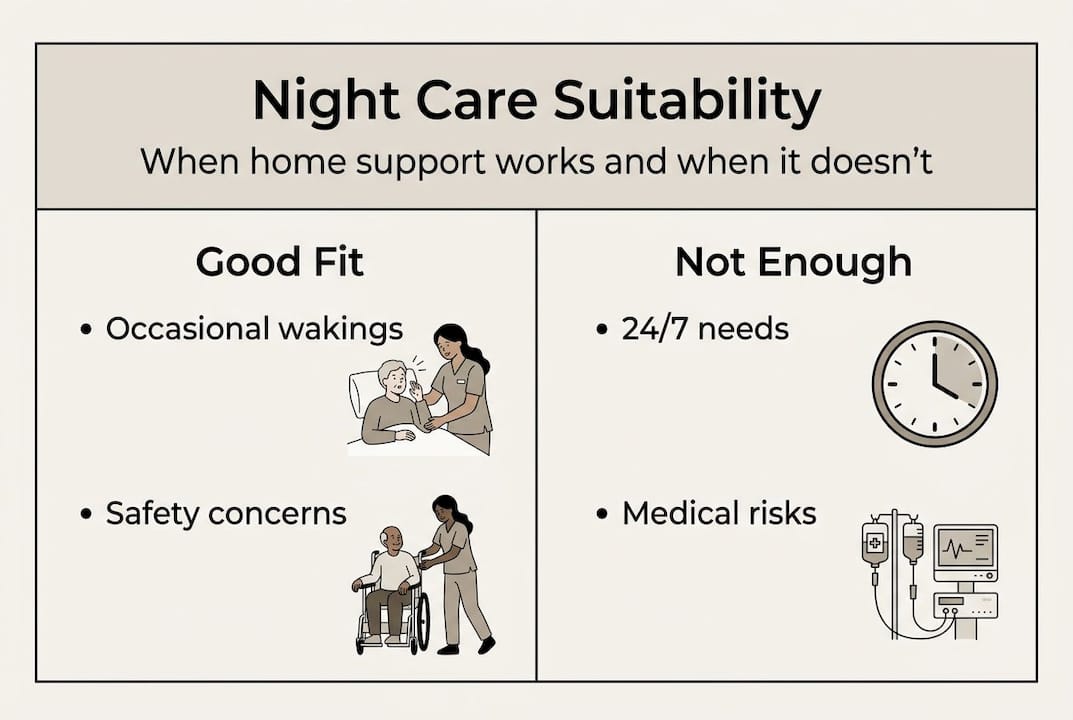
- When is night care most useful and when is it not enough?
- How to arrange night care at home in London
- Our perspective: Personalising night care for true peace of mind
- Explore trusted night care solutions
- Frequently asked questions
Key Takeaways
| Point | Details |
|---|---|
| Night care preserves independence | Overnight support allows elderly and disabled people to safely remain in their own homes. |
| Has clear financial benefits | Night care at home is usually 20-40% cheaper than residential care options. |
| Multiple care types available | Families can choose between sleeping night, waking night, or live-in support based on their needs. |
| Personalised planning is essential | Night care should be tailored to each person’s routine, health, and preferences for best results. |
What is night care at home?
Night care at home means a professional carer visits or stays overnight to assist your loved one during the hours when risks are highest and family members most need rest. It is a form of domiciliary care explained in which support is delivered within the person’s own home, preserving familiar surroundings and daily routines.
There are two main types of night care:
- Sleeping night care: The carer is present in the home and rests overnight but can be woken to assist if needed. This is suited to people with occasional, unpredictable needs.
- Waking night care: The carer remains awake throughout the night, providing active and consistent support. This is appropriate for individuals who need frequent attention, such as those with advanced dementia or complex continence needs.
Night carers typically help with toileting, repositioning, medication reminders, reassurance, and responding to distress or confusion. They are not registered nurses, so they do not provide clinical interventions such as wound management or intravenous medication. For those needs, live-in care or nursing care would be more appropriate.
Night care is commonly used in situations such as:
- Managing dementia-related wandering or night-time confusion
- Supporting recovery after a hospital discharge
- Assisting with continence and mobility during the night
- Providing reassurance after a fall or health scare
Overnight care prevents falls, reduces family burnout, and improves sleep quality, which are three outcomes that matter enormously to London families. Personalisation is central to night care. Support is shaped around individual needs, routines, and preferences, reflecting government guidance on person-centred social care.
Pro Tip: Before arranging night care, write down a clear picture of what your loved one needs overnight. Include how often they wake, what they need help with, and any specific preferences. This makes it far easier to choose the right type of night care.
Key benefits of night care for families and individuals
Night care offers practical and emotional advantages that go well beyond simple supervision. Understanding these benefits helps families make a confident, informed decision.
Safety during vulnerable hours. Night-time is when falls and accidents are most likely. A carer present during these hours can respond quickly, reduce risks, and prevent the kind of incidents that often lead to hospital admissions.
Respite for family caregivers. Many family members lose sleep worrying about their loved ones. Night care restores that rest, reducing exhaustion and improving the quality of care families can provide during the day. The benefits of home care extend to the whole family, not just the individual being supported.
Supporting night-time routines. Consistent support with toileting, hydration, and repositioning helps individuals sleep better and wake feeling more comfortable. This improves overall well-being and can reduce daytime distress.

Preserving independence. Staying at home matters deeply to most people. Night care enables individuals to remain in familiar surroundings rather than moving into residential care, which protects dignity and personal choice.
Cost-effectiveness. Home care is often 20-40% less expensive than residential care, making night care a financially sensible choice for many families before considering a care home placement.
“The most important thing is that our mum stays in her own home. Night care has made that possible for us.” This kind of feedback reflects what we hear from families regularly across London.
It is also worth recognising that families shape care quality in meaningful ways. When families stay involved, communicate openly, and share feedback with carers, the support becomes more effective over time.
Pro Tip: Keep a simple nightly log of any incidents, needs, or changes in your loved one’s condition. Sharing this with your care provider helps them adjust support quickly and appropriately.
Night care options: Sleeping night, waking night, or live-in care?
Choosing the right type of night care depends on how frequently your loved one needs assistance and how intensive that support needs to be. Here is a clear comparison to guide you.
| Care type | Carer status | Best suited for | Cost level |
|---|---|---|---|
| Sleeping night | Rests, available if needed | Occasional or unpredictable needs | Lower |
| Waking night | Awake throughout | Frequent or complex night needs | Higher |
| Live-in care | On-site 24 hours | Round-the-clock or clinical needs | Highest |
When deciding, consider the following steps:
- Assess how often your loved one wakes and what they need each time.
- Consider whether their needs are stable or likely to increase.
- Review your budget and explore what funding may be available.
- Discuss options with a care provider and request a full assessment.
- Review the chosen arrangement regularly and adjust if needs change.
Carer sleep deprivation is a real risk when sleeping night care is used more than it should be. If your loved one wakes three or more times per night consistently, a sleeping night arrangement may not be appropriate. In that case, waking night care or a 24-hour care guide may offer a better solution. For those with complex clinical needs, a home care vs nursing guide can help you understand when nursing care becomes the safer option.
It is important to see these arrangements as a continuum rather than fixed categories. Many families start with a sleeping night carer and transition to a waking night arrangement as needs evolve.
When is night care most useful and when is it not enough?
Night care works well in a wide range of situations. It is most effective when needs are regular but not constant, and when the individual is otherwise stable during the day.
Night care is particularly useful for:
- Assisting with bathroom visits two or three times per night
- Monitoring and reassuring someone with mild to moderate dementia
- Supporting repositioning to prevent pressure sores
- Managing scheduled medication reminders overnight
- Providing a calm presence for those who experience night-time anxiety
| Situation | Night care suitable? | Alternative to consider |
|---|---|---|
| Occasional night wakings | Yes | Sleeping night care |
| Frequent complex needs | Partially | Waking night care |
| Continuous clinical intervention | No | Nursing or live-in care |
| Rapid health deterioration | No | Immediate care review needed |
Night care may not be enough when an individual requires constant supervision throughout the day and night, or when clinical interventions such as catheter care, complex wound dressing, or palliative support are needed. Safety risks that cannot be managed with a single overnight carer are also a clear indicator that a higher level of support is required.
The importance of personalised care is central to government guidance on social care, with residential care recommended only when it is truly necessary for safety or medical reasons. If you are unsure whether night care is the right level of support, reading about transitioning to home care can help you understand the process of stepping care up or down thoughtfully. You might also find it helpful to review why home care matters as a foundation for your decision.
How to arrange night care at home in London
Arranging night care does not need to feel overwhelming. Taking it one step at a time makes the process manageable and ensures you find the right match for your loved one.
- Assess your loved one’s needs. Write down what happens during a typical night. Note how often they wake, what assistance they need, and any safety concerns.
- Shortlist reputable providers. Search for agencies registered with the Care Quality Commission (CQC). A good CQC rating indicates consistent, safe care.
- Ask the right questions. When speaking to providers, ask about their carers’ night care experience, how they handle emergencies, how they communicate with families, and how they adapt if needs change.
- Request a care assessment. A quality provider will carry out a thorough assessment before agreeing a care plan. This should be personalised, not a standard template.
- Agree a clear care plan. Ensure the plan covers all specific needs, routines, and preferences. Set regular review dates so the plan evolves with your loved one.
Personalisation is key when organising any social care support, including night care. A provider that listens carefully and adapts to individual circumstances will always deliver better outcomes than one using a rigid, one-size-fits-all approach.
For further guidance on selecting a provider, our guide on choosing a London home care agency covers what to look for in detail. You may also find our elderly home care guidance helpful when planning support for an older relative.
Pro Tip: Ask any provider you consider how they handle a situation where the overnight carer is unavailable at short notice. A strong agency will have a clear, reliable contingency process in place.
Our perspective: Personalising night care for true peace of mind
After working with London families for over 30 years, we have seen one pattern repeat itself: standardised care packages rarely serve anyone well. Families have unique routines, cultural preferences, and emotional dynamics. A care plan that ignores these factors creates friction, not comfort.
What genuinely works is listening. When a carer takes time to understand how your loved one prefers to be helped, what unsettles them at night, and what matters most to the family, the quality of support improves significantly. Night care is not simply a practical service. It is a relationship built on trust.
We have also found that families who stay involved and share regular feedback see better outcomes over time. Night care should be a partnership, not a handover. The advantages of home care are only fully realised when support is genuinely shaped around the individual, emotionally as well as practically.
Explore trusted night care solutions
If you are considering night care at home for a loved one in London, expert guidance can make a real difference. At Kells Domiciliary Care, we have been providing personalised home care across London for over 30 years. Our fully qualified, DBS-checked carers are experienced in night care, and our services are regulated by the CQC. Whether you need sleeping night support or a more active waking night arrangement, we will work with you to create a plan that truly fits. Explore our domiciliary care guidance, read our elderly home care resource, or review our home vs nursing care guidance to take the next step with confidence.
Frequently asked questions
What tasks does a night carer typically perform?
Night carers support routines and safety during the overnight hours, including toileting, mobility assistance, medication reminders, reassurance, and responding to emergencies.
Is night care more affordable than moving to a care home?
Home care is often 20-40% less expensive than residential care, making it a cost-effective choice for families seeking consistent overnight support.
How can I tell if my loved one needs night care or a higher level of support?
If frequent interventions, complex medical needs, or clear safety risks are present overnight, a professional care assessment will determine whether night care or a higher level of support such as live-in or nursing care is appropriate, in line with personalised care guidance.
How do I arrange reliable night care in London?
Research CQC-registered providers, ask about night care experience, and always request a tailored assessment, as personalisation is key to safe, effective social care support.