

Private domiciliary mental health support in London typically runs well above council-arranged rates, and live-in care carries a separate, higher weekly price shape entirely. Whether you end up paying the full amount depends largely on a local authority financial assessment and a capital threshold. Before signing anything, request a needs assessment from your local council, and if the person’s needs are complex, ask about eligibility for NHS Continuing Healthcare in the same conversation.
TL;DR:
- Private home care in London often costs significantly more than council rates, especially for complex mental health needs requiring specialist staff.
- NHS Continuing Healthcare and Section 117 aftercare can exempt individuals from paying, but eligibility depends on a thorough assessment of health needs beyond diagnosis alone.
- Council rates for home care are typically well below the minimum provider costs, resulting in limited provider choice and difficulties securing high-quality, specialized mental health support.
- Starting private care usually takes less time (about one to two weeks) than council or NHS-funded packages, which can take several weeks or longer to arrange.
Table of Contents
- How much does mental health support cost in London?
- Who pays: financial assessments and the capital threshold
- Are you exempt from paying? Section 117 and NHS CHC
- Council rates versus private cost: why there’s a gap
- Budgeting checklist: questions to ask before you commit
- What to do next: assessments, CHC, and record-keeping
- How long does it take to get home support in London?
- What extra costs catch families out?
- Private pay or funded care: which route makes sense?
- Priorities when balancing cost, quality and dignity
- Getting a quote from Kells Domiciliary Care
- Sources
- FAQ
How much does mental health support cost in London?
Ask three agencies for a quote and you’ll likely get three different numbers, but there’s a pattern behind them. One-to-one domiciliary mental health support in London tends to sit in a wideband, with the lower end reflecting daytime companionship-style visits and the top end reflecting complex behavioural support, medication oversight, or two-carer packages. Live-in care follows a different logic entirely: instead of an hourly rate, you’re usually quoted a weekly package price, which reflects a carer living in the home and being available across day and night, with a separate uplift for cases needing more clinical input or risk management.
Several things push a quote up or down:
- Complexity of need: behavioural support, dual diagnosis, or risk of self-harm all require more experienced staff and higher rates.
- Night cover: waking nights cost considerably more than sleep-in cover, where a carer is present but not expected to be active all night.
- Two-carer packages: some mental health presentations legally or practically require two staff on shift at once, which roughly doubles the staffing cost for those hours.
- Travel and locality: agencies covering Inner London boroughs often build higher travel time into visit-based pricing than those working purely in Outer London.
- London Living Wage: agencies paying the London Living Wage tend to sit at the higher end of the market, but usually with better staff retention and fewer last-minute cancellations.
What’s included in the headline hourly rate varies by provider, so ask specifically what sits outside it. Sleep-in shifts, mileage between visits, and bank-holiday enhancements are the three extras most commonly billed separately rather than folded into the standard rate.
Pro Tip: Ask every agency to quote you a full weekly figure for your actual rota, not just an hourly rate. Two providers with near-identical hourly prices can produce very different weekly totals once night cover and travel are added.
For a live-in comparison against other client groups, live-in carer cost guidance for UK families sets out how weekly packages are typically structured.
Who pays: financial assessments and the capital threshold
Whether you pay privately, contribute, or receive council funding comes down to a financial assessment, which is separate from the needs assessment that establishes what care is required. Under the Care Act 2014, councils must offer a needs assessment to any adult who appears to need care, regardless of what they earn or own. Money only enters the picture at the next stage.
The capital threshold for care funding in England is a capital threshold for 2025/26. If savings and assets sit above this, the expectation is that you pay the full cost of care yourself. Below it, the council assesses income, benefits, and disability-related expenses to work out what you can afford to contribute.
A financial assessment typically ends in one of four outcomes:
- Full private payment: capital is above the threshold, so you fund care entirely yourself.
- A contribution: you pay a set amount towards a council-arranged package.
- A council-arranged package: the local authority commissions and pays a provider directly.
- A direct payment: you receive a personal budget and choose and pay your own provider, including agencies like Kells-care.
Contact your local authority’s adult social care team to request both assessments, and have income details, savings statements, and any existing benefit letters ready. Guidance from councils such as Richmond upon Thames’s paying-for-care booklet sets out the process clearly and is a useful template for what to expect wherever you live in London. The social care support guide for London families walks through what a personal budget actually looks like once it’s agreed.
Are you exempt from paying? Section 117 and NHS CHC
Two routes may remove the obligation to pay for care entirely, and both are worth checking before you sign a private contract. Section 117 aftercare applies to people who have been detained under certain sections of the Mental Health Act 1983 and covers aftercare arranged following discharge, free of charge, regardless of income or savings.
NHS Continuing Healthcare works differently. It’s arranged and funded by the NHS for adults assessed as having a “primary health need” rather than a primarily social care need. Diagnosis alone doesn’t determine eligibility. CHC assessment looks at the nature, complexity, intensity, and unpredictability of someone’s needs, which means severe or unstable mental health conditions can meet the threshold even without a physical health diagnosis attached. Some people also qualify without paying, including those receiving Section 117 aftercare or NHS CHC.
Contact your local Integrated Care Board’s CHC team to request an assessment. Pursuing this before committing to a private contract can save thousands.
Council rates versus private cost: why there’s a gap
Councils in London routinely commission home care at rates below what providers say it actually costs to deliver, and that gap shapes what’s available to you. The Homecare Association calculates a Minimum Price for Homecare of £32.14 per hour for England in 2025–26, factoring in staff wages, travel, training, and compliance costs. Average council-paid rates fall well short of that figure, with London among the worst-affected regions, and separate reporting on the resulting £1.6bn funding shortfall puts average London council rates at roughly £22.10 an hour, some £10 below the calculated minimum.
A funding gap of this size doesn’t just squeeze provider margins. It changes what families can actually access.
The practical effects show up in three places:
- Fewer established providers are willing to take on council-rate work, which narrows choice for anyone relying on a council-arranged package.
- Continuity of staff suffers more under council-rate contracts, since providers under margin pressure struggle to retain experienced carers.
- Complex mental health packages, needing skilled or specialist staff, are the hardest to secure at council rates.
If continuity and specialist experience matter more than headline price, a private quote is often the only realistic way to secure them consistently. The disability care cost guide for London breaks down how council fee-setting works in more detail.
Budgeting checklist: questions to ask before you commit
Turning an hourly quote into a realistic weekly budget means accounting for more than the headline rate. Multiply the hourly figure by your expected weekly hours, then add sleep-in charges, travel time between visits, standby fees for on-call cover, and any one-off agency set-up cost. The housekeeping and home support budgeting guide shows how these extras stack up in a typical London weekly plan.
Before choosing an agency, ask:
- Are you registered with the Care Quality Commission, and can I see your latest inspection rating?
- Are all carers DBS checked, and how often are checks renewed?
- What specific training do staff have in mental health support, de-escalation, or risk management?
- How do you handle continuity, and what happens if my usual carer is unavailable?
- What are your notice periods and cancellation terms, on both sides?
- How and when will I be invoiced, and are there separate charges for bank holidays or mileage?
Get the answers in writing. A proper care agreement should set out the agreed hourly or weekly rate, what’s included, notice periods, and how any top-ups or price reviews will be handled.
Pro Tip: Build a small contingency line into your budget from day one, even 10 to 15 percent above the quoted weekly figure. Cover for sickness, bank holidays, or a temporary increase in hours is the most common reason families are caught out.
What to do next: assessments, CHC, and record-keeping
Start with two requests to your local authority: a needs assessment and a financial assessment. If needs are complex, or you suspect a primary health need is involved, contact your local ICB’s CHC team in parallel rather than waiting for the council process to finish. The care assessments guide for London families sets out what to prepare before either meeting.
Keep everything in writing. Save meeting notes, personal budget decisions, and any top-up agreements, and request formal decision letters for every assessment outcome. These records matter if you ever need to challenge a decision or reapply. For long-term financial planning, statutory guidance under the Care Act encourages councils to provide independent financial information and advice, and a regulated financial adviser is worth involving once care is likely to run for years rather than months.
How long does it take to get home support in London?
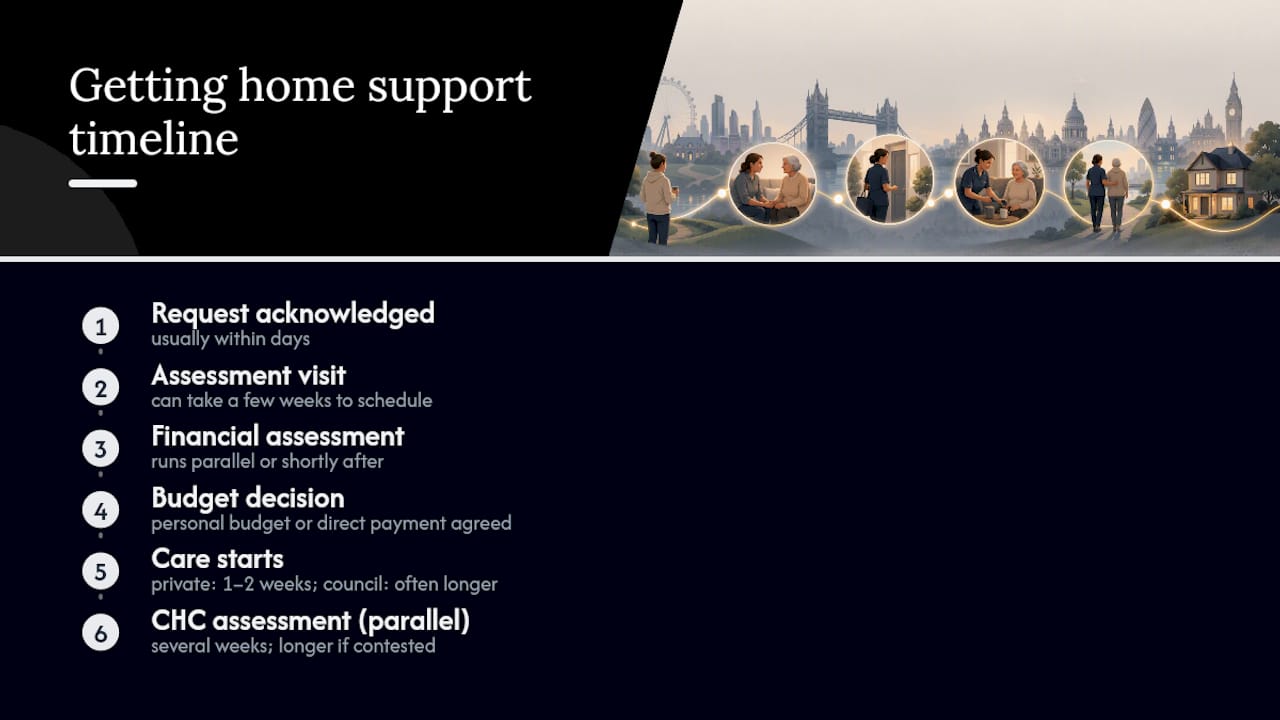
There’s no single fixed timeline, but a rough shape holds across most London boroughs. A needs assessment request usually gets acknowledged within days, though the assessment visit itself, whether in person or over the phone, can take a few weeks to schedule depending on the council’s current caseload. The financial assessment that follows often runs in parallel or shortly after, and this stage tends to move faster if you arrive with income and savings documents already organised.
Once a personal budget or direct payment is agreed, sourcing an agency and starting visits can happen within a week or two if you’re paying privately, since agencies control their own onboarding pace. Council-arranged packages can take longer to start, particularly for complex mental health needs, simply because fewer providers accept council-rate contracts and availability is tighter.
CHC assessments add their own timeline. A full multidisciplinary CHC assessment can take several weeks from referral to decision, longer if the case is contested or needs specialist input. Anyone pursuing CHC alongside a council needs assessment should expect the two processes to run at different speeds, and shouldn’t delay starting private or interim care while CHC eligibility is confirmed.
If speed matters more than anything else, going directly to a CQC-regulated agency for a private quote is almost always the fastest route to getting support in place, with council and CHC funding pursued in the background.
What extra costs catch families out?
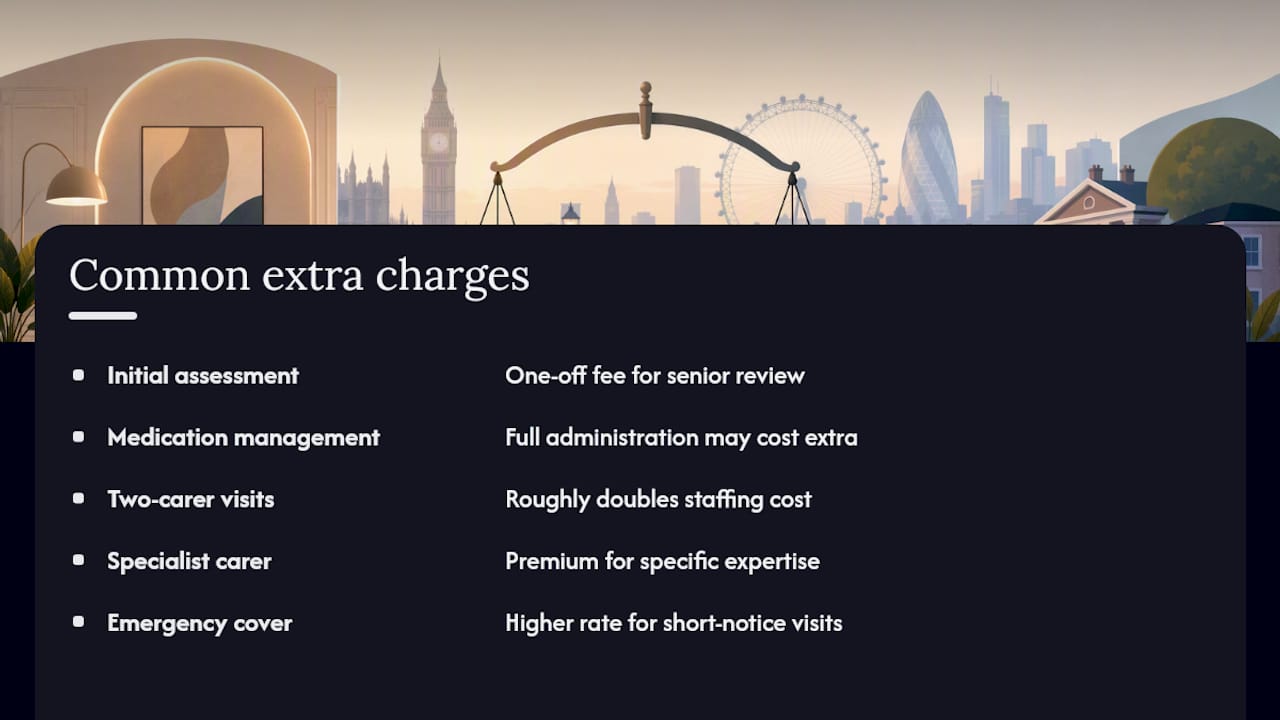
The headline hourly or weekly rate rarely covers everything a mental health care package needs, and the gaps are predictable if you know where to look. Many agencies charge separately for an initial assessment visit, where a senior carer or manager reviews the person’s needs, risks, and home environment before drawing up a care plan. This is usually a one-off fee rather than a recurring cost.
Medication management is another area where pricing varies. Simple prompting to take medication already at home is often included in a standard care visit. Full medication administration, particularly for complex psychiatric regimens involving multiple medications at different times of day, sometimes carries an additional charge or requires a carer with specific training, which agencies price differently.
Specialist services push costs higher still. Two-carer visits for higher-risk behavioural support roughly double the staffing cost for those hours. Access to a carer trained in specific therapeutic approaches, or one with experience of a particular condition, can also carry a premium over general care staff. Emergency or short-notice cover, arranged outside normal scheduling, is typically charged at a higher rate than pre-booked visits.
None of these costs are hidden exactly, but they’re easy to miss when comparing a single hourly figure across agencies. Ask every provider for a full breakdown of what triggers an additional charge before you commit, not just the base rate.
Private pay or funded care: which route makes sense?
The honest answer is that most London families end up blending the two, at least initially. Private pay gives you speed and choice: you select the agency, agree the care plan directly, and start visits within days rather than weeks. The trade-off is cost, since private rates sit above council-commissioned rates, particularly for complex mental health packages that require experienced or specialist staff.
Funded care through the council removes or reduces that cost, but comes with less control over which provider delivers your care and, in London specifically, a narrower pool of providers willing to accept council rates for demanding cases. Waiting times for a council-arranged package to actually start also tend to run longer than arranging a private quote directly with an agency.
CHC and Section 117 sit outside this trade-off entirely, since both remove the cost question if eligibility is confirmed. That’s precisely why pursuing an eligibility check early is worth the effort even if you start with private care in the meantime. Many families find the practical answer is to start privately to get support in place quickly, then step back the private arrangement, or replace it, once a personal budget or CHC decision comes through.
Priorities when balancing cost, quality and dignity
Cost matters, but continuity, dignity, and properly trained staff matter more once care is under way. A carer who understands someone’s history and triggers is worth more than the cheapest hourly rate. CQC regulation gives you a way to check quality before you sign anything, whichever provider you choose, including Kells Domiciliary Care.
— Dan
Getting a quote from Kells Domiciliary Care
Kells-care is one CQC-regulated provider offering call-in visits, live-in care, and dedicated support for mental health conditions, autism, and challenging behaviours, arranged around personalised care plans. The agency emphasizes assessment processes designed to understand risk and routine before scheduling visits.
If you’re at the stage of comparing costs, request a quote through the home care services page or download the free home care guide for budgeting templates you can take into your council assessment. Either step gives you a clearer picture before you commit to anything.
This article is general information, not a substitute for advice from a qualified financial advisor. Consult a qualified financial professional about your own circumstances before acting on anything here.
Sources
- Social care charging for care and support 2025 to 2026: local authority circular
- A minimum price for homecare (Homecare Association, 2025–26)
- Paying for your care and support 2026/27 (Richmond upon Thames Council)
- NHS continuing healthcare: England (NHS England guidance)
FAQ
How much does mental health home care cost in London?
Private one-to-one mental health support in London typically costs more per hour than council-commissioned care, with live-in packages priced weekly rather than hourly. Kells-care does not publish fixed rates online, so request a quote directly based on your specific care plan.
Do I have to pay for care myself?
It depends on a financial assessment and the a capital threshold. Above that threshold, you’re expected to pay privately; below it, the council assesses income and expenses to set a contribution or funded package.
What is NHS Continuing Healthcare and how do I apply?
NHS Continuing Healthcare is funded entirely by the NHS for adults with a primary health need, assessed by complexity and intensity of need rather than diagnosis alone. Contact your local Integrated Care Board’s CHC team to request an assessment.
Why do council rates and private quotes differ so much?
The Homecare Association’s calculated Minimum Price for Homecare sits at £32.14 an hour, while average council-paid rates in London fall well below it, which limits provider choice and continuity under council-arranged packages.
How long does it take to start receiving home support?
Private agency care can often start within a week or two once a care plan is agreed, while council-arranged packages and CHC assessments typically take several weeks from referral to decision. Starting a needs assessment and any CHC check in parallel, rather than sequentially, is the fastest route to support.


