
TL;DR:
- Choosing a home care agency requires assessing needs, priorities, and thorough research on credentials.
- Regulation, staff quality, communication, and personal compatibility are key factors beyond CQC ratings.
- Active involvement and asking targeted questions lead to better care outcomes and suitable agency selection.
Finding the right home care agency in London is rarely straightforward. For many families, the need arises quickly, often following a hospital discharge or a sudden decline in a loved one’s health. You want someone trustworthy, experienced, and genuinely caring, but the sheer number of agencies, combined with confusing or outdated quality ratings, makes the process feel overwhelming. This guide is here to help. We will walk you through exactly how to evaluate, compare, and select a home care agency that protects your loved one’s safety, dignity, and independence, every step of the way.
Table of Contents
- Understanding the home care landscape in London
- Preparing to choose: defining your needs and priorities
- Evaluating home care agencies: credentials, quality and safety
- Shortlisting and selecting your agency: making the final decision
- Our perspective: why choosing the ‘right’ agency goes beyond ratings
- How Kells Domiciliary Care can help your family
- Frequently asked questions
Key Takeaways
| Point | Details |
|---|---|
| Clarify your priorities | List your loved one’s care needs and values before speaking to agencies. |
| Verify agency credentials | Cross-check registration and reviews, as most CQC ratings are out of date. |
| Compare thoroughly | Interview multiple agencies and use a decision table to choose the best fit. |
| Review personal fit | Trust interactions and flexibility, not just ratings, when making your final decision. |
Understanding the home care landscape in London
Before you begin comparing agencies, it helps to understand what home care actually involves. Home care, also known as domiciliary care, refers to professional support delivered in a person’s own home rather than in a residential setting. It allows individuals to remain where they feel most comfortable while receiving the help they need.
The main types of home care include:
- Personal care: Assistance with bathing, dressing, toileting, and grooming
- Companionship care: Social visits, conversation, and emotional support
- Medical and complex care: Medication management, wound care, and support for conditions such as dementia or Parkinson’s disease
- Live-in care: Round-the-clock support from a carer who lives in the home
- Check-in visits: Short, scheduled visits to assist with specific daily tasks
For a fuller picture of what is available, explore these personalised support options to understand which type may suit your loved one best.
The Care Quality Commission (CQC) is the independent regulator for health and social care in England. It inspects and rates agencies on a scale from Outstanding to Inadequate. In theory, this gives families a reliable benchmark. In practice, however, the picture is more complicated.
Only 29.7% of homecare locations in the UK have up-to-date CQC ratings as of August 2025.
This means that for the vast majority of agencies, the published rating may be years old or simply absent. Relying on CQC data alone is not enough. You should also consult:
| Source | What it tells you |
|---|---|
| CQC website | Registration status and last inspection rating |
| Google and Trustpilot reviews | Recent client and family experiences |
| Local authority lists | Agencies approved for council-funded care |
| Word of mouth | Personal recommendations from GPs or social workers |
Understanding the difference between agency types is also important. Read more about private vs agency home care to clarify which model best suits your family’s needs. Always check that any agency you consider holds valid insurance, follows GDPR guidelines, and complies with local safeguarding policies.
Preparing to choose: defining your needs and priorities
One of the most common mistakes families make is contacting agencies before they have clearly defined what they need. Taking time to assess your loved one’s situation first will save you considerable effort later and help you ask the right questions.
Start with a honest review of daily living needs. Consider the following areas:
- Mobility: Does your loved one need help moving around the home, getting in and out of bed, or using stairs?
- Personal hygiene: Is assistance with bathing, dressing, or continence care required?
- Medication: Does your loved one need reminders or direct help administering medicines?
- Nutrition: Is meal preparation or feeding support needed?
- Companionship: Is social isolation a concern, and would regular visits make a meaningful difference?
- Specialist care: Does your loved one live with dementia, a physical disability, or a long-term health condition requiring specific expertise?
Beyond practical tasks, think about the values that matter most to your family. Independence, cultural sensitivity, language preferences, and religious observance can all influence how well a carer fits into your loved one’s life. These are not minor details. They shape the quality of every interaction.
As the Homecare Association notes, care needs, preferences, and independence should all be considered together when making this decision.
A formal needs assessment can help you document these requirements clearly. Once you have a written list of priorities, you will find it much easier to evaluate agencies consistently.

Pro Tip: Write down your three absolute non-negotiables before you speak to any agency. This keeps conversations focused and prevents you from being swayed by a polished sales pitch.
For broader guidance on the selection process, our article on choosing a home care agency covers additional considerations worth reviewing.
Evaluating home care agencies: credentials, quality and safety
Once you know what you need, it is time to scrutinise the agencies on your radar. This stage requires patience and a methodical approach.
Begin with registration. Every legitimate home care agency in England must be registered with the CQC. You can verify registration and quality through the CQC’s online database. However, keep in mind that 70.3% of homecare providers have unrated or outdated CQC ratings as of August 2025, so registration alone does not confirm current quality. Cross-reference with recent reviews and direct conversations.
Here is a comparison of what strong and weak agencies typically look like:
| Indicator | Strong agency | Weak agency |
|---|---|---|
| Staff vetting | Full DBS checks, references | Minimal checks |
| Training | Ongoing, specialist programmes | Basic induction only |
| Safeguarding | Clear written policy | Vague or absent |
| Communication | Regular updates to families | Reactive only |
| Complaints process | Formal, documented | Informal or unclear |
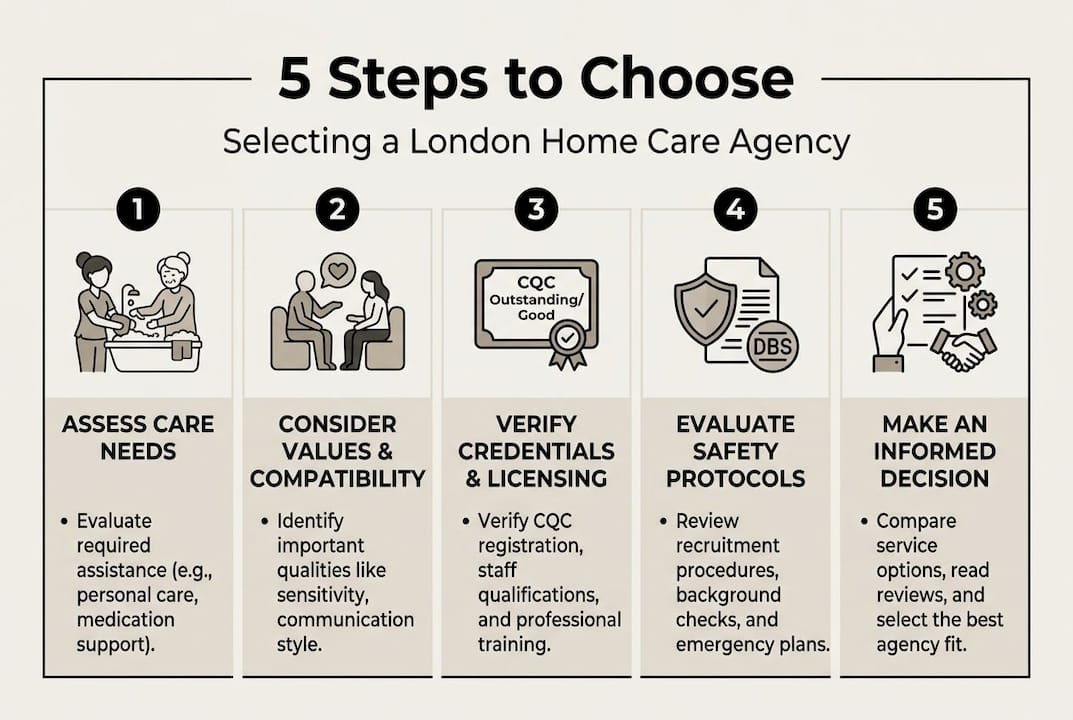
When speaking with agencies, work through these steps:
- Ask how they recruit and vet their carers, including whether all staff are DBS (Disclosure and Barring Service) checked
- Request details of their ongoing training programmes, particularly for dementia or complex care
- Ask how they handle emergencies or last-minute carer absences
- Request copies of their insurance certificates, GDPR policy, and complaints procedure
- Ask whether carers are directly employed or sourced through sub-contractors
For practical guidance on what to ask, our questions for agencies resource is a useful reference. You can also watch video tips for choosing a home care agency for additional insight. To better understand what carers actually do day to day, read about the role of home carers for London families.
Pro Tip: During your initial consultation, pay attention to how the agency listens. Do they ask thoughtful questions about your loved one, or do they jump straight to pricing? The quality of that first conversation often reflects the quality of care you will receive.
Shortlisting and selecting your agency: making the final decision
With your research complete, you are ready to narrow down your options and make a confident choice.
Aim to shortlist between three and five agencies that meet your core criteria. Having a shortlist prevents decision fatigue and gives you a meaningful basis for comparison.
When you interview each agency, focus on these key areas:
- Continuity of care: Will your loved one see the same carers regularly, or will staff rotate frequently?
- Emergency procedures: What happens if a carer calls in sick at short notice?
- Staff retention: High staff turnover is a warning sign. Ask how long their carers typically stay with the agency.
- Flexibility: Can the care plan be adjusted quickly if your loved one’s needs change?
- Pricing transparency: Are all costs clearly explained, with no hidden charges?
As the Homecare Association advises, families should use at least 2 to 3 sources to build a full picture of each agency before deciding. Reviews, direct conversations, and regulatory records together give you a much more reliable view than any single source alone.
To score each agency objectively, use a simple decision table:
- List your top five priorities down one side
- Score each agency from one to five against each priority
- Total the scores and compare
This removes some of the emotion from the decision and highlights which agency genuinely aligns with your needs.
Price matters, but it should not be the deciding factor. The cheapest option may cut corners on staff training or carer continuity. For guidance on funding, our article on paying for home care explains the options available. If you are weighing up home care against a residential setting, our home care vs nursing guide offers a balanced comparison. You may also find it helpful to read about the advantages of home care for loved ones before finalising your decision.
The right agency is not always the one with the highest rating. It is the one that listens, adapts, and genuinely cares about the person they are supporting.
Our perspective: why choosing the ‘right’ agency goes beyond ratings
After more than 30 years working in home care in London, we have seen families make excellent choices and, occasionally, choices they later regretted. The pattern is consistent. Those who focus only on CQC star ratings sometimes miss outstanding agencies that simply have not been inspected recently. Those who trust their instincts during conversations, ask probing questions, and stay actively involved in their loved one’s care tend to have far better outcomes.
As the Homecare Association makes clear, CQC ratings are only a starting point and should be weighed alongside personal factors. We agree completely.
A rating tells you about a single inspection on a single day. It does not tell you whether the agency manager will pick up the phone on a Sunday evening, or whether your loved one’s carer will remember how they take their tea. Those details are what make care feel genuinely human. Our guide to choosing an agency reflects this philosophy. Stay involved, ask questions regularly, and do not hesitate to raise concerns early. Good agencies welcome that kind of engagement.
How Kells Domiciliary Care can help your family
At Kells Domiciliary Care, we have been providing personalised home care across London for over 30 years. Every care plan begins with a thorough assessment of your loved one’s individual needs, preferences, and routines, and it adapts as those needs evolve over time. Our carers are fully qualified, DBS checked, and regulated by the CQC. Whether you need occasional check-in visits or full-time support, we are here to help.
Explore our personalised home care options to understand what is available, or read our home care vs nursing guide if you are still weighing up your options. When you are ready, contact us to arrange a no-obligation consultation.
Frequently asked questions
How do I check if a home care agency is regulated in London?
You can search for any agency on the CQC website to confirm their registration status. Bear in mind that only around 30% of providers have current ratings as of 2025, so always ask the agency directly about their most recent inspection.
What are the most important questions to ask a home care agency?
Ask about staff recruitment, DBS checks, training programmes, safeguarding policies, and how they manage carer absences. Asking about policies and procedures helps ensure both safety and continuity of care for your loved one.
How can I tell if a provider will be a good fit for my loved one’s cultural needs?
Raise language preferences, religious observance, and dietary requirements directly with the agency, and ask whether they can match your loved one with a carer who has relevant cultural experience.
Is it possible to switch agencies if we are unhappy with our choice?
Yes, you can change agencies at any time, but check your contract for notice periods and plan the transition carefully to avoid any gap in your loved one’s care.