

TL;DR:
- Private home care involves family managing carers directly, while agency care provides organized management.
- Agency care generally offers higher safety standards, consistent oversight, and handles employment responsibilities.
- Families should consider costs, safety, flexibility, and personal needs when choosing between private and agency home care.
Many London families assume that arranging home care for an elderly relative is a simple process. In reality, the choice between hiring a carer privately and engaging a regulated home care agency is one of the most significant decisions you will make. It affects safety, cost, reliability, and your own peace of mind. This guide breaks down the key differences between private and agency home care, so you can weigh the options clearly and choose the arrangement that genuinely fits your family’s situation.
Table of Contents
- Understanding private and agency home care
- Comparing costs, flexibility, and control
- Quality, safety, and regulation: what to expect
- How to decide: questions to guide your choice
- Why the ‘right’ choice depends on your family’s needs
- Explore home care solutions with Kells
- Frequently asked questions
Key Takeaways
| Point | Details |
|---|---|
| Clear definitions | Private home care is hired directly, while agencies manage carers for you. |
| Cost versus convenience | Agency care may cost more but offers peace of mind and easier management for families. |
| Safety and regulation | Agencies provide regulated carers and safety checks, while private hiring relies on the family’s due diligence. |
| Making an informed choice | Asking the right questions and understanding your needs is crucial in deciding the best care route. |
Understanding private and agency home care
Before comparing the two options, it helps to understand exactly what each one involves. Personalised support options in the UK fall broadly into two categories, and the structures are quite different.
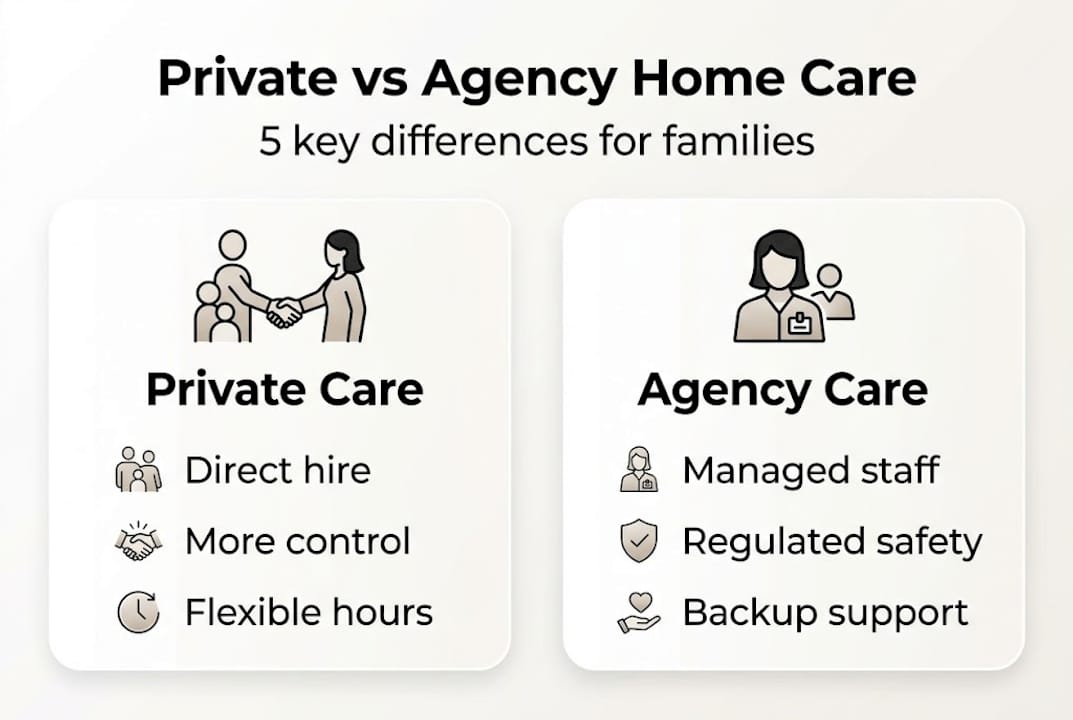
Private home care means your family finds and hires a self-employed carer directly, without an intermediary. You manage the relationship, the schedule, and any issues that arise. The carer works for you personally.
Agency home care means you engage an organisation that recruits, trains, and manages carers on your behalf. The agency handles vetting, scheduling, and replacements if a carer is unavailable.
Here is a summary of what each arrangement typically involves:
- Private care: You source the carer, agree on hours, handle pay, and manage any legal obligations as an employer.
- Agency care: The agency supplies a matched carer, manages all employment matters, and ensures continuity of care.
- Services covered: Both models can deliver personal care, medication prompts, companionship, meal preparation, and mobility support.
- Family responsibilities: With private care, you take on employer duties. With an agency, your role is primarily to communicate needs and preferences.
A needs assessment is a useful starting point regardless of which route you choose. It helps clarify exactly what level of support your relative requires before you commit to any arrangement.
Pro Tip: If you hire privately, you may legally become an employer. This means you could be responsible for National Insurance contributions, holiday pay, and sick pay. Always seek advice from an accountant or HR professional before proceeding.
Comparing costs, flexibility, and control
After reviewing what each option involves, it helps to visualise how private and agency care differ in everyday practicalities. Understanding paying for home care is essential before making any commitment.
| Factor | Private care | Agency care |
|---|---|---|
| Hourly rate | Lower (typically £12 to £18) | Higher (typically £20 to £30) |
| Holiday cover | Family arranges | Agency provides |
| Sick cover | Family arranges | Agency provides |
| Payroll and tax | Family responsible | Agency responsible |
| Flexibility | Negotiated directly | Set within agency terms |
| Control over carer | High | Moderate |
The lower hourly rate of private care can look attractive. However, the hidden costs add up quickly. You may need to pay for holiday cover, arrange insurance, and cover sick days. These responsibilities sit with you.
Here are the key financial and practical considerations ranked by importance:
- Total cost over time: Factor in all employer obligations, not just the hourly rate.
- Cover arrangements: What happens when your carer is ill or on holiday?
- Payroll management: Are you prepared to handle tax and National Insurance?
- Flexibility of hours: Can the arrangement adapt as your relative’s needs change?
- Your own time: Managing a private carer takes considerable effort and attention.
The advantages of home care are clear for both models, but the practical burden on families differs significantly.
Pro Tip: Agencies can minimise disruption when a carer is suddenly unavailable. They maintain a pool of trained staff and can often arrange a replacement the same day, which is rarely possible with a private arrangement.
Quality, safety, and regulation: what to expect
With day-to-day reality in mind, families must also weigh up who is keeping standards high in each care choice. This is where the differences become most significant.

Agencies registered with the Care Quality Commission (CQC) must meet strict national standards. Care staff qualifications are verified, training is ongoing, and inspections are carried out regularly. Private carers, unless working through a regulated platform, are not subject to the same oversight.
Key quality and safety differences include:
- DBS checks: Reputable agencies carry out Disclosure and Barring Service checks on all staff. With private arrangements, you must request and verify this yourself.
- Training: Agencies provide regular, structured training. Private carers may have qualifications, but you are responsible for checking them.
- Regulation: CQC-registered agencies are inspected and rated. Private carers operate outside this framework unless they register independently.
- Insurance: Agencies carry liability insurance. Private arrangements may leave your family exposed if an incident occurs.
- Consistency: Agencies have processes to maintain care standards across all visits. Private care depends entirely on the individual.
“Families who choose a CQC-regulated agency benefit from a layer of accountability that simply does not exist in unregulated private arrangements. Oversight protects both the client and the carer.”
Research consistently shows that safety and reliability are the top priorities for families choosing care. When regulated agency standards are in place, families report significantly greater confidence in the care their relative receives. This peace of mind is difficult to put a price on.
How to decide: questions to guide your choice
Having covered core differences, families now need a clear action plan for making the best choice. The right questions make all the difference. Reviewing questions for care agencies before any meeting is strongly recommended.
Here are the five most important questions to ask:
- What are the full costs involved? Ask for a written breakdown including all potential extras, not just the headline rate.
- How is continuity of care managed? Find out what happens if your regular carer is unavailable.
- What training and qualifications does the carer hold? Request evidence, not just verbal assurance.
- Who holds legal and financial responsibility? Understand your obligations before signing anything.
- How flexible is the arrangement? Needs change over time. Make sure the care can adapt.
A practical decision flow helps many families move forward with confidence. Start with a clear needs assessment, then research your options thoroughly. Conduct background checks, compare costs honestly, and consider a short trial period before committing long-term.
Common pitfalls to avoid when choosing a home care agency:
- Choosing based on cost alone without considering hidden obligations.
- Failing to verify DBS checks and qualifications independently.
- Not having a written agreement covering hours, duties, and pay.
- Overlooking the emotional impact on your relative during any transition.
- Delaying the decision until a crisis point, which limits your choices.
For further guidance, video tips for selecting agencies offer practical advice from experienced care professionals.
Why the ‘right’ choice depends on your family’s needs
It would be easy to say that agency care is always the better option. In many cases, it offers more protection, more reliability, and less stress for families. But that is not the full picture.
Some families genuinely benefit from the personal touch of a private arrangement. When a carer has been known to the family for years, the relationship itself becomes part of the care. That continuity and familiarity can be deeply valuable for an elderly person, particularly someone living with dementia.
Other families prioritise safety and oversight above all else. For them, the accountability of a CQC-regulated agency brings real peace of mind. There is no single correct answer.
What matters most is honest reflection. What does your relative need right now? What can your family realistically manage? And how might those needs change in six or twelve months? Revisiting the decision regularly is just as important as making it well the first time.
Our experience at Kells tells us that families who take time to weigh up the home care vs nursing guide alongside their personal priorities consistently make choices they feel confident about. The process itself, asking the right questions and being honest about priorities, is what leads to good outcomes.
“The families who feel most settled are those who made their decision based on their own situation, not on what they thought they were supposed to choose.”
Explore home care solutions with Kells
If you are weighing which option is right for your loved one, dedicated help is on hand. At Kells, we have supported London families for over 30 years, and we understand that every situation is different. Our elderly home care guidance covers the full range of options available, from check-in visits to round-the-clock support. Whether you are just starting to explore care or ready to make a decision, our team is here to talk things through with you. You can also read our step-by-step guide on transitioning to home care or explore our domiciliary care family guide for a broader overview. We are always happy to help.
Frequently asked questions
What is the main difference between private and agency home care?
Private home care means hiring a carer directly and managing the arrangement yourself, while agency care is handled by an organisation that vets, trains, and schedules carers on your behalf.
Is agency home care more expensive than hiring privately?
Agency care typically costs more per hour, but when you factor in employer obligations such as holiday pay and sick cover, total care costs can be comparable or even lower over time.
How can I check a carer’s qualifications and safety credentials?
Always ask for proof of DBS checks, training certificates, and references. Choosing a CQC-regulated agency means these checks are carried out and maintained on your behalf.
What questions should I ask when choosing a home care arrangement?
Ask about full costs, cover arrangements, qualifications, legal responsibilities, and flexibility. A full checklist is available in our London home care guide to help you prepare.