
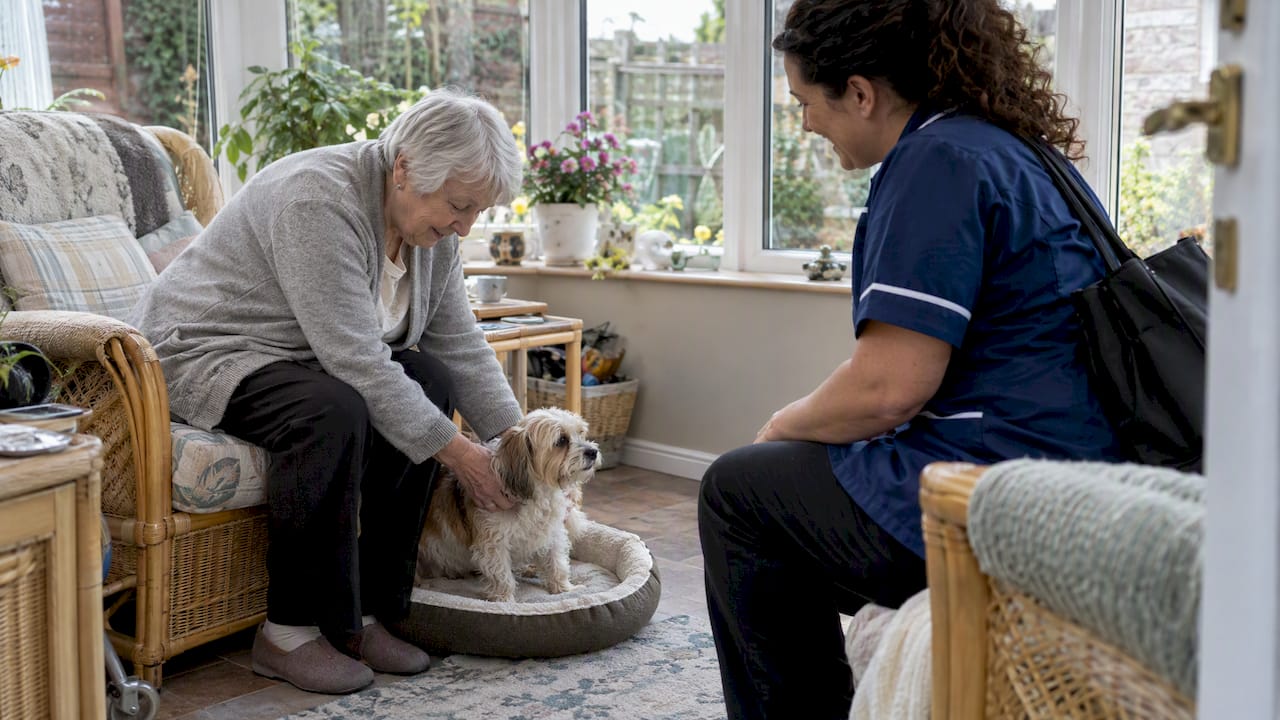
Yes, most domiciliary and live-in carers can work safely and comfortably in homes with pets, as long as two things happen before care begins: responsibilities for the pet are written into the care plan, and a bespoke risk assessment is carried out and shared with the carer. These two steps turn a source of worry into a manageable part of daily visits.
TL;DR:
- Pet care remains the household’s responsibility unless the care plan assigns tasks, costs, liability, and steps to take if the animal becomes hazardous.
- Request a written risk assessment tailored to the home, checking for trip hazards, allergies, animal behavior, and conflicts with hoists or wheelchairs.
- Arrange a supervised trial, set a review date, and record feeding, medication, calming methods, and agreed duties in a routine accessible to every carer.
- Specialist care, such as hoisting or clinical procedures, calls for closer assessment; families using direct payments should share risk reviews with their local authority.
Table of Contents
- What to include in the care plan and contract about pets
- How carers manage pets day to day
- Risk assessment, policies and regulatory expectations
- Questions to ask an agency or carer before and during care
- Balancing pet welfare with client safety
- How Kells Domiciliary Care supports homes with pets
- FAQ
- Sources
What to include in the care plan and contract about pets
A care plan that mentions your pet only in passing leaves too much to chance. We always recommend that families ask for pet arrangements to be written down clearly, in the same way personal care tasks are specified.
A good contract and care plan will cover:
- Named responsibilities: who feeds the cat, walks the dog or cleans the litter tray, and whether the carer takes on any of these tasks.
- Liability and costs: who pays for veterinary bills linked to the arrangement, and what happens if the pet becomes a genuine health hazard.
- A trial period and review date: how the first few visits are structured and when the arrangement gets reassessed.
- Integration with medical needs: noting where equipment, hoisting or a wandering pet changes the risk picture around personal care tasks.
- Recordkeeping: where the pet’s routine is stored, who signs off changes and how updates reach every carer involved.
The Care Provider Alliance advises care services to state clearly whether pets are accommodated, including conditions such as trial periods, responsibility for feeding and grounds for removal if the pet becomes a hazard. The same guidance recommends that these details sit alongside other essential consumer information, such as whether a service can support dementia or respite needs. Separately, Croner’s domiciliary care guidance is explicit that pet care remains the household’s own responsibility unless specific tasks are agreed in the individual care plan. That single rule is worth asking your agency to confirm in writing before care starts, and our guide to preparing your home for carers walks through the wider checklist families use alongside it.
How carers manage pets day to day
Once responsibilities are agreed on paper, the daily reality comes down to calm routines rather than rigid rules.
- Introductions come first. A short, supervised meet-and-greet lets the pet approach in its own time, often with the carer sitting quietly rather than reaching out.
- Hygiene stays separate from affection. Carers wash their hands after handling animals, keep pets away from clinical equipment or food preparation surfaces, and follow any footwear or clothing guidance the family sets.
- Agreed tasks follow a structure. Where a carer has taken on walks, feeding or litter tray duties, these slot into the visit at consistent times so the pet, and the person being cared for, know what to expect.
- Problem behaviours trigger a pause, not a guess. If a pet becomes anxious, possessive or aggressive, carers step back, record the incident and flag it for a review rather than continuing as normal.
A written pet plan makes all of this easier to hand between carers, particularly in live-in arrangements where staff may rotate. Feeding times, medication, calming strategies, favourite toys and regular walking routes all belong in one short document that travels with the care file.
Pro Tip: Keep the pet plan to one page and pin it near the care folder so every carer can check it in seconds, not minutes.

Risk assessment, policies and regulatory expectations
A written care plan only works alongside a proper risk assessment, and families are entitled to see it. We encourage anyone arranging care to ask directly for the document rather than assume one exists.
A thorough, bespoke risk assessment should cover:
- Trip hazards from bedding, bowls, leads or litter trays in frequently used rooms.
- Infection control points, including any allergy or immune concern for the person receiving care.
- Animal behaviour, particularly around strangers, medical equipment or sudden movement.
- How hoisting, wheelchairs or other equipment interact with a pet’s usual space in the home.
The Health and Safety Executive notes that risks in domiciliary care vary with the individual’s needs, environment, type of care and carer competence, and that duties under the Health and Safety at Work Act are more likely to apply where care involves complex healthcare activities or specialist training. In practice, this means a home with hoisting equipment or clinical procedures may need a more detailed pet-related assessment than a straightforward companionship visit.
One sourced point worth remembering: local authorities are required to assess individual care needs and may provide direct payments so people can employ their own carers, according to the Health and Safety Executive. Families using direct payments should share any pet-related risk assessment with the local authority and review it at the same intervals as the wider care plan, since the usual agency oversight does not automatically apply.
Questions to ask an agency or carer before and during care
A short list of direct questions at the first meeting saves confusion later.
- Is pet care written into the care plan and contract, and which tasks will the carer actually perform?
- Can we see the agency’s pet policy and a sample risk assessment before signing anything?
- Are the carers DBS-checked, qualified and given any training for working safely around animals?
- What is the escalation process if the pet starts to interfere with personal care or medical tasks?
- Can we arrange a supervised trial visit with the pet present before committing to a full schedule?
Our guide to carer safety at home covers related questions worth raising at the same meeting, particularly around equipment and access.
Balancing pet welfare with client safety

In our experience, the assessment process for pets and people follows a familiar shape: an initial meeting to understand the pet’s temperament and routine, a trial visit to see how the pet responds to a new carer, then a written pet plan that gets reviewed alongside the wider care plan.
Written expectations matter more than they might seem. A carer who knows exactly which tasks are theirs, and a family who knows exactly what to expect, both relax into the arrangement faster. Small adjustments often make the biggest difference: a fixed walking time so the dog settles before personal care begins, a feeding area kept away from where equipment is stored, or a laminated routine card by the door. None of this needs to be complicated, it just needs to be written down and followed.
— Dan
How Kells Domiciliary Care supports homes with pets
We have provided home care for many years, and pets come up in nearly every assessment we carry out. Our carers work under CQC regulation, which means pet arrangements sit inside the same documented, reviewed care plan as every other part of your support.
- We record pet responsibilities and routines directly in the care plan.
- We share the risk assessment with you before care begins.
- We can arrange a trial visit with the pet present to help everyone settle in before a full schedule starts, similar to how some home ear care visits in Glasgow & Edinburgh provide specialist care in a familiar environment.
If you would like to talk through an assessment, our home care services page sets out what is included, or you can request our free home care guide for a practical checklist to bring to your first conversation with us.
FAQ
Will a carer walk my dog or feed my cat?
Only if that task is specifically agreed in the care plan, since pet care otherwise remains the household’s own responsibility according to Croner’s domiciliary care guidance. Ask your agency to list any pet-related duties in writing before care starts.
What happens if my pet becomes a health hazard during care?
Agencies are advised to set clear conditions for removal of a pet if it becomes a genuine hazard, as outlined in Care Provider Alliance guidance. These conditions should sit in your care plan from the outset, alongside who covers any related costs.
Do carers need special training to work around pets?
There is no single national qualification for this, but a responsible agency will have a written pet policy and will brief carers on hygiene, introductions and handling agreed tasks safely. Ask to see the policy and confirm your carers are DBS-checked before care begins.
Who is responsible if my pet injures a carer?
Liability depends on what the signed care plan and contract say, which is why naming responsibilities and documenting a risk assessment matters before the first visit. The Health and Safety Executive notes that formal duties are more likely to apply where care involves complex healthcare activities, so homes using specialist equipment should expect a more detailed assessment.
Can I request a trial visit before committing to full-time care?
Yes, a short, supervised trial visit with the pet present is a reasonable request and helps everyone see how the carer and animal settle together. Many families use this alongside a review period written into the contract.
Sources
- Care provided in people’s own homes – HSE
- Care Provider Alliance guidance on compliance (care homes)
- Assessing and managing risks from pets in the homes of people using a domiciliary care service — Croner


