TL;DR:
- Carer safety is fundamental to delivering high-quality home care and preventing accidents or injuries. Regular risk assessments, proper equipment, ongoing monitoring, and clear communication are essential for maintaining safety standards in London households. Families and care providers must work together to adapt safety measures to unique home environments and ensure continuous compliance with regulatory requirements.
When a London family arranges home care for an elderly parent, the focus is naturally on the person receiving care. But when a carer is injured lifting a patient without proper equipment, or falls ill due to inadequate infection control, the consequences ripple outward fast. The carer may be unable to work, the loved one loses essential support, and the family faces a crisis they did not anticipate. Carer safety is not separate from good care. It is the foundation of it. This guide walks you through the key risks, legal duties, practical steps, and ongoing monitoring routines that keep both carers and clients safe in London homes.
Table of Contents
- Identifying risks and legal duties in home care environments
- Preparing your home: Essential tools, PPE, and planning for carer safety
- Step-by-step methodology for safer moving and handling
- Monitoring, reviewing, and sustaining safety standards at home
- What most guides miss about carer safety in London homes
- Next steps: Accessing safe, personalised home care in London
- Frequently asked questions
Key Takeaways
| Point | Details |
|---|---|
| Conduct regular risk assessments | Consistent, formal risk assessments are the foundation for safe home care and compliance with CQC standards. |
| Use certified PPE and aids | Equipping carers with approved PPE and handling tools prevents injury and limits infection hazards. |
| Train and retrain carers | Ongoing training ensures carers respond safely to changing environments and health situations. |
| Monitor and review weekly | Routine checks and feedback keep safety standards high and allow quick adaptation to new risks. |
| Prioritise dynamic safety management | Safety practices must adapt to individual needs, environment changes, and regulatory updates. |
Identifying risks and legal duties in home care environments
After establishing carer safety as critical, we must begin by understanding what the risks are and which regulations shape safety in London homes.
Home care environments present a unique set of hazards that formal care settings are better equipped to manage. In a London home, space may be limited, equipment may be minimal, and routines vary considerably from one household to the next. Understanding what risks exist is the essential starting point.
The three main categories of risk in home care are:
- Moving and handling risks: Lifting, repositioning, or transferring a person without correct technique or equipment can cause musculoskeletal injuries to the carer and harm to the client.
- Infection risks: Poor hand hygiene, inadequate personal protective equipment (PPE), or improper waste disposal creates pathways for infection to spread between carer and client.
- Environmental hazards: Cluttered hallways, loose rugs, poor lighting, and inaccessible bathrooms all increase the chance of trips, falls, or accidents during care tasks.
Safe moving and handling must be risk-assessed and controlled because unsafe handling can cause serious injury to both service users and staff. This is not optional guidance. It is a legal expectation under the Manual Handling Operations Regulations 1992.
From a regulatory perspective, two bodies matter most. The Health and Safety Executive (HSE) sets workplace safety law applicable to carers working in private homes. The Care Quality Commission (CQC) regulates care providers in England and expects providers to take a structured, proactive approach to safety. Understanding CQC’s role in home care helps families appreciate why safety planning is not just good practice but a regulatory requirement.
Under Regulation 12, providers must assess risks to people’s health and safety and ensure staff have the competence and skills to keep people safe, including risk prevention and control. Families who arrange care independently, rather than through a regulated agency, share responsibility for ensuring these standards are met in their home.
The most common mistake families make is treating risk assessment as a one-off task completed at the start of a care arrangement. Risk must be reviewed regularly and updated whenever the client’s condition or home environment changes.
Pro Tip: Download a simple room-by-room carer safety checklist and review it monthly. Walk through each area with the carer and note any new hazards. Refer to these home care safety steps to get started.
| Risk category | Examples | Review frequency |
|---|---|---|
| Moving and handling | Transfers, repositioning in bed | After any change in mobility |
| Infection control | Hand hygiene, PPE use, waste disposal | Weekly |
| Environmental hazards | Floor clutter, lighting, bathroom access | Monthly |
Preparing your home: Essential tools, PPE, and planning for carer safety
Having recognised the risks, families must ensure their home is well equipped and properly planned for daily safe care operations.
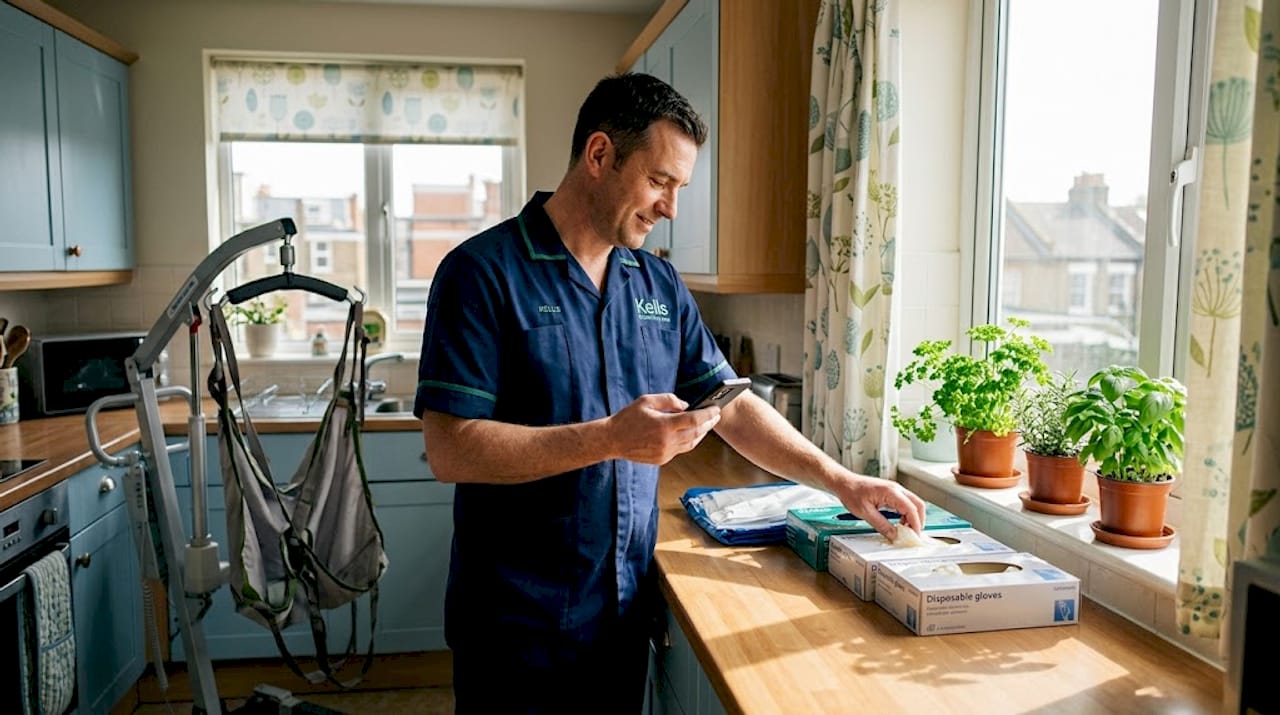
Equipping a home for carer safety does not require a complete renovation. It requires thoughtful preparation. The right tools and materials reduce the physical strain on carers, lower infection risk, and prevent accidents before they occur.
A typical set of essential safety tools for home carers includes:
- Hoist or transfer belt for assisting clients who have limited mobility
- Non-slip bath mat and grab rails to prevent falls in the bathroom
- Adjustable bed or bed rail to support safe repositioning
- Disposable gloves and aprons for personal care tasks
- Face masks where infection risk is elevated
- Hand sanitiser and soap dispensers at key points in the home
- Sharps disposal container if injectable medications are in use
- Clearly labelled cleaning supplies stored separately from personal items
PPE is particularly important. IPC expectations include equipping staff with appropriate PPE, providing PPE training, and applying national guidance on isolating symptomatic people. Buying gloves and aprons is only part of the requirement. Carers must also know how to put PPE on and remove it correctly to avoid self-contamination.
Families should also have a clear infection prevention plan in place. This means establishing a cleaning routine, knowing how to manage soiled laundry safely, and understanding when a carer or client should be isolated. According to CQC’s IPC policy requirements, providers must explain how infection risks are identified, assessed, and monitored within their policies.
Safety notice: Never assume that because a carer has experience, they are managing infection control correctly in your home. Ask to see their hand hygiene technique. Check that PPE is being used consistently and disposed of safely. Small gaps in practice can lead to serious outcomes.
The value of qualified carers cannot be overstated here. A well-trained carer will know the difference between standard and enhanced PPE, will understand isolation procedures, and will follow infection control steps without prompting. Families who use a regulated agency gain assurance that training is current and documented.
Here is a comparison of key safety tools and the risks they address:
| Safety tool | Risk addressed | Effectiveness rating |
|---|---|---|
| Patient hoist | Moving and handling injury | Very high |
| Grab rails and non-slip mats | Falls in bathroom | High |
| Disposable PPE (gloves, aprons) | Cross-infection | High |
| Adjustable bed | Repositioning strain | High |
| Sharps container | Needlestick injury | Very high |
| Sanitiser dispensers | Hand-borne infection | Moderate to high |
Step-by-step methodology for safer moving and handling
With infection risks managed and proper equipment sourced, the next challenge is ensuring carers follow safe handling methods. Here is the proven stepwise approach.
Manual handling is the single most common cause of injury for home carers. A practical methodology for manual handling in care settings follows a hierarchy: avoid if possible, then assess, then reduce using aids, equipment, and careful planning. This aligns with UK manual handling regulation duties and is the standard approach recommended for healthcare and social care workers.
The step-by-step process for safe handling in a home setting is:
- Avoid the lift entirely if possible. Can the client move independently with verbal guidance or a mobility aid? Always explore this first.
- Assess the task before acting. Consider the client’s weight, health status, available space, and any equipment already in place.
- Gather the right equipment. Choose the appropriate hoist, sling, transfer belt, or slide sheet before beginning.
- Brief the client. Explain what is about to happen. Ask for their cooperation where possible. This reduces sudden movements that can cause injury.
- Position yourself correctly. Keep a stable base, bend at the knees, and maintain a straight back. Never twist the spine during a lift.
- Carry out the movement slowly and smoothly. No rushing. Rushed movements are the most frequent cause of injury.
- Check for comfort and safety immediately afterwards. Ensure the client is settled and secure before leaving the area.
Manual handling safety is not just about technique. Control measures must align with the assessed risk. This means the same method is not appropriate for every client or every task. A carer assisting a partially weight-bearing person uses different approaches than one supporting a person with no mobility at all.
Important warning: Back injuries from improper handling are among the most debilitating occupational injuries a carer can suffer. A single poorly executed lift can result in chronic pain, time off work, and long-term disability. If a carer ever feels uncertain about a handling task, they must stop and seek guidance rather than attempt it alone.
Pro Tip: Use the home care safety checklist to pre-assess every regular handling task in the home. Update it whenever the client’s mobility or health changes. For complex manoeuvres such as stair transfers or full hoisting, consult a qualified occupational therapist who can recommend the safest approach for your specific home layout.
For families new to arranging care, the step-by-step elderly care guide offers practical context around how to set up safe and consistent routines from the beginning.
Monitoring, reviewing, and sustaining safety standards at home
Once safer practices are in place, the final task is to systematise checks and address any issues as they arise. Here is how to keep family and carers protected long term.
Safety is not a one-time achievement. It requires ongoing attention. In a home care setting, conditions change frequently. A client may recover from a procedure one month and deteriorate the next. A carer may develop new habits or slip into shortcuts under pressure. Families who actively monitor safety create a feedback loop that catches problems early.
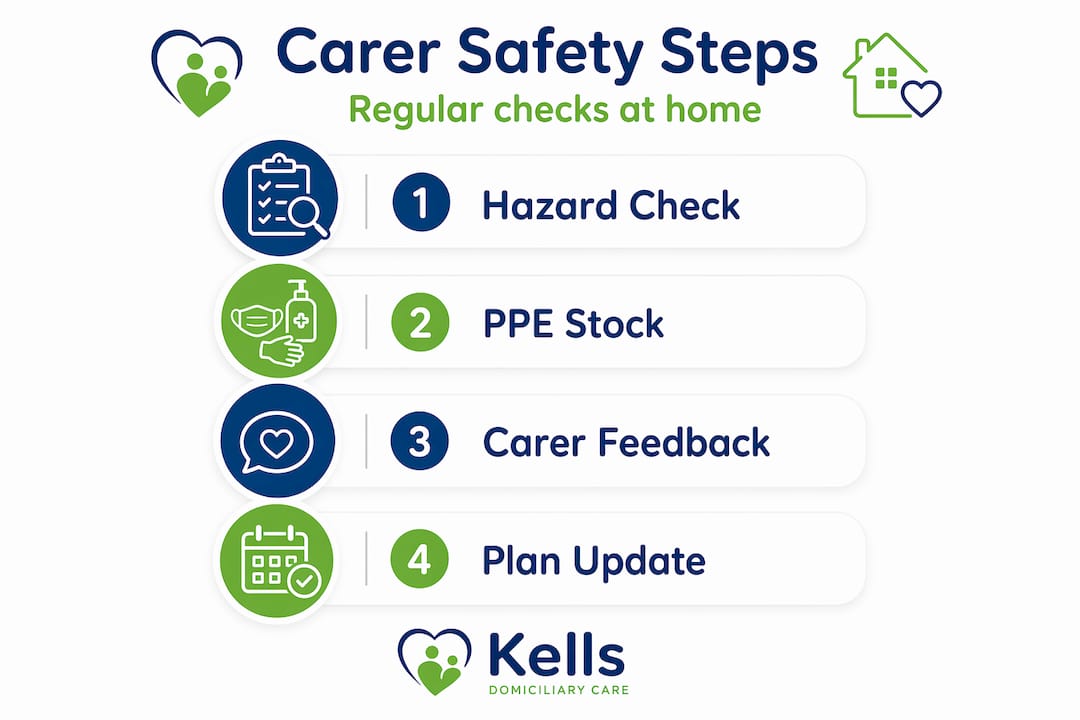
Here is a practical schedule for routine safety monitoring:
| Review task | Recommended frequency |
|---|---|
| Room-by-room hazard check | Monthly |
| PPE stock check and replenishment | Weekly |
| Moving and handling technique review | After any change in client mobility |
| Infection control procedure check | Weekly |
| Carer feedback conversation | Fortnightly |
| Medication storage and disposal check | Monthly |
| Emergency procedure review | Every three months |
CQC uses IPC expectations and risk control measures as part of inspection key lines of enquiry (KLOEs) to gauge provider compliance. This means that the standards families uphold at home directly mirror what regulators look for during formal inspections.
A strong infection control monitoring approach is also essential. CQC requires IPC policies to explain how infection risks are identified, assessed, and monitored on an ongoing basis. Even in a private home, keeping simple written records of cleaning routines, PPE use, and any infection-related incidents supports accountability and continuity of care.
Common mistakes to avoid include:
- Assuming nothing has changed when a client’s health is stable. Gradual changes in strength or cognition can go unnoticed without regular review.
- Relying solely on the carer’s self-reporting. Carers may not flag issues for fear of causing concern. A brief weekly check-in conversation removes this barrier.
- Failing to update risk assessments after a hospital discharge or new diagnosis.
- Neglecting to restock PPE until supplies run out mid-task.
- Overlooking carer wellbeing. A tired or stressed carer is more likely to cut corners or make errors.
Pro Tip: Involve the carer directly in regular safety reviews. Ask what feels difficult, what equipment would help, and whether any new risks have emerged. Carers working day-to-day in your home will often identify hazards before a family member does. This approach also supports carer dignity and professionalism.
The resources at personalised elderly care show how individual care planning and regular review can work together to sustain both client wellbeing and carer safety over time.
What most guides miss about carer safety in London homes
Generic carer safety guides are written for broad audiences. They tend to assume a purpose-built care environment, experienced staff, and formal management structures. London families experience something quite different.
A Victorian terraced house in Islington or a high-rise flat in Tower Hamlets presents physical constraints that standard guidance simply does not address. Narrow staircases, no lift access, shared bathrooms, and small bedrooms all affect what equipment can be used and how handling tasks are performed. When a guide tells you to “use a ceiling hoist,” that is not helpful advice for a carer working in a two-bedroom flat.
Family dynamics also play a role that professional guidance consistently ignores. Family members may instinctively want to help during transfers and, without training, may inadvertently create risk. Or a family may feel uncomfortable raising concerns with a carer they have come to know well, allowing unsafe practices to persist through politeness.
The most effective approach we have seen over more than 30 years of providing practical elderly care in London is one built on honest, frequent communication and genuine adaptability. Safety planning works best when it is treated as a living process, updated in response to real-world changes rather than filed away after the initial assessment.
The uncomfortable truth is that a completed checklist is not the same as a safe home. Safety is only real if the people carrying out care tasks understand the reasoning behind each measure and have the confidence to flag when something is not working. Static policies and annual reviews are not sufficient. Families who stay curious, ask questions, and encourage their carers to do the same tend to maintain significantly safer care environments.
Next steps: Accessing safe, personalised home care in London
If this guide has highlighted gaps in your current arrangements, you do not have to address them alone. At Kells Care, we have been providing safe, regulated home care across London for over 30 years. Our carers are fully trained, DBS checked, and supported by robust safety protocols that meet and exceed CQC requirements.
We understand that every home is different and that every family has unique concerns. Whether you are just starting to arrange care or reviewing an existing arrangement, our team can help you identify risks, source the right equipment, and put safer routines in place. Download our free home care guide for a practical overview of what to expect, or explore our domiciliary care family guide to learn how personalised home care works in practice. We are always happy to talk through your situation and offer straightforward, honest advice.
Frequently asked questions
What does CQC require for carer safety in home care?
CQC requires providers to assess risks, ensure staff competence, and document all safety and infection control measures under Regulation 12. This applies to all regulated home care providers operating in England.
How do I choose home care equipment for carer safety?
Select equipment based on a formal risk assessment of the client’s needs, the home environment, and the carer’s training level. Always use certified aids and PPE that meet the standards recommended by HSE guidance on moving and handling.
What are the top causes of carer injury in home environments?
Manual handling tasks and infection risks are the leading causes of carer injury, often resulting from poor initial assessment or a lack of appropriate training. Unsafe handling can cause serious injury to both carers and the people they support.
How often should carer safety checks be done at home?
Routine checks should take place weekly for infection control and PPE supplies, monthly for environmental hazards, and immediately after any change in the client’s health status or home layout.
Are home care agencies in London inspected for carer safety?
Yes. CQC inspects agencies for safety, staff competence, and infection control as part of their Key Lines of Enquiry, ensuring regulated providers maintain consistent, high standards of carer protection.