
TL;DR:
- Many families mistakenly believe care assessments are only for crises or are too bureaucratic to pursue.
- In reality, a free care needs assessment helps evaluate the support required for daily living, regardless of urgency.
- Understanding the process in London involves contacting local social care teams, attending assessments, and developing personalized care plans.
Many families assume care assessments are only for people in crisis, or that the process is too bureaucratic to be worth pursuing. Neither is true. A care needs assessment is the official, free route through which your local council evaluates what support your loved one needs. It applies whether your relative struggles to get dressed independently, manage medication, or simply needs companionship during the day. This guide explains exactly what to expect, how the process works across London’s boroughs, and what you can do to make sure your family gets the best possible outcome.
Table of Contents
- What is a care assessment and who needs one?
- How does the care assessment process work in London?
- What do councils look for during an assessment?
- What happens after a care assessment?
- What most families miss about care assessments
- Find caring support for your loved one
- Frequently asked questions
Key Takeaways
| Point | Details |
|---|---|
| Anyone can request an assessment | You don’t need to wait for a crisis; families or individuals can apply for a care assessment at any time. |
| Process is straightforward and free | The local council organises the assessment, and it costs nothing to arrange. |
| Assessment focuses on daily needs | Assessors look at daily living tasks, wellbeing and independence, not just diagnosis. |
| Financial support comes later | A separate means assessment follows if support needs are identified. |
| Preparation improves outcomes | Being clear about struggles and gathering supporting evidence helps achieve the right support plan. |
What is a care assessment and who needs one?
A care needs assessment is a formal conversation between your loved one and a trained professional from the local council. Its purpose is to understand what daily tasks the person struggles with, what their goals and wishes are, and what kinds of support might help them live safely and independently at home.
The most important thing to understand is that the needs assessment is free and can be requested by anyone who thinks they or someone else needs help with day-to-day care. You do not need a GP referral. You do not need to be in a crisis situation. You simply contact your local borough’s adult social care team and ask for one.
Many families worry that asking for an assessment will trigger costs they cannot afford, or that they will be turned away. This is a common concern, but it confuses the needs assessment with the financial assessment, which comes later. The needs assessment is purely about understanding what support is required. The financial question is entirely separate.
It is also worth knowing that getting a needs assessment is your right even if your loved one is likely to fund their own care. Some families assume only those who qualify for council funding need to bother. In fact, the assessment gives you expert advice about the types of support available, helps clarify what your relative genuinely needs, and can open doors to practical resources and local services you may not have known existed.
Here is a quick comparison of two terms families often confuse:
| Term | What it covers | When it happens | Cost to you |
|---|---|---|---|
| Care needs assessment | Daily living needs and support options | First step, before any funding discussion | Free |
| Financial (means) assessment | Income, savings, and what the council will contribute | After the needs assessment | Free |
The key point is this: even if your family has significant savings and expects to self-fund home care, requesting a care assessment is still a wise and worthwhile step. The advice and signposting alone can save you significant time and stress.
How does the care assessment process work in London?
London is made up of 32 boroughs plus the City of London, and each operates its own adult social care department. The broad process follows the national Care Act 2014 framework, but the timelines, paperwork, and local pathways can vary. Understanding the steps helps you know what to expect and when to follow up.
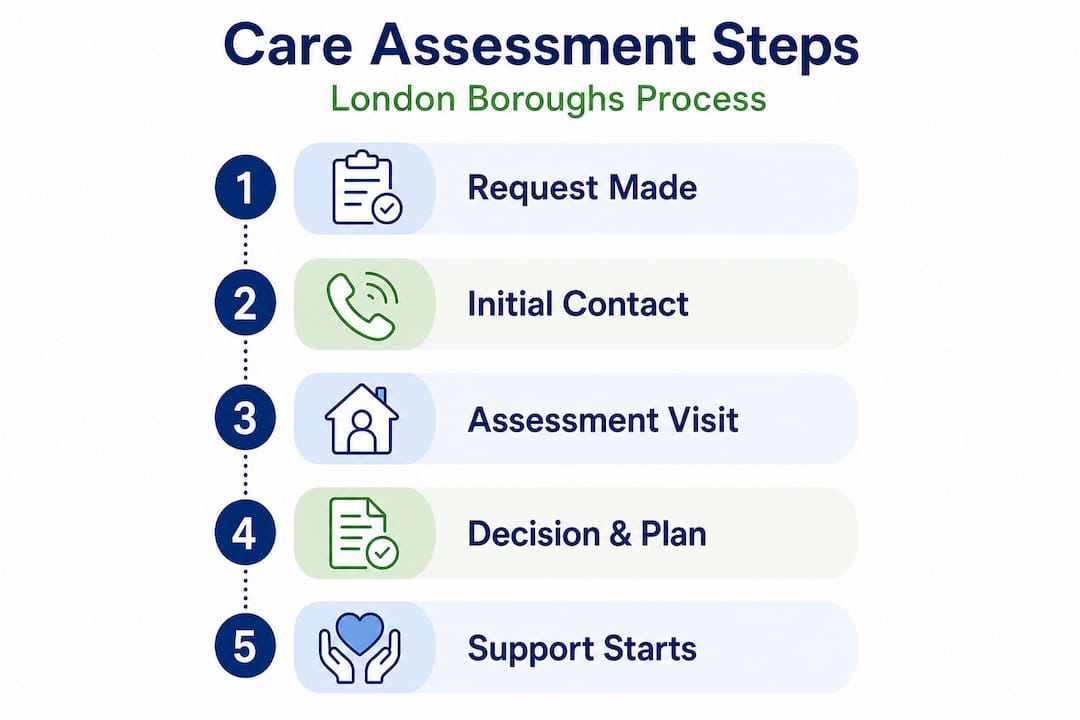
Here is how the process typically unfolds:
- Contact your local borough’s adult social care team. You can do this by phone, online form, or in writing. Be clear that you are requesting a care needs assessment under the Care Act 2014.
- Initial screening conversation. A duty worker will ask some brief questions to understand the situation and determine urgency. For straightforward cases, they may offer telephone guidance initially.
- Full assessment appointment. A social worker or occupational therapist will arrange a visit, usually at your loved one’s home. This is the main assessment, covering daily activities, health, environment, and wishes.
- Decision and care plan. Following the assessment, the council will determine whether your loved one meets eligibility criteria and what support options are recommended. You receive a written record of the outcome.
- Review and appeal. If you disagree with the outcome, you have the right to request a review or formal appeal.
Different boroughs publish their own care assessment workflows and target timelines, so it is always worth checking your specific borough’s website. The City of London, for example, aims to complete assessments within 28 days, with some complex cases extending to 42 days.
To give context to the scale of this process, official adult social care statistics report the number of people receiving local authority assessments across England each year, with hundreds of thousands of adults accessing this route annually. Understanding the home care transition process can also help your family prepare for what life looks like after an assessment concludes.
Here is a general guide to typical assessment timelines in London:
| Borough type | Target completion | Complex cases |
|---|---|---|
| City of London | 28 days | Up to 42 days |
| Standard London boroughs | 28 to 35 days | Up to 56 days |
| High-demand boroughs | 35 to 45 days | Variable |
It is worth noting that demand on London’s adult social care services is high. Being proactive, following up politely, and having your paperwork ready all help to keep things moving. Staying informed about local trends in home care can also help you understand the broader context.
Pro Tip: Keep a dated record of every phone call, letter, and email related to the assessment. Note the name of each person you speak with. If there are delays or disputes later, this documentation is invaluable.
What do councils look for during an assessment?
Understanding what the assessor will focus on helps you prepare thoroughly and ensures nothing important is overlooked. The assessment is guided by the Care Act 2014 eligibility criteria, which follow a three-part test.
Under the Care Act 2014 criteria, your loved one’s needs must:
- Arise from a physical or mental health condition. This includes conditions such as dementia, stroke, Parkinson’s disease, diabetes complications, mental health conditions, and age-related frailty.
- Cause an inability to achieve specific outcomes. The person must be unable to carry out certain daily activities safely or adequately.
- Have a significant impact on wellbeing. The difficulties must meaningfully affect their physical health, emotional wellbeing, dignity, social participation, or relationships.
All three parts of this test must be met for a person to receive council-funded support. However, even if someone does not meet the formal eligibility threshold, the assessor is still required to provide information and signposting to other relevant services.
The daily tasks the assessor will consider include:
- Personal hygiene, washing, and dressing
- Preparing food and drink safely
- Managing and taking medication correctly
- Using the toilet and maintaining continence
- Keeping the home in a safe and acceptable condition
- Making use of necessary facilities and services
- Maintaining family and social relationships
- Moving around the home safely, including getting in and out of bed
Assessments focus on outcomes in daily life and what the person can or cannot do independently. The council should also consider all options that could help maintain independence and wellbeing at home before recommending more intensive support.
Family members and carers can and should contribute their observations during the assessment. If you are a regular carer for your relative, you may be offered a separate carer’s assessment, which evaluates your own needs and capacity too. Do not overlook this. Carer support is an important part of the picture.
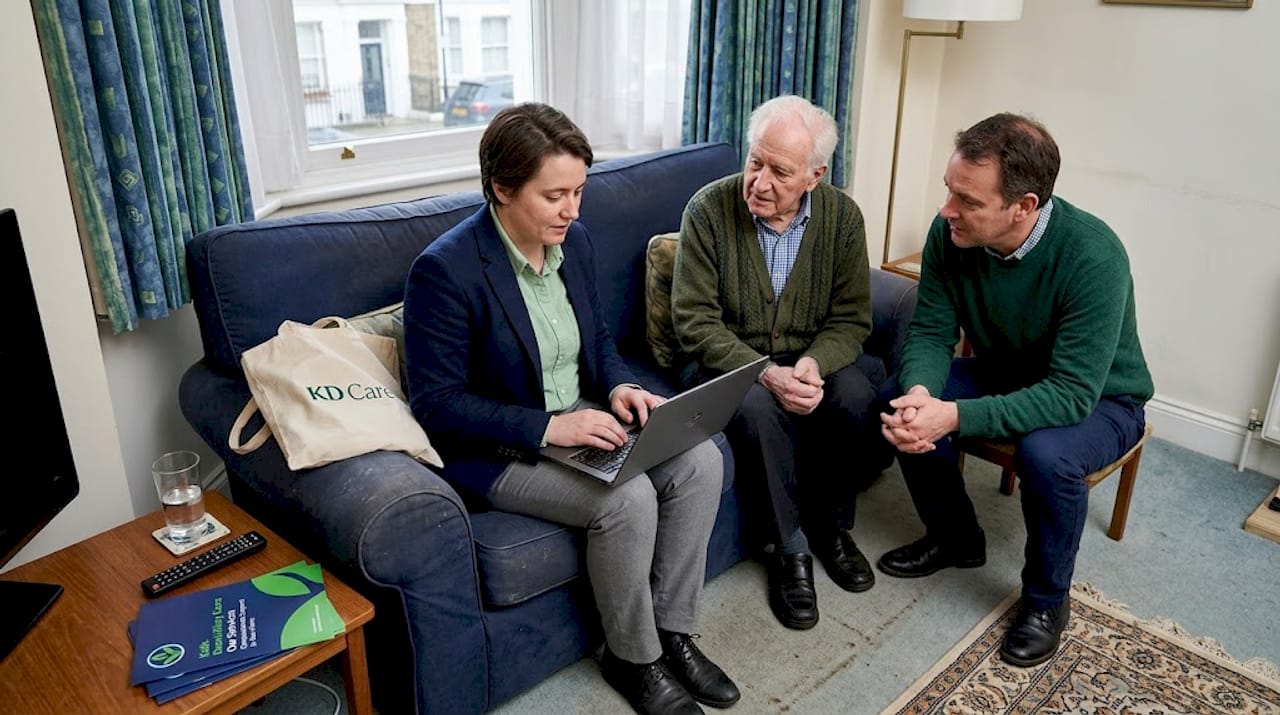
Pro Tip: Before the assessment visit, spend a few days writing down specific examples of what your loved one cannot do safely alone, how often incidents occur, and how these situations affect their dignity and daily life. Specific, concrete detail carries more weight than general descriptions.
What happens after a care assessment?
Once the assessment is complete, the council will notify you and your loved one of the outcome in writing. This is an important document. Keep it safely, as it forms the basis of any care planning and any future appeal.
If your loved one meets the eligibility criteria, the council will move forward as follows:
- Financial (means) assessment. If the council has agreed your relative has eligible needs, a separate financial assessment will determine how much the council will contribute toward the cost of eligible care. This considers income, savings, and assets. Currently in England, if savings exceed £23,250, the person is expected to fund their own care fully. Below £14,250, the council covers the full cost. Between those figures, the contribution is means-tested.
- Care and support plan. The council will produce a care and support plan outlining what support has been agreed, how it will be delivered, and who is responsible for each element. You and your loved one should be actively involved in developing this plan.
- Direct payments option. Instead of receiving council-arranged services, some people prefer to receive a direct payment and arrange their own care independently. This offers more control and flexibility, particularly useful for families who want to choose their own carer or agency.
- Review. Care plans are reviewed regularly, typically after the first few months and then annually. If your loved one’s condition changes significantly, you can request an unscheduled review at any time.
- Appeal rights. If you disagree with either the needs assessment outcome or the financial assessment, you have the right to ask the council to reconsider. If that does not resolve the issue, you can escalate to a formal complaint and ultimately to the Local Government and Social Care Ombudsman.
Over 609,000 adults accessed a council care assessment in England in a single year. This underlines both how widely used this process is and how important it is for families to understand their rights within it. Knowing what available home care support looks like in practice helps you engage meaningfully with your care plan once it is in place.
Pro Tip: If the council says your relative does not meet the eligibility threshold, ask them to explain exactly which part of the three-part test was not met. Sometimes needs are underreported during the assessment itself, and a review with additional evidence can lead to a different outcome.
What most families miss about care assessments
After more than three decades supporting families in London, we have seen the same pattern repeat itself. Families arrive at a care assessment focused solely on whether their relative will qualify for council funding. They leave either relieved or disappointed, depending on that one outcome. But this misses much of what a care assessment actually offers.
Even when someone does not qualify for council-funded support, a well-conducted assessment gives you access to expert professional opinion on your relative’s needs. That alone has real value. A social worker or occupational therapist may identify a falls risk that had been overlooked, recommend a practical aid that transforms daily life, or point you to a local service that provides exactly the right support at low or no cost.
The families who get the most from the process are those who arrive prepared. They have written notes on daily difficulties. They have thought about what their relative values most in terms of personalised support and planning. They have considered not just what their relative cannot do, but what they want to be able to do. There is a significant difference between simply managing personal care and actually living well.
We also encourage families to ask broad questions during and after the assessment. Ask about home adaptations. Ask about telecare options such as fall alarms and medication reminders. Ask about short breaks and respite support for carers. Ask about befriending services if social isolation is a concern. The council’s remit is wider than most families realise, and many of these options are available regardless of whether formal funding is granted.
The uncomfortable truth is that preparation determines outcomes far more than the strength of the underlying need. Two families in nearly identical situations can leave with very different results, simply because one came prepared with evidence and the other did not.
Find caring support for your loved one
If this guide has helped you understand the care assessment process, the next step is making sure you are ready to act on what you learn. At Kells Care, we have been supporting London families for over 30 years, and we know how overwhelming this period can feel. Our free home care guide gives families a practical starting point for arranging quality support at home. If you are new to this process, our domiciliary care explained resource answers the most common questions families ask. And when you are ready to explore personalised home care options for your loved one, the team at Kells Care is here to help every step of the way.
Frequently asked questions
Is a care needs assessment free in London?
Yes, the assessment is free and available to anyone who feels they or their loved one needs help with daily life, regardless of income or savings.
How long does it take to get a care assessment in a London borough?
Many London boroughs aim to complete assessments within 28 days, though the City of London notes that complex cases may extend to 42 days or longer depending on circumstances.
Can someone get help if they fund their own care?
Yes, anyone can request a care assessment regardless of whether they are expected to pay for their own support, as the needs assessment is entirely separate from any financial consideration.
What does the assessor look for during a care assessment?
They consider health, ability to carry out daily tasks, living arrangements, and the impact on wellbeing. Assessments focus on outcomes in daily life and what the person can or cannot do independently.
What happens if you disagree with the care assessment outcome?
You have the right to request a review or formal appeal with the local council. The City of London describes both a re-assessment route and a formal appeals process for cases where the outcome is disputed.