TL;DR:
- Qualified carers complete formal training, background checks, and work within regulated frameworks.
- Unqualified carers lack oversight, increasing risks of medication errors, neglect, and harm.
- Choosing regulated, professional providers ensures safer, personalized, and accountability-driven home care.
Many families choose home carers based on cost or personal recommendation, without fully understanding what separates a qualified professional from someone with no formal training. That gap can be dangerous. Errors in medication, missed warning signs, and a lack of accountability are real risks when care is unregulated. Yet the right support, delivered by a trained and vetted carer, can transform your loved one’s quality of life. This guide explains what qualifications actually mean in practice, what the risks of unregulated care look like, and how to make a confident, informed choice for your family.
Table of Contents
- What does ‘qualified carer’ mean in the UK?
- The real risks of unqualified or unregulated care
- How qualified carers ensure safety, dignity, and personal outcomes
- Short-term savings vs long-term security: cost, flexibility, and peace of mind
- What to look for (and ask) when choosing a carer in London
- The uncomfortable truth: why regulation and professionalism matter more than ever
- How Kells Care supports your family’s safety and peace of mind
- Frequently asked questions
Key Takeaways
| Point | Details |
|---|---|
| Regulated care prevents harm | Qualified carers reduce the risk of errors, neglect, and abuse compared to unregulated options. |
| Better outcomes for loved ones | Combined family and professional care offers the best results for health, mobility, and happiness. |
| Qualifications guarantee accountability | CQC oversight and formal training ensure carers are competent, reliable, and answerable to families and the law. |
| Short-term savings hide long-term risks | Unqualified care may cost less now, but puts your loved one’s safety and dignity at risk in the long run. |
What does ‘qualified carer’ mean in the UK?
To understand the value of qualifications, let’s clarify what sets a qualified carer apart from someone who simply offers help at home.
A qualified carer is a professional who has completed formal training, passed background checks, and works within a regulated framework. In the UK, the benchmark for entry-level care workers is the Care Certificate, a set of 15 standards covering everything from safeguarding to person-centred care. Completing it demonstrates a baseline of competence that protects clients from avoidable harm. Workforce shortages across adult social care make this training even more critical, as gaps in knowledge directly increase the risk of errors in home settings.
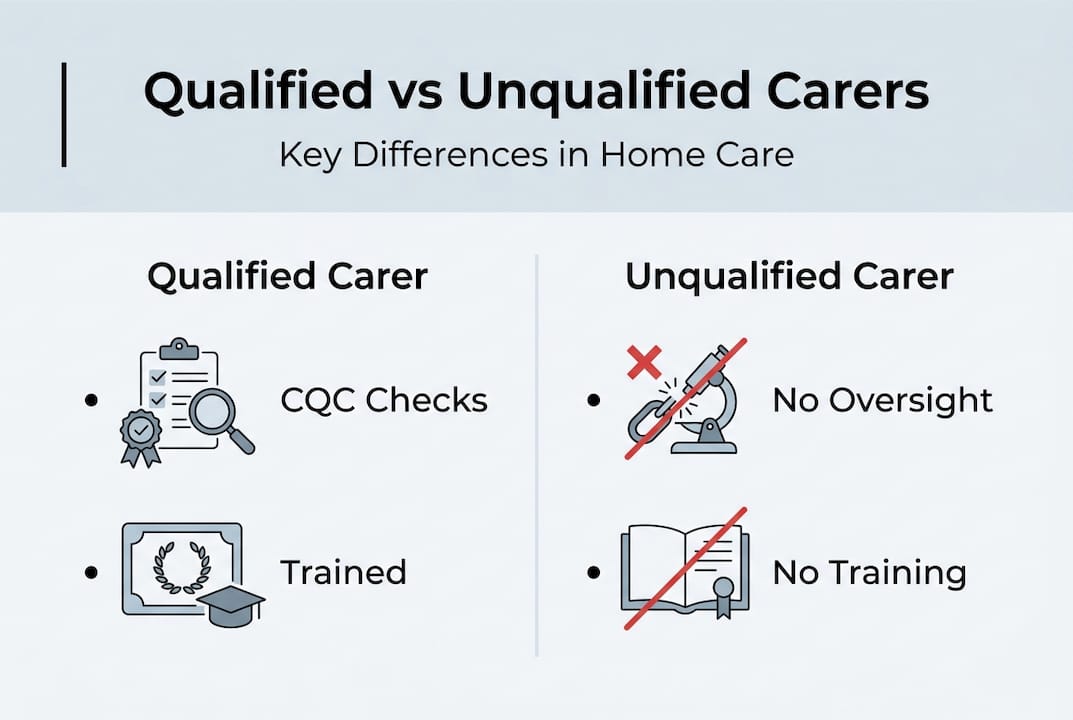
Unqualified carers, by contrast, typically have no formal training, no ongoing oversight, and no verified background checks. They may be well-meaning, but good intentions alone cannot replace structured knowledge.
Here is what you should expect from any qualified care staff member:
- Completion of the Care Certificate or equivalent formal training
- An enhanced DBS (Disclosure and Barring Service) check
- Verified references from previous employers
- Ongoing professional development and supervision
- Employment through an agency subject to CQC inspection
The figures are telling. 71% of care providers report difficulty recruiting qualified staff, and 93% do not offer additional pay for clinical tasks performed without proper training. This means unqualified carers are sometimes asked to carry out complex tasks they are simply not prepared for.
Understanding the role of home carers helps you ask the right questions. Always ask your care provider how they assess, train, and support their staff before agreeing to any arrangement.
Pro Tip: Ask every prospective care provider to show you their staff training records and their most recent CQC inspection report before making a decision.
The real risks of unqualified or unregulated care
With definitions in place, it is crucial to recognise the dangers of relying on unqualified care.
There are an estimated 123,000 unregulated carers working in England and Wales. Many families turn to them for convenience or cost savings, unaware of what can go wrong. Unqualified carers operate without oversight, lack emergency protocols, and have no formal accountability if something goes wrong. In documented cases, this has led to financial abuse, neglect, and serious physical harm.
The three most common risks are:
- Medication errors — Unqualified carers may administer the wrong dose, miss doses entirely, or fail to recognise dangerous side effects.
- Lack of emergency response — Without training in first aid or crisis protocols, an unqualified carer may not know what to do in a medical emergency.
- Poor safeguarding — Without formal training, carers may not recognise or report signs of abuse, deterioration, or neglect.
In England and Wales, an estimated 123,000 unregulated carers work without oversight, formal training, or accountability. For families relying on them, the consequences of something going wrong can be severe and irreversible.
CQC inspections consistently identify safety and consistency as the primary failings in unregulated or poorly managed care settings. Reviewing a home care safety checklist before engaging any carer is a practical first step. It is also worth understanding the key differences between private and agency home care, as agency care provides far greater protection through contractual accountability and regulatory oversight.
How qualified carers ensure safety, dignity, and personal outcomes
To see the positive difference, consider what qualified care achieves that unregulated options simply cannot.

In 2024 to 2025, 758 out of 1,052 homecare services inspected by the CQC were rated Good or Outstanding. That is a strong indicator of what regulated, professionally staffed providers consistently deliver. Person-centred care plans, reliable medication management, and proactive safeguarding are not optional extras in qualified settings. They are standard practice.
Here is how qualified carers add measurable value:
- Personalised care plans tailored to each client’s health needs, preferences, and routines
- Consistent communication with families and healthcare professionals
- Proactive risk management to identify and address changes in health before they escalate
- Regulated standards upheld through regular CQC inspections and internal audits
| Feature | Qualified carer | Unqualified carer |
|---|---|---|
| CQC regulation | Yes | No |
| Formal training | Care Certificate and beyond | None required |
| Emergency response | Trained protocols | No standard approach |
| Continuity of care | Agency backup available | Dependent on individual |
| Accountability | Regulated and contractual | Minimal or none |
The advantages of home care delivered by qualified professionals extend beyond physical safety. Research shows that elderly and disabled people who receive structured, professional support alongside family involvement experience better emotional health, greater mobility, and improved overall wellbeing. Choosing a qualified provider also supports your loved one’s benefits for independence, allowing them to remain at home with confidence rather than moving into residential care unnecessarily.
Pro Tip: Check the CQC website before choosing any provider. You can search by postcode and view full inspection reports, including specific ratings for safety and leadership.
Short-term savings vs long-term security: cost, flexibility, and peace of mind
Cost often shapes families’ choices, but it is worth weighing short-term savings against the long-term security your loved one deserves.
Unqualified care can appear more affordable at first glance. There are no agency fees, no regulatory overheads, and arrangements can feel more flexible. But the hidden costs can be significant. If something goes wrong, families may face emergency hospital admissions, legal complications, or the distress of finding urgent replacement care at short notice.
Consider these false economies of unqualified care:
- Emergency costs if a health crisis is missed or mishandled
- Missed red flags that lead to delayed diagnosis or treatment
- No insurance cover if the carer causes accidental harm
- No continuity if the carer becomes unavailable without notice
- No recourse if care quality deteriorates or abuse occurs
The CQC inspection backlog means that poor care in unregulated settings can go undetected for extended periods. Regulated providers, by contrast, are subject to regular scrutiny that keeps standards visible and accountable.
For elderly people in London with complex or long-term care needs, qualified expertise is not a luxury. It is a necessity. The influence families have on care quality is real, but it works best when paired with professional oversight rather than used as a substitute for it. Understanding the differences between private and agency care will help you make a decision that holds up over time.
What to look for (and ask) when choosing a carer in London
Now that you understand the benefits and risks, here is how to confidently select a qualified carer.
Start with a clear checklist of what every family should ask:
- What formal training has the carer completed?
- Is the agency registered with and inspected by the CQC?
- Has the carer undergone an enhanced DBS check?
- Does the agency carry public liability insurance?
- What happens if the regular carer is unavailable?
- How are families kept informed about their loved one’s care?
- What is the process if a safeguarding concern arises?
Then follow these steps to verify what you are told:
- Search the CQC register online to confirm the agency’s registration and current rating.
- Ask to see the carer’s Care Certificate or equivalent training documentation.
- Request references from current or recent clients and follow them up.
- Ask how the agency supervises its carers and how often performance is reviewed.
- Confirm the complaints procedure in writing before care begins.
Research from Duke University Medical School shows that combined family and professional care produces significantly better outcomes for health, mobility, and emotional wellbeing than family care alone. Choosing a qualified carer does not replace your role. It strengthens it.
Learning how to approach communicating with carers and understanding what to expect when choosing a home care agency will give you the confidence to make the right choice.
Pro Tip: Speak directly with current clients of any agency you are considering. Genuine feedback on reliability, respect, and communication is more revealing than any brochure.
The uncomfortable truth: why regulation and professionalism matter more than ever
Stepping back, it is worth considering why these standards matter so deeply for modern families.
There is a common assumption that familiar, informal carers offer something warmer and more human than regulated professionals. That feeling is understandable. But comfort alone cannot prevent a missed medication dose, an undetected fall, or a safeguarding concern that goes unreported for weeks.
Real dignity does not come from a friendly face without accountability. It comes from a carer who is answerable to your family, to their employer, and to a national regulator. Regulation is not bureaucracy for its own sake. It is the mechanism that protects your loved one when no one else is watching.
‘Professional oversight ensures that compassion is matched by accountability.’
If you genuinely value your loved one’s benefits of independence, then insisting on professional standards is the most loving thing you can do. Even the most devoted families need expert backup. Acknowledging that is not a weakness. It is wisdom.
How Kells Care supports your family’s safety and peace of mind
If you are ready for confident, professional support, here is how Kells Care can help.
At Kells Domiciliary Care, we have spent over 30 years providing regulated, expertly trained carers to London families. Every member of our team is fully qualified, DBS checked, and supported through ongoing professional development. We are regulated by the CQC, so you can verify our standards independently before you make any commitment.
Whether you are weighing up home care vs nursing options or just beginning to think about what support looks like, we are here to guide you. If you are not sure how to start the conversation with your family, our advice on talking about home care can help you take that first step with confidence.
Frequently asked questions
What qualifications should a home carer have in London?
A qualified carer should have completed the Care Certificate, undergone an enhanced DBS check, and work for an agency regulated by the CQC. The Care Certificate establishes the baseline competence needed to reduce errors and protect clients in home settings.
Is there a risk in choosing an unregulated or unqualified carer?
Yes. Families risk poor care, safety failures, and no formal recourse if things go wrong. Unregulated carers have no oversight, no mandatory training, and no accountability structure to protect your loved one.
How does the Care Quality Commission (CQC) protect families?
The CQC inspects homecare providers for safety, quality, and compliance, publishing ratings so families can compare services. CQC inspections consistently show that regulated providers deliver better person-centred care and safer outcomes than unregulated alternatives.
Can family members provide care alongside professionals?
Yes, and the evidence strongly supports it. Combined family and professional care produces measurably better outcomes for health, mobility, and emotional wellbeing than family care provided alone.