
TL;DR:
- Visiting care provides scheduled in-home support for daily tasks without residential or overnight arrangements.
- It offers flexible assistance with personal care, medication, meals, and companionship, supporting independence.
- Most providers are regulated by the Care Quality Commission, ensuring quality and safety in England.
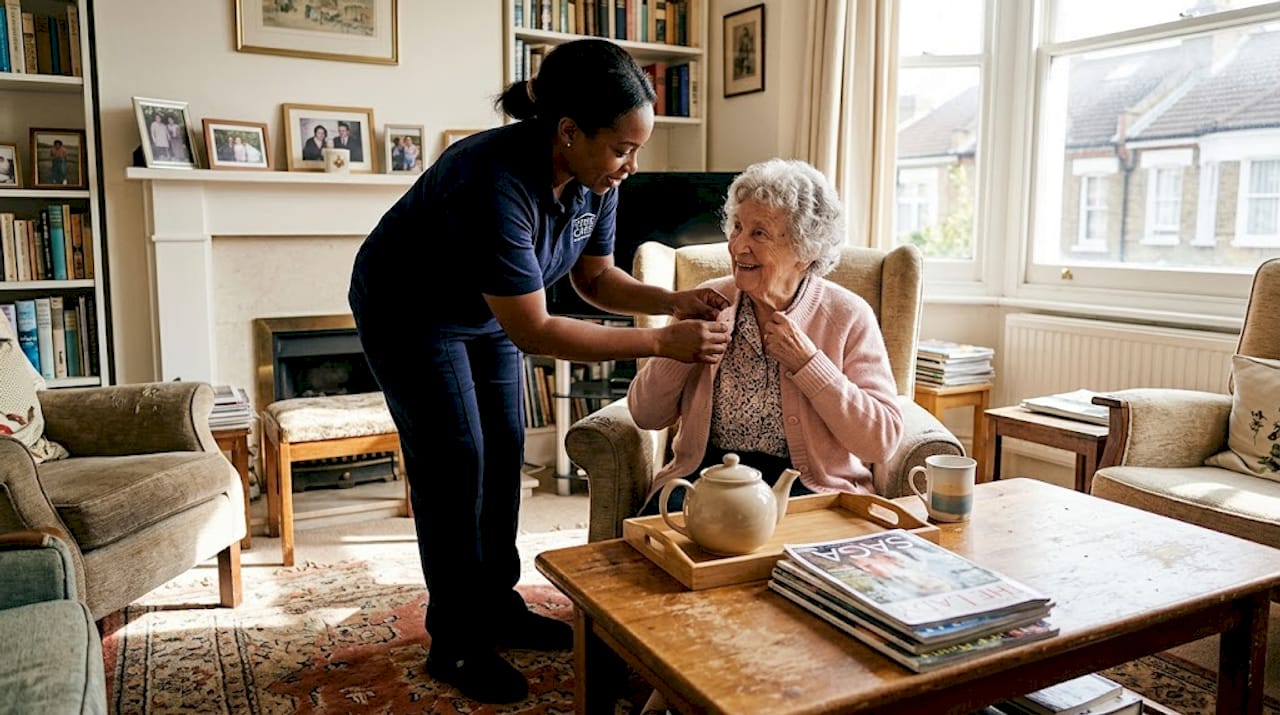
Many families searching for support for a loved one first encounter the term ‘visiting care’ and assume it relates to visiting rights in a care home or access to a hospital ward. It does not. Visiting care means a trained carer comes directly to your relative’s home to help with daily living tasks, from washing and dressing to medication reminders and meal preparation. It is one of the most flexible and widely used forms of home support available in the UK. This guide explains exactly what visiting care involves, how it compares to other options, what tasks are covered, and how to arrange it for your family.
Table of Contents
- What is visiting care?
- Visiting care versus home help and other options
- What support does visiting care offer?
- How to arrange and personalise visiting care
- What most guides miss about visiting care in London
- If you need further guidance on visiting care
- Frequently asked questions
Key Takeaways
| Point | Details |
|---|---|
| Clear visiting care definition | Visiting care means a carer comes to your family member’s home on a schedule to help with daily living. |
| Flexible support options | You can arrange for as little as an hour a week up to several daily visits depending on your loved one’s needs. |
| Personal and domestic help | Visiting care covers tasks from washing and dressing to meal prep, medication reminders and more. |
| Established and regulated | Over 500,000 people in England use regulated visiting care services, showing it is tried-and-trusted. |
What is visiting care?
Visiting care is a form of domiciliary care (home-based support) where a professional carer arrives at a person’s home on a scheduled basis to provide personal or practical assistance. It is not a residential arrangement. Your relative stays in their own home, surrounded by familiar surroundings, while receiving structured support.
You may come across several overlapping terms: ‘domiciliary care’, ‘home care’, ‘home help’, and ‘visiting care’. These are often used interchangeably, but they are not always identical. For a fuller breakdown, our domiciliary care explained guide covers the distinctions in detail.
Visiting care typically includes support with:
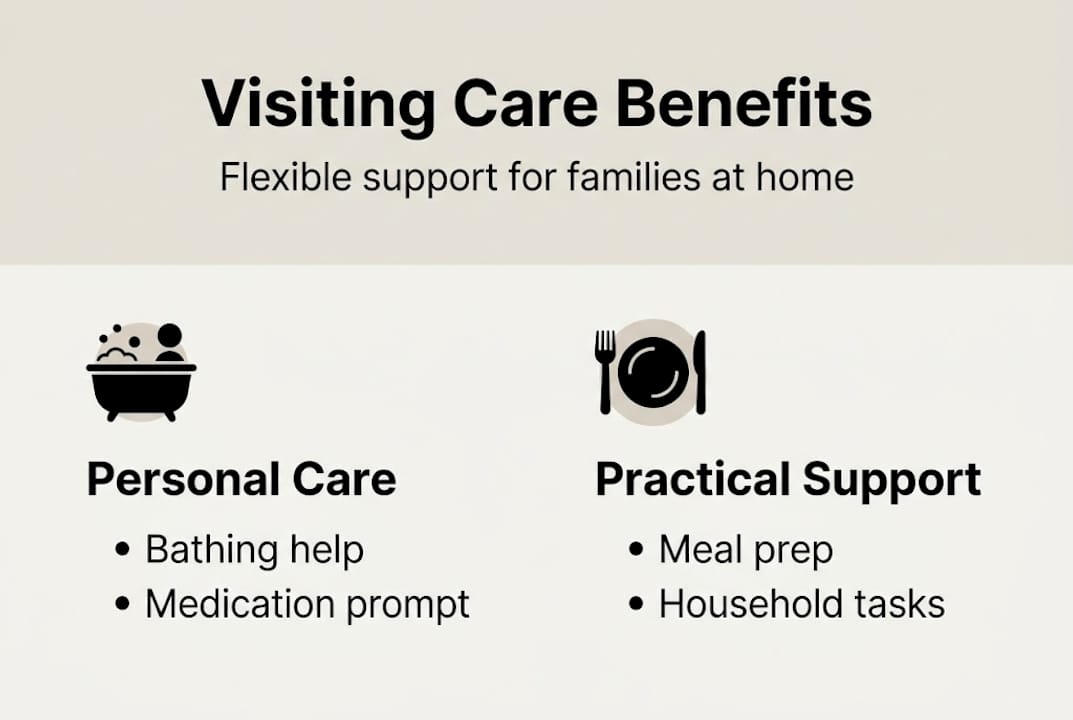
- Personal care: washing, bathing, dressing, and toileting
- Mobility assistance: helping someone move safely around their home
- Medication reminders: ensuring the right medicines are taken at the right time
- Meal preparation: planning and cooking nutritious meals
- Companionship: spending time together and supporting emotional wellbeing
- Domestic tasks: light cleaning, laundry, and shopping
The scale of this kind of support across England is significant. Over 500,000 people in England were receiving CQC-regulated domiciliary care as of early 2026, confirming it is a well-established pathway rather than a niche option.
Visiting care is designed to fit around your relative’s life. Visits can range from a brief check-in once a week to multiple visits throughout the day, giving families enormous flexibility.
For a broader overview of home-based services, the NHS guidance on homecare and our own home care services guide are good starting points. Visiting care is neither a last resort nor a luxury. It is simply a practical, regulated form of support that helps people live safely and comfortably at home.
Visiting care versus home help and other options
Families often feel overwhelmed by the range of terms they encounter when looking at care. Understanding the differences makes the decision far clearer.
Visiting care provides both personal and practical support, whereas home help focuses mainly on domestic tasks such as cleaning, shopping, and cooking. If your relative needs assistance with washing, dressing, or toileting in addition to domestic support, visiting care is the appropriate option.
Here is a simple comparison:
| Care type | Personal care | Domestic help | Overnight presence | Regulated by CQC |
|---|---|---|---|---|
| Visiting care | Yes | Yes | No | Yes |
| Home help | No | Yes | No | Not always |
| Live-in care | Yes | Yes | Yes | Yes |
| Residential care | Yes | Yes | Yes (full-time) | Yes |
Live-in care is appropriate when someone requires round-the-clock supervision and companionship. Residential care suits those with very high or complex needs who can no longer be safely supported at home. For more detail on where the line sits, our guide on the difference between home care and nursing is helpful.
A common misconception is that visiting care is only suitable for low-level needs. In reality, skilled visiting carers can support quite complex conditions, including post-operative recovery, early to mid-stage dementia, and physical disabilities. You can explore the full range of personalised support options available to families.
Many families find that visiting care provides exactly the right level of support without removing the independence their relative values so deeply.
Pro Tip: Before choosing any care type, list your relative’s daily tasks and note which ones they struggle with most. If personal care is on that list, visiting care or live-in care will almost certainly serve better than home help alone.
What support does visiting care offer?
Now that you know where visiting care sits among care options, let’s get specific about what help it actually provides day to day.
Visiting carers can help with tasks such as getting out of bed, washing, dressing, using the toilet, meal preparation, medication reminders, shopping, and collecting prescriptions. This covers a wide range of daily living needs, and most families find the list broader than they initially expected.

Here is an overview of common visiting care tasks and how frequently they tend to be provided:
| Task | Typical frequency |
|---|---|
| Washing and personal hygiene | Daily |
| Dressing and undressing | Daily |
| Medication reminders or prompts | One to four times daily |
| Meal preparation | One to three times daily |
| Light housekeeping | Several times weekly |
| Shopping or prescription collection | Weekly |
| Companionship and conversation | Each visit |
| Mobility support and transfers | As needed |
The support can be structured in a numbered sequence across the day:
- Morning visit: assistance getting up, washed, dressed, and having breakfast
- Midday visit: meal preparation and medication prompt
- Afternoon visit: companionship, light housekeeping, or shopping
- Evening visit: support with supper, personal care, and settling for the night
Visiting care is not limited to ongoing needs. It works equally well for short-term situations, such as recovery after a hospital stay, or during a period when a family carer is unwell or travelling. You can read more about personalising home care services to match your specific circumstances.
Pro Tip: When speaking with a care provider, describe your relative’s daily routine from the moment they wake up. This gives the carer and care manager a realistic picture and leads to a far more accurate, personalised plan rather than a generic package.
For families caring for older relatives, our elderly home care guidance covers many of the practical questions that arise during this process.
How to arrange and personalise visiting care
Understanding the services is just the start. Here is how you can actually arrange and tailor visiting care for your relative in London.
Visiting care can be short-term or regular, ranging from an hour a week to several visits daily, and is designed to fit around the individual’s timetable. That flexibility is one of its greatest strengths, but it also means the planning stage matters.
Follow these steps to set up visiting care effectively:
- Assess your relative’s needs: Consider personal care, mobility, medication, nutrition, and social contact. A written list is useful.
- Contact your local council or a care agency: You can request a social care assessment from your local authority, or approach a regulated private agency directly.
- Ask the right questions: Find out how carers are selected, how visits are scheduled, what happens if a regular carer is unavailable, and how quality is monitored.
- Agree a care plan: A good agency will produce a written care plan tailored to your relative’s needs and preferences.
- Review regularly: Needs change. Schedule reviews every few months and update the plan accordingly.
When choosing a provider, look for CQC registration, experienced staff, and a clear communication structure for families. Our guide on choosing a home care agency covers this in detail, and our video tips for home care selection walk through common questions families ask.
Key questions to ask a prospective provider include:
- Are your carers DBS checked and fully insured?
- How do you match carers to clients?
- What is your procedure if a visit is missed or a carer is unwell?
- How do families give feedback or raise concerns?
Pro Tip: Ask the agency to introduce the carer to your relative before visits begin. A familiar face from the outset makes a real difference to how settled your relative feels, especially in the early weeks.
What most guides miss about visiting care in London
Most articles position visiting care as a stepping stone to something more intensive. We disagree with that view.
Visiting care remains the preferred model for regulated home support in England, even as alternatives grow. That is not because families cannot afford live-in care or residential options. It is because scheduled visits, done well, preserve independence in a way that constant supervision cannot.
When someone knows their carer arrives at 8am, they prepare. They maintain a routine. That structure itself supports cognitive and physical wellbeing. We have seen this repeatedly over more than 30 years of supporting London families. The role of home carers is often about enabling, not doing everything.
The families who struggle most are those who wait too long before arranging support, fearing it signals a loss of independence. In our experience, the opposite is true. Starting visiting care early, even just a few hours a week, gives your relative and your family time to adjust and build trust with a carer before needs intensify. That gradual approach is far less disruptive than a sudden, crisis-driven move to residential care.
If you need further guidance on visiting care
At Kells Domiciliary Care, we have been supporting London families for over 30 years with flexible, personalised home care. Our carers are fully qualified, DBS checked, and our services are regulated by the Care Quality Commission. Whether your relative needs a brief morning visit or several calls throughout the day, we can build a care plan around their needs and routines.
Explore our domiciliary care family guide or download our free home care guide for practical next steps. If you are ready to talk through your options, visit our page on personalised home care explained or get in touch directly. We are here to help you find the right level of support for your family.
Frequently asked questions
Can visiting care be used for short-term recovery after hospital stays?
Yes, visiting care is flexible and can be arranged for temporary periods to support recovery at home. It can be short-term or long-term and adapts to changing needs.
Does visiting care cover help with medication and meals?
Most providers include medication prompts and meal preparation as standard tasks in a visiting care plan. Meal preparation and medication reminders are among the most commonly requested forms of support.
Is visiting care regulated in England?
Yes, most visiting care agencies are regulated by the Care Quality Commission and must meet strict quality standards. 505,886 people were receiving CQC-regulated domiciliary care as of early 2026.
How is visiting care different from live-in care?
Visiting care involves scheduled visits by a carer, while live-in care means a carer is present in the home at all times. Visiting care is by set visits and does not provide overnight or continuous supervision.
Recommended
- What is home care? Personalised support options explained – Kells Domiciliary Care
- What is domiciliary care? A family guide to home support – Kells Domiciliary Care
- Home care services: a complete guide for London families – Kells Domiciliary Care
- Why home care matters: Key benefits for independence – Kells Domiciliary Care