

TL;DR:
- Respite care at home provides temporary support from trained carers, keeping loved ones in familiar surroundings.
- Arranging care involves assessments, researching providers, planning, trial sessions, and ongoing feedback.
- Funding options such as local authority support, carers’ benefits, and grants can help manage costs effectively.
Caring for an elderly parent or a relative with a disability is one of the most meaningful things you can do. But it is also exhausting. Many London families reach a point where they need a genuine break, not because they love their relative any less, but because caring without rest eventually takes a toll on everyone. Respite care at home offers a practical, compassionate solution. Rather than moving your loved one into a facility temporarily, a trained carer comes to them. This guide walks you through everything you need to know, from understanding what home respite care involves to arranging it, funding it, and making sure it stays high quality.
Table of Contents
- What is respite care at home and who can benefit?
- How to arrange respite care at home: Step-by-step approach
- Paying for respite care: Funding and financial support
- Ensuring quality: Monitoring care and handling common challenges
- A fresh perspective on home respite: What most guides miss
- How Kells Domiciliary Care can support your family
- Frequently asked questions
Key Takeaways
| Point | Details |
|---|---|
| Flexible support option | Home respite care allows carers to take breaks while loved ones stay comfortable and safe. |
| Accessible in London | Arranging respite at home is possible for many London families through local services and private agencies. |
| Funding routes available | Various financial support schemes and local authority funding can help cover respite care costs. |
| Quality monitoring is key | Regular communication and feedback ensure high standards and positive experiences for everyone involved. |
What is respite care at home and who can benefit?
Respite care at home means a professional carer steps in temporarily so that you, the family carer, can rest, work, attend appointments, or simply recharge. Unlike residential respite, where your loved one would move into a care home for a short stay, home-based respite keeps them in familiar surroundings. That familiarity matters enormously, especially for people living with dementia, where changes in environment can cause significant distress.
According to the NHS explanation of respite care, respite support is available for carers who need a break, and it can be arranged in a range of settings. Home-based options are increasingly popular because they preserve routine and dignity.
Home respite is suitable for a wide range of situations, including:
- Elderly individuals who need assistance with daily tasks but wish to remain at home
- People living with dementia or Alzheimer’s disease, where routine and familiar settings are critical
- Adults with physical disabilities who require personal care or mobility support
- Those recovering from illness or surgery, where short-term support bridges a gap
- Families managing a sudden change, such as a carer going into hospital themselves
The key benefits of home care are well documented. For the person receiving care, remaining at home reduces anxiety and supports independence. For the family carer, it provides a genuine, guilt-free break. Research consistently shows that quality of life improves for both carers and those they support when proper respite is in place.

Common types of home respite care include short daytime visits, full day cover, overnight stays, and regularly scheduled weekly sessions. Some families start with a few hours per week and gradually increase as everyone becomes more comfortable.
Knowing when to seek support is equally important. If you are unsure, reading about recognising when care is needed can help you identify the right moment to act.
Pro Tip: If your loved one is nervous about a new carer, start with short one or two hour sessions. Familiarity builds trust, and shorter visits make the transition far less daunting for everyone involved.
How to arrange respite care at home: Step-by-step approach
Arranging respite care does not need to feel overwhelming. Breaking the process into clear steps makes it manageable.
- Request a needs assessment. Contact your local authority’s adult social care team. Needs assessments are often the first step for accessing care services in London, and they determine what level of support your loved one requires.
- Research providers. Look for regulated agencies registered with the Care Quality Commission. Consider both local authority referrals and private agencies. Reading guidance on choosing a home care agency will help you compare options effectively.
- Clarify funding. Before committing to a provider, understand what financial support is available (more on this in the next section). Funding sources affect which providers you can access.
- Develop a care plan. Work with the agency to create a personalised plan covering tasks, timings, preferences, and any medical or dietary needs.
- Book a trial session. Before committing long term, arrange a trial visit. This allows your loved one to meet the carer, and gives you a chance to observe how things go.
- Create a feedback loop. After each session, check in with your relative and with the provider. Note what went well and what could improve.
The Carers UK guide to arranging respite care is also a reliable resource for additional guidance throughout this process.
| Feature | Local authority arrangement | Private provider ||
|—|—|—|
| Cost | Often subsidised or free | Typically self-funded |
| Flexibility | Less flexible, set criteria | Highly flexible |
| Speed of access | Can take weeks | Often available quickly |
| Range of services | Standard packages | Fully customisable |
Pro Tip: Always arrange at least two trial sessions before committing to a longer-term contract. A single visit may not give an accurate picture of how the carer and your relative interact over time.
Paying for respite care: Funding and financial support
Cost is often the first concern families raise. Home respite care in London does involve expense, but there are several ways to reduce the financial burden.
Typical costs vary considerably depending on the provider and the level of care required.
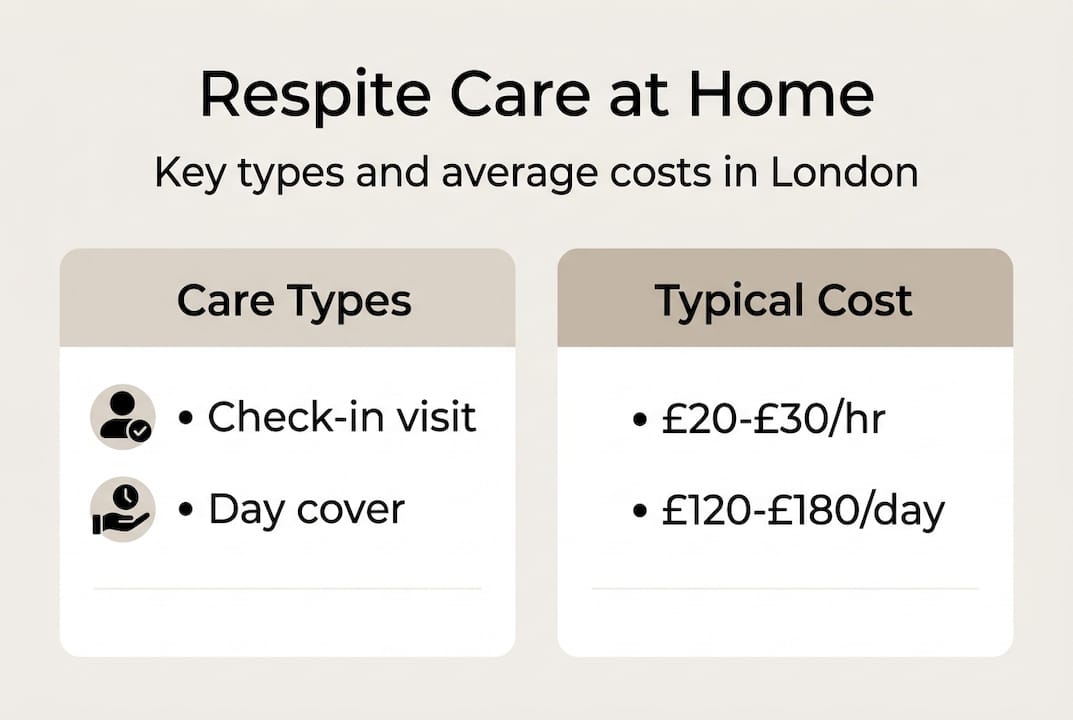
| Type of care | Approximate hourly cost | Typical session length |
|---|---|---|
| Check-in visit | £20 to £30 | 30 to 60 minutes |
| Daytime companion care | £25 to £35 | 3 to 8 hours |
| Overnight care | £100 to £180 | 10 to 12 hours |
| Live-in care | £900 to £1,400 per week | Continuous |
These are estimates for London in 2026. Always confirm current rates directly with providers.
Some carers may be eligible for local authority funding or carer’s allowance for respite breaks, which can make a significant difference to what you pay. Financial support options worth exploring include:
- Local authority funding: Following a needs assessment, your local council may contribute to or fully cover care costs
- Carer’s Allowance: A weekly benefit for eligible carers providing substantial unpaid support
- NHS Continuing Healthcare: Available where the person’s needs are primarily health related
- Charitable grants: Organisations such as Age UK and Turn2us offer grants to help with care costs
- Direct payments: Local authorities can provide money directly to families to arrange their own care
For a thorough overview of what financial support is available, the Age UK respite care costs guide is extremely useful.
“Many families are surprised to find they qualify for funding they were unaware of. Always ask your local authority about all available options before assuming you must self-fund.”
Pro Tip: Ask every provider upfront whether they charge for travel time, cancellations, or bank holidays. These additional costs can add up quickly and should be factored into your budget from the start.
Ensuring quality: Monitoring care and handling common challenges
Once respite care is in place, your role does not end. Staying actively involved is one of the most effective ways to maintain high standards. Research shows that family involvement improves home care outcomes significantly, so your ongoing presence matters.
Here are some practical ways to monitor care quality:
- Review care logs: Ask the provider to keep a written record of each visit, noting tasks completed and any observations
- Schedule regular check-ins: Speak to the carer and your relative after sessions to gather honest feedback
- Involve a trusted contact: If you cannot always be present, ask a trusted friend, neighbour, or other family member to check in occasionally
- Watch for signs of distress: Changes in mood, appetite, or behaviour in your relative can signal that something is not right
Common challenges families encounter include:
- Adjustment anxiety: Your relative may initially resist the new arrangement or show reluctance to engage with the carer
- Communication gaps: Important information about your relative’s needs may not be passed on clearly between family and carers
- Scheduling problems: Visits may occasionally run late or change without sufficient notice
- Personality mismatches: Sometimes the first carer is not the right fit, and that is normal
For guidance on how to discuss care arrangements sensitively within the family, reading about talking about home care can ease that process. You can also find practical video tips for choosing care from experienced professionals.
“Carers and families can seek advice, raise concerns, or make complaints about home care services through the Care Quality Commission, which regulates and inspects providers across England.”
Pro Tip: Keep a simple diary noting the date, carer name, tasks completed, and any observations after each session. Over weeks, this record becomes invaluable if you ever need to raise a concern or review the arrangement.
A fresh perspective on home respite: What most guides miss
Most practical guides focus on logistics. Fewer talk about the emotional side of arranging respite care, and that gap is worth addressing.
Carer guilt is real. Many family carers feel they are letting their relative down by accepting help, or that handing over care to someone else is a sign of failure. It is not. Taking a break makes you a better carer. Rest restores your patience, energy, and emotional capacity. The person you care for benefits directly from that.
Involving the whole family early also matters more than most people realise. Decisions made without consulting everyone can create resentment or confusion later. A brief family conversation before arranging respite, covering who is involved, what is expected, and how progress will be reviewed, prevents many problems down the line.
The additional advantages of home care extend well beyond the practical. Home respite supports emotional wellbeing, social connection, and personal dignity in ways that other care settings often cannot match.
Pro Tip: Before any care arrangement begins, sit down with both the carer and your loved one and invite everyone to share their concerns. Starting with open dialogue avoids misunderstandings and builds trust from day one.
How Kells Domiciliary Care can support your family
If you are ready to explore respite care at home, Kells Domiciliary Care has been supporting London families for over 30 years. Our qualified, DBS checked carers deliver personalised care built around your loved one’s specific needs, whether that means a few hours of weekly support or more intensive assistance. We are regulated by the CQC, so you can trust that quality is never compromised. Explore our domiciliary care guide for a full picture of how home support works, or browse our complete guide to home care services to find the right fit. Families with elderly relatives can also read our dedicated elderly home care guide. We are here to help you take the next step with confidence.
Frequently asked questions
Who is eligible for respite care at home in London?
Eligibility is based on the assessed needs of the person being cared for, which can include elderly individuals, those with dementia, or adults with disabilities. Eligibility is determined through a formal needs assessment carried out by your local authority.
How much does home-based respite care typically cost?
Costs vary by provider and care level, typically starting from around £20 per hour for short visits. Funding options from local authorities or the NHS may reduce or cover these costs entirely.
Is respite care at home better than residential respite care?
Home respite offers continuity, familiarity, and is generally less disruptive, particularly for people with dementia. Suitability depends on individual needs, and personalised support options can help families find the right balance.
What should I look for in a home respite care provider?
Prioritise providers registered with the CQC, with experienced staff and clear communication processes. Guidance on choosing a care agency can help you ask the right questions before committing.
Can I get help to pay for respite care services?
Yes. You may qualify for financial support through local authority funding, NHS Continuing Healthcare, or carer’s allowances. Explore your home care funding options early to understand what support is available to you.
Recommended
- How to transition to home care in London: a step-by-step guide – Kells Domiciliary Care
- Home care services: a complete guide for London families – Kells Domiciliary Care
- Elderly home care in London: A guide for families – Kells Domiciliary Care
- How to choose a home care agency in London: 5 steps – Kells Domiciliary Care