

TL;DR:
- Social care assists with daily tasks for those with age, disability, or health issues, separate from NHS services.
- Access involves local authority assessment, eligibility, and means-testing to determine funding support.
- Person-centred care is crucial, but systemic overstretch and ageism impact care quality and advocacy.
When a loved one begins to struggle with daily life, whether due to age, dementia, disability, or a long-term condition, many London families find themselves overwhelmed and uncertain about where to turn. Social care and support is non-medical assistance provided by local councils to help individuals manage day-to-day living due to age, disability, illness, or other vulnerabilities. But understanding exactly what that means in practice, who qualifies, how to access it, and what it costs is rarely straightforward. This guide cuts through the confusion and gives you clear, practical information so you can take confident steps forward for your family.
Table of Contents
- Understanding social care support: What it is and who it’s for
- Kinds of social care support: Services available for families
- How to access social care support in London: Step-by-step
- Paying for social care: Funding, means testing and council support
- A fresh perspective: Why person-centred care matters (and what’s missing from the system)
- Discover personalised home care solutions for your family
- Frequently asked questions
Key Takeaways
| Point | Details |
|---|---|
| Social care covers daily living | Support includes personal care, home help, and assistance for vulnerable individuals. |
| Access starts with assessment | Families must request a needs assessment from their local borough to begin receiving support. |
| Funding is means-tested | Council help depends on savings and assets; carers follow different rules. |
| Person-centred planning matters | Tailoring services to individual needs promotes independence and quality of life. |
Understanding social care support: What it is and who it’s for
Many families confuse social care with NHS care. This is one of the most common misunderstandings we encounter, and it matters because the two systems operate very differently, with separate funding, eligibility rules, and processes.
NHS care covers medical treatment, hospitals, GP visits, district nursing, and other health services. It is free at the point of use. Social care, on the other hand, covers assistance with daily living tasks such as washing, dressing, preparing meals, and getting out of the house safely. Social care is largely organised and funded by local councils, and it is not always free. The distinction between the two is significant, and integrating them remains one of the biggest challenges in the sector, made harder by sustained funding pressures and rising demand.
Who social care support is for
Social care support is available for a wide range of people. In London, you may be looking at arranging support for:
- Older adults who need help at home due to frailty or age-related conditions
- People living with dementia, including Alzheimer’s disease, who may need supervision and personal care
- Adults with physical disabilities who require assistance with mobility, personal hygiene, or household tasks
- Adults with learning disabilities who benefit from support in daily routines and community participation
- Children with special educational needs and disabilities (SEND), who may need additional social care alongside education support
- Unpaid carers who care for a family member and need assessments and breaks
The services available typically include personal care such as bathing and dressing, home help such as meals and cleaning, equipment provision, respite care, day care centres, supported living arrangements, residential care homes, and direct support for carers themselves.
NHS vs social care: A quick comparison
| Feature | NHS care | Social care |
|---|---|---|
| Covers | Medical and health treatment | Daily living and personal support |
| Funded by | Central government (free to all) | Local councils (means-tested) |
| Accessed via | GP or hospital referral | Local authority assessment |
| Examples | Surgery, prescriptions, nursing | Home help, personal care, day centres |
For families in London seeking further detail on supporting an older relative at home, our elderly home care guide offers practical, step-by-step information to help you plan ahead.
Kinds of social care support: Services available for families
With the concept clear, let’s explore what practical support these services provide for your loved ones. Social care is not one-size-fits-all. It covers a broad range of services designed to address very different needs, and the way it is delivered has changed significantly in recent years to reflect a more person-centred approach.
Core service types
| Service | What it involves | Who it is for |
|---|---|---|
| Personal care | Bathing, dressing, grooming, continence | Elderly, disabled adults |
| Home help | Meal preparation, cleaning, shopping | Anyone with daily living needs |
| Equipment provision | Grab rails, hoists, specialist beds | People with mobility issues |
| Day care centres | Social activities, meals, supervision | Elderly, those with dementia |
| Respite care | Temporary break for family carers | Carers needing rest |
| Residential care | Full-time care in a care home | Those who cannot safely live at home |
| Supported living | Semi-independent housing with support | Adults with learning disabilities |
The range of key services spans personal care, home help, equipment, respite, day care, and residential options. Each is planned around your loved one’s individual circumstances rather than delivered as a standard package.

Children’s services and prevention-focused support
For children with special needs, social care operates alongside education and health through a coordinated approach. The focus for children’s services is strongly on early intervention, preventing situations from escalating to crisis. Support can include family support workers, short breaks and respite for parents, and specialist equipment.
A person-centred approach sits at the heart of all good social care planning. Care plans are built around individual goals, existing strengths, and support networks, promoting independence rather than creating dependency. This means your loved one’s care plan should reflect what matters to them, not just what is easiest to arrange.
Pro Tip: When speaking to a social worker about a care plan, prepare a list of your loved one’s daily routines, preferences, and things they can still do independently. This helps the social worker build a plan that genuinely supports independence rather than replacing it unnecessarily.
Knowing the types of services available helps you advocate effectively during assessment. You can explore how to build a personalised home care plan for a loved one, or browse our complete home care guide for a broader overview of what families across London are arranging.
How to access social care support in London: Step-by-step
Once you know which services are relevant, here is how to actually access them in London. The process can feel daunting, but breaking it into clear steps makes it far more manageable.
The step-by-step process
-
Contact your local London borough. Adult social care services are run by your local authority. Each of London’s 32 boroughs has its own adult social care or children’s social care team. You can find the right contact on your borough’s website or through the NHS website.
-
Request a needs assessment. Under the Care Act 2014, everyone has the right to a free needs assessment. This looks at how a person’s health and wellbeing are affected by their needs, and whether those needs meet the eligibility threshold.
-
Understand the eligibility criteria. To qualify for council-funded support, an adult’s needs must arise from a physical or mental health condition and must present a substantial risk to their independence or wellbeing. Not everyone assessed will automatically qualify for funded care, but the assessment itself is always free.
-
Attend the financial assessment. If you meet the eligibility threshold, the council will carry out a financial assessment to determine how much, if anything, you contribute to the cost of your care.
-
Receive your care plan. Once eligibility and funding are confirmed, a care plan is developed in partnership with you and your family. This sets out what support will be provided, how, and by whom.
-
Request a review or appeal if needed. If you disagree with the assessment outcome, appeals are possible within two weeks. Mental capacity assessments can also be requested if there are concerns about a person’s ability to make decisions about their own care.
Pro Tip: Always ask for decisions in writing. If a council declines your application or limits your care package, a written decision gives you the evidence you need to challenge it formally.
Navigating London’s borough-by-borough system
London’s social care system is decentralised, which means the quality and availability of services can vary significantly between boroughs. Some boroughs, such as Islington, offer a well-signposted directory of services including targeted support for children and families. Others may prioritise universal services first before moving to targeted support. Understanding your specific borough’s approach early on saves considerable time.
If your family is thinking about arranging home care alongside the council assessment process, our guide to transitioning to home care walks you through the practical steps. You might also find our broader home care services guide helpful when weighing up your options.
Paying for social care: Funding, means testing and council support
After accessing services, understanding costs and funding ensures you make informed decisions. This is often the part families find most stressful, largely because the rules are complicated and the financial stakes are high.
How the means test works
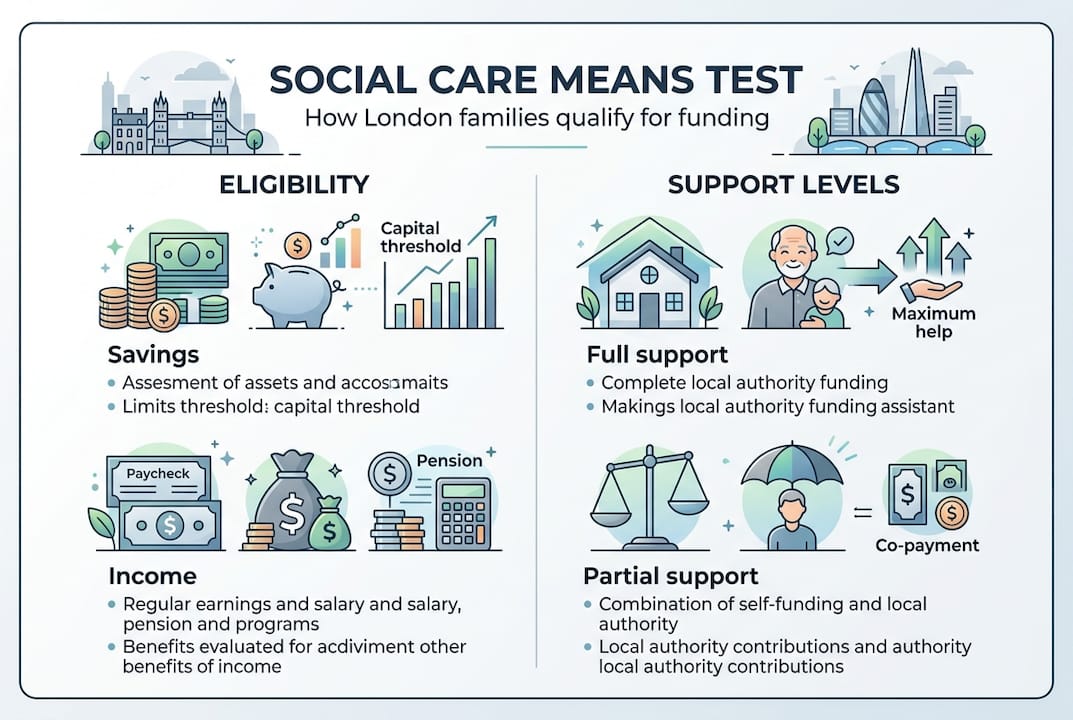
Social care funding for adults is means-tested. This means the council assesses your income and savings to decide how much financial support you receive. The key thresholds in England are:
- Below £14,250 in savings: The council covers the full cost of your care
- Between £14,250 and £23,250: You pay a sliding contribution based on your assets
- Above £23,250: You are expected to self-fund your care entirely
It is important to note that property is generally excluded from the means test if you are receiving care at home. However, if you move into a permanent residential care home, your property may be included in the financial assessment. This distinction catches many families off guard.
Carers are not means-tested. If you are an unpaid carer, any support you receive as a carer is assessed differently and does not depend on your financial situation.
The bigger funding picture
In 2024/25, England’s adult social care expenditure exceeded £32 billion, with approximately 889,000 people receiving long-term publicly funded care, a 3% increase on the previous year. Despite this, access has fallen on a per capita basis due to population growth, rising costs, and workforce shortages. Research also highlights a concerning trend: older adults over 65 are often receiving less favourable care relative to younger adults, raising real questions about age-related inequality within the system.
What this means for your family
| Scenario | Property included? | Means-tested? |
|---|---|---|
| Care at home | No | Yes (income and savings) |
| Permanent residential care | Yes | Yes (income, savings, property) |
| Unpaid carer support | No | No |
| Respite care | Depends on arrangement | Yes |
Pro Tip: If your loved one is considering moving into a care home, seek independent financial advice before the move. Decisions made about property at this stage can have long-term consequences that are difficult to reverse.
Understanding the role of carers within this system is also important. Our article on the role of home carers explains how professional carers complement council-funded support, and how families can shape the quality of care their loved ones receive by reading our guide on quality home care.
A fresh perspective: Why person-centred care matters (and what’s missing from the system)
At Kells, we have worked with London families for over 30 years. In that time, we have seen a clear pattern: families who engage most actively with the care planning process achieve significantly better outcomes for their loved ones. This is not accidental. A person-centred approach built around individual goals, strengths, and relationships is transformative when it is done well.
The honest problem is that it is often not done well. The system in London is overstretched. Social workers carry heavy caseloads. Assessment appointments are brief. Care plans can default to ticking boxes rather than genuinely understanding what a person needs to live well.
Then there is the ageism issue. Despite best intentions, research consistently shows that older adults receive less favourable treatment within the care system compared to working-age adults with disabilities. This is uncomfortable but important to acknowledge, because it means families of elderly relatives may need to advocate more assertively.
Your most powerful tool is knowing the system and speaking up clearly. When arranging personalised home care services, insist on a plan that reflects your loved one’s identity, preferences, and daily rhythms, not just their physical care needs. That level of specificity is what separates adequate care from genuinely good care.
Discover personalised home care solutions for your family
Navigating social care can feel like a full-time job, especially when you are also worried about a loved one’s wellbeing. At Kells Domiciliary Care, we have been providing high-quality, personalised home care across London for over 30 years. Our fully qualified, DBS-checked carers are here to support your family every step of the way. Download our free home care guide for practical next steps, explore our domiciliary care family guide to understand your options clearly, or browse our personalised support options to find the right level of care for your loved one. We are regulated by the CQC and proud to promote independence, dignity, and freedom of choice.
Frequently asked questions
What is the difference between social care support and NHS services?
Social care covers non-medical help with daily living tasks such as washing, dressing, and meal preparation, while NHS services focus on health and medical treatment. The two systems are funded and accessed separately.
Who can apply for social care support in London?
Anyone experiencing difficulties with daily living due to age, disability, illness, or caring responsibilities can apply. Social care support is available from local councils and begins with a free needs assessment.
How does the means test for social care funding work?
The council assesses your savings and income: full support is available below £14,250 in savings, partial support between £14,250 and £23,250, and self-funding is expected above £23,250.
Can families appeal a social care decision?
Yes. If you disagree with the outcome of an assessment, appeals are possible within two weeks of receiving the decision. Always ask for the decision in writing before submitting an appeal.
What support do unpaid carers receive?
Unpaid carers are entitled to their own needs assessment, and any support they receive is not means-tested. However, carers of people in permanent residential care may have limited access to funded support.