TL;DR:
- Growing demand for UK home care is hindered by funding gaps and workforce challenges.
- Modern outcome-driven approaches focus on prevention, personalized routines, and cognitive support.
- Families should prioritize agencies with transparency, consistent carers, and evidence-based care methods.
Demand for home care in London is growing rapidly, yet the system supporting it is under serious strain. Families are increasingly choosing in-home support for elderly relatives, people with dementia, and those with complex needs, only to discover that fees, funding, and care quality vary enormously. Understanding why this gap exists, and what you can do about it, is now essential knowledge for any family navigating care options in 2026.
Table of Contents
- Why more London families are choosing home care
- Outcome-driven and preventive care: Modern approaches
- Workforce and funding realities: What families must know
- How to make informed care decisions in 2026
- Why outcome-driven care matters more than ever
- Explore tailored home care solutions in London
- Frequently asked questions
Key Takeaways
| Point | Details |
|---|---|
| Strong demand shift | Most London families now prefer home care over residential, but funding gaps mean private pay is increasingly common. |
| Structured care is essential | Outcome-driven approaches like CST are necessary to improve wellbeing and reduce hospital admissions for dementia patients. |
| Staffing affects quality | Workforce shortages and pay gaps impact the reliability and quality of care families receive in 2026. |
| Practical guidance | Families should focus on evidence-based interventions, ask tough questions, and use checklists to select the right provider. |
| Perspective matters | Prioritising outcome-based care over cost ensures better results for elderly or disabled relatives. |
Why more London families are choosing home care
The shift towards home care is not simply a trend. It reflects something deeply personal. Most people want to remain in the comfort and familiarity of their own home as they age or manage health conditions. 73% prefer home care over residential settings, yet the financial structures supporting this preference are failing to keep pace.
Local authority funding rates sit around £24.10 per hour, while the actual minimum delivery cost stands at £32.14 per hour. That gap of over £8 per hour means many providers simply cannot operate on public funding alone. The result is a growing reliance on private pay arrangements, where families meet the difference themselves. The sector is facing a funding gap of over £1bn for 2025/26, which directly affects the availability and quality of services across London.
Understanding the difference between home care options is important. If you are unsure whether a residential or home-based arrangement is right for your relative, our home care vs nursing guide explains the practical differences in detail. It is also worth knowing the distinction between privately employed carers and regulated agencies, which our guide on private vs agency care differences covers clearly.
Key reasons London families are choosing home care include:
- Dignity and autonomy: Remaining at home allows individuals to follow their own routines and maintain independence.
- Personalised support: Care plans are built around individual needs rather than institutional schedules.
- Familiarity: Familiar environments are especially beneficial for people with dementia.
- Flexibility: Care can be scaled from a single check-in visit to full round-the-clock support.
- Cost perceptions: Many assume home care is cheaper, though private pay costs can rival residential fees depending on care complexity.
“Choosing home care is rarely just a practical decision. For most families, it is about preserving their loved one’s sense of self, their routines, and their connections to a place that feels like theirs.”
Outcome-driven and preventive care: Modern approaches
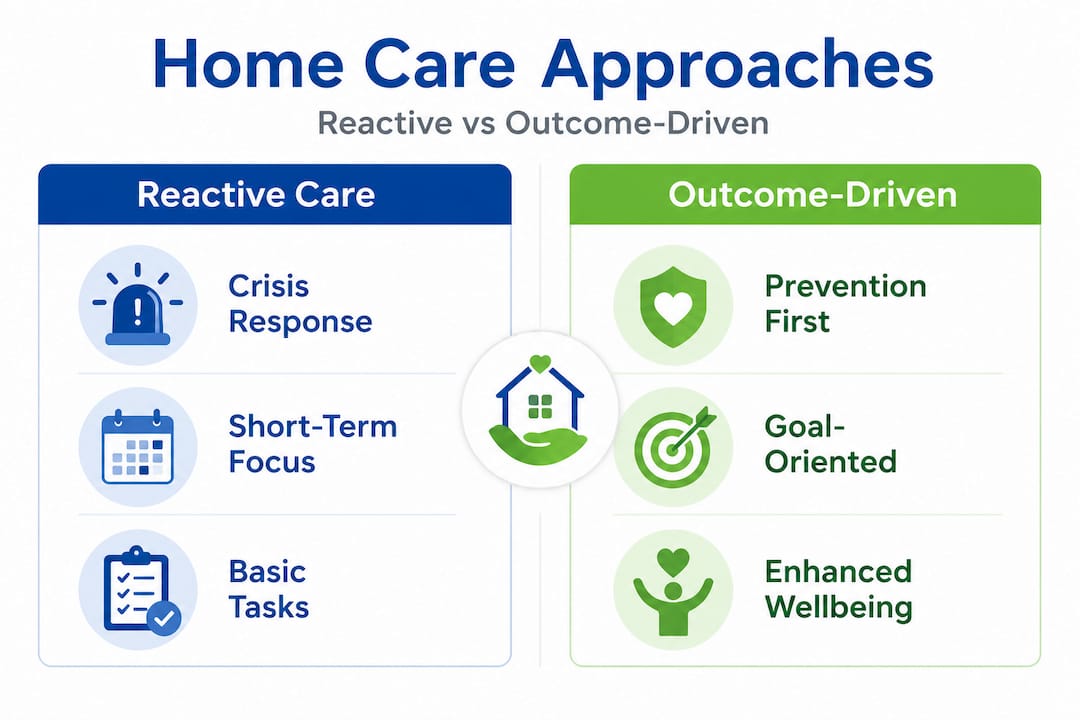
The way care is delivered is changing significantly. For decades, home care has largely been reactive: responding to incidents, managing crises, and addressing needs as they arise. Modern approaches are shifting this entirely.
Dementia now affects 70 to 80% of care residents, which means the majority of home care clients have some degree of cognitive impairment. Reactive care is simply not sufficient for this population. Structured interventions, including Cognitive Stimulation Therapy (CST), are increasingly central to quality dementia care at home. CST involves guided activities designed to maintain and improve cognitive function, and research shows it reduces falls, behavioural disturbances, and hospital admissions.
Here is how reactive and outcome-driven care compare:
| Feature | Reactive care | Outcome-driven care |
|---|---|---|
| Focus | Responds to problems after they occur | Anticipates and prevents problems |
| Dementia support | Crisis management | CST and structured cognitive activities |
| Hospital admissions | Higher risk | Reduced through proactive monitoring |
| Care planning | Generic or task-based | Personalised and evidence-based |
| Family involvement | Minimal | Regular updates and shared goals |
| Wellbeing outcomes | Variable | Measurably improved |
Preventive monitoring is another key feature of modern home care. This includes regular wellbeing checks, nutritional oversight, medication reviews, and early flagging of changes in health status. Our home care safety checklist provides a practical framework for evaluating whether a provider meets these standards.
Steps a quality provider should follow for outcome-driven care:
- Conduct a thorough needs assessment before commencing care.
- Develop a written care plan with measurable goals and review dates.
- Assign consistent carers who build familiarity with the individual.
- Incorporate CST or equivalent structured activities for clients with dementia.
- Monitor health indicators regularly and report changes to families promptly.
- Review and update the care plan at agreed intervals or after any significant change.
Our guide on personalising home care walks through how these steps translate into practical daily care arrangements.
Pro Tip: When interviewing a home care agency, ask directly whether they use outcome-based frameworks and whether their carers are trained in CST or structured dementia support. Vague answers are a warning sign.
Workforce and funding realities: What families must know
The quality of home care is directly connected to the people delivering it. This is why workforce challenges are among the most significant issues facing the sector in 2026.

Home carers currently earn around £7,000 per year less than NHS Band 3 workers performing comparable roles. That pay gap of 28.6% makes it difficult for agencies to attract and retain skilled staff. The sector’s vacancy rate stands at 7%, which means many providers are operating with insufficient capacity.
A Fair Pay Agreement for care workers is planned for 2028, but that is two years away. In the meantime, families are experiencing the real-world consequences: inconsistent carer allocation, high staff turnover, and stretched rotas.
Here is a snapshot of the current workforce and funding situation:
| Area | Current situation | Impact on families |
|---|---|---|
| Pay gap vs NHS | 28.6% lower (approx £7k/year) | Experienced carers often leave the sector |
| Vacancy rate | 7% nationally | Fewer carers available per client |
| Funding per hour | £24.10 (council rate) | Providers struggle to cover true costs |
| Fair Pay Agreement | Planned 2028 | Short-term staffing pressures remain |
| Private pay demand | Rising significantly | Families face increasing out-of-pocket costs |
Understanding the supply of care staff in London helps explain why some agencies struggle to maintain consistency. The role of home carers is also broader than many families realise, encompassing personal care, medication management, companionship, and basic health monitoring.
When speaking to agencies, workforce transparency matters enormously. Good agencies will be open about staff ratios, turnover rates, and how they handle carer continuity. For a structured approach, our list of questions to ask agencies helps families gather the right information before committing.
Key questions to ask any prospective agency:
- How many regular carers will be assigned to my relative’s care?
- What is your staff turnover rate?
- How do you handle cover when a regular carer is unavailable?
- Are your carers paid above minimum wage, and what training do they receive?
- How do you monitor the quality of care delivered in the home?
Pro Tip: An agency that cannot clearly answer questions about staff pay, retention, and continuity should be treated with caution. Transparency on workforce matters is a strong indicator of overall quality.
How to make informed care decisions in 2026
Navigating the home care landscape can feel overwhelming, especially when you are making decisions under emotional pressure. The good news is that a structured approach significantly improves outcomes.
Proactive methodologies like CST and preventive monitoring have been shown to reduce hospital admissions and improve quality of life for people receiving home care. However, it is important to acknowledge that home care is not always the right solution for every situation. For individuals with highly complex medical needs or significant safety risks, institutional settings may provide more appropriate support. Understanding this distinction honestly is part of making a sound decision.
Follow this process to assess your options effectively:
- Start with a needs assessment. Identify your relative’s specific care needs, including physical, cognitive, emotional, and social requirements. Our needs assessment guide is a helpful starting point.
- Research funding options. Contact your local council to explore whether your relative qualifies for funded support. Understand the financial assessment process and what private top-up arrangements may be necessary.
- Shortlist regulated agencies. Look for providers regulated by the Care Quality Commission (CQC). Check their inspection ratings and read recent reports.
- Ask about care approaches. Specifically enquire about outcome-driven methods, dementia care experience, and how they personalise support.
- Compare costs carefully. Request a clear breakdown of hourly rates, any minimum hours requirements, and how costs may change if care needs increase.
- Plan for transitions. If your relative is moving from hospital or another care setting, our guide on transitioning to home care provides a step-by-step framework.
Additional factors to weigh when comparing providers:
- Whether the agency uses consistent carer assignments or rotates staff frequently.
- Whether care plans are written, reviewed regularly, and shared with the family.
- The agency’s experience with your relative’s specific conditions, particularly dementia or mental health needs.
- Whether the agency offers flexible care packages that can scale up or down as needs change.
- Whether there is a named care coordinator or manager who oversees the service.
Pro Tip: Use a checklist when speaking to multiple agencies. It keeps comparisons fair and ensures you do not forget important questions under pressure. Focus particularly on how each agency handles dementia care, as this is where approaches vary most significantly.
Why outcome-driven care matters more than ever
Most conversations about home care in 2026 focus on cost. Funding gaps, hourly rates, private pay burdens. These are real and important concerns. But we believe there is a deeper issue that families need to pay attention to: what actually happens during a care visit, and whether it is genuinely improving someone’s quality of life.
We have seen, over more than 30 years of delivering home care in London, that the difference between good and poor care rarely comes down to price alone. It comes down to approach. A carer who sits and does a structured activity with a person living with dementia, engages them in conversation, notices a change in mood or behaviour, and reports it promptly, is delivering something fundamentally different from one who simply completes tasks and leaves.
With dementia affecting 70 to 80% of those receiving residential and home care, the sector cannot afford to treat cognitive support as optional or secondary. Outcome-driven care, using CST and structured interventions, is not a luxury. It is the standard families should expect and demand.
We think the industry needs to be honest about this. Reactive care is cheaper to deliver in the short term. But it costs more in the long run: more hospital admissions, more crises, more distress for families and individuals alike. Investing in structured, evidence-based care is not idealistic. It is practical.
Our approach to personalised care reflects this belief. Every care plan we develop is built around the individual’s needs, preferences, and goals, not a generic checklist. We encourage families to ask the same of any provider they consider.
Explore tailored home care solutions in London
At Kells Domiciliary Care, we have spent over 30 years helping London families find the right care arrangements for their loved ones. Whether you are just beginning to explore your options or ready to arrange regular home visits, we are here to help you navigate each step with confidence. Our free home care guide is a practical resource covering everything from funding and costs to choosing the right provider. For families new to in-home support, our domiciliary care family guide explains clearly what to expect. If your relative already has some care in place but you want to improve it, our guidance on how to personalise home care offers concrete steps. All of our carers are fully qualified, DBS checked, and regulated by the CQC.
Frequently asked questions
What is outcome-driven care in home settings?
Outcome-driven care uses evidence-based methods such as Cognitive Stimulation Therapy to proactively improve wellbeing and reduce risks for individuals at home, particularly those living with dementia, rather than simply responding to problems after they occur.
Why do home care fees vary so much in London?
Council-set hourly fees are often well below actual delivery costs, with local authority rates sitting around £24.10 per hour against a minimum cost of £32.14, which drives demand for private pay models and creates wide variation depending on the provider and the complexity of care required.
What should families prioritise when choosing a home care provider?
Focus on outcome-based care approaches, carer consistency, and agency transparency about staff pay and retention, as these factors are the strongest indicators of sustained quality and safety in home care.
Are outcome-driven care techniques available through all home care agencies?
Not all agencies offer structured outcome-driven approaches, so families should directly ask providers about CST and preventive monitoring capabilities, particularly for clients with dementia or complex medical needs, before committing to a service.
Recommended
- Home care services: a complete guide for London families – Kells Domiciliary Care
- Elderly home care in London: A guide for families – Kells Domiciliary Care
- Home care safety checklist: Key steps for London families – Kells Domiciliary Care
- Recognising signs you need home care: London family guide – Kells Domiciliary Care
- Blog & Resources | Graceland Hospice Care