TL;DR:
- Managing medicines at home involves complex tasks beyond simply giving pills at the right time, including reconciliation, storage, monitoring, and documentation to prevent errors. Clear roles, written care plans, and regular reviews with professionals are vital to ensure safety, especially during care transitions and for individuals with complex needs. Technology and professional oversight significantly reduce risks, making proactive, structured medication management essential for safe home care.
Managing medicines at home is far more complex than simply handing over a tablet at the right time. Many families are surprised to discover that medication errors are among the most common and preventable causes of harm for elderly and disabled people receiving care at home. When several conditions are being treated at once, or when someone has recently left hospital, the risk rises sharply. This guide walks you through everything you need to know: what medication management actually involves, who does what, the practical steps to keep your loved one safe, and the tools that genuinely help.
Table of Contents
- What is medication management in a home care setting?
- Who does what? Roles and responsibilities in medication management
- Essential steps for safe and effective medication management
- Common challenges and advanced solutions
- Home care versus facility: Comparing medication management approaches
- Our perspective: What most families miss about medication management in the home
- How Kells Domiciliary Care supports safe medication management
- Frequently asked questions
Key Takeaways
| Point | Details |
|---|---|
| Medication management is complex | It involves safe routines, ongoing checks, and multiple roles—not just giving pills. |
| Roles and communication matter | Clear division of responsibilities and good care plans reduce errors significantly. |
| Review after care transitions | Changes in health or hospital stays require careful review and reconciliation of all medicines. |
| Tools boost, but don’t replace, oversight | Apps and organisers help, but expert review and involvement are crucial for safety. |
| Families need reliable support | Specialist advice, personalised guides, and ongoing monitoring keep loved ones safe at home. |
What is medication management in a home care setting?
Most people think of medication management as giving the right tablet at the right time. In reality, it covers a much broader set of tasks. As one overview of medication management explains, it is the comprehensive process of ensuring the right medication is given in the right dose, at the right time, via the right route, with ongoing monitoring for safety and effectiveness.
In practice, this means the following tasks all fall under medication management:
- Reconciliation: Checking that all medicines are accurate and up to date, particularly after a hospital stay.
- Safe storage: Keeping medicines in the correct conditions, away from heat, light, or young children.
- Administration or assistance: Giving medicines directly or prompting someone to take them.
- Monitoring: Watching for side effects, changes in condition, or signs that a medicine is not working.
- Documentation: Recording what was given, when, and any reactions observed.
- Re-reconciliation: Reviewing the full medicines list every time there is a change in care setting or health status.
For elderly or disabled people, this process requires skilled, ongoing assessment. Physical changes with age affect how the body processes medicines. Kidney and liver function decline, which means standard doses can build up to dangerous levels. Cognitive changes add another layer of risk.
Errors most commonly occur during transitions in care, for example when someone is discharged from hospital with a new prescription, and the home carer is not properly briefed. You can download a free home care guide for a full overview of what to look out for when setting up care at home.
Pro Tip: Keep an up-to-date written medication list and bring it to every health appointment, hospital visit, and care review. This one habit prevents many of the most common errors.
Who does what? Roles and responsibilities in medication management
One of the most common sources of confusion for families is understanding who is allowed to do what when it comes to medicines. The answer depends on the type of carer involved, the setting, and the specific task.
As a general rule, licensed nurses handle administration requiring clinical judgement, while care aides can provide reminders and help with pill organisation but cannot administer medicines without proper delegation from a qualified clinician.
Here is a simple comparison to clarify the key responsibilities:
| Task | Registered nurse | Home care aide | Family member |
|---|---|---|---|
| Administer injections | Yes | No | With training only |
| Give oral medicines | Yes | With delegation | Yes |
| Crush tablets or alter dose form | Yes | No | Only if directed by clinician |
| Remind and prompt | Yes | Yes | Yes |
| Monitor for side effects | Yes | Yes (basic) | Yes (basic) |
| Update care plans | Yes | No | No |
| Order repeat prescriptions | No (but can request) | No | Yes |
This matters because when roles are unclear, tasks get missed or duplicated. Both outcomes carry risk. A family member might assume the carer has given a medicine. The carer might assume the family member has. Nobody has.
To prevent this, every care arrangement should include a written care plan that states clearly who is responsible for each task, at what time, and what to do if something goes wrong. You can learn more about starting these conversations by reading our guide on talking about home care with your family.
Pro Tip: Use a written care plan and review it every few months, or whenever there is a change in health or carer. A shared record reduces miscommunication and keeps everyone accountable.
Essential steps for safe and effective medication management
Good medication management follows a logical process. Understanding each step helps you spot where problems might occur and take action before they become serious.
- Medication reconciliation on admission. When home care begins, a full review of all current medicines should take place. This includes prescribed medicines, over-the-counter products, and supplements.
- Accurate documentation. Every medicine should be recorded on a formal medication administration record (MAR), including the name, dose, route, and timing.
- Safe storage setup. Assess the home for safe storage. Some medicines need refrigeration. Others need to be locked away if there is a risk of accidental ingestion or misuse.
- Administration or assistance. Trained staff administer or assist with medicines according to the care plan and the individual’s needs and preferences.
- Ongoing monitoring. Carers observe and record any side effects, changes in condition, or signs that a medicine is not being effective.
- Re-reconciliation at transitions. Each time there is a hospital admission, discharge, or change in health, the full medicines list must be reviewed and updated. This step is often missed, yet it is one of the most critical.
A striking finding from research is that 30 to 70% of patients experience medication discrepancies during care transitions. These are not minor administrative oversights. They include missed doses, duplicated medicines, and unrecognised interactions.
Regular pharmacist-led reviews have been shown to reduce these risks significantly. A study published in research on pharmacist-led reviews found that structured reviews detect unnecessary or inappropriate drugs and reduce the risk of hospitalisation in older adults. Families using a home care safety checklist can find practical tools at Kells home care safety checklist, and you can also request a needs assessment to identify what level of support your loved one currently requires.
| Stage | Common error | Prevention strategy |
|---|---|---|
| Hospital discharge | New medicines not communicated to carer | Discharge medication review with GP or pharmacist |
| Daily administration | Missed dose or double dose | MAR chart and two-person check |
| Long-term management | Outdated medicines continued | Annual pharmacist-led review |
| Emergency or illness | Dose adjustment not actioned | Clear escalation pathway in care plan |
Common challenges and advanced solutions
Even with a solid process in place, real life presents complications. Understanding the most common challenges helps you plan for them rather than react to them under pressure.
Cognitive decline and dementia. Someone with memory loss may forget they have taken a medicine and take it again. Or they may resist taking medicines altogether, which is common in moderate to advanced dementia. These situations require patience, clinical input, and sometimes a reformulation of the medicine (for example, switching from tablets to a liquid).
Swallowing difficulties (dysphagia). This is more common in elderly people than many families realise. The risk here is significant: if tablets are crushed without clinical guidance, the dose may be released too quickly and cause an overdose effect. Always seek advice from a pharmacist or speech and language therapist before altering how a medicine is taken.

Polypharmacy. This refers to taking multiple medicines at once, which is very common after hospital stays. Polypharmacy increases the risk of interactions, side effects, and confusion about what to take and when. According to the National Elder Care Authority, polypharmacy post-hospitalisation is one of the highest-risk points in home care medication management.
Physical barriers. Arthritis, poor vision, and reduced strength can make opening blister packs or reading labels very difficult. Small adaptations, such as easy-open packaging, large-print labels, or pre-prepared doses, can make a real difference.
“Tools like pill pouches and apps improve adherence by 35%, but they work best when combined with regular professional oversight.”
Blister packs, monitored dosage systems, and drug compliance tools such as reminder apps are genuinely useful aids. You can find practical guidance on pill organisers and reminder apps through our free resources. For more advice on tailoring your care arrangement, our guide on personalising home care covers exactly how to adapt routines to individual needs.
Pro Tip: If your relative is on more than five medicines, ask the GP to refer them for a structured medication review with a pharmacist. This single step can simplify their regimen and reduce the risk of interactions.
Home care versus facility: Comparing medication management approaches
It is worth being clear-eyed about the differences between managing medicines at home and managing them in a care facility. Neither option is universally safer. Both carry distinct advantages and risks.
| Factor | Home care | Care facility |
|---|---|---|
| Flexibility | High; routines tailored to individual | Lower; scheduled around staff rotas |
| Oversight | Dependent on carer skill and support | Structured and regulated |
| Error risk | Higher without robust systems | Lower with regulated protocols |
| Personal autonomy | Preserved | May be limited |
| Family involvement | Direct | Less frequent, more formal |
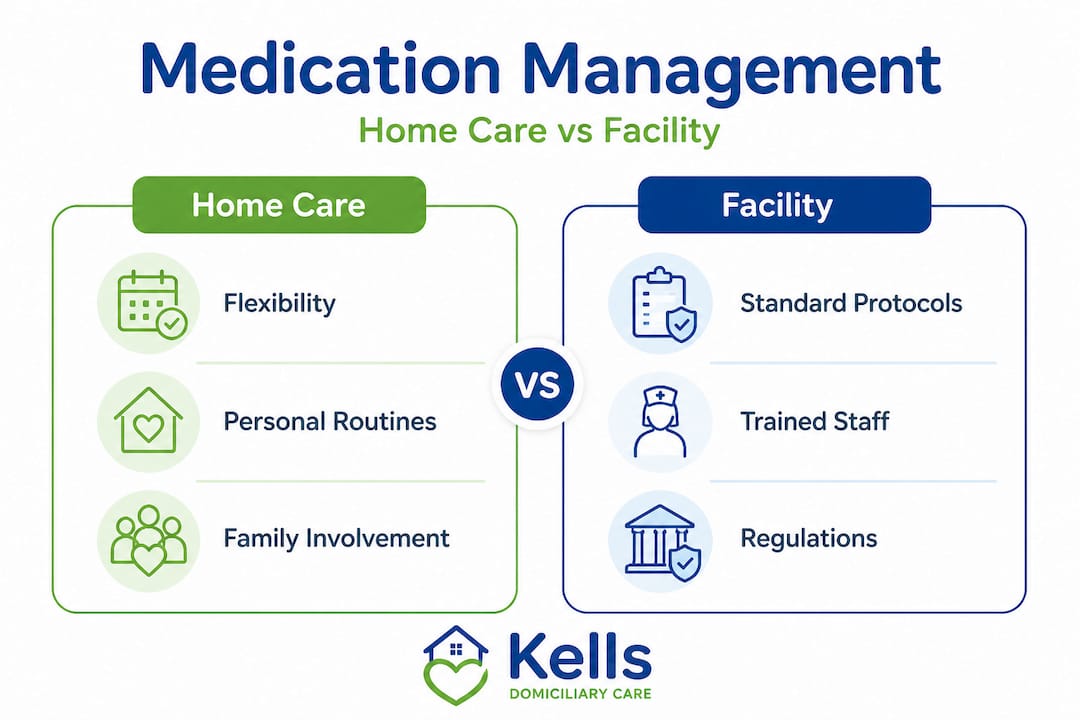
Home care allows your loved one to remain in familiar surroundings, follow personal routines, and maintain greater autonomy. These factors support wellbeing and dignity. However, as the National Elder Care Authority notes, home management can be error-prone without adequate oversight, especially for complex medicine regimens.
Care facilities are regulated more strictly, with formal medicines management protocols and trained staff on duty at all times. However, they offer less flexibility and can feel clinical or impersonal.
For many families, the right answer is home care with additional professional support layered in: a visiting nurse for complex medicines, regular pharmacist reviews, and robust documentation. You can compare your options in detail by reading our guide on private vs agency home care, and learn about regular drug monitoring practices that strengthen home-based routines.
Key questions to ask when deciding:
- How complex is the current medicine regimen?
- Does your relative have cognitive or physical barriers to self-managing?
- Is there a family member available to support and monitor daily?
- Is professional nursing input accessible when needed?
Our perspective: What most families miss about medication management in the home
After more than 30 years supporting London families with home care, we have seen the same pattern repeatedly. When a medication error occurs at home, families often blame themselves for forgetting or not paying enough attention. In most cases, the real cause is something more structural: unclear roles, a failure to reconcile medicines after a hospital stay, or a lack of clinical involvement in an increasingly complex regimen.
Technology helps. Pill organisers, reminder apps, and blister packs all have a genuine role to play. But the evidence is clear: as noted in pharmacist involvement guidance, prioritising nurse and pharmacist involvement for complex regimens is the most effective safeguard, especially after hospital discharge and during care transitions.
“Tools don’t replace people. Regular reviews and clear communication are the real safeguards in home medication management.”
We also see families who have never once had a formal medication review arranged. Many GPs will refer older patients for an annual medicines review if asked. Pharmacists in community settings can carry out these reviews too. This is one of the most underused, most effective, and most accessible tools available to London families managing care at home.
Our advice is this: do not wait for an error to prompt a review. Be proactive. Build the review into your care routine, the same way you would a dental check-up or an eye test.
Pro Tip: Schedule a medication review with a pharmacist at least once a year, and always after any hospital stay or significant change in health. Read more about families’ role in care and how to stay actively involved.
How Kells Domiciliary Care supports safe medication management
At Kells Domiciliary Care, we understand that managing medicines at home can feel overwhelming, especially when the regimen is complex or circumstances change quickly. Our experienced, fully qualified, and DBS-checked carers work to carefully support safe medication routines as part of a personalised care plan.
We invite you to request your free home care guide, which covers medication management and much more for London families. You can also explore our dedicated resource on elderly home care in London for practical, family-focused guidance. To stay up to date with the support available in your area, our article on latest home care trends in London is regularly updated. Whether you need check-in visits or full-time support, we are here to help you feel confident and in control.
Frequently asked questions
How can families help prevent medication errors in home care?
Keep an updated medicines list, double-check prescriptions after every hospital stay, and involve a pharmacist or nurse for complex regimens. These three steps address the most common causes of medication discrepancies during care transitions.
What role do pill organisers and reminder apps play in home medication management?
They boost adherence, particularly for routine daily medicines, but tools improve adherence by 35% only when combined with appropriate professional oversight for complex cases.
How often should medication reviews happen in home care?
Reviews should happen at least once a year and after any hospital stay or significant change in health status, as pharmacist-led reviews consistently identify unnecessary or harmful medicines.
Is home care safer for medication than a care home?
Home care offers greater flexibility and personal autonomy but carries a higher error risk unless well supported; care homes provide more structured oversight. The right balance depends on the complexity of the individual’s needs.
What should you do if your relative refuses medication at home?
Consult a nurse or pharmacist to understand the reason, whether it is side effects, confusion, or anxiety, and explore practical solutions. Resistance is a recognised edge case in dementia care and should never be ignored or forced without clinical guidance.