

TL;DR:
- Domiciliary care is regulated personal support provided at home for various needs; it can be funded privately, through local authorities, or by NHS support. Families should verify provider registration, compare costs to recommended rates, and ask detailed questions about staffing, supervision, and care plans to ensure quality. Effective home care relies on consistency, clear communication, and choosing agencies committed to transparency and staff well-being.
Dom care, short for domiciliary care, means regulated personal care and support delivered by trained carers in a person’s own home. If you are starting to arrange care for a relative, do two things first: check that any agency you consider is registered with the Care Quality Commission, and if cost is a concern, contact your local council to request a care needs assessment.
Three funding routes at a glance:
- Self-funding: you arrange and pay privately; gives the most choice and flexibility.
- Local authority support: available after a needs assessment and means test; in England, assets above £23,250 generally mean you fund your own care.
- NHS Continuing Healthcare: fully funds care at home for people with a primary health need under the National Framework.
Table of Contents
- What does dom care actually mean in the UK?
- What services can a domiciliary carer provide?
- Who is domiciliary care suitable for?
- How domiciliary care is arranged in the UK
- What does domiciliary care cost and how is it funded?
- How to choose a domiciliary care provider
- What the evidence says about getting better outcomes
- Key takeaways
- A provider’s perspective on what good home care looks like
- Kells-care: London home care you can rely on
- Useful sources for further reading
What does dom care actually mean in the UK?
Domiciliary care goes by several names: home care, personal care, dom care, or sometimes home help. They all describe the same core idea: a trained carer visits you at home, rather than you moving into a residential setting. The NHS describes it as help that can make a significant difference to independence, especially for people who have difficulty getting around.
The most important distinction is between personal care and domestic help. Personal care covers tasks that involve physical contact or health-related support: washing, dressing, medication prompts, and moving safely around the home. Domestic help covers cleaning, shopping, and cooking. Agencies providing personal care must be registered with the CQC; agencies offering only domestic help may not be regulated at all. That gap matters when you are choosing a provider.
Typical visit types give a clearer picture of the range:
- A 30-minute check-in for medication prompts and a welfare check.
- An hourly personal care visit for washing, dressing, and breakfast.
- Multiple daily visits for someone with complex needs or limited mobility.
- Live-in care, where a carer stays in the home around the clock.
Dom care is distinct from NHS intermediate care (short-term rehabilitation after a hospital stay, usually time-limited to six weeks) and from care home placements, where the person moves out of their own home. As of 2025, there were 15,232 CQC-registered domiciliary care providers in England alone, which reflects both the scale of demand and the importance of checking individual inspection reports rather than assuming all providers are equivalent.
What services can a domiciliary carer provide?
Domiciliary carers cover a wide range of practical and personal tasks. The list below shows what a well-staffed agency should be able to offer:
- Personal care: washing, bathing, showering, dressing, oral hygiene, continence support.
- Medication support: prompting, administering, and recording medication.
- Mobility assistance: safe transfers, use of hoists and mobility aids.
- Meals and nutrition: preparing meals, supporting hydration, monitoring dietary needs.
- Companionship: conversation, accompanying to appointments, social engagement.
- Domestic tasks and errands: light cleaning, laundry, shopping.
- Respite care: short-term cover to give family carers a break.
- Specialist dementia support: structured routines, cognitive stimulation, behavioural understanding.
- End-of-life and complex care: palliative support, complex medication regimes, liaison with district nurses.
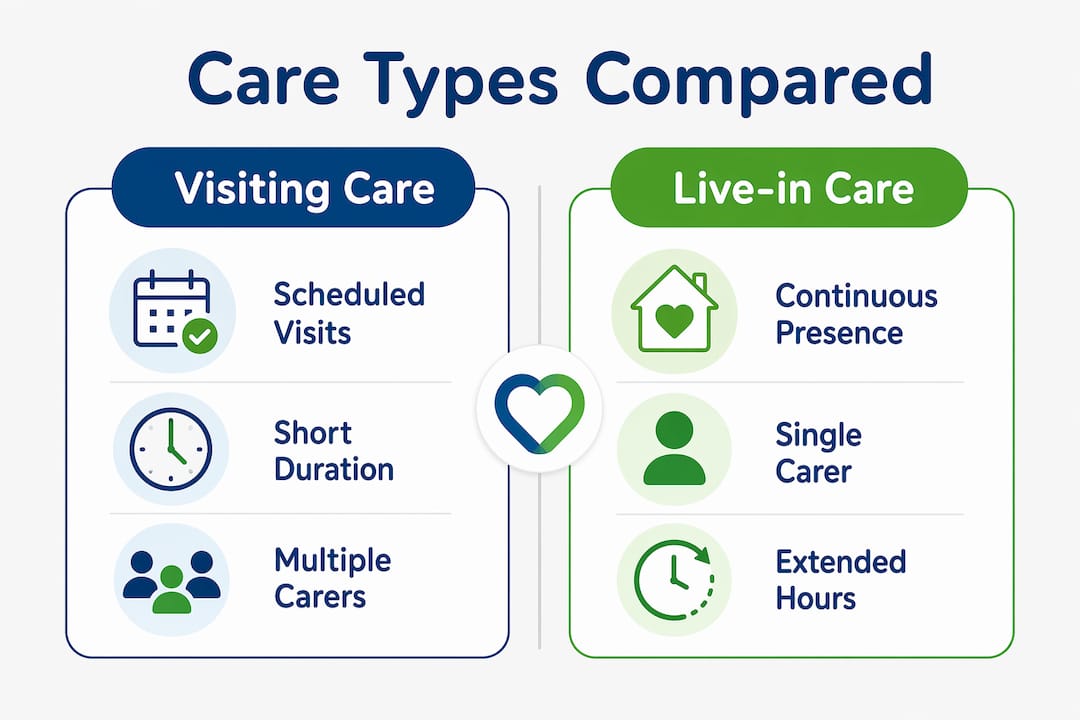
Visiting care versus live-in care
| Feature | Visiting care | Live-in care |
|---|---|---|
| Carer presence | Scheduled visits (30 min to several hours) | Carer lives in the home |
| Typical use | Moderate support needs, regular check-ins | High or round-the-clock needs |
| Supervision | Carer leaves between visits | Continuous oversight available |
| Approximate cost | Market rates vary regionally | Live-in care costs more and vary by provider and needs. |
| Best suited to | People who are safe between visits | People with dementia, falls risk, or complex health needs |

Pro Tip: Ask any agency whether their carers are employed directly or supplied through a third party. Directly employed carers are covered by the agency’s insurance, training standards, and supervision structures, which gives you clearer accountability if something goes wrong.
Any agency providing personal care in England must be CQC-registered. If an agency cannot show you its CQC registration number, that is a firm reason to look elsewhere.
Who is domiciliary care suitable for?
Home care suits a broad range of people, but it works best when the level of support matches the person’s actual needs. Typical candidates include:
- Older adults with reduced mobility, personal care needs, or early-to-moderate dementia.
- People with long-term health conditions such as Parkinson’s, MS, or stroke-related disability.
- Adults and children with physical or learning disabilities who need daily support to live at home.
- People returning from hospital who need short-term support while they recover.
- Family carers who need regular respite to avoid burnout.
A few decision signposts help families judge the right level of care. Single daily check-ins work well for someone who is largely independent but needs a medication prompt or a safety check. Multiple daily visits suit someone who needs help with most personal care tasks but is safe overnight. Live-in or round-the-clock care is appropriate when there are significant falls risks, advanced dementia, or complex health needs that require continuous oversight.
Watch for these red flags that suggest the current level of support is no longer enough: missed medication, unexplained weight loss, repeated falls, or a family carer who is consistently exhausted. These are signals to review the care plan promptly, not at the next scheduled review. Kells-care’s guide on promoting independence in care offers practical pointers for families weighing these decisions.
How domiciliary care is arranged in the UK
The process from first enquiry to an active care package follows a broadly consistent path, whether you are going through the council or arranging care privately.
- Initial enquiry: contact your local council’s adult social care team or approach a CQC-registered agency directly.
- Care needs assessment: the council assesses what support is needed; this is free and available to anyone who appears to need care. You can apply for a needs assessment through GOV.UK.
- Financial (means) assessment: a separate process that determines what the council will contribute; in England, assets above £23,250 generally mean you pay in full.
- Care plan: a written document setting out what support will be provided, when, and by whom; it should be reviewed regularly.
- Service agreement and scheduling: the agency confirms visit times, named carers where possible, and what happens if a carer is unwell.
- Ongoing reviews: needs change; the care plan should be revisited at least annually or after any significant health event.
Before your needs assessment, have these ready:
- A current medication list with dosages and prescribing GP.
- Contact details for the GP and any specialist consultants.
- Notes on existing care arrangements (family support, district nurse visits).
- A brief summary of daily routines and any specific preferences.
The CQC does not arrange care, but its inspection reports are one of the most reliable ways to assess an agency’s track record. Reports are published on the CQC website and rate providers on safety, effectiveness, responsiveness, and leadership. Kells-care’s page on what regulated care means explains what these ratings mean in plain language.
What does domiciliary care cost and how is it funded?
The Homecare Association recommends a minimum sustainable hourly rate of £34.42 for domiciliary care in England for 2026/27. That figure covers legal pay rates, travel time, employer on-costs (National Insurance, pension contributions, holiday pay), and basic business running costs. Private market rates typically range from £26 to £38 per hour, with London agencies often charging above £35/hr for standard visits.

Regional variation is real. Rates in London and the South East sit at the higher end; Northern England and Wales tend to be lower. Live-in care costs are more consistent nationally but still vary by provider and the complexity of needs.
The three funding routes in practice:
- Self-funding: you pay the agency directly; gives the widest choice of provider and scheduling flexibility. Comparing private and agency-arranged care can help you decide which model suits your situation.
- Local authority funding: after a needs assessment and means test, the council may contribute or fully fund care. In England, the upper capital limit is £23,250; in Wales it is £24,000 (with a weekly charge cap); in Scotland, personal care is often free after assessment. Families can also request a direct payment to manage their own budget.
- NHS Continuing Healthcare (CHC): for people with a primary health need, CHC can fund 100% of domiciliary care costs. Eligibility is assessed using the National Framework and is not means-tested.
One practical caution: providers charging significantly below the recommended minimum often do so by cutting staff pay, skipping travel-time payments, or reducing supervision. Local authority purchase rates are frequently below the minimum viable rate, which creates financial pressure that can translate into high staff turnover and inconsistent care. The cheapest option is rarely the most stable one.
How to choose a domiciliary care provider
Choosing a provider is one of the most consequential decisions a family makes. These questions cut through the marketing and get to what actually matters.
Questions to ask about staffing:
- Are all carers DBS-checked before they start work?
- What induction and ongoing training do carers receive?
- Will my relative have a consistent, named carer for most visits?
- How is cover arranged when a regular carer is unwell?
Questions to ask about scheduling and oversight:
- How do you handle travel time between clients? Is it included in the visit duration or charged separately?
- What happens if a visit is missed or significantly late?
- Who is the named care manager, and how often do they supervise carers?
- Can I see a sample care plan and a sample rota?
Red flags to watch for:
- The agency cannot or will not provide its CQC registration number.
- Rates are substantially below the Homecare Association’s recommended minimum with no clear explanation.
- Contract terms are vague about cancellation notice periods or what constitutes a missed visit.
- No named care manager or supervisor is identified.
- References from other families are refused.
How to verify what you are told:
- Search the agency on the CQC website and read the most recent inspection report in full.
- Ask for a sample care plan and check it includes medication records, emergency contacts, and review dates.
- Request references from current or recent clients.
- Ask whether the agency uses electronic medication records (eMAR) or digital visit logs — these are practical quality signals.
Kells-care has a dedicated guide on questions to ask home care agencies that you can print and use during phone calls or visits.
What the evidence says about getting better outcomes
The Homecare Association’s recommended minimum rate of £34.42/hour is not an arbitrary figure. It is calculated to cover carers’ base pay, travel between clients, employer National Insurance, pension auto-enrolment, holiday pay, and training costs. Agencies paying below this level are almost certainly cutting one or more of those components, and the most common casualty is staff pay and continuity.
The Homecare Association highlights a direct link between underpriced contracts and high staff turnover. High turnover means your relative sees a different face at every visit, which is distressing for someone with dementia and unsafe for anyone with complex medication needs.
Age UK advises families not to assume local authority support is the only route. Many families successfully combine a council-funded package with privately arranged top-up visits, giving them greater consistency and choice of carer. This mixed approach is more common than most families realise.
Pro Tip: If you receive a direct payment from the council, you can use it to purchase care from any CQC-registered provider, including one you have chosen yourself. This gives you the benefit of council funding with the flexibility of private arrangement. Ask your social worker specifically about direct payments during the needs assessment.
Predictors of good outcomes in domiciliary care include: consistent named carers, clear and up-to-date medication records, transparent rostering that families can view, and regular supervision of care staff. When you are assessing a provider with no recent CQC rating, ask about their digital systems. Agencies using electronic visit logs and eMAR systems give families and GPs a verifiable record of what was done and when.
Key takeaways
Domiciliary care is regulated personal support delivered at home; the three funding routes are self-funding, local authority means-tested support, and NHS Continuing Healthcare.
| Point | Details |
|---|---|
| Check CQC registration first | Any agency providing personal care in England must be CQC-registered; always read the inspection report before committing. |
| Request a needs assessment | A free council assessment determines eligibility for funded support and is the starting point for any state-funded package. |
| Compare rates against guidance | The Homecare Association recommends a minimum of £34.42/hr for 2026/27; rates well below this often signal instability or high staff turnover. |
| Escalate when risk increases | Falls, missed medication, or family carer exhaustion are signals to review the care plan immediately, not at the next scheduled date. |
| Kells-care for London families | Kells-care is a CQC-regulated, DBS-checked London agency with over 30 years’ experience, offering hourly visits, live-in care, and specialist dementia support. |
A provider’s perspective on what good home care looks like
Good domiciliary care is built on consistency and trust, and those two things are harder to deliver than most families expect when they first start looking. The agencies that do it well share a few common traits: they invest in their staff, they are transparent about their processes, and they treat the care plan as a living document rather than a box-ticking exercise.
What concerns me most, having seen how the sector works, is the number of families who choose a provider primarily on price and then find themselves dealing with a different carer at every visit. For someone living with dementia, that inconsistency is not just inconvenient. It can be genuinely distressing. The Homecare Association’s recommended minimum rate exists precisely because delivering consistent, well-supervised care has a real cost, and agencies that undercut it are usually making savings somewhere that matters.
The other thing families often underestimate is the value of asking hard questions upfront. A good agency will welcome detailed questions about staffing, supervision, and what happens when things go wrong. An agency that deflects those questions, or cannot name a specific care manager, is telling you something important.
Kells-care has been providing personalised home care in London for over 30 years. Our carers are fully qualified, DBS-checked, and supported by a CQC-regulated framework that prioritises dignity, continuity, and genuine independence for every client. If you would like to talk through your situation or request our free home care guide, we are here to help.
Kells-care: London home care you can rely on
Thirty years of experience delivering home care in London means Kells-care understands what families actually need: carers who show up on time, know the person they are supporting, and communicate clearly with the family. Services include hourly visits, live-in care, specialist dementia support, respite care, and personalised care plans built around each client’s routines and preferences. Kells-care also supplies vetted, qualified staff to care homes and local authorities across London.
Getting started is straightforward. Download the free home care guide for a practical overview of arranging care, funding routes, and what to ask providers. Or visit the domiciliary care family guide to read more about how Kells-care approaches personalised support. If you are ready to talk, contact the team directly to arrange an initial needs conversation with no obligation.
Useful sources for further reading
These organisations publish authoritative, regularly updated guidance on domiciliary care in the UK. Use them to verify facts, check provider registrations, and explore funding options.
| Source | What it covers | Link |
|---|---|---|
| Care Quality Commission (CQC) | Provider registration, inspection reports, and ratings for all domiciliary care agencies in England | cqc.org.uk |
| Homecare Association | Recommended minimum hourly rates, sector guidance, and a directory of member agencies | homecareassociation.org.uk |
| NHS | Plain-language guide to arranging home care and applying for a needs assessment | nhs.uk |
| GOV.UK | How to apply for a needs assessment by social services in England and Wales | gov.uk |
| Age UK | Factsheet on finding help at home, mixed funding options, and direct payments | ageuk.org.uk |
| Kells-care | Free home care guide, family explainers, and contact for London-based care enquiries | kells-care.com |
This article provides general information about domiciliary care in the UK. It is not professional legal, medical, or financial advice. For guidance specific to your situation, contact your local council’s adult social care team, the NHS, or a qualified care adviser.