TL;DR:
- Many London families mistakenly believe home care requires full-time support, which limits access to flexible help. Hourly care provides professional assistance for a set number of hours, supporting independence and safety without disrupting family routines. It suits those with mild to moderate needs, but beyond six to eight hours daily, transitioning to live-in care may be more appropriate to ensure continuous support.
Many London families assume home care means someone moves in full-time or it does not happen at all. That assumption stops people getting help they actually need. Hourly care is far more flexible than most people realise, and it can make a genuine difference to a loved one’s wellbeing, independence, and safety without turning family life upside down. This guide explains exactly what hourly care involves, who it suits best, where its limits lie, and how to choose a provider you can trust.
Table of Contents
- What is hourly care? Key features and benefits
- Who is hourly care ideal for, and when is it not enough?
- Hourly care vs live-in care: A side-by-side comparison
- What to look for in a quality hourly care provider
- Why the right match matters more than the care model
- How Kells Care can help you get started
- Frequently asked questions
Key Takeaways
| Point | Details |
|---|---|
| Hourly care explained | Hourly care offers flexible at-home support for those not needing constant supervision. |
| Best for moderate needs | It suits people needing under 6 hours daily care, especially with family help. |
| Limits and risks | Hourly care may be risky or costly if more than 6–8 hours a day are required. |
| Check provider quality | Choose CQC-regulated agencies with well-supported staff for safer and more reliable care. |
| Review care regularly | Care needs can change, so review arrangements often to ensure the best fit. |
What is hourly care? Key features and benefits
Hourly care is professional home support delivered at agreed times during the day or week. A trained carer visits for a set number of hours, carries out the tasks your loved one needs, and then leaves. It is that straightforward. You only pay for the hours used, and you can adjust the schedule as needs change.
The range of support covered is wider than many families expect. A typical visit might include:
- Personal care: washing, dressing, grooming, and toileting assistance
- Medication reminders: prompting or administering prescribed medicines on schedule
- Meal preparation: cooking nutritious meals and tidying up afterwards
- Companionship: conversation, reading together, light activities, and social engagement
- Household tasks: light cleaning, laundry, and shopping lists
- Mobility support: helping someone move safely around their home
These home care services are particularly well suited to older people who want to remain in their own home but find certain daily tasks difficult. They also work well for people with physical disabilities who need routine support but do not require constant supervision throughout the day.
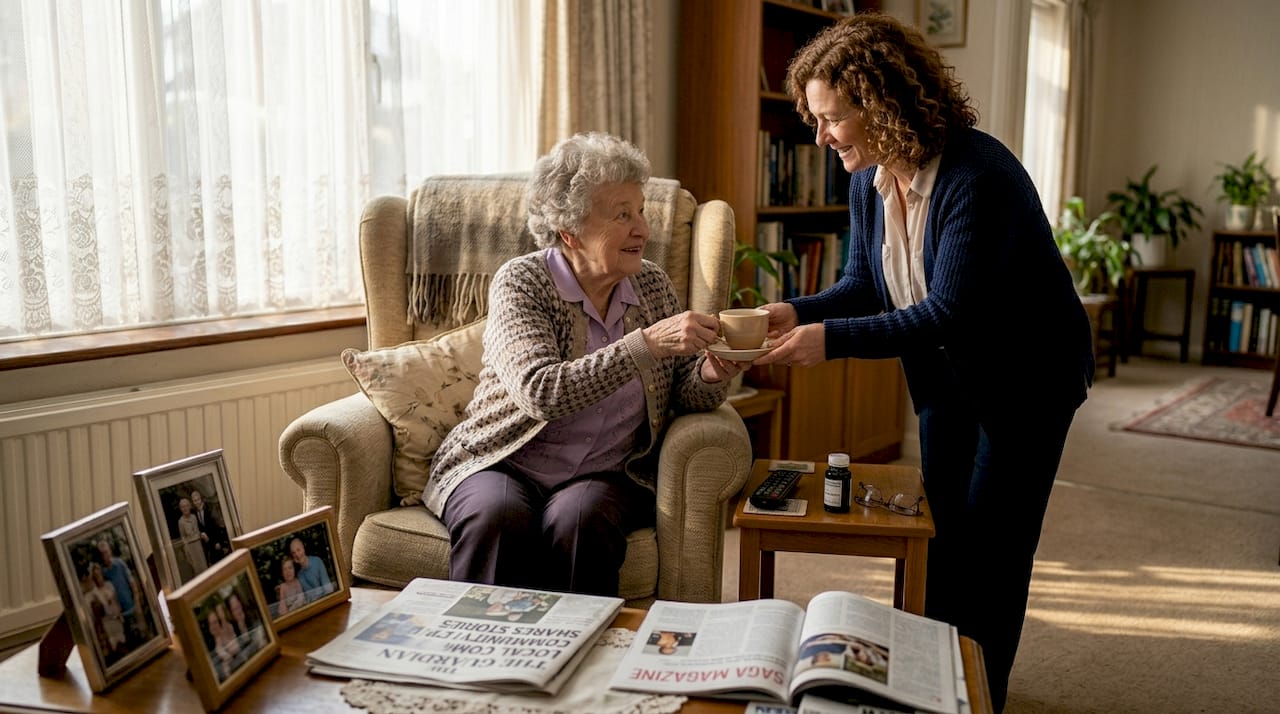
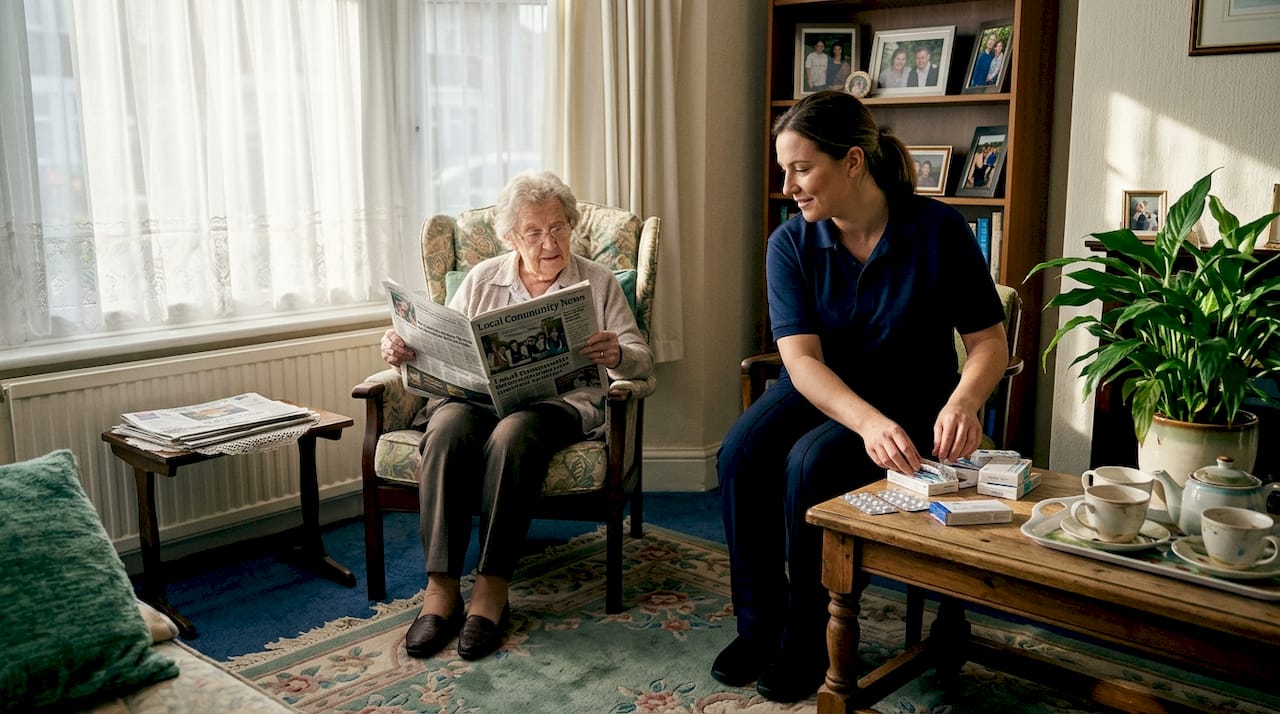
To give you a practical picture, consider an 82-year-old woman living alone in South London. She is sharp and sociable but struggles with bathing and breakfast preparation. A morning visit of 90 minutes covers washing, dressing, and a hot meal. An afternoon visit of one hour provides companionship and medication reminders. That is two and a half hours of professional care each day. She remains independent. Her family has peace of mind without needing to rearrange their own lives entirely.
| Feature | Hourly care |
|---|---|
| Typical hours per day | 1 to 6 hours |
| Schedule | Agreed in advance, adjustable |
| Cost model | Pay per hour used |
| Best suited to | Mild to moderate care needs |
| Carer presence | Visits only, not overnight |
| Flexibility | High |
Pro Tip: Before selecting a care package, write down your loved one’s actual daily routine hour by hour. Note where they struggle and where they manage independently. This makes it far easier to assess how many visits they genuinely need, rather than guessing.
It is worth noting that hourly care has real limitations when needs exceed six to eight hours per day, as costs rise sharply and gaps between visits can become risky for people prone to falls, dementia, or sundowning. The same report highlights that 72% of hourly carers spend unpaid time travelling between clients, and 87% miss their required eleven-hour rest periods due to rota instability. These conditions affect the reliability of care, which is why choosing an established, well-managed agency matters enormously.
Who is hourly care ideal for, and when is it not enough?
Hourly care works best when someone needs regular support but not constant supervision. The sweet spot is roughly one to six hours of care per day. Within that range, visiting care is both practical and cost-effective.
Hourly care tends to suit people who:
- Are generally independent but need help with specific tasks
- Have a predictable, stable routine each day
- Have family or friends available to check in at other times
- Are in the early to moderate stages of a condition such as Parkinson’s or early dementia
- Are recovering from a hospital stay and need short-term extra support
- Have a physical disability but remain mentally alert and able to communicate their needs
However, there are situations where hourly care is not the right fit. If your loved one has advanced dementia, they may become distressed or confused during the gaps between visits. People with significant night-time needs, frequent falls, or rapidly fluctuating conditions can be at genuine risk when a carer is not present. It is also worth considering cost. Beyond six to eight hours a day, multiple daily visits become expensive and it often becomes more practical to consider a live-in arrangement instead.
Research into hourly home care highlights that the model becomes less suitable as daily care needs exceed six to eight hours. Gaps between visits carry real risks for people with dementia, sundowning, or a history of falls. Carer rota instability, with 87% of workers missing their required eleven-hour rest breaks, can further reduce the reliability of support at these higher levels of need.
Signs it may be time to consider more support:
- Your loved one has been found on the floor after a fall between visits
- Night-time wandering or distress is becoming more frequent
- They are no longer eating properly or taking medicines reliably
- Multiple carers are needed throughout the day and costs are mounting
- Family members are burning out trying to fill gaps between visits
For guidance on how different care settings compare, you may find it helpful to read about home care vs nursing options. If overnight or round-the-clock support is becoming necessary, our 24-hour care guide explains what that level of care involves in practical terms.
Hourly care vs live-in care: A side-by-side comparison
When needs begin to increase, families often face the question of whether to add more hourly visits or transition to live-in care. The following comparison should help clarify the decision.
| Factor | Hourly care | Live-in care |
|---|---|---|
| Cost at low hours | Lower | Higher |
| Cost above 8 hrs/day | Often becomes more expensive | More cost-effective |
| Carer continuity | Can vary with rotas | Typically one or two regular carers |
| Night-time support | Not covered | Covered |
| Best for | Mild to moderate needs | Complex or high-frequency needs |
| Flexibility | High for scheduling | Less flexible day-to-day |
| Risk of gaps | Present between visits | Minimal |
| Privacy | Greater privacy between visits | Carer present throughout |
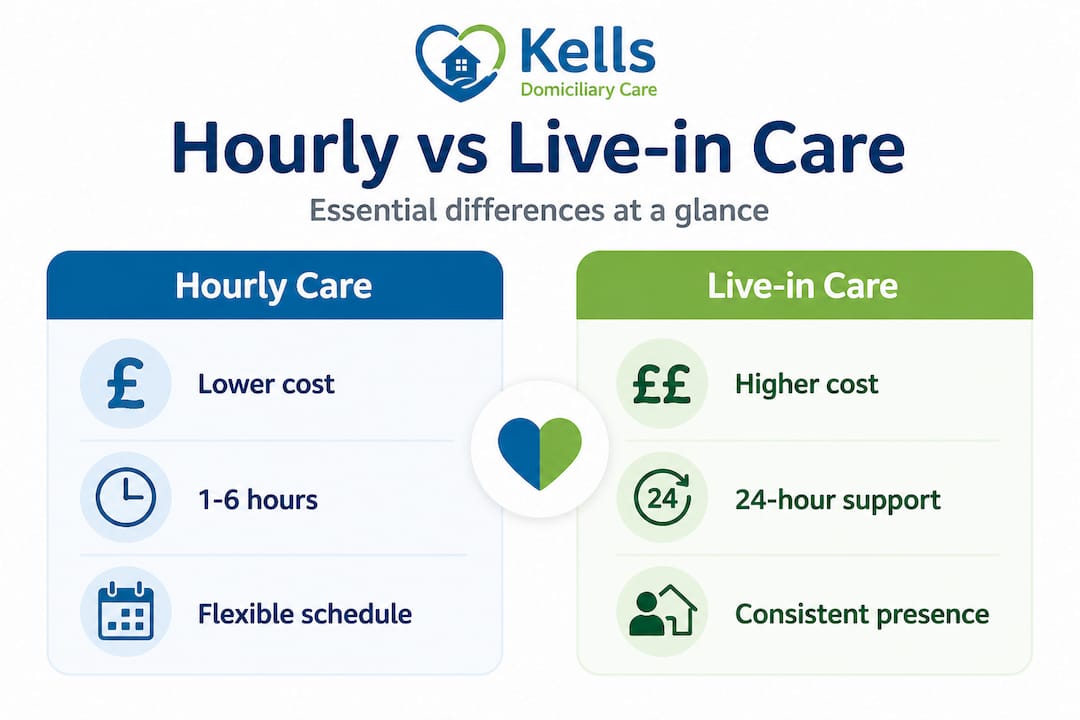
Live-in care does carry a higher upfront cost, but for people who need support for more than eight hours a day, it frequently works out less expensive overall. Beyond cost, the continuity of having a consistent carer builds familiarity and trust, which matters enormously for people with dementia or anxiety.
Checklist: Consider moving to live-in care if your loved one:
- Needs more than eight hours of support daily
- Has experienced a fall or medical event when alone
- Requires night-time supervision or reassurance
- Has advancing dementia with unpredictable episodes
- Is becoming increasingly isolated between visits
Understanding the differences between providers is equally important. Whether you are comparing private vs agency home care arrangements, or learning about the process of transitioning to home care from a hospital or family setting, having clear information makes every decision less stressful.
One important point: do not wait for a crisis to review care arrangements. The most difficult transitions happen under pressure. Reviewing the care plan every three to six months, even when things seem stable, gives you the time to make calm, considered decisions.
What to look for in a quality hourly care provider
Choosing the right provider is just as important as choosing the right type of care. Not all agencies operate to the same standard, and the gap between a good and a poor provider can significantly affect your loved one’s experience and safety.

Regulation is the starting point. All home care agencies in England must be registered with and inspected by the Care Quality Commission. A CQC registration is not just a box to tick. It means the agency is accountable to an independent regulator that publishes inspection reports. Understanding CQC’s role in home care helps you interpret these reports and ask the right questions during your search.
Staff conditions directly affect the quality of care you receive. Research shows that poor worker conditions, including unpaid travel time and rota instability, reduce the reliability and quality of care delivered. When carers are overworked and undervalued, turnover rises and your loved one ends up with a rotation of unfamiliar faces rather than a consistent, trusted support worker. Asking about staff retention rates and employment conditions is a practical way to gauge agency quality.
Key questions to ask a potential agency:
- Are you registered with and inspected by the CQC, and what is your current rating?
- How do you match carers to clients, and what happens if a carer is ill or unavailable?
- Are your carers employed directly, or are they contracted workers?
- What training do carers receive, and how is it kept up to date?
- Are all staff DBS (Disclosure and Barring Service) checked before working with clients?
- How is the care plan created, reviewed, and updated over time?
- Who is my point of contact if something goes wrong or I have a concern?
Warning signs to watch for include high staff turnover, vague answers about training, inconsistent shift coverage, and no clear process for handling complaints. Also be cautious of agencies that focus only on availability and price without discussing your loved one’s specific needs.
Asking to see actual shift plans and rotas, not just marketing materials, gives you a realistic picture of how the agency operates in practice. This is especially important for families arranging care for the first time.
Pro Tip: Ask the agency for references from current or recent clients and, where possible, speak to the carers themselves. How a carer describes their working environment tells you a great deal about the standard of care your loved one will receive. Look for agencies that invest in qualified care staff and demonstrate low turnover.
Why the right match matters more than the care model
There is something the standard care guides rarely say plainly: the type of care chosen matters less than the quality of the relationship between carer and client.
We have seen it many times over more than three decades of supporting London families. A person who was resistant to any care at all becomes genuinely happy and settled when they are paired with the right carer. Not necessarily the most experienced carer on the books. The right carer. Someone whose personality, pace, and sense of humour fits with theirs.
Families often spend significant energy weighing up hourly versus live-in care, comparing costs, and checking CQC ratings. All of that matters. But once a provider clears those thresholds, the most important question is whether the people involved will actually get on.
This extends to family involvement too. In our experience, the best outcomes happen when families remain engaged, not just in the initial assessment, but in ongoing reviews of the support plan. Needs change. Moods change. A routine that worked six months ago may no longer feel right. Flexible home care benefits are only realised when the plan is regularly revisited and adapted.
Our advice is to trust your instincts during the selection process. If a provider feels rushed or formulaic during your initial conversations, that experience tends to carry through into day-to-day care. Good agencies take time to understand your loved one as an individual, not just as a set of care needs on a form.
How Kells Care can help you get started
At Kells Care, we have been providing flexible, personalised home care across London for over 30 years. Whether your loved one needs a few hours of support each week or a more structured daily routine, we are here to help you find the right fit. Our carers are fully qualified, DBS checked, and matched to clients with care and attention. You can download our free home care guide to get an in-depth overview of your options, or explore our personalised home care support pages to understand how we tailor care to individual needs. For families just starting this journey, our elderly care at home guide walks you through every step of the process clearly and calmly. We would love to hear from you.
Frequently asked questions
Is hourly care suitable for someone with advanced dementia?
Hourly care is generally not recommended for advanced dementia, as gaps between visits carry real risks for distress, falls, and sundowning episodes. Continuous or live-in care tends to be a safer and more appropriate arrangement.
Why is CQC regulation important when choosing an hourly care provider?
CQC regulation ensures that a provider meets national standards for safety, quality, and accountability, giving families confidence that the agency is independently monitored. Poor worker conditions at unregulated or poorly managed agencies can directly affect the reliability of the care delivered.
Can I mix hourly care with family support?
Yes, combining professional hourly visits with family support is a common and practical approach. It allows the care to be focused on the tasks that require a trained professional while family members cover companionship, social activities, and informal check-ins.
When should a family consider moving from hourly to live-in care?
If your loved one’s care needs consistently exceed six to eight hours per day, or if emergencies or falls between visits are becoming more frequent, live-in care is likely to be both safer and more cost-effective than continuing to add hourly visits.
Recommended
- What is 24-hour care? Expert guide for London families
- Flexible home care benefits: improve lives, cut loneliness
- What is home care? Personalised support options explained – Kells Domiciliary Care
- FREE Home Care Guide, Kells Domiciliary Care, North London
- My Homecare Franchise Opportunity for Sale – Start a My Homecare Business