
TL;DR:
- Respite care provides short-term relief for caregivers to prevent burnout and support long-term care.
- Available types include in-home care, day centres, short stays, and emergency options in London.
- Accessing respite care improves caregiver mental health, physical well-being, and maintains the quality of care.
Caring for an elderly loved one is one of the most meaningful things you can do. But it is also one of the most demanding. 74% of UK carers report feeling stressed or anxious, and 40% experience depression. In London, where the pace of life is already fast and support services are stretched, family carers often reach exhaustion before they seek help. Respite care is a practical, well-established solution, yet many families misunderstand what it offers or simply do not know it exists. This guide will clarify what respite care is, what types are available in London, and how to access the support you and your loved one deserve.
Table of Contents
- What is respite care and who is it for?
- Types of respite care available in London
- How respite care supports carers and prevents burnout
- Barriers to accessing respite care in London
- A fresh perspective: Why every carer needs respite care, despite the obstacles
- Explore further support options for London carers
- Frequently asked questions
Key Takeaways
| Point | Details |
|---|---|
| Respite care definition | Respite care offers short-term relief for carers by temporarily supporting their loved one’s needs. |
| Types of services | Families in London can access home-based, centre, or residential respite care depending on their unique situation. |
| Mental health impact | Consistent respite care reduces stress and supports better mental health for both carers and elderly relatives. |
| Barriers and solutions | Cost and shortages can hinder access, but informed choices and support resources improve outcomes for London carers. |
| Take action locally | Specialist guides and care agencies in London provide practical next steps for securing respite support. |
What is respite care and who is it for?
Respite care is short-term or temporary care provided for an elderly or disabled person, giving their usual carer a planned break. The word “respite” simply means a short rest from something demanding. In the context of caring for an elderly parent or relative in London, it means arranging for a trained professional to step in while you take time to rest, attend appointments, work, or simply recover your energy.
Respite care is not a sign that you are struggling to cope or that you are abandoning your loved one. It is a recognised, evidence-based way to sustain long-term care at home. Respite prevents burnout but shortages across the country continue to limit how many families can access it.
Who benefits from respite care?
Respite care is designed for two groups: the carer and the person being cared for.
- Family carers who provide daily personal care, medication management, or overnight supervision
- Elderly individuals living at home who need consistent, safe support during the times their family carer is unavailable
- Working carers who are balancing employment and care responsibilities simultaneously
- Carers with their own health needs, who require time to attend medical appointments or manage their own conditions
- Families facing a sudden change, such as a carer recovering from illness or surgery
Here are some realistic examples you may recognise. A daughter caring for her mother with dementia in Hackney may need two evenings off each week to maintain her own mental health. A husband caring for his wife following a stroke in Kingston may need a week’s cover while he travels for work. A son in Ealing who visits his father daily may need someone to step in while he is on annual leave. These are all normal, reasonable needs. Seeking respite care at home is not a last resort. It is good forward planning.
“Taking a break is not giving up. It is what keeps you going. Regular respite care helps carers continue providing love and support for longer.”
Common misconceptions about respite care:
Many families delay seeking help because they believe respite care is only for people in crisis, only for those with significant financial means, or that their loved one will resist unfamiliar faces. In reality, a good respite carer builds rapport gradually and can follow the same routines your loved one already has at home. Most elderly individuals adapt well when the transition is handled with care and consistency.
Types of respite care available in London
London offers a broader range of respite care options than most other areas of the UK, though demand consistently outpaces supply. Understanding the available formats helps you choose what suits your situation and your loved one’s needs.
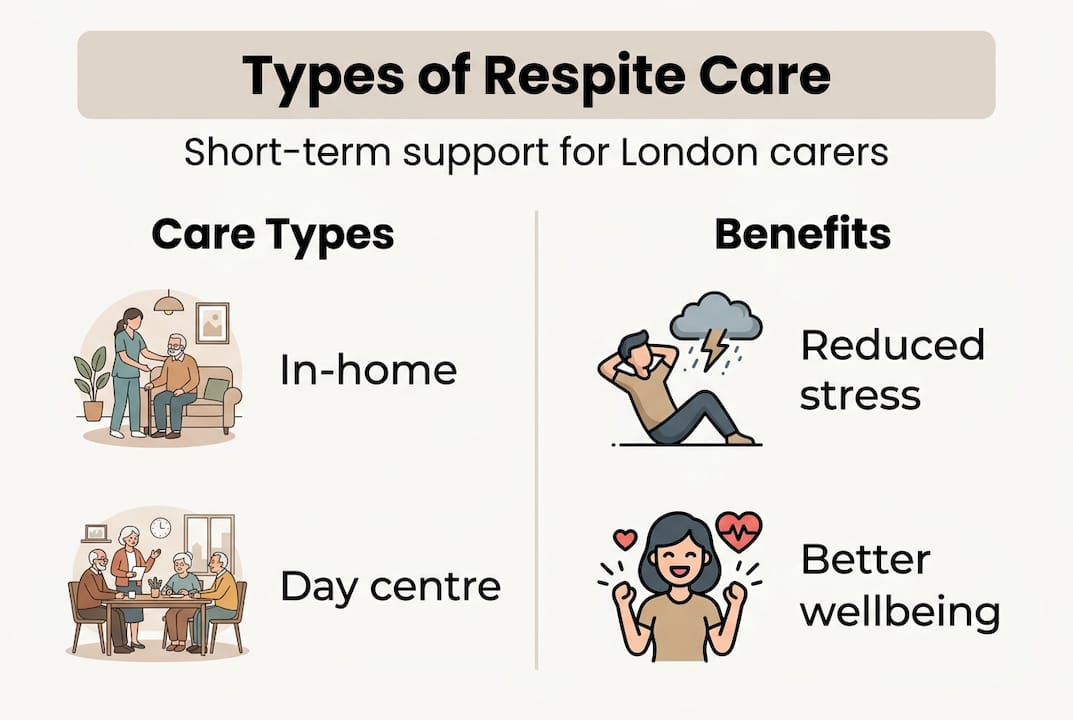
Main types of respite care in London:
- In-home respite care involves a professional carer visiting your loved one’s home for a set number of hours or days. This is the least disruptive option, as the elderly person remains in familiar surroundings. It can range from a few hours each week to full overnight care.
- Day centre services allow elderly individuals to attend a community facility during the day, where they receive social activities, meals, and personal care support. This frees up the family carer for several hours at a time.
- Short-stay residential care means your loved one stays at a care home for a planned period, typically one to four weeks. This is often used when a carer is travelling or recovering from illness.
- Emergency respite care is arranged at short notice when a carer is suddenly unable to provide care due to illness, an accident, or an unexpected event. This is often the hardest to access and requires advance planning with a provider.
| Type of respite care | Duration | Level of disruption | Best suited to |
|---|---|---|---|
| In-home respite care | Hours to days | Minimal | Daily or weekly breaks |
| Day centre services | Daytime only | Low | Regular weekday breaks |
| Short-stay residential | Days to weeks | Moderate | Holiday or illness cover |
| Emergency respite | Immediate need | Variable | Sudden, unplanned gaps |
Shortages of respite services remain a serious problem in London, particularly for emergency and residential care. This is why planning ahead is so important. Families who wait until a crisis arises often find that suitable placements are not immediately available.
When arranging any type of respite care, it helps to contact your local council’s adult social care team first, as a carer’s assessment can unlock funded or subsidised support. You can also contact a regulated home care agency services provider directly to explore self-funded options.
Pro Tip: Always visit a day centre or meet a potential carer before the first official visit. Introducing your loved one to the environment gradually makes the transition far smoother for everyone involved.
How respite care supports carers and prevents burnout
After reviewing service options, it is essential to understand why respite care matters to both carers and their families. The research is clear and the evidence is consistent.
74% of UK carers report stress or anxiety, and 40% experience depression. These are not small numbers. They represent hundreds of thousands of people across the country quietly struggling, many of whom have not taken a proper break in months or even years.
The wellbeing benefits of regular respite care include:
- Reduced physical exhaustion, particularly for carers managing overnight duties
- Lower anxiety levels, as carers gain reassurance that their loved one is in safe hands
- Restored social connection, since isolation is a major contributing factor to carer burnout
- Improved sleep quality when carers are relieved of overnight or early-morning responsibilities
- Greater patience and emotional resilience when returning to caring duties
| Carer wellbeing indicator | Without regular respite | With regular respite |
|---|---|---|
| Reported stress levels | High (74% of carers) | Significantly reduced |
| Depression rates | 40% of carers | Lowered with access to breaks |
| Risk of physical illness | Increased | Decreased |
| Quality of care provided | Declines over time | Sustained and improved |
The benefits extend to the person being cared for as well. When a carer is rested and emotionally well, the care they provide is more consistent, more patient, and more attentive. Elderly individuals often thrive when their family carer is in good health. Understanding the benefits of home care reinforces why keeping care arrangements sustainable matters so much.

There is also a relational dimension that is easy to overlook. Caring for a parent or spouse can change the nature of the relationship. When every interaction centres on physical care tasks, the emotional bond can suffer. Time apart, even briefly, can help restore the relationship as it was, not only as carer and cared-for, but as family. Exploring how families shape quality home care shows just how central these dynamics are to good outcomes.
Pro Tip: Use your respite time intentionally. Even a few hours spent doing something you enjoy, rather than catching up on chores, has a measurable positive effect on mental health and mood.
The advantages of home care are best realised when carers are supported to stay well themselves. Respite care is the tool that makes that possible.
Barriers to accessing respite care in London
While the benefits are clear, many families face significant challenges in securing the right respite care. Understanding these barriers helps you plan around them.
Financial barriers are the most commonly cited concern. 49% of UK carers have cut essential spending due to the costs of caring. Respite care itself adds another expense, and many families feel they simply cannot afford it. In reality, there are several funding routes available:
- Local authority funding following a carer’s assessment, where eligible carers may receive direct payments or funded respite hours
- NHS Continuing Healthcare, which can fund respite care for those with complex health needs
- Attendance Allowance or Carer’s Allowance, which can contribute towards the cost of professional care
- Charitable grants, available through organisations such as Carers Trust and Turn2Us
“Financial difficulty should not be the reason a carer goes without rest. A carer’s assessment is free and can open doors to support that many families do not realise is available to them.”
Provider shortages in London mean that even when families are financially ready, finding a suitable and available provider can take time. Day centres may have waiting lists. Residential short stays may be fully booked during school holiday periods, which are peak times for family carers seeking cover. Emergency care is the most difficult to secure at short notice.
Awareness and information gaps are also significant. Many carers simply do not know that respite care exists in the forms described above, or they are uncertain how to start. Knowing where to look is half the battle.
- Contact your GP or local authority social care team for a formal carer’s assessment
- Use a structured guide to respite care to map out your options before making calls
- Research your financial options thoroughly via resources on paying for care
- If a family member is in a care home and needs staffing support, there are options for care staff for homes too
Pro Tip: Request a carer’s assessment from your local council even if you are not sure you qualify. The process is free, and you may be entitled to more support than you expect. Many carers are surprised by the options available once they make this first step.
Guilt is also a hidden barrier. Many carers feel deeply uncomfortable stepping away, even briefly. Acknowledging this feeling is important, but it should not stand between you and the support you need.
A fresh perspective: Why every carer needs respite care, despite the obstacles
After more than 30 years of supporting London families, we have seen one consistent pattern. The carers who access respite care early and regularly do not just survive their caring role. They sustain it, often for many years, with genuine love and presence intact.
The carers who wait until they break down often find that the breakdown affects everyone: themselves, their loved one, and the wider family. Respite care is not a luxury. It is a foundation. The guilt that many carers feel about taking time away is understandable, but it is rooted in a myth: that taking a break means caring less. In our experience, the opposite is true.
We also believe that accessing qualified carers matters enormously, not just for safety, but for dignity. A well-trained respite carer maintains your loved one’s routines, preferences, and sense of self. Understanding the role of home carers helps families see that professional care is not a substitute for love. It is a complement to it.
Every carer needs and deserves a break. Seeking one is one of the most responsible things you can do.
Explore further support options for London carers
At Kells, we have been providing trusted home care across London for over 30 years, and we understand how much is at stake when you are caring for someone you love. Whether you are exploring respite care for the first time or looking to improve your current arrangements, we have resources to help. Download our free home care guide to understand your options clearly, or explore our detailed elderly home care guide written specifically for London families. Our team at Kells Care is ready to talk through your situation and help you find a flexible, personalised solution that puts your loved one’s wellbeing first. You do not have to work this out alone.
Frequently asked questions
How do I qualify for respite care in London?
Eligibility usually depends on your loved one’s care needs and your own role as a primary carer, with local councils and agencies best placed to advise after a carer’s assessment.
What types of respite care are available?
Respite care is available in various formats, including in-home visits, day centres, short stays at residential facilities, and emergency services for sudden needs.
Does respite care help carer mental health?
Yes. 74% of UK carers feel stressed or anxious, and regular respite care is one of the most effective tools for reducing burnout and preventing depression.
Is respite care affordable for most families in London?
49% of carers have cut essential spending due to costs, so many families need financial support, which can come from council funding, NHS pathways, or benefits such as Attendance Allowance.