
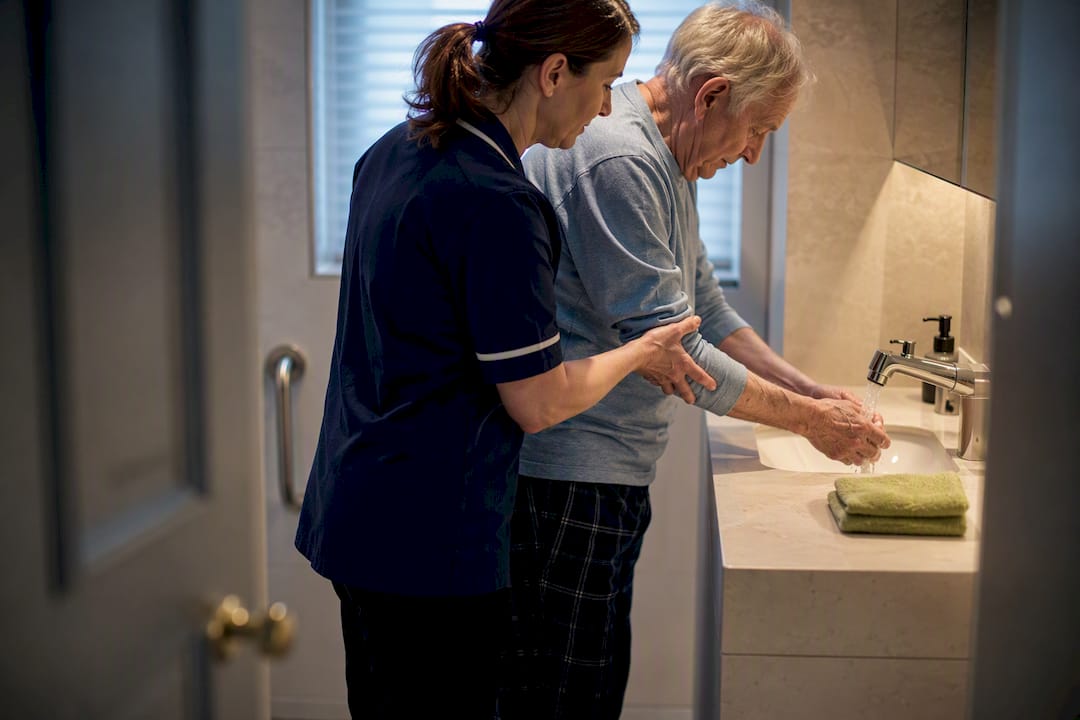
Yes, most people with Parkinson’s can be supported safely at home, often for years, with the right mix of professional care, home adaptations and family involvement. The first step is a free needs assessment through your local authority or a call to a specialist helpline such as Parkinson’s UK. That assessment identifies what care, funding and safety measures should follow.
TL;DR:
- A needs assessment is essential to determine appropriate care levels and funding options, including NHS support, self-payment, or local authority aid.
- Signs indicating the need for outside help include falls, medication mis-timing, weight loss, confusion, and visible caregiver fatigue.
- Home safety improvements, such as removing hazards and installing grab rails, can prevent many falls and should be reassessed regularly as Parkinson’s progresses.
- Reputable agencies conduct DBS checks, are inspected by the CQC, and provide condition-specific staff training to ensure safe, tailored care.
- Supporting family carers through assessments, respite, peer groups, and early intervention helps prevent caregiver exhaustion and maintains overall wellbeing.
Table of Contents
- What does Parkinson’s care at home actually involve?
- When should you bring in outside help?
- How do you get a needs assessment and pay for care?
- What does professional home care look like day to day?
- Making the home safer as Parkinson’s progresses
- Supporting the family carer, not just the patient
- Choosing and starting with a home care agency
- What Kells’ care teams have learned from families like yours
- How Kells-care can help you take the next step
- Sources
What does Parkinson’s care at home actually involve?
Parkinson’s care at home covers several formats, and most families use more than one over time. Visiting hourly care brings a carer in for set slots, anywhere from 30 minutes to several hours, to help with medication, washing, or meal preparation. Live-in care places one carer in the home around the clock, useful once mobility or supervision needs grow. Nursing at home brings clinical skills for wound care, catheter management or complex medication regimes. Day services offer structured activity and social contact outside the home, which can ease isolation and give family carers a proper break.
Packages rarely stay static. A plan that starts with two visits a week for medication prompts commonly grows into daily calls, then live-in support, as Parkinson’s progresses. Private home care packages can be arranged quickly, and funding can come from self-payment, the local authority, or NHS Continuing Healthcare.
Typical tasks across these formats include:
- Medication reminders timed to the person’s specific dosing schedule
- Personal care: washing, dressing, continence support
- Mobility assistance and fall prevention during transfers
- Meal preparation suited to swallowing difficulties, where relevant
- Light domestic help and errands that keep the household running
When should you bring in outside help?
Parkinson’s rarely announces the exact moment care becomes necessary. It creeps up through small signs that families often explain away for months. Watch for these markers:
- Falls or near-misses, especially during transfers or in the night
- Missed or mistimed medication, which can worsen motor symptoms within hours given how narrow some Parkinson’s dosing windows are
- Unintentional weight loss, often linked to swallowing difficulty or fatigue at mealtimes
- Increased confusion or slowed thinking, particularly later in the day
- Visible carer fatigue, including irritability, disrupted sleep or neglected appointments of their own
Bringing in help before a crisis point tends to go far more smoothly than reacting to one. Parkinson’s UK notes that involving the person with Parkinson’s early in these conversations preserves their dignity and reduces resistance later. Rather than announcing “you need a carer,” try framing it around a specific task: “Would it help to have someone here for the morning routine, so you’re not rushing?” That keeps the person in charge of the decision rather than having it made for them.
How do you get a needs assessment and pay for care?
Every adult in England has the right to a free needs assessment from their local authority’s social services. It looks at daily living, safety and mobility, and results in a written care plan that can specify personal care, home adaptations, day care or respite. Parkinson’s UK explains that carers themselves can request a separate carer’s assessment, free of charge, which looks specifically at what support the carer needs to keep going.
Funding then depends on circumstances. Some people qualify for NHS Continuing Healthcare, a fully funded package for those with significant, ongoing health needs, assessed separately from the local authority process. Others self-fund, or receive partial local authority support depending on savings and income.
Several benefits are worth checking on Gov:
- Attendance Allowance for the person with Parkinson’s, if they need help with personal care
- Carer’s Allowance for those providing at least 35 hours of care a week
- Personal Independence Payment (PIP) for people under state pension age with long-term conditions
Once funding is confirmed, families can request direct payments, giving control over hiring an agency directly, rather than the council commissioning care on their behalf.
What does professional home care look like day to day?
A well-run home care visit rarely feels clinical. Carers typically handle personal care, medication prompts, meal preparation and transport to appointments, alongside the practical conversation and companionship that keeps someone engaged rather than isolated. The NHS confirms there’s no cure for Parkinson’s, but therapies including physiotherapy and occupational therapy, alongside medication and a solid care plan, do genuinely help manage symptoms and sustain quality of life.
Safety sits underneath all of it. Reputable agencies:
- Carry out full DBS checks on every member of staff before they enter a client’s home
- Are registered with and inspected by the Care Quality Commission (CQC)
- Provide condition-specific training, so staff understand tremor, freezing episodes and swallowing risk
- Supervise and review staff performance on an ongoing basis
Staffing models differ too. Visiting care usually runs on a rota of familiar faces, while live-in care means one carer becomes a constant presence, which many families with Parkinson’s prefer given how many routine matters to symptom management.
Making the home safer as Parkinson’s progresses
Falls are one of the most common reasons Parkinson’s care escalates unexpectedly, and most fall risks are fixable with fairly simple changes. Start with the obvious: clear loose rugs and trailing cables, improve lighting on stairs and landings, and fit grab rails near the bath, toilet and bed. Non-slip mats in the bathroom cost little and prevent a great deal.

Beyond that, an occupational therapist assessment is worth requesting through the same needs assessment process. Parkinson’s UK highlights that OTs can recommend raised toilet seats, stair rails, and standing aids tailored to how someone with Parkinson’s actually moves, which differs from generic elderly-care advice. Our practical home safety guide covers many of the same adaptations in more depth, and a family guide to arranging an OT assessment walks through what to expect from that first visit.
Pro Tip: Reassess “safe” tasks every few months, not just once. Families often assume someone can still manage the step stool or the kettle because they could last year. Parkinson’s changes gradually enough that these small risks slip past unnoticed until something goes wrong.
Community alarm schemes and telecare pendants are worth installing well before anyone thinks they’re needed, since Parkinson’s UK recommends them specifically for people who worry about being alone between visits.
Supporting the family carer, not just the patient
Caring for someone with Parkinson’s is physically and emotionally demanding in ways that rarely show up until exhaustion sets in. A scoping review of caregiver burden in Parkinson’s found that carers commonly report high strain, with many receiving no compensation for the hours they put in, and describing social isolation and measurable health impacts as a direct result.
The same review found that structured interventions, including caregiver training and combined patient-carer programmes, meaningfully reduce that burden when families actually use them.
Practical options that help:
- A carer’s assessment, requested alongside or separately from the patient’s needs assessment
- Respite care, whether a few hours a week or a short residential stay
- Peer support groups, often run through Parkinson’s UK local branches
- The Parkinson’s UK helpline, for immediate advice when a situation feels unmanageable
Building a simple weekly rota, even an informal one shared between siblings or neighbours, protects the primary carer’s sleep and health far more effectively than good intentions alone.
Choosing and starting with a home care agency
Getting the first call right matters more than most families expect. Ask every agency:
- Are you CQC registered, and what was your last inspection rating?
- Are all staff DBS checked, and do they receive Parkinson’s-specific training?
- Can you guarantee continuity of carer, particularly for the first few weeks?
- What does a trial visit look like, and can we meet the carer beforehand?
A genuine trial visit, ideally the same carer for two or three sessions, tells you far more about rapport than any brochure. Consistency of staff in the early stages matters more than frequency of visits. Before signing anything, check the care agreement covers exact tasks, visit times, notice periods for changes, and a clear breakdown of costs. Our guide on personalising home care services walks through matching carer personality and skills to the person receiving care.
What Kells’ care teams have learned from families like yours
Over more than 30 years supporting London families, we’ve seen the same pattern repeat: early contact builds trust that a crisis-driven call never can. Families who ask questions months before they need care get smoother introductions and calmer first visits. The biggest pitfall isn’t reluctance from the person with Parkinson’s, it’s waiting too long to have the conversation at all. Start small, stay consistent, and let the relationship grow.
— Dan
How Kells-care can help you take the next step
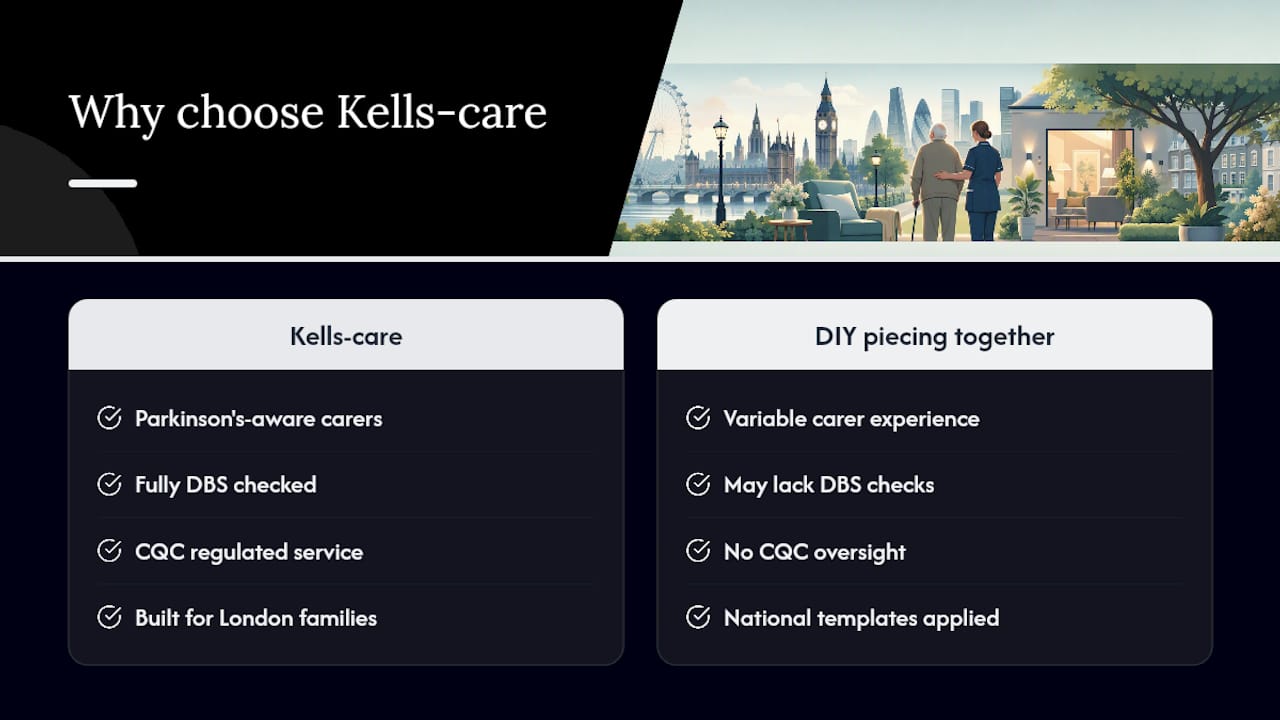
Alongside the options already covered, Kells-care offers a direct route into properly regulated Parkinson’s support without months of research. We’re the alternative to piecing together care yourself from scratch: our carers are Parkinson’s-aware, fully DBS checked, and we’re regulated by the CQC, so the safeguards discussed above aren’t promises, they’re already built into how we operate. Whether you need a 30-minute morning visit or full live-in support, our home care services are built around London families specifically, not a national template.
If you’re not ready to commit to anything, start with our free home care guide, which walks through exactly what to expect before your first visit. Request a free, no-obligation consultation and we’ll talk through what a care plan could look like for your family.
This article is general information, not a substitute for advice from a qualified doctor. Consult a qualified healthcare professional about your own circumstances before acting on anything here.


