
TL;DR:
- Scheduling daily care visits involves obtaining a free council needs assessment to determine eligibility and inform planning. Choosing a CQC-registered provider with stable staff and building a strong relationship with the manager improves care quality and consistency. Developing a detailed, regularly reviewed care plan ensures personalized support and reduces the risk of care gaps.
Scheduling daily care visits is defined as the process of arranging regular, timed visits from a professional carer to support an elderly or disabled person in their own home. Known formally as domiciliary care or home care, this process covers everything from requesting a council assessment to writing a personalised care plan. Getting it right matters enormously. Consistent, well-planned visits protect your loved one’s health, safety, and sense of routine. This guide walks you through every stage, from the first assessment to ongoing daily care visit planning, so you can make confident decisions for your family.
How to schedule daily care visits: what you need to do first
Before you book a single visit, a care needs assessment is the correct starting point. Families have a legal right to a free assessment regardless of income or savings. This is not a means-tested benefit; it is a statutory right under the Care Act 2014, and you should request it from your local London borough council without delay.
Starting the assessment early prevents crisis-driven decisions. Families who wait until a fall or hospital discharge often find themselves rushing into contracts without proper comparison. The assessment gives you a formal record of your loved one’s needs, which then informs every scheduling decision that follows.
What to expect from the council assessment process:
- Contact your local council’s adult social care team to request the assessment
- Council timelines are statutory: expect initial contact within 28 days and a written outcome within 4–6 weeks
- A social worker or care assessor will visit and ask about daily tasks, mobility, medication, and safety
- A financial assessment follows to determine whether the council contributes to costs
- Family members can and should attend to provide context
Pro Tip: Prepare a two-page typed summary of how your loved one’s needs have changed over recent months. Assessors find this far more useful than verbal accounts alone, and it leads to a more accurate outcome.
The financial assessment determines eligibility for council funding. Daily domiciliary care costs average £26–£38 per hour in the UK in 2026. If your loved one does not qualify for council funding, private arrangements are fully available and give you greater flexibility over scheduling.
How do you choose a home care provider before booking visits?
Choosing the right provider is the decision that most directly affects the quality of daily visits. The single most important check is CQC registration. All personal care providers in England must be registered with the Care Quality Commission (CQC). As of 2024, over 16,000 services are registered. Registration is a legal baseline, not a quality guarantee. You must also check the provider’s most recent inspection rating on the CQC website before signing anything.
Only 5% of care companies in England receive an Outstanding rating from the CQC. That figure puts the importance of personal recommendations into sharp relief. A Good rating from a well-run agency with stable staff often delivers better day-to-day care than a poorly managed Outstanding-rated provider.
Follow these steps when evaluating any provider:
- Search the CQC register online and confirm the agency is active and rated
- Read the full inspection report, not just the headline rating
- Ask for personal recommendations from your GP, hospital discharge team, or trusted neighbours
- Request a meeting with the registered manager before committing
- Ask directly: “How many carers would visit my relative, and how often do they change?”
- Ask about staff pay and turnover. Low-cost agencies often rely on minimum wage staff, which leads to high turnover and inconsistent visits
- Clarify whether the agency is council-arranged or privately contracted, as this affects your scheduling flexibility
Pro Tip: Build a relationship with the registered manager before care starts. Personal relationships with agency managers influence care quality more than any brochure or website. A manager who knows your family will respond faster when problems arise.
You can find detailed guidance on choosing a home care agency that covers what questions to ask and what answers to trust.
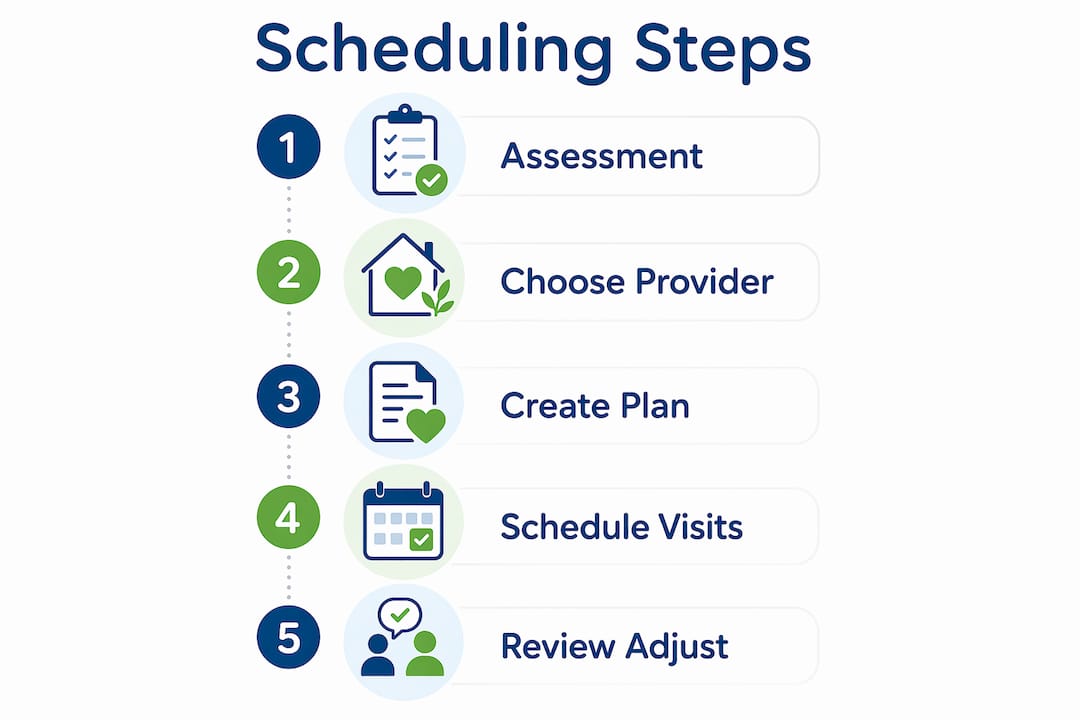
Step-by-step: creating a care plan and scheduling visits
Once you have chosen a provider, the scheduling process moves into its practical phase. This is where daily care visit planning becomes specific and personal.
Deciding visit frequency and duration
Start by mapping your loved one’s daily needs against realistic visit slots. A person who needs help getting up, washing, dressing, and taking morning medication needs at minimum a 45-minute morning visit. Someone who also needs a lunchtime meal and an evening wind-down routine may need three visits per day. Be honest about the time each task genuinely requires. Contracts that specify 15-minute visits for complex care routines are a common and serious mistake.
Holding a care plan meeting
The care plan meeting sets the terms for every visit that follows. Cover these points clearly:
- Specific tasks for each visit (personal care, meal preparation, medication prompts, companionship)
- Preferred times and any non-negotiable routines (e.g., medication must be taken at 8:00 AM)
- Your loved one’s preferences, likes, dislikes, and communication style
- Emergency contacts and what to do if the carer cannot reach the client
- Mobility aids, equipment, and any physical handling requirements
Punctuality is not a minor detail. Communicating clearly about medication timing during the care plan meeting prevents scheduling errors that can have real health consequences.
Setting up a communication log
A physical communication book kept in the home is one of the most practical tools in daily care. A communication log for carers to note visit details improves continuity and alerts families to emerging needs before they become crises. Ask the agency to make entries after every visit, and review the log regularly.
| Visit slot | Typical tasks | Suggested duration |
|---|---|---|
| Morning | Personal care, dressing, breakfast, medication | 45–60 minutes |
| Lunchtime | Meal preparation, companionship, hydration check | 30–45 minutes |
| Afternoon | Activities, social engagement, light tasks | 30–60 minutes |
| Evening | Meal, medication, personal care, settling for bed | 45–60 minutes |
Reviewing and adjusting the care plan
A care plan is not a fixed document. Needs change, sometimes quickly. Build in a formal review every three months, and request an unscheduled review whenever your loved one’s condition changes significantly. Keep a record of any concerns you raise and the agency’s response.
What mistakes should you avoid when planning daily visits?
Families new to scheduling caregiver appointments often make the same avoidable errors. Recognising them early saves significant distress.
- Accepting too many different carers. Consistent carers assigned to daily visits improve safety, wellbeing, and outcomes compared to rotating rosters. Push the agency to limit the number of carers visiting your relative
- Choosing the cheapest option without checking staff stability. Price is not a reliable indicator of quality. Ask about staff turnover before you sign
- Underestimating assessment timelines. The council process takes time. Do not wait for a crisis before requesting an assessment
- Failing to specify punctuality requirements. If medication must be taken at a set time, write it into the care plan explicitly
- Not keeping written records. Verbal agreements with agencies are difficult to enforce. Confirm everything in writing
- Ignoring early warning signs. If the communication log shows missed entries or your loved one seems unsettled, raise it with the agency immediately
“The families who get the best outcomes are the ones who treat the care plan as a living document and stay in regular contact with the agency. Passive oversight leads to drift, and drift leads to gaps in care that are hard to recover from.”
If concerns are not resolved at agency level, you can escalate to the CQC or your local council’s adult social care team. Knowing this option exists gives you real leverage.
Key takeaways
Effective daily care visit scheduling depends on completing the council assessment early, choosing a CQC-registered provider with stable staff, and maintaining a detailed, regularly reviewed care plan.
| Point | Details |
|---|---|
| Start with a council assessment | Request a free care needs assessment from your local borough before approaching any provider. |
| Verify CQC registration and ratings | Check the CQC register and read the full inspection report, not just the headline rating. |
| Prioritise carer consistency | Fewer carers per client means better safety, trust, and continuity of care. |
| Write a detailed care plan | Cover tasks, timings, medication, preferences, and emergency contacts at the outset. |
| Review the plan regularly | Schedule formal reviews every three months and request unscheduled reviews when needs change. |
What I have learned from years of watching families get this right and wrong
Families often come to the scheduling process feeling anxious and underprepared. That is completely understandable. What I have observed, though, is that the families who fare best are not necessarily the ones with the most resources. They are the ones who prepare thoroughly and stay engaged.
The typed summary for the assessment is the single most underused tool I know of. Assessors see dozens of families. A clear, factual two-page document that describes what has changed over the past six months cuts through the noise and produces a better outcome. It takes an hour to write and pays dividends for months.
The relationship with the registered manager matters more than most families realise. An agency’s marketing materials tell you very little. A 20-minute conversation with the manager tells you a great deal. Ask them what they do when a carer calls in sick. Ask them how they handle complaints. Their answers reveal the culture of the organisation.
Finally, I would encourage you to resist the temptation to under-schedule visits to save money. Short visits for complex needs create pressure on carers and risk to your loved one. It is far better to start with the right level of support and reduce it later if circumstances improve than to start too lean and scramble to increase visits in a crisis.
— Dan
How Kells-care supports London families with daily care scheduling
Kells-care has provided personalised home care in London for over 30 years. Every client receives a care plan built around their specific needs, preferred routines, and personal preferences. Kells-care’s carers are fully qualified, DBS checked, and the agency is regulated by the CQC. Whether your loved one needs a single daily check-in or multiple visits throughout the day, Kells-care’s team will help you get the scheduling right from the start. Download the free home care guide for a clear, practical overview of the full process, from assessment through to ongoing care management.
FAQ
What is the first step to schedule daily care visits?
Request a free care needs assessment from your local London borough council. This is a legal right under the Care Act 2014 and forms the foundation for all subsequent care planning.
How long does a council care needs assessment take?
Expect initial contact from the council within 28 days of your request, with a written assessment outcome typically issued within 4–6 weeks.
How many carers should visit my relative each day?
Fewer is better. Consistent carers assigned to daily visits improve safety and wellbeing. Ask any agency to commit to a small, named team rather than a rotating roster.
Does CQC registration mean a provider is high quality?
CQC registration is a legal requirement for all personal care providers in England, not a quality guarantee. Always read the full inspection report and check the current rating before choosing a provider.
How much do daily home care visits cost in London in 2026?
Daily domiciliary care in the UK averages £26–£38 per hour in 2026. Council funding may be available following a care needs and financial assessment, depending on your loved one’s circumstances.