

TL;DR:
- Emergency home care quickly provides short-term support to keep vulnerable individuals safe at home during health crises. Acting in parallel with NHS clinical services ensures rapid stabilization and ongoing personal care, vital for safe recovery or discharge.
If someone you care for has had a sudden fall, been discharged from hospital earlier than expected, or can no longer be left safely alone, emergency home care is the fastest way to keep them safe without a hospital stay. In plain terms, it means short-term, rapid domiciliary support arranged urgently to manage a health or caregiving crisis at home.
Here is what to do in the next hour:
- Life-threatening emergency (suspected stroke, chest pain, not breathing, severe bleeding): call 999 immediately.
- Urgent but not life-threatening (recent fall with no major injury, sudden confusion, medication crisis, carer breakdown): call NHS 111 or your GP, who can refer to an NHS Urgent Community Response (UCR) team. UCR aims to reach appropriate cases within two hours.
- Need for personal care, meals, or daily support that the NHS does not cover: contact a CQC-regulated private agency. Many reputable UK providers can arrange visits within 24–48 hours.
Before you make any call, have these five details ready: the person’s full name and date of birth, a brief medical history, their complete medication list (doses and times), their mobility level, and a short list of immediate care needs such as washing, dressing, or meals.
Table of Contents
- What does emergency home care actually mean?
- Who needs urgent home care? Signs and red flags to watch for
- What types of in-home emergency services are available?
- How quickly can emergency home care start?
- How to arrange emergency home care in the UK
- Costs, NHS involvement, and council funding options
- What should you expect from a reputable emergency home care agency?
- How NHS Urgent Community Response and private emergency home care fit together
- Can a bed-bound person live at home safely?
- What to do when you can’t be a caregiver anymore
- Key takeaways
- A perspective on the first hours of a care crisis
- Kells-care is ready to help London families right now
- Useful sources and further reading
What does emergency home care actually mean?
Emergency home care is rapid, short-term domiciliary support arranged in response to an acute health or caregiving crisis. The goal is to keep the person safe at home, either to prevent a hospital admission or to support a safe return after an early discharge.
It differs from routine long-term care in one important way: speed. Routine care is planned over days or weeks, with a full assessment and matched carer. Emergency home care compresses that process, prioritising safety first and refinement later.
It also differs from immediate medical emergency care. A paramedic or UCR clinician manages the clinical crisis. Emergency home care manages what comes next: the personal care, meals, medication prompts, and supervision that keep someone safe once the acute clinical moment has passed.
Common situations where it applies include:
- A 78-year-old who falls at home, is not seriously injured, but can no longer manage alone while awaiting physiotherapy.
- Someone discharged from hospital after a hip replacement who needs help washing, dressing, and preparing meals for the first two weeks.
- A family carer who is suddenly hospitalised themselves, leaving the person they care for without support.
Who needs urgent home care? Signs and red flags to watch for
Recognising the warning signs early gives you more options and more time to arrange the right support.
Signs that suggest urgent home care is needed:
- A recent fall, even without serious injury, especially if the person lives alone.
- New or worsening confusion, disorientation, or delirium.
- Inability to manage basic daily activities (washing, dressing, preparing food, getting to the toilet).
- Missed medications over several days.
- Unsafe hospital discharge with no care package in place.
- A main family carer who is suddenly ill, injured, or unavailable.
- Rapid weight loss, signs of dehydration, or poor nutrition.
Red flags: call 999 immediately if you notice:
- Suspected stroke (face drooping, arm weakness, speech difficulty).
- Chest pain or difficulty breathing.
- Loss of consciousness or unresponsiveness.
- Severe bleeding or a fall with suspected fracture.
A note on capacity and consent
If the person lacks the mental capacity to make decisions about their care, the Mental Capacity Act 2005 applies. Decisions must be made in their best interests, involving family members and health professionals. If you are unsure whether someone has capacity, ask the GP or the UCR team to assess. Acting in someone’s best interests to keep them safe is always the right starting point.
What types of in-home emergency services are available?
Not all urgent home support looks the same. The right type depends on the person’s clinical needs, living situation, and how long the crisis is likely to last.
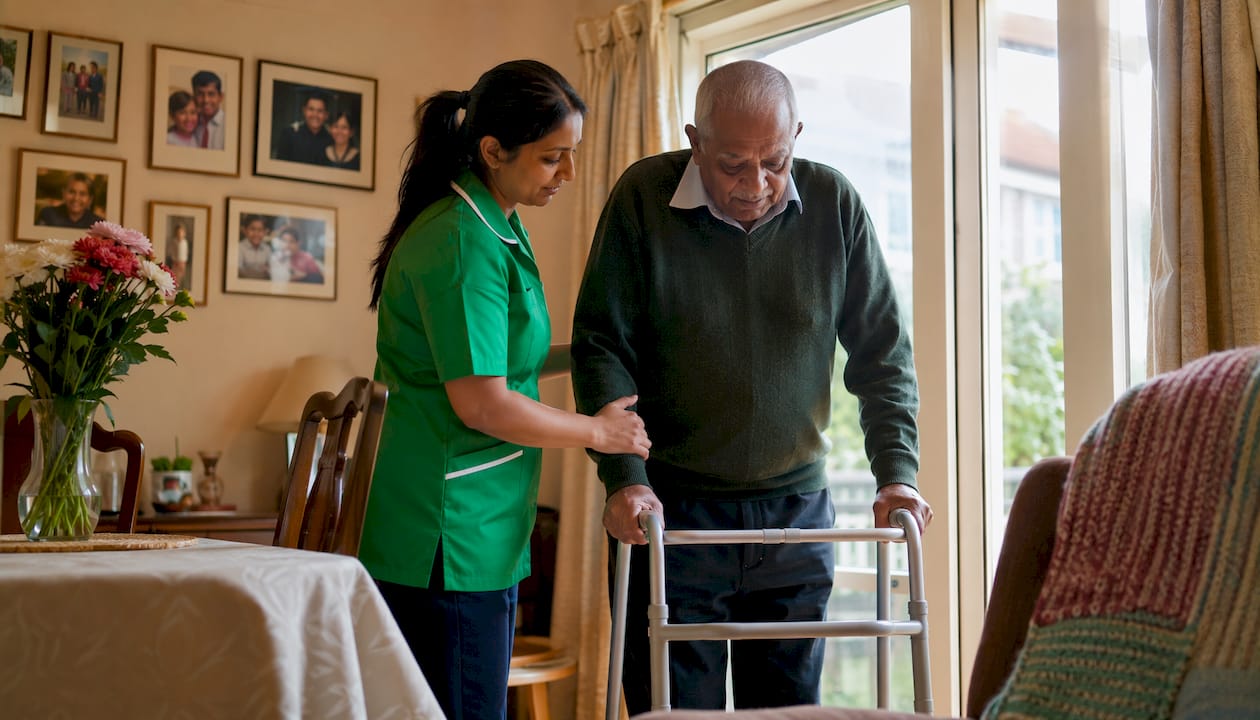
Rapid personal care visits are the most common first response from a private agency. A carer visits once or several times a day to help with washing, dressing, meals, and medication prompts. These can often start within 24 hours.
Live-in emergency cover places a carer in the home around the clock. This suits people who cannot be left alone safely, or where a family carer has suddenly become unavailable. It is more intensive and more expensive, but it removes the gap between visits entirely.
Short-term nursing support is clinical in nature and usually arranged through the NHS, a GP, or a hospital discharge team. Community nurses can manage wound care, catheter care, IV antibiotics, and medication changes at home.
Respite and urgent relief for family carers gives an exhausted or suddenly unavailable carer a break while a professional steps in. This can be a block of daily hours or a live-in arrangement for a defined period.
Palliative and end-of-life input is available when someone is in the final stage of illness and wishes to remain at home. This typically involves a combination of NHS community nursing and private personal care support working alongside each other.
During the urgent phase, you may receive a rapid-response carer who is not a long-term match. Once the situation stabilises, a more carefully matched carer can take over. That transition is normal and expected.
How quickly can emergency home care start?
Response times vary depending on the route you take and the complexity of the situation.

| Scenario | Route | Realistic response time |
|---|---|---|
| Life-threatening emergency | 999 | Immediate |
| Clinical crisis (fall, delirium, diabetic emergency) | NHS 111 / GP / UCR referral | Within 2 hours (UCR standard) |
| Post-discharge personal care needed | Hospital discharge team + private agency | Same day to 24 hours |
| Carer breakdown, personal care only | CQC-regulated private agency | 24–48 hours typically |
| Complex needs requiring equipment | Private agency + OT assessment | 48 hours or longer |
NHS England guidance requires UCR services to reach appropriate cases within two hours where clinically necessary. In practice, NHS data from winter 2024 showed that 85% of UCR patients were seen within two hours in September of that year, consistently above the 70% national target.
For private agencies, a couple of days is a realistic expectation for most personal care arrangements, though some providers can deploy a carer the same day for straightforward cases. Geography matters: London and other cities tend to have more available staff than rural areas. Having your five key details ready at the point of first contact speeds up the intake process considerably.
How to arrange emergency home care in the UK
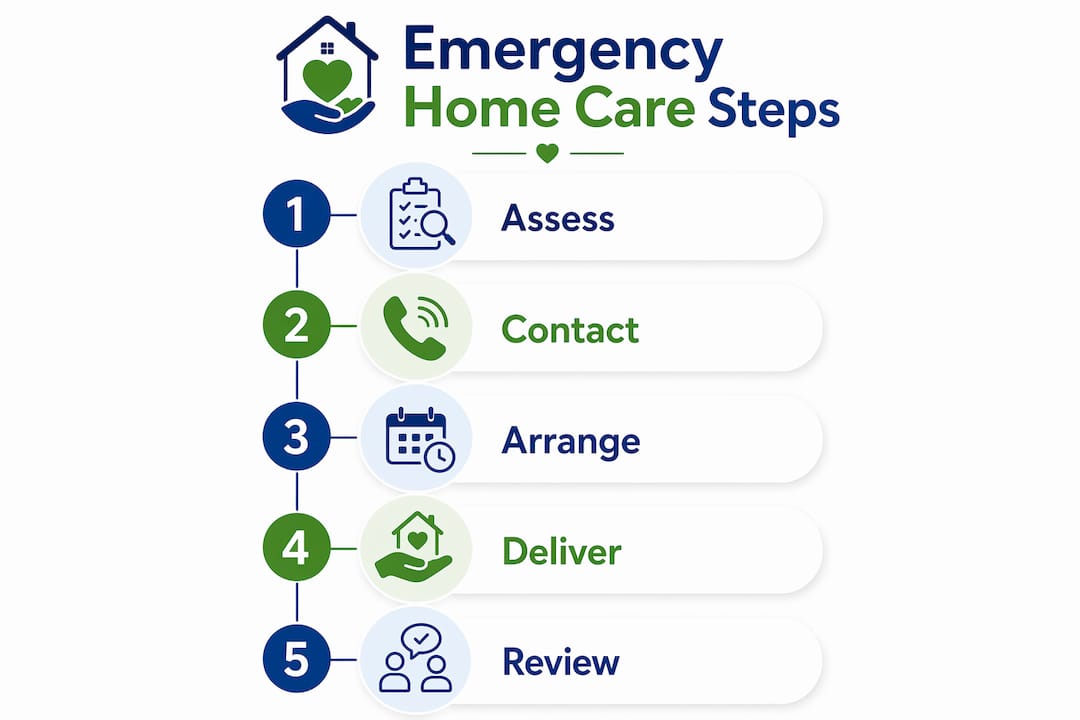
Follow these steps in order, running the clinical and care routes in parallel where possible.
-
Triage the clinical situation first. Call 999 for anything life-threatening. Call NHS 111 or your GP for urgent but non-life-threatening concerns. They can refer directly to a UCR team or a hospital discharge team.
-
Contact the hospital discharge team if the person is already in hospital. Ask specifically about a discharge care package and whether the NHS will fund short-term reablement support. Do not leave the hospital without a plan in writing.
-
Contact your local council’s adult social services. Request a care needs assessment. Councils have out-of-hours emergency duty teams for situations that cannot wait until the next working day. Age UK explains the council assessment process clearly and is a useful first reference.
-
Contact a CQC-regulated private agency in parallel. Do not wait for the council assessment if the person needs care now. Start private care immediately and notify the council; funding eligibility can be reviewed retrospectively. This is often the fastest way to ensure safety.
-
Prepare your information before you call. Have ready: full name and date of birth, medical history summary, complete medication list with doses and times, mobility level (e.g. uses a walking frame, bed-bound), and a list of current care needs.
Questions to ask a private agency on first contact:
- Are you registered with the CQC? What is your current rating?
- Are all your carers DBS-checked and trained?
- How quickly can you start, and what does the first visit include?
- Will I have a written care plan?
- Who do I contact if something goes wrong, including out of hours?
You can verify any agency’s CQC registration and inspection reports directly at cqc.org.uk. For a broader guide to arranging in-home care, the checklist of information to gather and first calls applies broadly regardless of location.
Pro Tip: Start private care immediately if you can self-fund, even partially. Waiting for a council assessment can take days or weeks. Arrange the care first, then request the assessment in parallel. The council can review funding eligibility later, but a gap in care cannot be undone.
Costs, NHS involvement, and council funding options
Understanding who pays for what helps you act faster and avoid unnecessary delays.
NHS-funded care
The NHS UCR service is free at the point of use and covers short-term clinical input: assessment, treatment, medication review, and stabilisation. It is not designed for ongoing personal care such as washing, dressing, or meal preparation. NHS Continuing Healthcare (CHC) is a separate, fully funded package for people with a primary health need, but eligibility assessments take time and are not guaranteed.
Council-funded social care
Local councils in England carry out care needs assessments and means-tested financial assessments to determine whether they will contribute to homecare costs. Eligibility is not universal. If you qualify, the council may fund some or all of your care, or offer a direct payment so you can arrange it yourself. Independent Age’s factsheet on arranging home care sets out the assessment and funding process in detail.
Self-funded care
NHS guidance notes that paid homecare in the UK typically costs in the range of £15–£30 per hour, varying by location and the level of specialist support required. London rates tend to sit at the higher end of that range.
Practical steps to take now:
- Start private care if safety is at risk and you can fund it, even temporarily.
- Request a council care needs assessment as soon as possible; ask specifically about the out-of-hours emergency duty team.
- Ask the GP or hospital team whether the person may be eligible for NHS CHC.
- If the person lacks capacity to manage finances, check whether a Lasting Power of Attorney for property and financial affairs is in place. If not, this may need to be addressed urgently through the Court of Protection. For more detail on paying for home care, Kells-care’s guidance covers the key funding routes for London families.
What should you expect from a reputable emergency home care agency?
Speed matters in a crisis, but it should never come at the cost of safety. A reputable agency will meet these standards even when deploying at short notice.
Trust signals to look for:
- CQC registration and a published inspection rating (Good or Outstanding). You can check any agency at cqc.org.uk. Understanding why CQC matters for elderly and vulnerable people helps you ask the right questions quickly.
- DBS-checked staff. Every carer visiting your home should have a current Disclosure and Barring Service check.
- Trained and qualified carers. Ask about induction training, manual handling, medication administration, and dementia awareness as a minimum.
- A written, personalised care plan produced with the person and their family, even in an emergency context.
- A clear complaints process and a named supervisor or manager you can contact at any time, including out of hours.
What a first emergency visit typically includes:
A rapid initial assessment of the person’s immediate needs and safety risks, a medication check, a basic safeguarding review, and agreement on a short-term care plan. The carer should introduce themselves, explain what they will do, and ask for the person’s consent before providing any care.
Questions to ask when the carer arrives:
- Can you confirm your name and that you are from [agency name]?
- Do you have a copy of the care plan?
- Who is your supervisor, and how do I reach them if I have a concern?
How NHS Urgent Community Response and private emergency home care fit together
NHS UCR and private domiciliary care are not alternatives to each other. They address different parts of the same crisis.
NHS England’s UCR guidance describes UCR as a service for adults experiencing a health crisis that puts them at risk of hospital admission. It covers clinical presentations such as recent falls, diabetic complications, worsening confusion or delirium, catheter problems, and carer breakdown. The two-hour response standard applies to clinically urgent cases; a same-day response is expected for others.
UCR is intentionally narrow in scope. It stabilises the clinical situation. It does not provide ongoing personal care, help with meals, or daily supervision once the clinical team has withdrawn. That gap is where private, CQC-regulated agencies become necessary.
NHS England’s clinical decision-making framework (March 2026) supports integrated teams in treating more acutely unwell patients at home, listing shared decision-making, access to diagnostics, and coordinated community care as key actions. The framework explicitly recognises that clinical stabilisation and personal care support must work in parallel, not in sequence, to keep people safely at home.
In practice, this means a family may need to contact both the NHS and a private agency on the same day. The UCR team handles the clinical assessment and treatment. The private agency handles the personal care that follows. Families should not assume the NHS will manage all aspects of a crisis; daily-living support is routinely arranged through CQC-regulated agencies working alongside NHS community teams.
Can a bed-bound person live at home safely?
Yes, in many cases. The key is having the right equipment, the right level of care, and a realistic assessment of risk.
Conditions that support safe home care for a bed-bound person:
- A profiling bed that allows repositioning to prevent pressure sores.
- A pressure-relieving mattress, which is often available through the NHS or can be sourced privately.
- A hoist for safe transfers, assessed and set up by an occupational therapist.
- Regular carer visits, or live-in care, to manage personal hygiene, nutrition, and repositioning.
- Community nursing input for wound care, catheter management, or medication administration if needed.
Sourcing equipment quickly
Your GP or hospital discharge team can refer to an occupational therapist for an urgent equipment assessment. Some equipment, such as a riser recliner chair or basic bed rails, can be purchased or hired privately within 24–48 hours. For more complex needs, the NHS community equipment service can often deliver within a few days of referral. For families weighing up whether home care is genuinely viable, alternatives to care homes outlines the practical decision points clearly.
When to consider residential or nursing placement:
- The person requires 24-hour clinical nursing that cannot be safely delivered at home.
- Risk cannot be mitigated even with maximum care input and equipment.
- The person themselves expresses a clear wish to move to a care home.
Interim options include short-term respite placements in a care home while a home care package is arranged, or a NHS-funded intermediate care bed for reablement.
What to do when you can’t be a caregiver anymore
If you are the main carer and you can no longer continue, whether due to illness, exhaustion, or a sudden change in circumstances, act on these steps immediately.
Immediate cover:
- Call NHS 111 or your GP and explain that the carer has become unavailable. This triggers a clinical review and may prompt a UCR referral or a social services alert.
- Simultaneously, contact a CQC-regulated private agency and request urgent visits or live-in cover. Most agencies can begin an intake conversation within the hour.
- If the person is at immediate risk and you cannot reach anyone, call 999 and explain the safeguarding concern.
Short-term options to consider:
- Block-booked daily hours from a private agency (e.g. morning and evening visits for two weeks).
- Live-in care for a defined period while a longer-term plan is made.
- An urgent respite placement in a care home, arranged through the local council or privately.
Parallel administrative steps:
- Request a carer’s assessment from the local council. As a carer, you have a legal right to this assessment, and it may unlock additional support.
- Inform adult social services that the care arrangement has broken down. They have a duty to respond.
- Review whether a Lasting Power of Attorney is in place for both health and welfare and property and financial affairs. If not, this is worth addressing as soon as the immediate crisis is managed. For practical guidance on personalising home care once the urgent phase has passed, Kells-care’s guide covers the transition from emergency to longer-term support.
Key takeaways
Emergency home care works best when you act on two routes at once: NHS clinical triage and a CQC-regulated private agency for personal care support.
| Point | Details |
|---|---|
| Call the right service first | Call 999 for life-threatening emergencies; use NHS 111 or your GP for urgent clinical crises to access UCR within two hours. |
| Private agencies fill the gap | NHS UCR covers clinical stabilisation only; personal care, meals, and daily support require a CQC-regulated private agency. |
| Have five details ready | Name and DOB, medical history, full medication list, mobility level, and current care needs speed up every intake call. |
| Start care before the assessment | Arrange private care immediately if safety is at risk; the council can review funding eligibility later. |
| Kells-care for London families | Kells-care is a CQC-regulated, DBS-checked London agency offering urgent care from check-in visits to live-in cover. |
A perspective on the first hours of a care crisis
When a family member calls in a panic because their mother has fallen and the usual carer is in hospital, the instinct is to wait for the NHS to sort everything out. That instinct, while understandable, is the single most common reason people spend unnecessary days in hospital or go without proper support at home.
What actually works is running two calls in parallel. The first to NHS 111 or the GP to get the clinical picture assessed and a UCR referral made if appropriate. The second to a CQC-regulated agency to begin the intake process for personal care. Neither call takes more than ten minutes if you have the five key details to hand. By the time the UCR team has completed their assessment, the agency intake is already underway.
The families who navigate these crises most calmly are not the ones with the most medical knowledge. They are the ones who know which call to make first and what to say when someone answers. That is what this guide is for.
Kells-care has been providing CQC-regulated, DBS-checked domiciliary care in London for over 30 years. That depth of experience means the intake team knows how to move quickly when a family is under pressure, and how to match the right carer to the right situation even at short notice.
Kells-care is ready to help London families right now
When a care crisis hits, you need a provider who can move quickly and safely. Kells-care offers CQC-regulated, DBS-checked home care across London, from brief check-in visits to round-the-clock live-in support. The team has over 30 years of experience placing carers at short notice, and every placement comes with a written care plan and a named point of contact.
To get started, download the free home care guide for an immediate overview of your options, or go directly to Kells-care’s home care services to speak with the team about urgent availability. When you call, have the person’s name and date of birth, their medical history, their medication list, their mobility level, and their immediate care needs ready. That information allows Kells-care to begin matching a carer straight away.
| Service | Typical response | Best suited for |
|---|---|---|
| Rapid daily visits | 24–48 hours | Personal care, meals, medication prompts |
| Live-in emergency cover | 24–48 hours | Continuous supervision, carer breakdown |
| Short-term respite care | 24–48 hours | Family carer relief for a defined period |
This article provides general information only and is not a substitute for professional medical, legal, or financial advice. Always confirm current NHS and council processes with the relevant authority or a qualified professional for your specific situation.
Useful sources and further reading
- NHS England: Urgent Community Response — explains the UCR two-hour standard, clinical scope, and how to access the service via NHS 111 or a GP referral.
- NHS England: UCR clinical decision-making framework — the March 2026 framework for integrated teams treating acutely unwell patients at home; useful for understanding shared decision-making expectations.
- Care Quality Commission (CQC) — search and verify any homecare agency’s registration, rating, and latest inspection report before you engage them.
- Age UK: Homecare guidance — clear explanation of how to request a council care needs assessment and what the financial assessment process involves.
- Independent Age: Arranging home care factsheet — detailed, practical guidance on finding agencies, understanding care plans, and what to do if you are unhappy with the service.
- NHS: Help at home from a paid carer — overview of homecare costs, council eligibility, and how to find a local provider.
- Kells-care free home care guide — a practical downloadable resource for London families covering immediate steps, funding options, and what to expect from a CQC-regulated agency.
- Understanding CQC regulation — step-by-step explanation of CQC ratings and inspection reports, useful when checking a provider at short notice.