
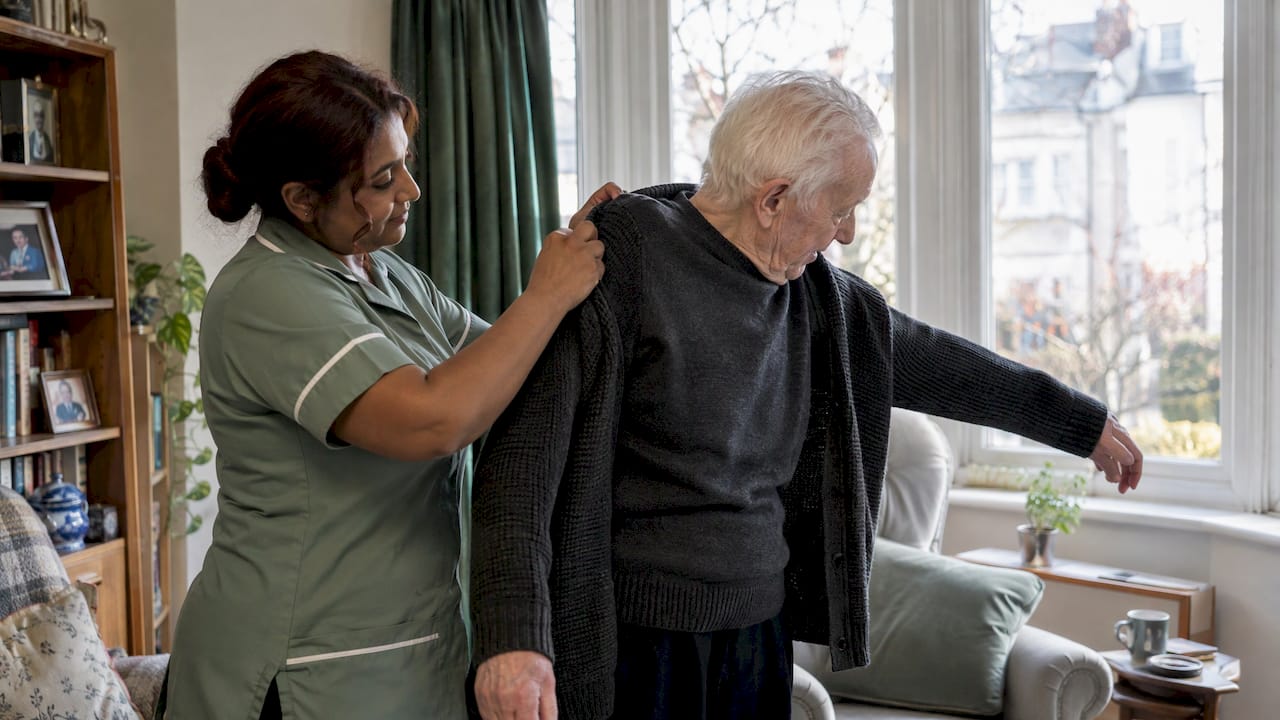
Carer continuity means that the person receiving home care is visited by the same carer, or a small team of carers they know, rather than a different face each time. UK guidance treats it as a basic part of good home care, not a luxury. It builds trust, helps carers notice changes early and makes personal care feel less intrusive. This guide explains what continuity means in practice, what national guidance expects, what can get in its way and what you can ask any provider before you sign an agreement.
TL;DR
- Carer continuity means the same carer or a small, familiar team supports you, with advance notice if anyone new is coming.
- NICE guidance asks providers to prioritise it, to match carers to people openly and to hand over properly when the regular carer is away.
- Familiar carers build trust and are more likely to notice small changes in mood, eating or behaviour.
- Staff turnover, short visits and rota pressure can all weaken continuity, so ask how a provider protects it.
- Before choosing a provider, ask how many carers will visit, how continuity is monitored and what happens during absences.
Table of Contents
- What carer continuity means in home care
- What good continuity looks like day to day
- Why a familiar carer makes a difference
- Perspective
- What can limit continuity
- Questions to ask a provider about continuity
- Home care with a team that knows you
- FAQ
- Sources
What carer continuity means in home care
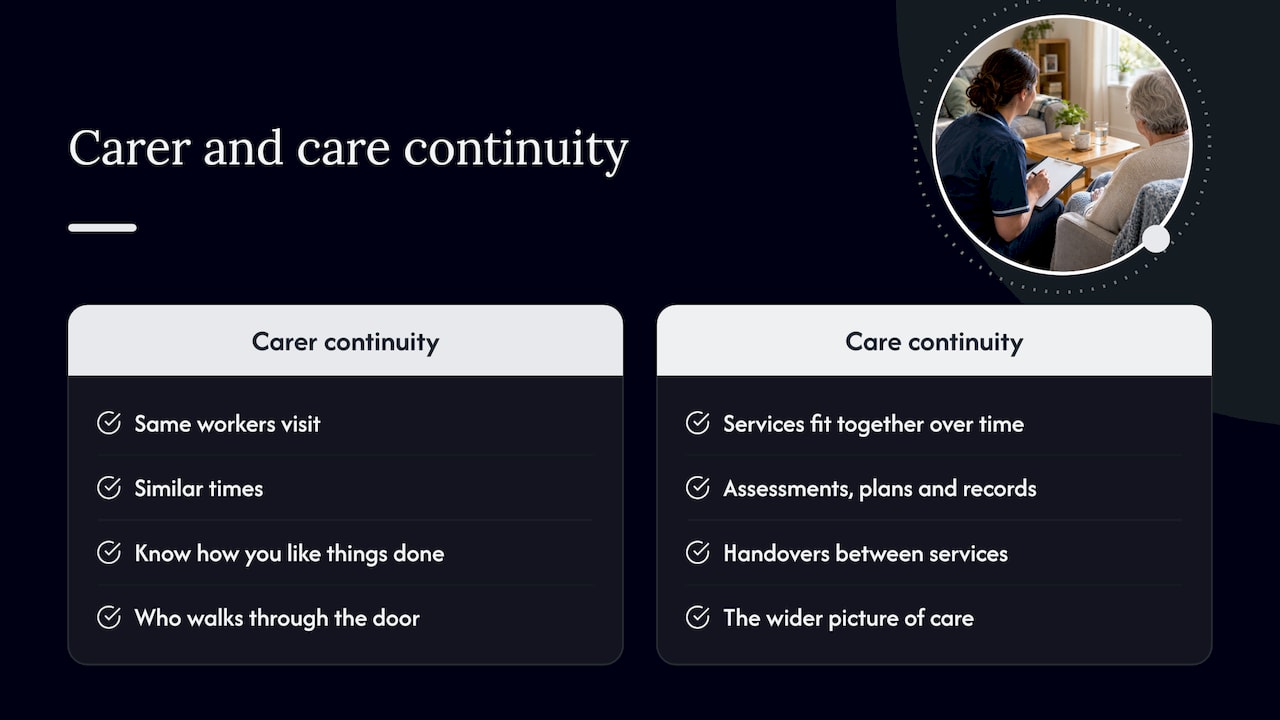
In home care, continuity of carer is simple to describe. You or your relative see the same people, at similar times, who know how you like things done. It is closely linked to “continuity of care”, which is the wider idea that services fit together sensibly over time. The two overlap, but they are not the same thing. Families may also see this described as homecare or care at home.
Continuity of care covers the whole picture: assessments, care plans, records, handovers between services. Continuity of carer is the human part. It is about who actually walks through the door.
NICE puts the first part clearly in its quality standard for home care. Older people using home care should receive care from a consistent team of home care workers who are familiar with their needs, and providers should always tell them in advance if new staff will be visiting. Research on dementia home support makes the same point. The NIHR SSCR findings define continuity as allocating the same care worker or workers to a client to build trusting relationships, and say the service should have enough staff to make that possible.
A note on the search results you may have seen: much of what is written under “continuity of carer” online concerns midwifery, where the phrase describes a maternity model. This article is about home care for adults and children who need support in their own homes.
What good continuity looks like day to day
Continuity is not only a promise on a website. It shows up in specific habits that a provider either has or does not have. NICE’s home care guidance, NG21, sets many of them out.
A clear process for matching carers
NICE NG21 recommends a transparent process for matching care workers to people. That process should take account of the person’s needs, the workers’ skills and, where possible and appropriate, the interests and preferences of both sides. In plain terms, the carer who visits should be chosen for you, not simply whoever is free.
The same guidance asks providers to prioritise continuity by making sure the person is supported by the same worker or workers, so they can become familiar with them. It also recommends:
- introducing the person to any new worker;
- building a team of workers around the person and their family carer;
- telling people in advance about changes in staff and explaining why;
- negotiating changes to care with the person rather than imposing them.
If you are arranging care in London, our page on named carer matching in London explains how we approach this.
Handovers and notes when the regular carer is away
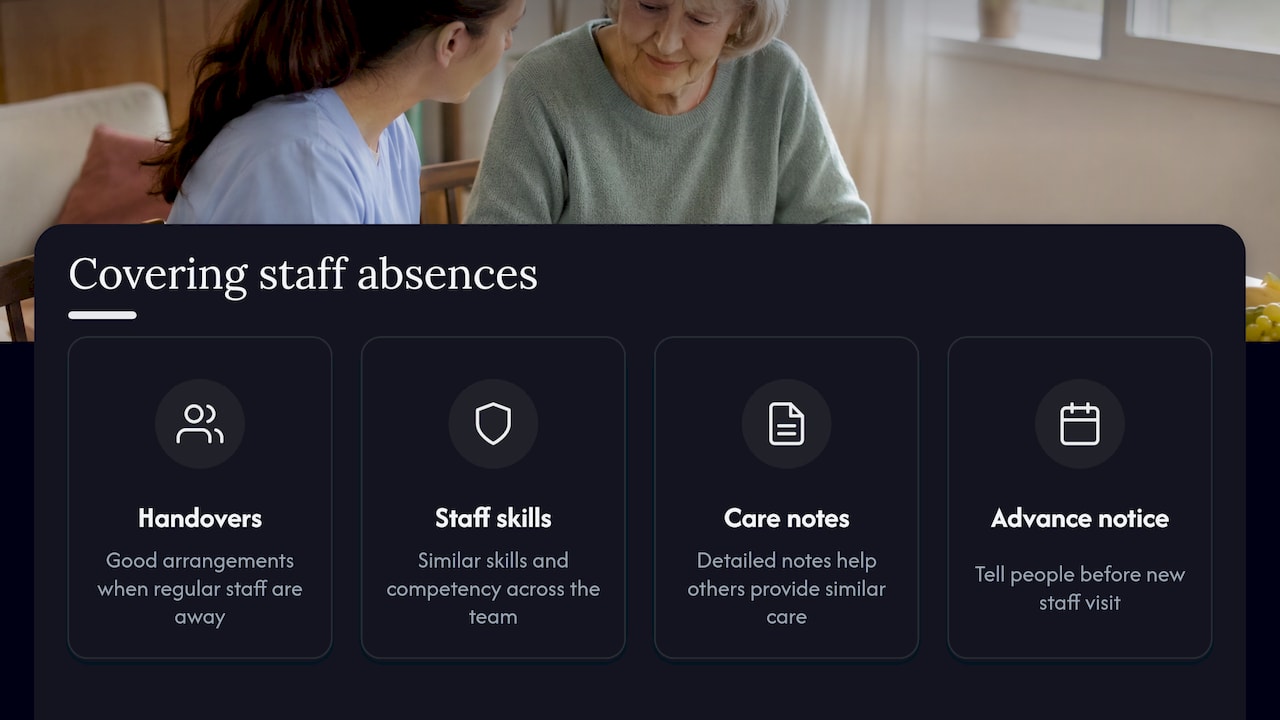
No carer works every day. Good continuity therefore depends on what happens when someone is off. NICE QS182 says that where the same staff are not available, there should be good handover arrangements, and that everyone supporting the person should have similar levels of skills and competency. It also says practitioners should make detailed notes when they provide care, so other team members can care for the person in a similar way, and that people should be told in advance if new staff will be involved.
This is why written records matter as much as rotas. Our guide to what good care visit reports include shows what a useful record contains, and why it helps a stand-in carer pick up where the regular carer left off.
Rotas built with continuity in mind
Continuity is partly a scheduling matter. A local authority example makes this concrete: Nottingham City Council’s quality monitoring framework for home care expects that rotas are managed with continuity of carer in mind, runs are kept fixed as far as possible and travel time between calls is allowed for. It also expects the choice of support worker to reflect the person’s preferences and needs alongside the worker’s skills and strengths. Although this is one council’s standard, it describes what a well-run provider anywhere should be aiming for.
Skills for Care has also described how neighbourhood-based working helps. In its practical approach on block-pay models, it reports that a provider working with commissioners on a neighbourhood model improved workforce stability and retention, and that neighbourhood-based care increases continuity and leaves more time for meaningful support rather than travel. Keeping carers close to the people they visit is one reason a London-based agency can offer a steadier team.
Why a familiar carer makes a difference
The evidence for continuity comes from official standards, research and the experience of people receiving care.
Trust, confidence and a sense of safety
NICE explains that continuity promotes person-centred care. When the person knows their workers, it builds confidence and a sense of safety. When workers know the person, they better understand needs and preferences, communicate well, deliver care the way the person wants it and respond to risks or concerns.
This matters most for personal care, which is intimate. Being washed or dressed by someone you know is very different from being helped by a stranger. If you want to see what a routine looks like in practice, see our guide to personal care routines for caregivers.
Wellbeing and quality of life
NICE’s quality standard on people’s experience of adult social care says that continuity has a considerable impact on a person’s wellbeing and quality of life, because it can lead to positive relationships with care workers. Steady, supportive relationships help in other parts of health too, and the benefit of consistent contact is also discussed in this look at ongoing nutrition support results for UK adults.
For a longer discussion of why this matters for older people specifically, read our article on why continuity of care is important for elderly patients.
Noticing small changes early
A 2025 article in Futures of Work describes a person upset because she had seen ten different caregivers in a single week. The same piece notes that good continuity allows carers to pick up on small changes in behaviour, eating habits or general wellbeing that an unfamiliar face is unlikely to notice.
For families, that early noticing can be the difference between a quick call to the GP and a crisis. If you are worried about memory, our list of signs of dementia in seniors is a good place to start.
Dementia, disability and mental health needs
For people living with dementia, familiarity does particular work. A 2019 study by Sutcliffe and colleagues in the Journal of Long-Term Care found that matching care workers to clients with dementia led to a more personalised approach by increasing consistency and continuity. Managers in the study described using information from the assessment to choose a suitable carer as a way of encouraging a close, trusting relationship that helps maintain the client’s wellbeing.
Other settings show similar thinking:
- Reablement. SCIE says that consistency of workers is important so a relationship can be built and progress properly monitored.
- Breaks for family carers. SCIE also says continuity of staff is important to build trust, and that family carers may need reassurance before they feel able to trust someone in their home.
- End of life. Skills for Care research on key worker competences found that domiciliary care workers can provide continuity for the person and their family.
The same principle applies to adults and children with learning disabilities, autism or mental health needs, where predictable faces and routines often matter a great deal. Our pages on learning disabilities at home and the autism care workflow look at this further.
Perspective
For over 30 years we have provided home care across London, and the lesson we return to most is that people do not remember a rota, they remember who came.
We build care around the person. That means choosing carers with your needs, preferences and routines in mind, introducing them properly and keeping the team small enough for real familiarity to grow. Our carers are qualified and DBS checked, and we are regulated by the CQC. Those are the foundations, but trust is built visit by visit.
Whether you need call-in visits, live-in care, dementia support or respite cover, we aim to protect independence, dignity and freedom of choice. A familiar carer is one of the most practical ways we do that. We would rather talk to you honestly about how we will keep your team consistent than promise you something vague.
Dan
What can limit continuity
Continuity depends on staffing, funding and scheduling, so it helps to understand the pressures. Knowing them lets you ask better questions.
Staff turnover and structural pressures
Research on home support for people with dementia reports that services work within significant structural constraints arising from partnership issues and commissioning policies. One manager reported taking on eight care workers and losing four each month. The same findings note that poor pay and conditions can discourage staff from staying in post. Sutcliffe and colleagues reported a turnover rate of almost 38% among care workers in the services they studied.
That is the sector picture. What you want to know is how a particular agency responds to it: how it recruits, how it keeps carers and how it plans cover.
Visit length
Short visits make continuity harder, because there is less time to build a relationship and to hand over. The Nuffield Trust notes that shortening home care visits can make it difficult for carers to provide the care and support people need. NICE’s position is specific: visits shorter than half an hour should be made only if the worker is known to the person, the visit is part of a wider package of support and it allows enough time for specific, time-limited tasks or a safe-and-well check.
We have written two practical guides on this: how to document, negotiate and monitor 30 minute visits and what to expect from a first home care visit.
Changing needs
The Nuffield Trust also notes that as dementia advances, a person’s needs may become too complex for home care services alone. That is a reason to review the plan regularly with your provider, and to talk early about options such as live-in care, which keeps one or two carers in the home. Our dementia live-in care guide covers typical costs, and our page on live-in carer breaks and handover explains how continuity is protected when the live-in carer takes time off.
Questions to ask a provider about continuity
You can bring these questions to an assessment or a first phone call. They draw on national guidance and on the way councils write continuity into their contracts.
- How many different carers will visit? Wandsworth Borough Council’s home care specification, for example, requires the provider to limit the number of care workers assigned to an individual to a minimum and reasonable level, particularly where personal care is delivered. It is a fair benchmark to raise with any agency.
- How are carers matched to me or my relative? Ask whether the process considers needs, skills and preferences, in line with NICE NG21.
- Will you tell us in advance about changes? Both NICE standards say people should be told beforehand if new staff will be involved.
- What happens when the regular carer is on leave or sick? Ask about handover, written notes and who steps in.
- How do you keep an eye on continuity? Good providers review rotas and carer changes, and talk with the person receiving care about how it is going.
- How often is the care plan reviewed? Needs change, especially with dementia, so the team and the plan should be revisited.
A short checklist for your own preparation can also help. Our guide to preparing your home for carers covers safety, medicines and privacy, so that a new carer can settle in quickly. A broader explanation of the job is in understanding the role of home carers for London families.
Make your preferences known
Continuity works best when you help shape it. Tell the provider about the times of day that suit you, whether you prefer a male or female carer, what language you want spoken, which routines matter and what you dislike. Our article on personalising home care for your loved ones gives examples. Passing on those details early means a new carer starts with knowledge, not guesses.
Home care with a team that knows you
If you are looking for home care in London, we can talk through how we would match carers to you or your relative and how we would keep the team steady. We offer call-in visits, live-in care, dementia care, personal care, companionship, medication assistance, respite cover and support for adults and children with disabilities or mental health needs. Our carers are qualified, DBS checked and the agency is regulated by the CQC.
See our full range on the home care services page, or contact us through Kells Domiciliary Care to arrange a conversation about your situation.
FAQ
What does continuity of carer mean in home care?
It means the same carer, or a small team of carers who know you, provide your support. They learn your needs, preferences and routines, and you are told in advance if someone new will visit. NICE guidance asks providers to organise care this way.
Is continuity of carer the same as continuity of care?
No, though they are linked. Continuity of care is the wider idea that assessments, plans, records and handovers fit together over time. Continuity of carer is about the people who actually deliver your care and whether they are familiar to you.
What happens if my regular carer is away?
A good provider arranges a stand-in who has been briefed, has read the care notes and has similar skills. NICE says there should be good handover arrangements and that people should be told in advance if new staff will be involved. Ask your provider how this works before care starts.
Can a provider guarantee the same carer every visit?
No provider can promise that, because carers take leave and fall ill. What you can expect is a small team, careful matching, advance notice of changes and written handovers. Ask how your provider will do each of these.
Do shorter visits affect continuity?
They can, because there is less time to build a relationship. NICE says visits under half an hour should happen only when the carer already knows the person and the visit is part of a wider package of support. If your plan includes short visits, ask who will attend and how they will be recorded.
Sources
- NICE QS123, Quality statement 3: Consistent team of home care workers
- NICE NG21, Home care recommendations
- NICE QS182, Quality statement 3: Continuity of care and support
- NIHR SSCR, Home support for people with dementia
- Nottingham City Council, Quality Monitoring for home care and extra care
- Skills for Care, Neighbourhood-based block-pay
- Futures of Work, Continuity and change in the homecare sector
- Sutcliffe et al., Delivering Personalised Home Care for People with Dementia
- SCIE, Reablement: a guide for carers and families
- SCIE, Providing carers’ adult carers’ breaks
- Skills for Care, Developing key worker competences for domiciliary care workers
- Nuffield Trust, Dementia and social care
- Wandsworth Borough Council, Domiciliary home care services specification
- FoodConnection, Ongoing nutrition support results