A good care visit report is a short, factual record written at every visit. It says what care was given, how the person was, and anything that changed or went wrong. It is only useful if it is accurate, written the same day and read by the people who need it. This guide explains what a visit report should contain, how you can brief agency carers so the notes reflect the real person, who is allowed to see them, and what to do when a visit is late, missed or does not follow the plan.
TL;DR
- Every visit should leave a written record in a care diary: what was done, how the person seemed, and any incident or change.
- Brief the carers in writing. Families often hold outdated or partial information, so agree one up-to-date care plan instead of passing details by word of mouth.
- The care plan belongs to the person receiving care. Share notes with relatives only with their consent, unless a safeguarding concern means information must be passed on.
- A late or missed visit should trigger the response set out in the care plan, and the provider should record and monitor it.
- Unresolved concerns go to the provider’s complaints process first. Abuse or neglect goes to the local authority safeguarding team or the CQC.
Table of Contents
- What a care visit report should include
- Changes a carer should record and escalate
- How to brief agency carers properly
- Who can see the notes: consent and confidentiality
- When a visit is late, missed or too short
- Reviews: where reporting becomes better care
- Our view on visit reporting
- Raising a concern about the care
- How we can help
- FAQ
- Sources
What a care visit report should include
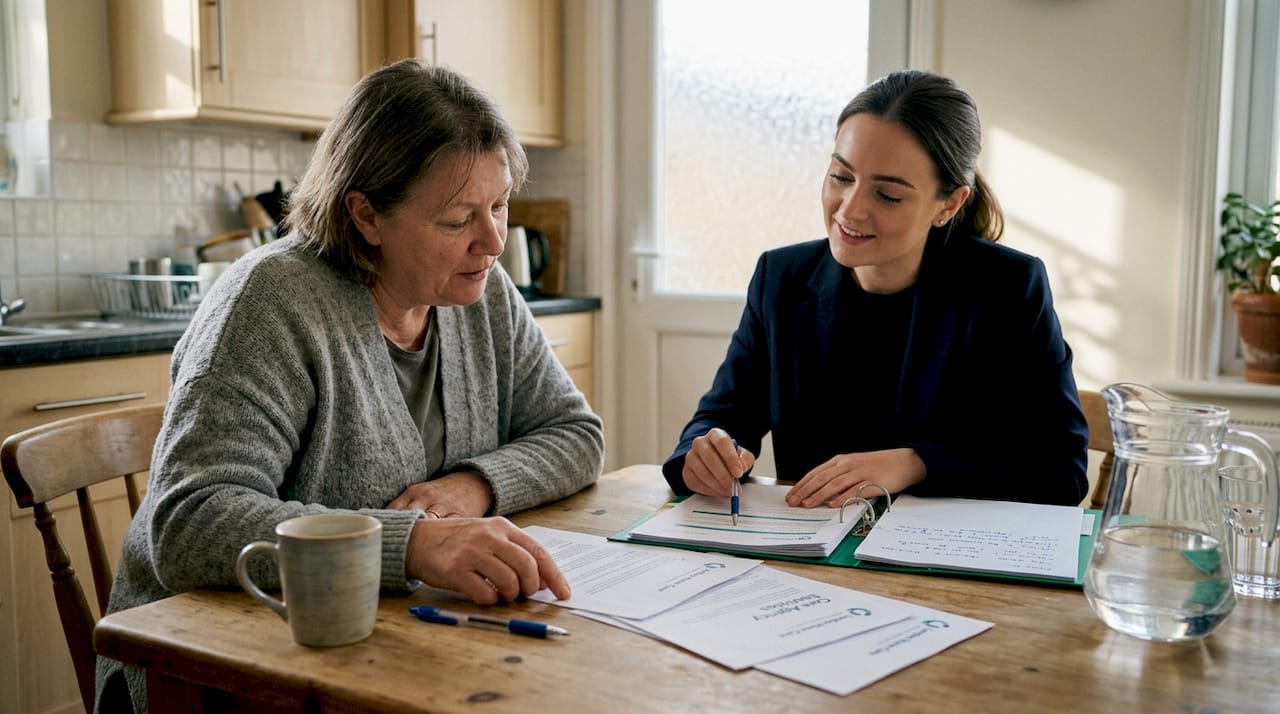
NICE describes a care diary, also called a care record, as a detailed log of all the care and support given. It should record the person’s needs, preferences and experiences, and note incidents or changes. It should be complete enough to keep the person, their carers and professionals informed, and easy for all of them to use. The same NICE resource says the diary should be filled in at each visit.
In practice, a useful visit entry answers six questions:
- Who and when? The carer’s name, arrival and departure times, and the date.
- What was done? Personal care, meals and drinks, medication prompts or assistance, mobility support, shopping or household tasks, matched to the tasks in the care plan.
- How was the person? Mood, alertness, appetite, comfort, skin, mobility, and anything different from their usual self.
- What did they say or choose? Preferences and refusals matter. If someone declined a wash or a meal, the note should say so and what was offered instead.
- Was anything unusual? A fall, a near miss, a new bruise, confusion, a visitor, a delivery that did not arrive.
- What needs to happen next? Supplies running low, a call to the GP, something for the next carer to check.
Good entries are plain and specific. “Ate half of the soup, drank two cups of tea, said her left knee was sore when standing” tells the next carer far more than “fine today”.
Why copied notes are a risk
The quality of notes is something the CQC looks at. In one enforcement case, inspectors found that a home care service shared personal information and documents with staff through WhatsApp, which did not protect people’s privacy. They also found staff sometimes copied and pasted daily notes, so the record no longer reflected the care given that day.
Two lessons follow for families. First, ask how notes are recorded and stored. Second, read a few entries now and then. If every day reads identically, ask the provider how entries are written and checked.
Changes a carer should record and escalate
There is no single official list, and the right threshold depends on the person. What counts as a change is set by what is normal for them, which is why the care plan and a good briefing matter. As a family, you can ask the provider to agree with you what should be written down and what should trigger a same-day phone call.
Common examples worth discussing:
- Physical changes: a fall, new pain, swelling, a skin mark or sore, poor appetite or thirst, changes in continence or sleep.
- Thinking and mood: new confusion, unusual agitation, withdrawal, distress, or a change in how someone responds to familiar routines. These matter particularly with dementia, autism and mental health conditions.
- Home and safety: a cooker left on, no food in the house, a broken lock, a heating failure, medication not taken as planned.
- Safeguarding signs: unexplained injuries, fear of a particular person, missing money or belongings, or a person telling a carer they are being harmed.
An emergency is always a phone call to 999, not a note in a diary. For everything else, the diary records it and the carer tells the office or the named contact at the time.
If you want to see how concerns about abuse and neglect are handled, our guide on safeguarding in care for families sets out the process.
How to brief agency carers properly
The notes a carer writes are only as good as what they were told at the start. A US study of information sharing in home care found that relying on family members for medical information can leave knowledge gaps, because relatives may not know every diagnosis. It also found that without a standard way of recording routines and preferences, staff may rely on family information that is out of date or inaccurate. The study is from the United States, but the lesson applies to any home care arrangement.
A written briefing fixes this. Before the first visit, put together:
- A one-page profile: name they like to be called, background, interests, family and important people, what calms or upsets them.
- Daily routine: waking and bedtime, meals and drinks, what they like to eat, how they take tea, favourite programmes.
- Health information: diagnoses, allergies, medicines and who prescribes them, GP and district nurse contacts. Check these with the GP surgery or a recent hospital letter rather than memory.
- Communication: hearing aids, glasses, language, how the person shows pain or distress, what to avoid saying.
- Risks: falls history, wandering, choking risk, behaviours that challenge and known triggers.
- Contacts: who to call first, who to call if you cannot be reached, and the order to follow.
Hand it over in writing, then review it after the first two weeks. Routines change, and a briefing that was right in March may be wrong by June. Our guide on communicating with carers covers how to keep that conversation going, and our piece on personalising home care shows how a profile feeds into the plan.
Briefing for complex needs
For someone with dementia, a learning disability, autism or a mental health condition, consistency matters as much as the paperwork. NICE says older people should receive care from a consistent team of workers who are familiar with their needs. Ask the provider how many different carers are likely to visit, and how a new carer is introduced and briefed before working alone.
For children and young people, an Education, Health and Care Plan can shape what home support looks like. Our guide to how an EHCP can secure home care for your child explains the link.
Who can see the notes: consent and confidentiality
Families often assume they can read everything. The position is more careful than that. SCIE guidance says a care plan belongs to the person and should be shared with others only with their consent, where they have the capacity to give it. Care planning should be a conversation in which the person keeps ownership of their plan and decides how it is shared. Where someone lacks capacity for a particular decision, the Mental Capacity Act framework applies, and decisions are made in their best interests, involving the people close to them.
Practical steps:
- Ask the person, at the start, who should receive updates and in what form (phone call, message, access to the diary).
- Write the answer into the care plan, with names.
- Review it if circumstances change, for example after a hospital stay.
If a relative is struggling with how to talk about difficult subjects such as mental health, resources on supporting a loved one with mental health concerns can help you prepare for conversations about sharing information and support.
Carers cannot promise secrecy
There is an important limit. SCIE says an individual employee cannot give a personal assurance of confidentiality, and safeguarding concerns should be shared in line with the organisation’s policy. The same guidance says an organisation’s own management interests should not override the need to share information to protect adults at risk of abuse. In short, if a carer sees something that suggests harm, it is reported, whatever has been agreed about privacy.
When a visit is late, missed or too short
NICE says the home care plan should set out how the provider will respond to a missed or late visit. That includes how and when the person and their carers are told, emergency contact details, and arrangements for a family member, carer or neighbour to visit instead, plus an assessment of risk. Providers should monitor missed and late visits and report them to the commissioner.
What you can do:
- Check the plan first. Does it say who rings you and by when? If not, ask for it to be added.
- Phone the office or on-call line as soon as a visit is late. Note the time you called and who you spoke to.
- Keep your own short log. Date, scheduled time, actual arrival, what was missed, what you were told. Dates and times make a complaint far easier to investigate.
- Ask for the incident record after a missed visit.
One local authority procedure shows what a serious response looks like. For a completely missed call, Derbyshire’s procedure says the registered manager decides whether a safeguarding referral or CQC notification is needed, and an incident record must be completed. It is one council’s document, but it gives you a fair idea of what to expect from a well-run service.
Technology and accountability
Electronic visit monitoring can help. CQC inspectors found governance failures at one London service that left a pattern of late and missed calls unaddressed. At a later assessment, an upgraded electronic monitoring system had eliminated missed care visits. Ask any provider how it knows a visit has started and ended, and who reviews the data.
Short visits are a related concern. If the planned time seems too tight to do the tasks properly, our guides on documenting, negotiating and monitoring 30-minute visits and what to expect at a first visit walk through it.
Reviews: where reporting becomes better care
Notes are only worth the time if somebody reads them. The CQC found that one south-east London service did not always involve people and families in care decisions or hold regular reviews to check needs were being met, and that care plans and risk assessments were missing or lacked detail.
Ask for these as standard:
- A review soon after care begins, then at regular intervals and after any hospital stay or fall.
- A named person at the agency who reads the diary entries and spots patterns.
- A way for you to add information, such as a change in medicines or a bad night.
If you are also trying to understand how the regulator inspects these things, see the CQC’s role in home care and why the CQC matters for elderly and vulnerable people.
Our view on visit reporting
We have provided home care in London for over 30 years, and our view is simple: a visit report is part of the care, not paperwork after it.
The best reports start before the first visit. When a family gives us a clear picture of routines, preferences and what a good day looks like, our carers can write notes that mean something to the next person who reads them. We encourage families to tell us what they want to hear about, and how quickly.
We believe reporting should protect dignity and independence. The person receiving care decides, as far as they can, who sees their information. Our care is personalised around the individual, delivered by qualified, DBS-checked carers, and we are regulated by the CQC.
If something changes, we would rather you ask us about it early. A short conversation about a note is far better than a worry that grows.
Dan
Raising a concern about the care
Sometimes a report, or the absence of one, tells you something is wrong. Where to go depends on who arranged the care. Age UK explains that if the local authority arranged it, you can complain to the council; if you arranged and fund it privately, you can use the provider’s own complaints procedure. If that does not resolve it, you can ask the Local Government and Social Care Ombudsman to consider the complaint.
Abuse or neglect is different. Age UK advises that these concerns should be reported directly to the local authority’s safeguarding team or the CQC, not left to a complaints process. If someone is in immediate danger, call 999.
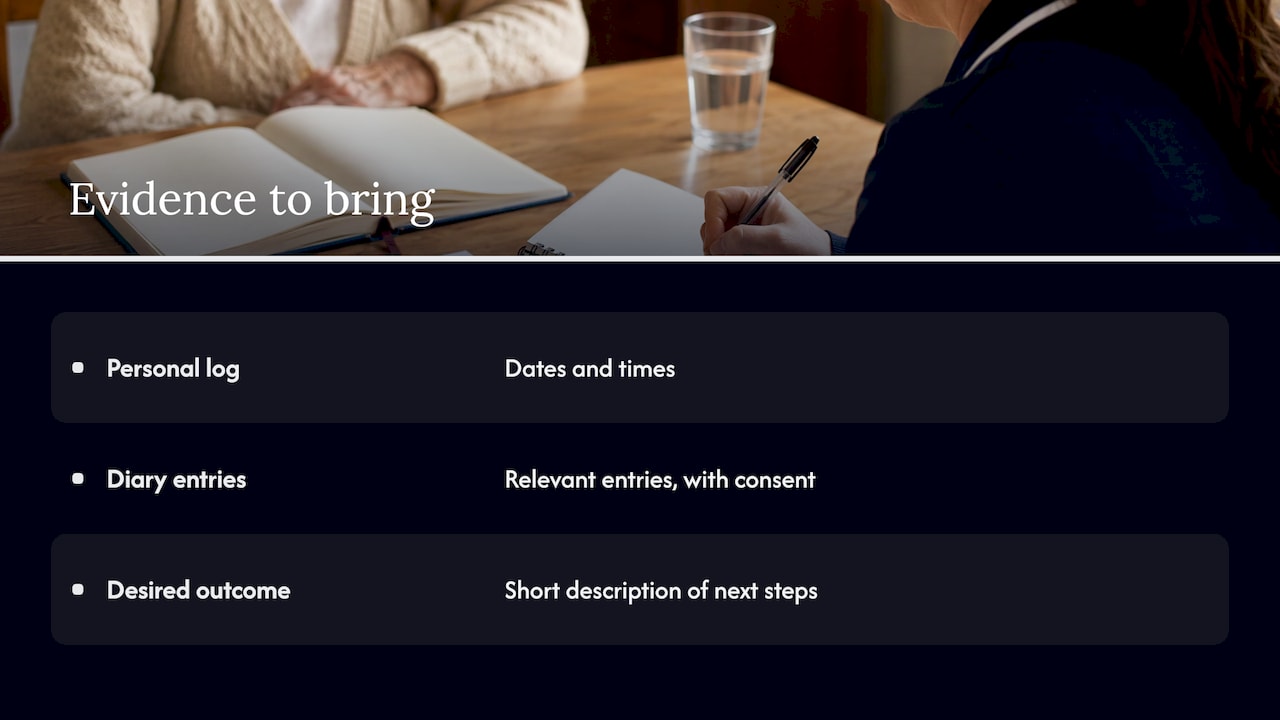
Whatever route you take, bring your evidence: your own log of dates and times, copies of relevant diary entries (where the person has consented), and a short description of what you want to happen next.
How we can help
If you are arranging care in London and want clear communication built in from the start, we can talk through your needs, the visit pattern and how you would like to be kept informed. Our services include call-in visits, live-in care, dementia care, support for adults and children with disabilities or mental health needs, and respite cover. You can see the range on our home care services page, or start from our main site to get in touch.
FAQ
How often should a carer write a visit report?
At every visit. NICE says care diaries should be filled in on each visit, so that the next carer, the family and other professionals have an up-to-date picture. Entries should be written the same day, not reconstructed later.
Can I read my parent’s care notes?
Only with your parent’s consent, if they have the capacity to give it. The care plan belongs to the person, and they decide who sees it. If they lack capacity for that decision, it is made in their best interests, usually with those close to them involved.
What should I do if a carer does not turn up?
Phone the agency’s office or on-call number straight away and follow the arrangements in the care plan, such as a neighbour or relative checking in. Note the time and who you spoke to, then ask for the incident record afterwards. If someone is at risk, call 999.
Who do I contact if I think a carer is neglecting my relative?
Report suspected abuse or neglect to your local authority’s safeguarding team or to the CQC. For a complaint about the quality of service, start with the provider’s complaints procedure if you pay privately, or the council if it arranged the care.
Sources
- NICE: Communication, Home care tools and resources
- NICE: Home care for older people quality standard
- CQC: action to protect people supported by My Homecare
- CQC: action to protect people using a south-east London care service
- CQC: Allfor Care Croydon inspection reports
- Derbyshire: home care failed, aborted and missed calls procedure
- SCIE: Care planning, involvement and person-centred care
- SCIE: Safeguarding adults, sharing information
- Age UK: How to resolve problems and complain about social care
- Age UK: Safeguarding older people from abuse and neglect
- Information sharing in home care (PMC study)