Caring for someone who is bedbound at home comes down to five things: keeping their skin healthy, moving them safely, keeping them clean and comfortable, making sure they eat and drink well, and getting the right professionals and equipment involved early. You do not have to do it alone, and you should not try to do all of it without training. This guide explains each part in plain terms, with advice from NHS, NICE and national charity sources, and shows where a regulated home care team can share the load.
TL;DR
- Reposition people at risk of pressure ulcers at least every 6 hours, and those at high risk at least every 4 hours, as NICE guidance recommends.
- Never take most of the person’s weight yourself. Ask an occupational therapist, physiotherapist or district nurse to show you how to move someone safely.
- Check skin daily over the heels, hips, elbows and tailbone, and contact a GP if you suspect a pressure ulcer.
- Ask your council for an occupational therapy assessment and a carer’s assessment. Both are free routes to equipment and support.
- Regular visits, overnight care or live-in care can take pressure off family carers. Our CQC-regulated team can talk through what suits you.
Table of Contents
- Making daily life comfortable and dignified
- Keeping clean: washing, continence and bedding
- Preventing pressure sores
- Moving and repositioning safely
- Food and drink in bed
- Equipment and assessments in London
- When to get urgent medical advice
- Our perspective
- How Kells can support you at home
- FAQ
- Sources
Making daily life comfortable and dignified
Being in bed all day can feel isolating and frightening, so small routines matter. Marie Curie suggests calm communication, a bell or monitor for calling help, a visible clock, good ventilation and consistent day and night routines to support comfort and orientation.
Some practical habits that help:
- Open curtains in the morning and dim lights in the evening, so day and night feel different.
- Keep a bell, phone or monitor within easy reach, so the person can call you without worry.
- Place a clock and calendar where they can see them.
- Offer choices every day: what to wear, what to listen to or watch, when to wash.
- Spend time simply talking, reading aloud or looking at photographs.
Carers First recommends light exercise such as gentle stretches, emotional support and companionship, and letting the person choose their washing preferences and entertainment. Choice is the heart of dignity. Even when a person cannot do much physically, deciding things for themselves keeps a sense of control. Always check with a GP, nurse or physiotherapist before starting any stretches or exercises.
If you want to shape care around a person’s habits and wishes, our guide on personalising home care services shows how to set that out. This is often called homecare or care at home, and the right support should reflect the person’s daily routine.
Keeping clean: washing, continence and bedding
The NHS gives a clear baseline. Wash hands after toileting, wash the face and genitals or bottom daily, bathe or shower at least twice weekly, and brush teeth twice daily. Ask the person how they like to be washed and let them do as much as they safely can.
For someone who cannot get to a bathroom, the washing routine moves to the bedside. Useful options include no-rinse washes, dry shampoo and rinse-free single-use sponges, which keep water and bedding changes to a minimum.
Continence
Continence needs sensitive handling. The Independent Living Centre explains that it may be managed with a commode or urinal, absorbent close-fitting pads and absorbent bed sheets, and warns that wet pads or damp surfaces can damage skin. Change pads promptly and keep skin dry.
The NHS advises speaking to your GP, who can refer to continence specialists, occupational therapists, physiotherapists or dietitians. A continence adviser may provide bed covers, pads or waterproof pants, and social services may provide commodes. If the person has a catheter, our guide to safe catheter care at home covers the daily habits.
Bedding and the room
Change bedding whenever it is damp or soiled. Smooth out creases beneath the person, because folds in sheets and clothing press into skin. Keep the room well ventilated and tidy enough that equipment, pathways and the call bell are always reachable.
For more on washing, dressing and grooming routines, see our guide to personal care routines for caregivers.
Preventing pressure sores
Pressure sores, also called pressure ulcers, are the biggest skin risk for anyone who spends long periods in bed. NHS inform says they commonly develop over the heels, elbows, hips and tailbone. Risk assessment looks at general health, mobility, posture, signs of infection, previous ulcers, continence, diet and circulation.
How often to reposition
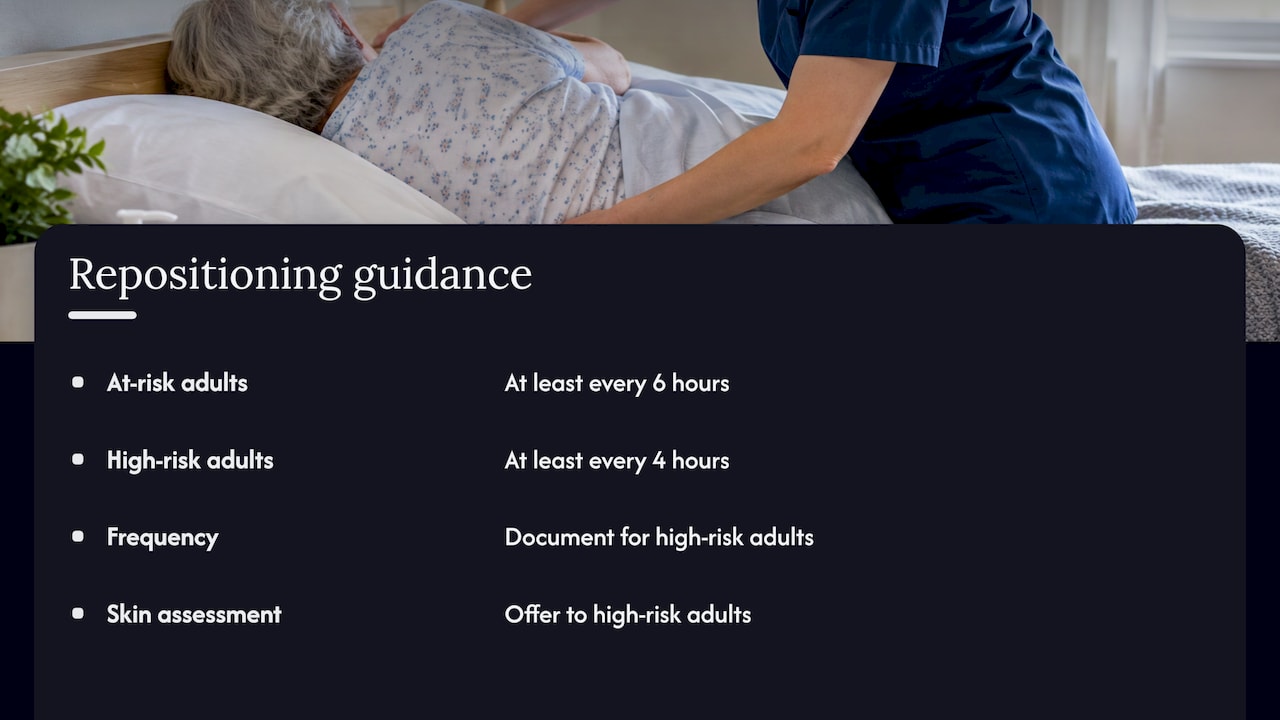
NICE recommends that adults at risk change position frequently and at least every 6 hours, or get help with repositioning and suitable equipment if they cannot move themselves. Adults at high risk should be repositioned at least every 4 hours, with the frequency documented. Those at high risk should also be offered a trained skin assessment.
NICE’s quick guide adds that high-risk people should have a written care plan, including extra pressure relief such as a high-specification foam mattress or cushion where needed.
A simple daily skin routine
- Check the skin at every wash and every position change, especially the heels, hips, elbows, shoulders and tailbone.
- Look for skin that stays discoloured when pressed, feels warm, spongy or hard, or hurts. NHS inform lists these as warning signs.
- Keep skin clean and dry, and use pillows to keep knees and ankles from pressing together.
- Do not rub or massage the skin to prevent ulcers. NICE specifically says not to massage or rub skin for this purpose.
- Write down when and how the person was turned. A simple chart on the wall works well, especially when several people share care.
Moving and repositioning safely
This is where families most often hurt themselves or the person they care for. Marie Curie is clear that carers should not support all or most of another person’s weight, and should only help someone stand, walk or get out of bed once an appropriate health professional has shown them how.
An occupational therapist, physiotherapist or district nurse can assess the situation and teach you safe methods. They can also advise on slide sheets, a hoist or a profiling bed. Call NHS 111 if mobility suddenly worsens or you need urgent support.
What this means in practice:
- Do not attempt transfers, such as bed to commode, until you have been trained for that specific person.
- Use the techniques and equipment you were shown, every time, even when you are in a hurry.
- If you are struggling physically, say so. It is a sign that the care package needs more hands, not that you are failing.
Our manual handling guide for family carers goes into more detail, and our overview of mobility support explains what help is available. Where a person needs two carers at a time, we can discuss our high dependency care with two carers attending, which you can read about on our care staff and high dependency page.
Food and drink in bed
Good nutrition and hydration support skin health and energy, and they are easy to overlook when someone eats little.
The Independent Living Centre advises sitting the person upright for eating and drinking. A bed backrest or V pillow can help, but support under the knees can reduce sliding and pressure on the buttocks and heels.
If the person has swallowing difficulties, Bradford District Care NHS Foundation Trust advises that they sit upright for meals and drinks and stay upright for at least 30 minutes afterwards. Carers should use the prescribed food and drink consistencies and seek dietetic advice if weight is falling. Coughing, choking or a wet-sounding voice during meals should be raised with a GP.
Small, frequent portions, favourite foods and a drink always within reach are simple ways to help. Keep a note of what is eaten and drunk each day so you can share it with the GP or nurse.
Equipment and assessments in London
The right equipment makes care safer for both of you. Marie Curie lists items to discuss with a professional, including bed rails or guards, electric profiling beds, mattress elevators or pillow lifts, bed raisers, slide sheets, hoists and active air-pocket mattresses. Our equipment guide for elderly care at home explains what these are for.
Occupational therapy assessment
Scope explains that you can request an occupational therapy assessment through your local council or care team. The therapist visits the home, looks at daily activities and recommends equipment or adaptations, although waiting lists may apply. Councils in London run these services. Bromley, for example, says its team can assess needs, recommend equipment, alarms or adaptations, and provide or loan equipment, with referrals by telephone, email or self-assessment. Contact your own borough’s adult social care team to ask how to refer.
Support for you as a carer
Lambeth Council states that anyone providing care can request a carer’s assessment regardless of the amount or type of care, income or level of need. It can identify practical, financial, health and wellbeing support. The same page explains that respite can be arranged through social services, voluntary organisations, family or private providers, and that providers delivering intimate personal care must be CQC-registered. Other boroughs offer similar assessments, so ask yours.
When to get urgent medical advice
Bedbound people can deteriorate quickly, so know the signs.
- Contact a GP if you suspect a pressure ulcer, as the NHS advises.
- Seek urgent help from a GP or NHS 111 if the skin is hot, swollen or red, blue or purple, if there is pus, a high temperature, or severe or worsening pain.
- Call NHS 111 if the person’s mobility suddenly worsens, as Marie Curie advises.
- Raise falling weight, coughing at meals or new continence problems with the GP.
In an emergency, call 999.
Our perspective
Families rarely plan to become full-time carers for someone who is bedbound. It happens after a fall, a stroke, an illness or a slow decline, and suddenly you are learning to wash, turn and feed someone you love, often at night and with little sleep.
In our experience, the families who cope best bring in help early rather than late. Over more than 30 years of supporting people in their own homes across London, we have seen that regular, reliable carers give the person a familiar face and give the family room to be a son, daughter, husband or wife again, not only a carer.
Our carers are fully qualified, DBS checked and regulated by the CQC. We build care around the person: their routines, their wishes and their dignity. That can be personal care and medication assistance, companionship, respite cover so you can rest, or round-the-clock live-in care. We would always encourage you to involve your GP, district nurse and occupational therapist too, because the best care is joined up.
Dan
How Kells can support you at home
We provide personal care on a contracted hours basis, call-in visits, live-in care, palliative care and respite cover for people in London who are cared for at home. We can begin with a personal care assessment, so the plan reflects the person’s needs and preferences. See our home care services or get in touch through our main site to talk about what would help your family. If you want to read first, our free home care guide is a good start, and our guide to respite care at home in London explains how to get a break.
To prepare the room and the household before carers arrive, see how to get your home ready for carers.
FAQ
How often should a bedbound person be turned?
NICE recommends that adults at risk of pressure ulcers are repositioned at least every 6 hours, and adults at high risk at least every 4 hours. Your nurse or GP can tell you which applies and may set a personal schedule. Record each position change.
Can I move a bedbound person on my own?
Only if a professional has shown you how for that person. Marie Curie advises that carers should not take most of someone’s weight. Ask an occupational therapist, physiotherapist or district nurse for training and equipment.
Who arranges equipment such as a profiling bed or hoist?
Your council’s occupational therapy service can assess needs and recommend or loan equipment. Referral is usually through adult social care, your GP or the care team looking after the person. Waiting lists may apply, so ask early.
Can home care cover bedbound people overnight?
We offer live-in care and respite cover, which can include nights. Call us on the number on our website to discuss what arrangement would suit the person and your family.
Sources
- Recommendations | Pressure ulcers: prevention and management (NICE)
- Helping to prevent pressure ulcers (NICE quick guide)
- How to move someone in bed (Marie Curie)
- Supporting someone who is bedbound (Carers First)
- How to help someone you care for keep clean (NHS)
- Taking Care in Bed (Independent Living Centre)
- Pressure ulcers (NHS inform)
- Pressure ulcers (pressure sores) (NHS)
- Dysphagia, swallowing disorders (Bradford District Care NHS Foundation Trust)
- Occupational therapy service (Bromley Council)
- Carer’s assessment and care plan (Lambeth Council)
- Home adaptations and occupational therapist assessments (Scope)