
For most UK professionals, the best alternatives to uk.linkedin.com fall into four clear categories: events platforms (Meetup, Eventbrite), niche communities (Discord, Reddit, Slack), job boards and freelance marketplaces (Indeed, PeoplePerHour, Upwork), and portfolio networks (GitHub, Behance, Dribbble). No single platform replaces LinkedIn entirely, but two or three chosen by use-case will often serve you better than one generalist network.
TL;DR shortlist by use-case:
- Local networking and events: Meetup, Eventbrite
- Niche community and discussion: Discord, Reddit, Slack communities
- Job search (employed roles): Indeed, Glassdoor, FlexJobs
- Freelance gigs and project work: PeoplePerHour, Upwork, Twine, Contra
- Portfolio and creative discovery: Behance, Dribbble, GitHub
- Start-up and founder hiring: AngelList (Angel.co)
Try this first: UK freelancers should start with PeoplePerHour or Twine for paid work, then add a portfolio platform. In-house jobseekers should go straight to Indeed or Glassdoor alongside any sector-specific board.
Table of Contents
- Which platform type matches what you need?
- Grouped alternatives: events, community, jobs, and portfolios
- How the main alternatives work in practice
- How to choose the right alternative: a practical checklist
- When you should still use LinkedIn in the UK
- Key takeaways
- The real trade-offs when leaving LinkedIn behind
- Useful sources and further reading
- Kells-care: a different kind of professional network for care in London
Which platform type matches what you need?
The table below maps the main categories of professional networking sites to the dimensions that matter most for UK users. Individual platforms within each category are profiled further below.
| Category | Best for | Primary format | UK reach | Cost | Recruiter use |
|---|---|---|---|---|---|
| Events (Meetup, Eventbrite) | Local networking, workshops | In-person / virtual events | Strong in cities | Free / freemium | Low |
| Community & groups (Discord, Slack, Reddit) | Niche discussion, peer support | Channels / forums | Varies by server | Free / freemium | Low to moderate |
| Job boards (Indeed, Glassdoor) | Employed role search | Listings | Very high | Free to apply | High |
| Freelance marketplaces (Upwork, PPH, Twine) | Gig and project work | Listings / profiles | Good | Free to join; commission | Moderate |
| Portfolio networks (GitHub, Behance, Dribbble) | Showcasing work | Portfolio / code | Moderate | Free / freemium | Moderate |
| Start-up networks (AngelList) | Founder / start-up hiring | Profiles / listings | Growing | Free | Moderate |
| Academic networks (ResearchGate) | Research collaboration | Papers / profiles | Niche | Free | Low |
Fastest picks by common need:
- Fast local meetups: Meetup (filter by city and topic)
- Curated creative portfolios: Behance or Dribbble
- Vetted freelance gigs in the UK: PeoplePerHour or Twine
- Employer research before applying: Glassdoor
- Developer visibility: GitHub
LinkedIn still dominates recruiter access in the UK. Career advisers consistently recommend keeping an optimised LinkedIn profile precisely because most major UK recruiters use LinkedIn Recruiter as their primary search tool. The platforms below work best alongside LinkedIn, not instead of it, for most employed professionals.
Grouped alternatives: events, community, jobs, and portfolios
Grouping platforms by the job you need done is the most practical way to evaluate LinkedIn substitutes. Here is how the main options break down.
Events
Meetup and Eventbrite serve different event sizes. Meetup suits recurring, interest-based groups where you attend regularly and build relationships over time. Eventbrite handles ticketed, one-off events and larger professional workshops. Both are free to attend most events; organisers pay fees on Eventbrite. UK reach is strongest in London, Manchester, Birmingham, and Edinburgh.
- Use when: you want face-to-face contact and local professional relationships
- UK reach: good in major cities; thinner in rural areas
- Pros: genuine in-person connection; low barrier to attend
- Cons: inconsistent quality; organisers vary widely in professionalism
Community and groups
Discord, Slack communities, Facebook Groups, Reddit, and X each attract different types of professional conversation.
- Facebook Groups — offer large audiences but variable quality. Useful for sector-specific leads and informal discussion; signal-to-noise can be poor.
- Reddit — rewards consistent, helpful participation. Subreddits like r/freelanceuk or sector-specific communities let you build reputation anonymously before revealing your identity.
Pros across this group: free, immediate, and community-driven. Cons: moderation quality varies; professional signal is lower than on LinkedIn for most recruiters.
How the main alternatives work in practice
Meetup
Free to attend; organisers pay a subscription. Filter by city and professional topic to find recurring groups. UK reach is strong in London and other major cities.
- Pros: — genuine relationship-building; recurring format builds familiarity
Pro Tip: Search Meetup by topic keyword plus your postcode rather than browsing category pages. You will surface smaller, specialist groups that rarely appear in default recommendations.
Eventbrite
Free to attend most events; paid events carry booking fees. Widely used for professional workshops, conferences, and sector meetups across the UK.
- Pros: — large event inventory; easy to discover by location and date
Discord
Free. Servers are invitation or link-based. Many UK professional communities in tech, design, and media run active Discord servers.
- Pros: — real-time conversation; tight community feel
Slack communities
Free tier available; paid Slack plans for larger workspaces. Invitation-based, which filters quality.
- Pros: — structured channels; integrations with professional tools; higher signal than Facebook Groups
Indeed and Glassdoor
Both free for jobseekers. Indeed carries the highest volume of UK job listings of any board. Glassdoor pairs listings with employer reviews and salary data.
- Pros: — huge UK reach; employer research built in (Glassdoor)
GitHub
Free for public repositories; paid plans for private. Your public profile is your portfolio. Technical recruiters search GitHub directly for candidates.
- Pros: — live, verifiable work samples; strong developer community
Pro Tip: Pin your six best repositories to your GitHub profile and write a clear README for each. Recruiters spend less than two minutes on a profile; make those repositories self-explanatory.
Behance and Dribbble
Both free with premium options. Behance (Adobe) has broader reach; Dribbble is more selective and community-driven. Both are used by UK design recruiters and agencies.
- Pros: — visual showcase; community exposure; recruiter familiarity in creative sectors
Upwork and PeoplePerHour
Both free to join; commission applies to earnings. PeoplePerHour has a stronger UK client base and hourly pricing. Upwork is larger globally and suits longer-term remote contracts.
- Pros: — direct client access; payment protection; UK-friendly on PPH
Twine
Twine matches creative and digital freelancers to project briefs. Profiles are portfolio-led, and briefs are curated rather than open-marketplace.
- Pros: — curated briefs reduce noise; portfolio-first matching
AngelList (Angel.co)
Free for candidates. The primary destination for start-up roles in the UK and globally. Founders post early-stage hires here before using recruiters.
- Pros: — direct founder access; equity-visible listings
FlexJobs
Subscription-based (paid). All listings are hand-vetted for legitimacy, which removes the scam risk common on free boards. Specialises in remote and flexible roles.
- Pros: — verified listings; strong remote-work focus
Free with premium options. Stronger in Germany, Austria, and Switzerland than in the UK. Worth a profile if you work in cross-border European roles, but limited for purely UK-focused networking.
How to choose the right alternative: a practical checklist
Before committing time to any new platform, run through these questions.
- Does the audience match your goal? Check whether the platform’s active users are the people you need to reach: clients, employers, collaborators, or peers.
- Are UK recruiters or clients present? A platform with global reach but few UK-based buyers or hirers will not serve you well for local work.
- Is there a discovery mechanism? Can people find you without you already knowing them? Platforms without search or recommendation features require you to do all the outreach.
- Does it support portfolio or work samples? For creative and technical roles, a platform that shows your work is worth more than one that only lists credentials.
- What does verification look like? Platforms with identity or credential verification reduce spam and raise the quality of inbound contact. This matters especially in regulated sectors.
- What are the privacy and data defaults? Check whether your profile is public by default, whether your employer can see your activity, and how the platform uses your data.
- Is there a mobile app? Most UK professionals manage networking on mobile. A poor mobile experience reduces how consistently you will use it.
Red flags to watch for:
- No verification or moderation of members
- Heavy engagement-bait (likes, reactions, viral content) that drowns professional signal
- Weak or absent direct messaging tools
- No location or postcode filtering for local work
- Platforms that require a work email to sign up, which can expose job-seeking activity to employers
Questions to ask community admins or hiring contacts:
- How do you verify member credentials or identities?
- What is the policy on job postings and commercial promotion?
- How long is message and post history retained?
- Who moderates the community and how quickly are reports acted on?
When you should still use LinkedIn in the UK
Keep LinkedIn active when recruiter reach matters. The UK Government’s partnership with LinkedIn to share anonymised labour-market data with Skills England and the new Jobs and Careers Service confirms LinkedIn’s position as infrastructure for the UK labour market, not just a social network. The government text cites 40 million UK accounts, a scale no alternative currently approaches.
Key fact: LinkedIn’s UK Government partnership means anonymised jobs, skills, and workforce movement data flows directly into national labour-market planning. Recruiters using LinkedIn Recruiter are, in effect, working within a system that now has government-level data integration.
For most UK professionals, the practical implication is straightforward. Keep an optimised LinkedIn profile for broad discoverability, particularly if you work in sectors where large employers and recruitment agencies dominate hiring. Use niche platforms for the specific signal those sectors cannot provide: local events, verified trade credentials, creative portfolios, or founder-to-founder introductions.
A practical hybrid workflow:
- Freelance marketplace: — maintain an active profile with recent reviews on one or two platforms (PPH, Upwork, or Twine depending on your discipline)
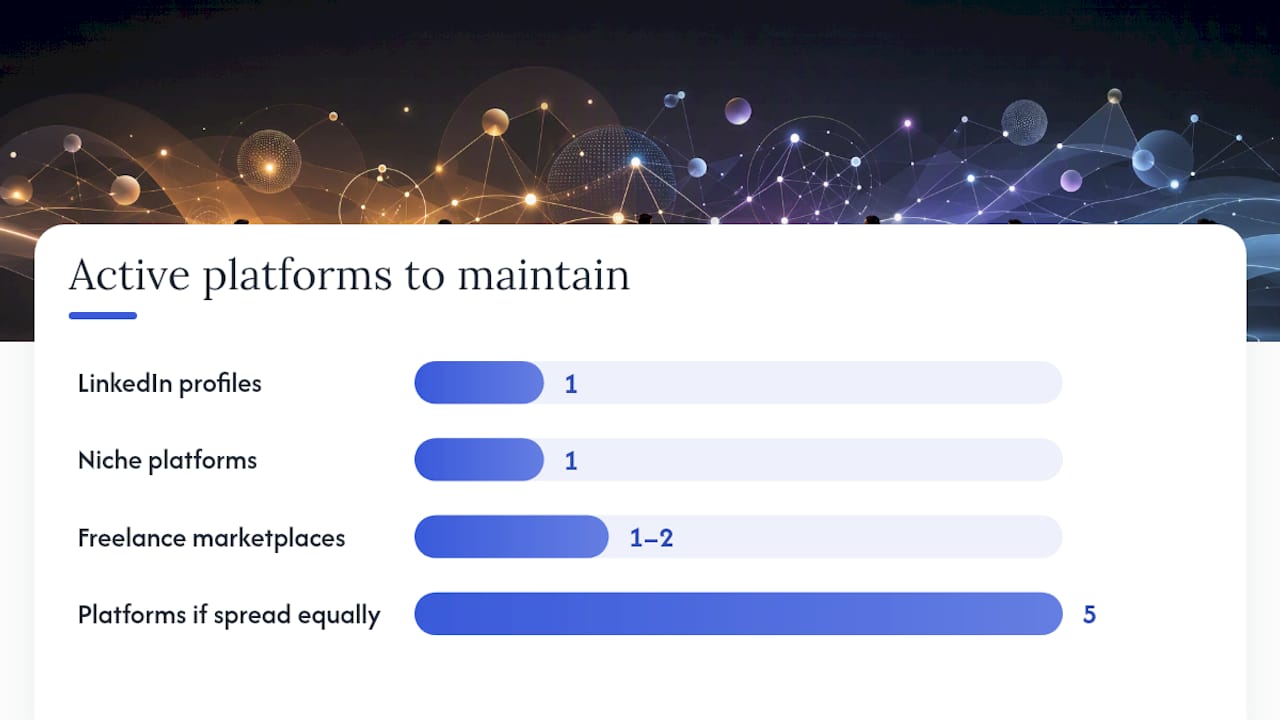
Pro Tip: Allocate no more than 20 minutes per week to LinkedIn maintenance (updating your profile, accepting connections) and spend your active networking time on the niche platform where your target clients or collaborators actually spend time. Spreading effort equally across five platforms produces thin results on all of them.
Key takeaways
The most effective approach to replacing uk.linkedin.com alternatives is to pick two or three platforms by use-case rather than one generalist substitute, and to keep LinkedIn active for recruiter discoverability while niche platforms handle everything else.
| Point | Details |
|---|---|
| No single replacement exists | Pick two or three platforms by use-case: one for jobs, one for community, one for portfolio. |
| LinkedIn stays essential for recruiter reach | The UK Government’s 40-million-account partnership makes LinkedIn part of national labour-market infrastructure. |
| UK freelancers: start with PeoplePerHour or Twine | Both have UK-focused client bases and portfolio-led matching that suits creative and digital professionals. |
| Verification matters in regulated sectors | Platforms like MESHHH (trades) and UKNetworker (professionals) offer credential displays and local trust signals. |
| Kells-care recruits care staff through verified, local channels | For care-sector hiring in London, CQC-regulated verification matters more than broad social reach. |
The real trade-offs when leaving LinkedIn behind
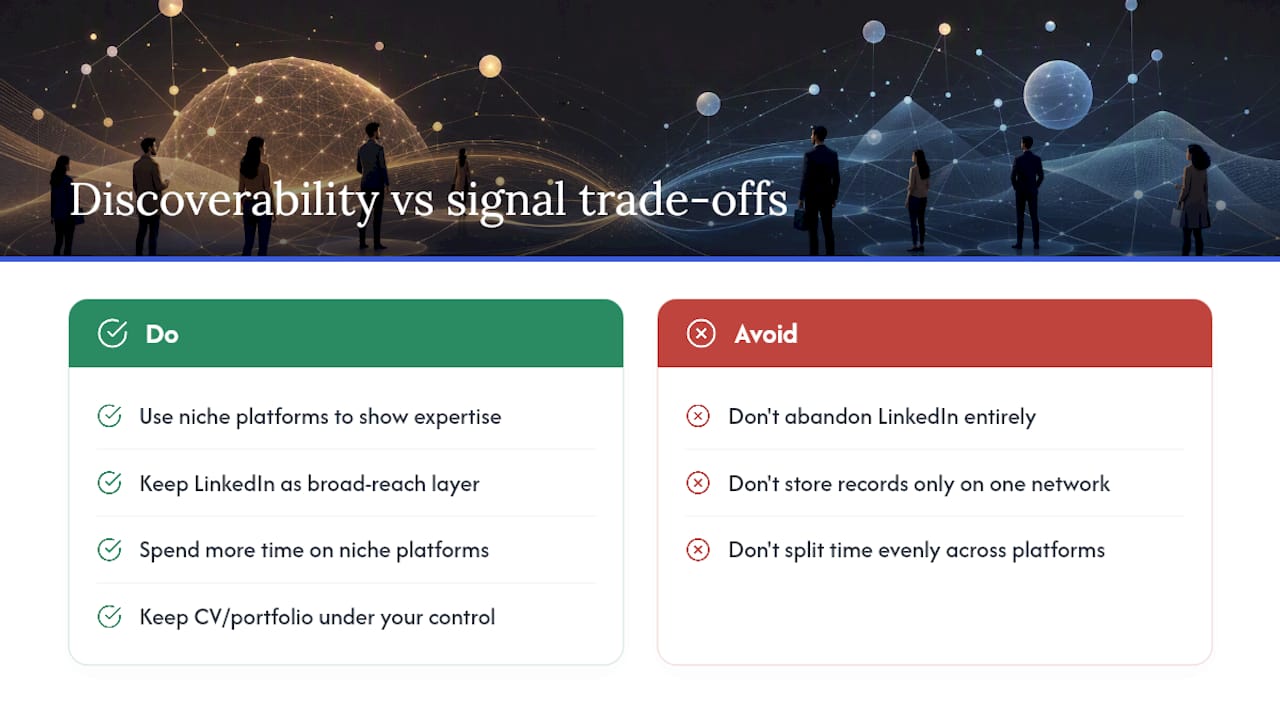
Most professionals who try to replace LinkedIn entirely end up returning to it within a few months, not because it is the best platform for any single task, but because it is the one platform where the widest range of UK recruiters, clients, and collaborators already have active accounts. The trade-off is not quality versus quantity; it is discoverability versus signal.
A freelance designer who moves entirely to Dribbble and Behance will get better creative feedback and more relevant project enquiries, but will miss the corporate clients who search LinkedIn first and never look elsewhere. A developer who builds a strong GitHub profile will attract technical recruiters, but will be invisible to the HR generalists who run first-round screening at larger companies. Neither outcome is wrong; both require a conscious choice about which audience you are optimising for.
The professionals who get the most from niche platforms are those who treat them as depth tools: places to demonstrate expertise, build genuine relationships, and surface high-quality leads, while keeping LinkedIn as the broad-reach layer that ensures they are findable. Splitting your time unevenly in favour of the niche platform usually produces better results than equal effort across everything.
One practical note: keep your CV, portfolio, and professional records stored somewhere you control, whether that is a personal website, a PDF, or a cloud folder. Platforms change their terms, restrict features, or shut down. Your professional history should not live exclusively on any single network.
Useful sources and further reading
- LinkedIn and government join forces to help jobseekers build their careers — GOV.UK
- UKNetworker
- Using LinkedIn in the UK — WordDragon
- 8 LinkedIn alternatives for professional networking — Search Engine Journal
- The 10 best alternatives to LinkedIn — Twine blog
- CR3W — The human intelligence network for founders & builders
- MESHHH — Networking app for tradespeople
- Swwwift — Community for freelance graphic designers
Kells-care: a different kind of professional network for care in London
The platforms above help professionals find work and build networks. For families in London arranging care for a loved one, the search looks different. You are not looking for the highest-follower account or the most active subreddit. You are looking for a provider you can trust, with verified staff, a clear regulatory record, and the flexibility to adapt as needs change.
Kells-care has provided home care services across London for over 30 years. Every carer is DBS-checked, fully qualified, and working within a CQC-regulated framework. Whether you need hourly check-in visits, live-in support, dementia care, or help with daily tasks, the service is built around your family’s specific situation, not a standard package.
If you are researching options for a parent or relative, download the free home care guide to understand what to look for, what questions to ask, and how regulated home care compares to other arrangements.