
TL;DR:
- Social workers play a vital role in assessing needs, safeguarding, and coordinating home care for vulnerable individuals. They facilitate safe hospital discharges, support families with dementia and disabilities, and handle complex legal and safeguarding cases. Their behind-the-scenes work ensures smooth care pathways, preserving independence and safety within the home environment.
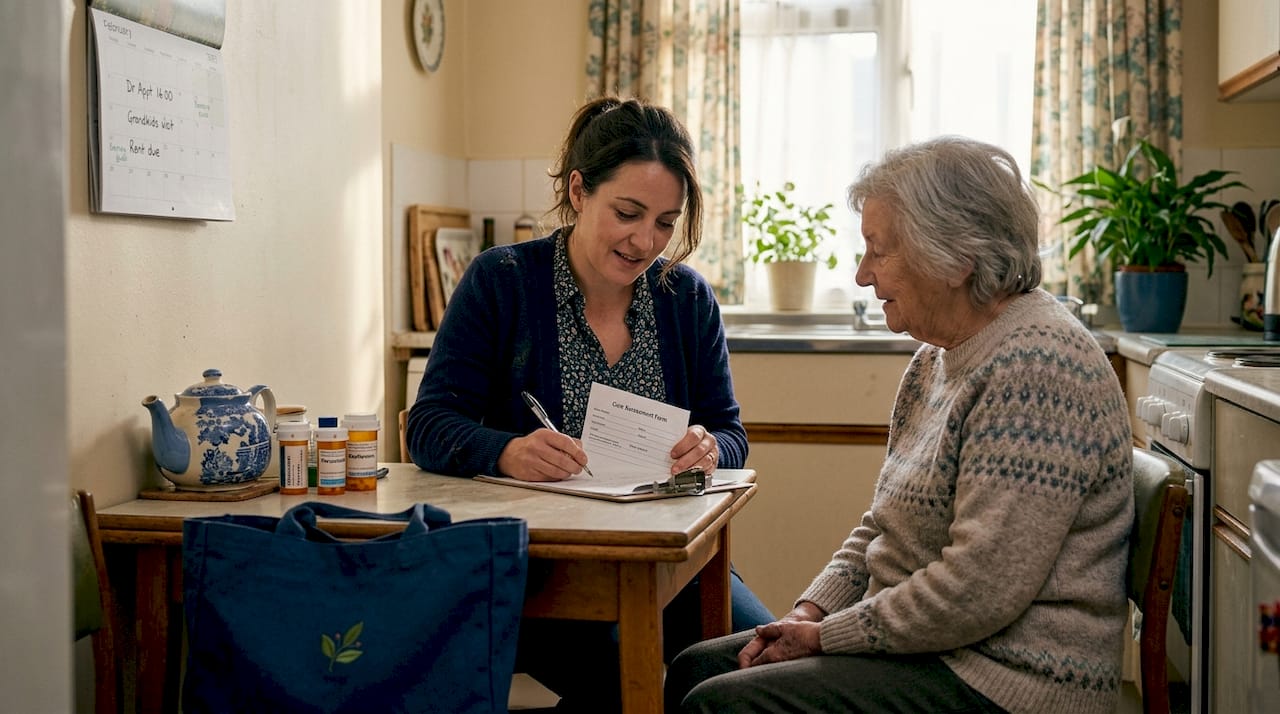
When a family member needs home care, most people picture nurses, carers, and doctors. Social workers rarely enter the picture until something goes wrong. Yet the role of social workers in care is far more pivotal than many London families realise. They assess needs, safeguard vulnerable individuals, coordinate hospital discharge, and build the personalised care plans that keep people safely at home. Whether your relative has dementia, a physical disability, or complex care needs, understanding what social workers actually do will help you navigate the system with far greater confidence.
Table of Contents
- Understanding social workers’ role in adult social care pathways
- How social workers ensure safe and timely hospital discharge
- Supporting families with dementia and disabilities: assessments and care navigation
- Navigating complex care: mental capacity, safeguarding and independent social work
- Why social workers’ wider value often goes unnoticed by families
- Connecting with home care services supported by social workers in London
- Frequently asked questions
Key Takeaways
| Point | Details |
|---|---|
| Social worker role | Social workers assess needs and coordinate care to protect wellbeing and independence, not just provide hands-on care. |
| Legal framework | The Care Act 2014 guides social workers to focus on personalised, needs-based assessment and safeguarding in England. |
| Hospital discharge | Social workers arrange safe, timely discharge by assessing home support and coordinating services with families and health teams. |
| Dementia and disability | Early social worker assessment is critical to access support and manage complex needs for dementia and disabled individuals. |
| Complex care assessments | Independent social workers provide expert, impartial evaluations for mental capacity, safeguarding, and legal cases. |
Understanding social workers’ role in adult social care pathways
Social workers in adult care do not simply arrange services. They are trained professionals working within a legal framework that shapes every decision about your relative’s care. That framework is the Care Act 2014, which places wellbeing, prevention, and safeguarding at the heart of all support planning. It means social workers assess outcomes and daily life impact, not just medical diagnoses.
In practice, this matters enormously for families. A social worker conducting a needs assessment will ask questions like: Can your relative manage their meals independently? Are they at risk of falls? Do they feel isolated? These questions shape eligibility decisions for local authority support and help create care plans that genuinely reflect what matters to the person. You can read more about how adult social care pathways work for London families on our dedicated guide.
Social worker responsibilities under this framework include:
- Assessing care and support needs based on wellbeing, prevention, and risk
- Helping local councils determine eligibility for funded care
- Developing personalised care plans that respect dignity and independence
- Reviewing plans regularly to ensure they remain appropriate
- Leading safeguarding enquiries when abuse or neglect is suspected
- Upholding legal compliance through the Principal Social Worker role within their team
The Principal Social Worker role is worth noting specifically. Every local authority team has one, and their function is to maintain legal compliance, uphold best practice, and ensure that decisions centre on the individual. Understanding your caregiver duties guide alongside social workers’ responsibilities gives families a complete picture of who does what.
Now that we understand the legal framework, let us explore how social workers specifically support hospital discharge and safe return home.
How social workers ensure safe and timely hospital discharge
Hospital discharge is one of the highest-pressure moments in any family’s care journey. The medical team declares your relative fit to leave. But fit enough to go where, with what support, and managed by whom? This is precisely where social workers become indispensable.
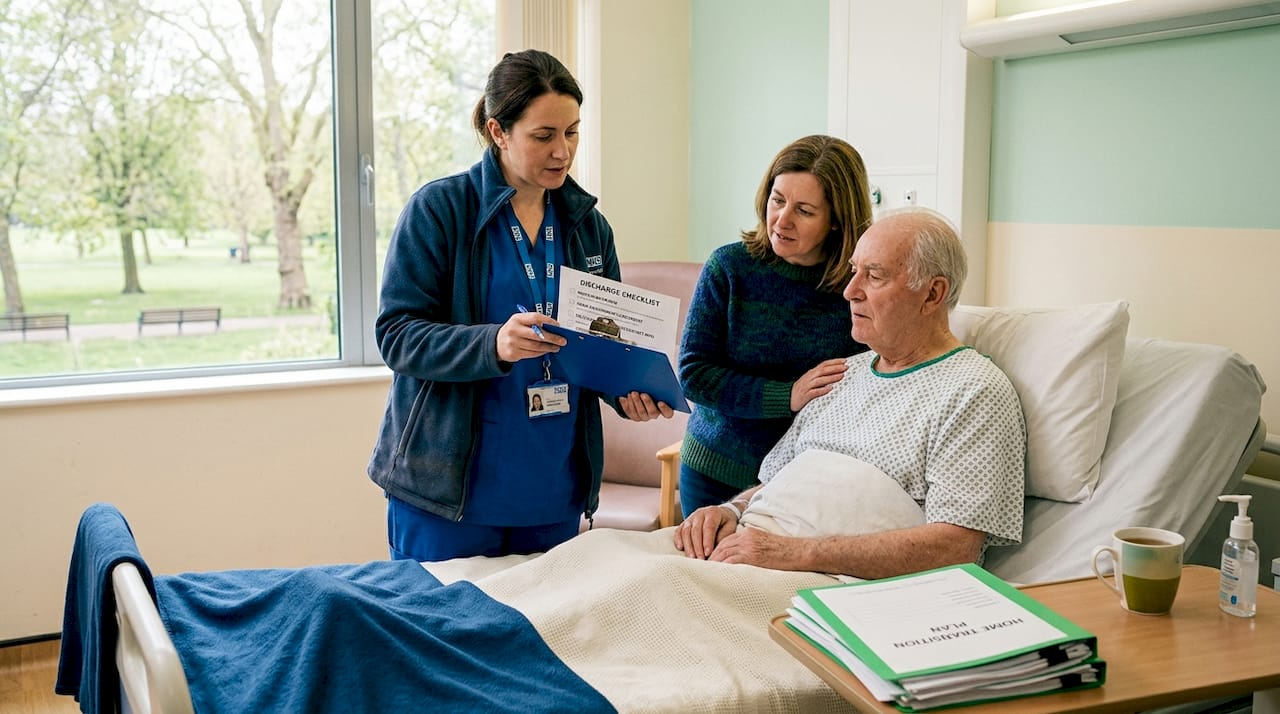
Social workers help make discharge safe and timely by assessing care needs, arranging services, and coordinating with families and community teams to prevent unsafe transitions and reduce the risk of readmission. That coordination is more complex than it sounds. It involves evaluating the home environment, identifying equipment needs such as grab rails or hospital beds, confirming carer availability, and establishing daily routines before the person returns home.
Their assessments during discharge planning cover:
- Whether the home environment is physically safe and accessible
- What care hours are needed and whether family carers can provide them
- Whether equipment, adaptations, or community nursing support is required
- What formal care services need to be in place from day one
- How to resolve disagreements between family members about the best plan
Social workers also play an emotional support role at this stage. Family members often disagree about whether a care home or home care is the right choice. Social workers are trained to mediate those conversations calmly and keep the focus on what the person themselves wants. Read our full guide on transitioning to home care for a step-by-step breakdown of what to expect.
Pro Tip: If your relative is in hospital and discharge feels rushed or unsafe, you have the right to request a formal needs assessment before your relative leaves. Ask the ward team to involve the hospital social worker immediately.
With discharge and transition understood, let us focus on how social workers support families affected by dementia or disabilities.
Supporting families with dementia and disabilities: assessments and care navigation
Dementia and disability care present some of the most complex challenges social workers face. The needs change over time, family dynamics are often strained, and the risk of both under-support and over-intervention is real.
For families dealing with dementia, the Alzheimer’s Society advises that care is managed by local authorities with early assessment essential to securing support and reducing delays. Social workers are the professionals who initiate and carry out those assessments. Acting early matters because assessments serve as the gateway to care packages, and delays in accessing them can leave families struggling without legal or practical support for months.
A social worker supporting someone with dementia will typically:
- Assess the person’s current daily living abilities and how dementia affects them
- Evaluate the carer’s own needs separately, using a carer’s assessment
- Identify risks such as wandering, medication errors, or nutritional decline
- Develop a care plan that includes personalised care hours, crisis prevention strategies, and community support
- Refer to memory services, legal support for Lasting Power of Attorney, and respite care where needed
You can explore more about practical approaches in our dementia personal care guide, which supports what social workers typically recommend for families at home.
For disability, the approach differs in structure but shares the same values. Social work in disability teams combines supportive care planning with safeguarding and a structured assessment of daily life, safety, and family functioning. For parents of children with special needs, this often involves coordinating education, health, and care plans simultaneously.
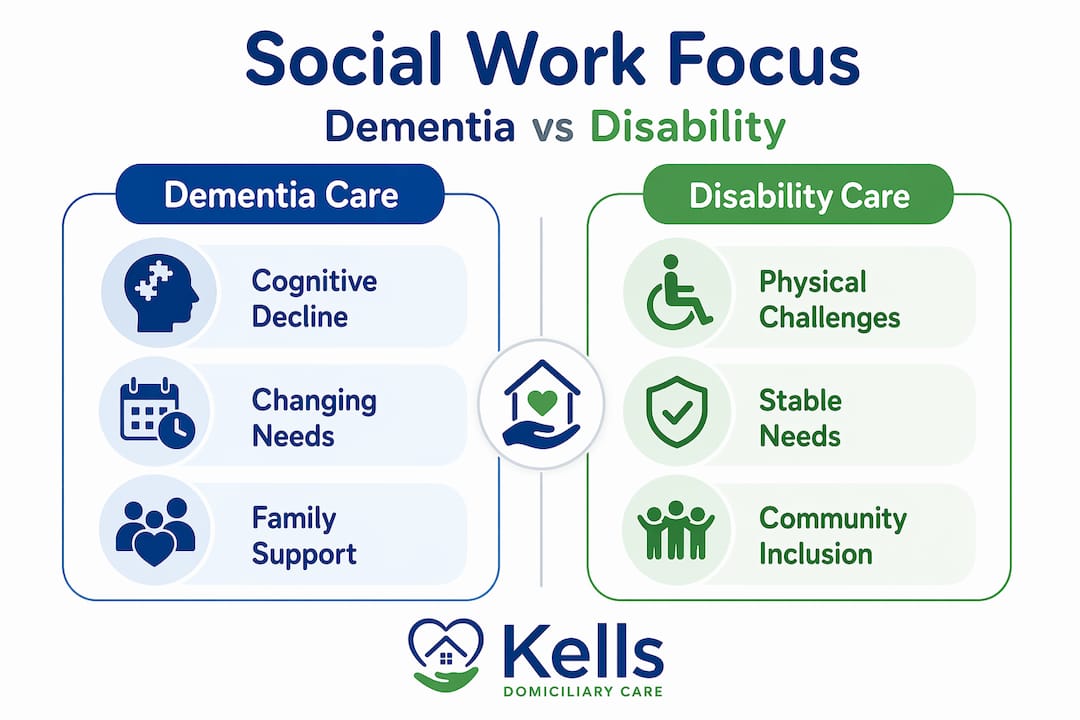
| Area of focus | Dementia social work | Disability social work |
|---|---|---|
| Primary concern | Cognitive decline and safety | Daily functioning and independence |
| Assessment type | Care needs and carer’s assessment | Structured daily life and safety assessment |
| Key risks addressed | Wandering, nutrition, isolation | Physical safety, family strain, access to education |
| Common services arranged | Home care, respite, memory services | Short breaks, adapted equipment, specialist support |
| Legal frameworks used | Care Act 2014, Mental Capacity Act | Care Act 2014, Children Act 1989 |
Pro Tip: Request separate carer’s assessments for yourself and your relative. Many families do not realise that you, as a carer, are legally entitled to your own assessment and support. Find out more about care assessments for London families through our dedicated resource.
Understanding the specialised care for dementia and disabilities helps clarify social workers’ broader role in complex care and safeguarding.
Navigating complex care: mental capacity, safeguarding and independent social work
Some care situations move beyond standard assessments into legally complex territory. When a relative can no longer make decisions for themselves, or when there are concerns about abuse or neglect, the functions of social workers in care shift to a more formal and often more urgent register.
The Mental Capacity Act 2005 provides the legal framework for decisions made on behalf of people who lack capacity. Social workers assess whether a person can understand, retain, and weigh up information to make a specific decision. These assessments are careful, structured, and legally significant. Social workers are used in complex care for expert assessments related to mental capacity, safeguarding risks, and legal decisions, often through independent social work reports.
Key social worker responsibilities in complex situations include:
- Leading safeguarding enquiries under Section 42 of the Care Act 2014
- Coordinating multi-agency responses involving police, NHS, and housing
- Assessing best interests when a person lacks mental capacity
- Representing vulnerable individuals in legal proceedings
- Commissioning specialist independent social work reports when impartiality is needed
An independent social worker, known as an ISW, is a registered practitioner who works outside the local authority. Families or solicitors commission them to provide impartial expert reports in disputes about care, capacity, or safeguarding. If you are involved in a legal case or feel a local authority assessment has missed important details, an ISW may provide the independent view the situation requires.
“Social workers bring a values-led, strengths-based approach that balances technical expertise with moral and relational work, often behind the scenes.” ADASS
Our social care support guidance covers what families should know before engaging with complex care processes, including when to seek independent advice.
Why social workers’ wider value often goes unnoticed by families
Here is something worth saying plainly: most families who interact with social workers feel frustrated by the process long before they feel grateful for it. The assessments can feel slow. The language is often bureaucratic. And the outcomes are sometimes less than hoped for.
But here is what experience reveals. The impact of social workers is largely invisible precisely because their work prevents things from going wrong. When a hospital discharge goes smoothly, families credit the nurses. When a care plan holds together for two years without a crisis, families credit the carers. Rarely does anyone think: the social worker designed this.
Social workers operating in healthcare and community settings function as the connective tissue between the NHS, local authority funding, family dynamics, legal rights, and daily care routines. They are the people who know that a person’s home environment makes their prescribed medication regime unmanageable. They are the ones who identify that a family carer is at breaking point before that becomes a safeguarding crisis. Their moral and relational work, as ADASS describes it, is not a soft add-on. It is the part that holds everything else together.
The challenges faced by social workers also deserve acknowledgement. High caseloads, underfunding, and time pressure mean that the people who most need extended engagement sometimes receive only the minimum legally required. Families who understand this can advocate more effectively, ask for reviews sooner, and seek independent assessments when needed.
The importance of social workers becomes clearest not when things go wrong, but when you map what went right and trace the decisions back to their source. You will often find a social worker there. Our guide on qualified carers and social workers explores how trained professionals working together produce the safest, most consistent outcomes at home.
Connecting with home care services supported by social workers in London
At Kells Domiciliary Care, we have worked alongside social workers and local authority care teams across London for over 30 years. We understand how care plans are structured and what families need from a home care provider to make those plans work in practice.
Our home care services guide for London families outlines how we support elderly relatives, individuals with dementia, adults with disabilities, and children with special needs, all in the comfort and familiarity of their own home. Our carers are fully qualified, DBS checked, and regulated by the Care Quality Commission.
Whether a social worker’s care plan calls for daily check-in visits or round-the-clock support, we can deliver care that aligns with those recommendations. Explore our approach to personalised elderly care in London, or download our free home care guide to understand the full range of options available to your family.
Frequently asked questions
What do social workers do during a care needs assessment?
They assess the person’s daily living needs, wellbeing, risks, and preferences to create personalised care plans focused on outcomes, not just medical diagnoses. Assessments evaluate wellbeing, prevention and risk rather than diagnoses alone under the Care Act 2014.
How do social workers help with hospital discharge for elderly relatives?
Social workers evaluate whether the home environment and support can safely sustain recovery, arrange services such as home care or specialist equipment, and coordinate with families and health teams. Social workers plan and coordinate discharge to avoid unsafe transitions and minimise delays.
Why is early referral to social care important for someone with dementia?
Early referral helps reduce delays, preserves independence, and allows carers to be assessed and supported before situations become urgent. Early assessment is essential to securing care packages, as delays are common once the need becomes acute.
What is an independent social worker, and when might they be involved?
An independent social worker is a registered professional who provides expert, impartial assessments in complex care or legal situations such as mental capacity evaluations or safeguarding disputes. Independent social workers assess capacity and risk in situations requiring impartiality outside local authority processes.
How do social workers support families caring for disabled children?
They conduct structured assessments of how disability affects daily life, safety, and family functioning, then develop care plans including short breaks and safeguarding measures. Disability social work focuses on care planning and safeguarding across daily life, safety, and family dynamics.

