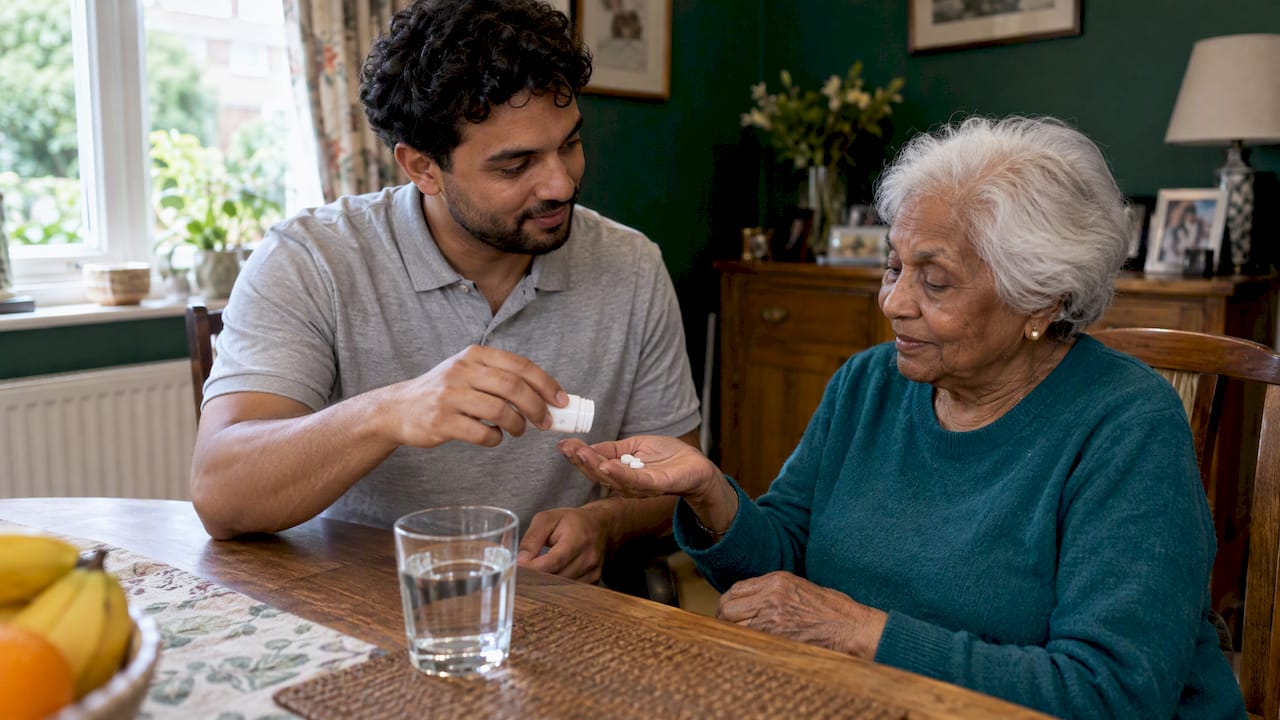
If an older person with diabetes has a blood sugar reading below 4.0 mmol/L and can swallow safely, give 15 to 20g of fast-acting carbohydrate, such as 150ml of fruit juice or 5 glucose tablets. Re-check after 10 to 15 minutes. If the reading is still below 4.0 mmol/L, repeat. This is the method many people know as the “15-15 rule”. The NHS describes the same steps. If the person is unconscious, do not give food or drink. Call 999.
This guide is for family members and carers. It covers what to give, what to do next, and why low blood sugar looks different in older people, especially those living with dementia.
TL;DR
- Low blood sugar (a “hypo”) means a reading below 4.0 mmol/L. Treat it straight away with 15 to 20g of fast-acting carbohydrate, then re-check after 10 to 15 minutes.
- Once the reading is above 4.0 mmol/L, follow with a slower-release snack, such as two biscuits or a slice of bread, unless a meal is due.
- If the person is unconscious or cannot swallow, do not put anything in their mouth. Use the recovery position, and call 999 if they do not recover within 10 minutes or no glucagon is available.
- In older people the signs are often subtle: confusion, personality change, falls. Never assume it is “just the dementia”.
- Every severe or repeated hypo needs a medication review with the GP or diabetes team.
Table of Contents
- Why hypos are different in older people
- What counts as a hypo
- Step by step: treating a hypo when the person is awake
- When the person is drowsy or unconscious
- After the hypo: what to do next
- Spotting the early warning signs
- Preventing hypos at home
- What carers should have ready
- Our perspective: what we see in people’s homes
- How Kells can help
- FAQ
- Sources
Why hypos are different in older people
The classic signs of a hypo are sweating, shaking and hunger. In older people, and particularly in people with dementia, these signs are often absent or faint. NHS guidance points instead to personality changes, morning headaches, confusion or more frequent falls, all of which can be mistaken for dementia getting worse.
So a sudden change in behaviour is worth a finger-prick test if the person has diabetes. If you are unsure whether you are seeing dementia or a hypo, check the glucose first. It takes seconds.
Diabetes UK lists several risk factors that make hypos more likely in later life:
- use of insulin or certain diabetes tablets
- chronic kidney problems
- reduced food intake
An older person who eats less because of a poor appetite, a bad week with a cold, or difficulty with swallowing can drift into a hypo on the same medication they have taken for years.
The same Diabetes UK page notes that frequent hypos in older adults are linked with further cognitive decline. That is one reason prevention matters as much as treatment.
What counts as a hypo
For adults, a hypo is a blood glucose reading below 4.0 mmol/L. The hospital guideline on hypoglycaemia uses the same threshold and adds that if the reading is not below 4.0 mmol/L but the person has symptoms, a small carbohydrate snack is appropriate. It also states that hypoglycaemia is a serious condition and should be treated as an emergency, whatever the level of consciousness.
Not everyone has a meter at hand. If you see symptoms in someone who has diabetes and cannot test, treat as if it is a hypo. The treatment is safe and quick, and a few extra grams of sugar are far less risky than leaving a real hypo untreated.
Step by step: treating a hypo when the person is awake
This applies when the person is conscious, can sit up and can swallow safely.
- Stop what they are doing. Ask them to sit down. Stay with them.
- Give 15 to 20g of fast-acting carbohydrate. Diabetes UK advises treating the hypo immediately this way.
- Wait 10 to 15 minutes, then re-test. The NHS advice is to check again after this interval.
- If the reading is still below 4.0 mmol/L, repeat the treatment. The NHS says you can repeat up to three times.
- Once above 4.0 mmol/L, give a long-acting carbohydrate. Examples are two biscuits, a slice of bread or 200 to 300ml of milk, unless they are about to eat a meal.
- Write it down. Note the time, the reading, what you gave and what had happened beforehand. This helps the GP or nurse later.
If three rounds of treatment have not lifted the reading, or the person is getting drowsier, call 999.
What 15 to 20g looks like
| Fast-acting option | Amount |
|---|---|
| Glucose tablets | 5 tablets |
| Fruit juice | 150ml |
| Jelly babies | 4 sweets |
These are the examples given in the NHS advice. Check the label on glucose tablets, as tablet sizes vary.
Practical points for older people
- Swallowing. If the person coughs on drinks or has been assessed as needing thickened fluids, ask their GP or community nurse in advance what is safe to use during a hypo. Do not wait until it happens.
- Do not give chocolate or a large meal as the first treatment. The aim is fast sugar first, then a slower snack.
- Keep it simple. A person with memory problems may refuse or forget. Offer a small amount calmly, and repeat the request in plain words.
- Stay until they are better. Confusion can last a little after the reading recovers.
When the person is drowsy or unconscious
This is an emergency. Per Diabetes UK:
- Do not try to feed them or give them a drink.
- Place them in the recovery position.
- If a glucagon injection is available and you are trained to use it, give it.
- If they do not recover within 10 minutes, or there is no glucagon, call 999.
Two details are worth knowing. First, Diabetes UK notes that the Ogluo pen was discontinued in September 2025, and that GlucaGen kits need the powder and water mixed by hand, so carers need to have practised. Second, glucagon works by releasing sugar stored in the liver. The hospital guideline linked above explains that it can be less effective in people who are chronically malnourished, have liver disease, or have had repeated prolonged hypos. In these cases, medical teams may need to give glucose through a drip. This is one more reason to call 999 rather than wait.
If you are not sure what to do in the first minutes of any urgent situation at home, our guide to emergency home care in the UK sets out the options.
After the hypo: what to do next
Tell the GP or diabetes team
Any severe hypo, and any pattern of repeated mild ones, needs a call to the GP or diabetes nurse. UK guidance expects a full medication review after a severe episode. According to the community hypoglycaemia guideline, this often means reducing insulin or stopping certain tablets, such as sulfonylureas, which carry a high risk of prolonged hypos in older people.
Do not change or skip doses yourself. Give the clinician your written log instead, and ask them to decide.
Ask whether the targets are right
Tight control is not always the right goal in later life. The NICE guideline on type 2 diabetes addresses blood glucose management, and local guidance for frail older people says targets should be more relaxed. The community guideline sets HbA1c targets for the frail and older person higher than for the general diabetes population. The reason is that falls, confusion and severe hypos can do more immediate harm than slightly higher glucose. Diabetes UK makes the same point: preventing severe episodes and controlling symptoms should come first.
The right target for your relative is a clinical decision that depends on their frailty, wishes and other conditions. If they have had hypos, ask the GP directly: “Is their current target still right for them?”
Check for a fall or injury
Hypos and falls are closely linked. If your relative fell during or after an episode, look for injury and mention it to the GP. Our fall prevention guide for seniors covers the home changes that reduce risk.
Spotting the early warning signs
Watch for these, especially if your relative has dementia:
- sudden irritability, tearfulness or an unusual refusal of help
- new or worse confusion
- drowsiness or being unusually quiet
- unsteadiness or a fall without a clear cause
- headaches on waking
- classic signs where present: sweating, shaking, hunger, pale skin
If several of these appear in someone taking insulin or tablets for diabetes, test their glucose. If you are also wondering whether memory changes themselves are new, our guide to the signs of dementia in seniors may help you separate the two.
Preventing hypos at home
Make meals reliable
Missed or small meals are a common trigger. Set regular meal times, keep easy snacks in view, and watch how much is actually eaten rather than how much is served. For ideas that suit a reduced appetite, see our guides on elderly nutrition for caregivers and meal planning for dementia.
Watch for the first sign of lost self-management
The NHS England care home diabetes guidelines point out that forgetting insulin, getting doses wrong or skipping meals can be the first quiet sign of cognitive decline in someone with diabetes. If you notice any of this, do not wait for a crisis. Ask the GP to review the medication regime early.
Simple tools can help with the day-to-day routine. Some families use medication reminders for seniors and check-in alerts so that a missed dose or a missed check-in is noticed quickly. A reminder does not replace supervised medication when someone can no longer manage it safely, but it can catch problems earlier for a person who still lives independently.
Keep a hypo box
Diabetes UK recommends, for people in care settings, a personal “hypo box”: a clearly labelled kit with fast-acting glucose, written instructions and a record log, so carers do not have to search during an emergency. It works just as well in a private home. Keep it in a fixed place, tell everyone who visits where it is, and check the use-by dates on the glucose.

Review medicines regularly
Ask for a yearly check of all medicines, and a review after any hospital stay, illness or weight loss. The aim is to catch doses that were right for a heavier, more active person and are now too strong.
What carers should have ready
| Item | Why |
|---|---|
| Blood glucose meter and strips | To confirm a hypo and check recovery |
| Glucose tablets or small juice cartons | For the first treatment |
| A long-acting snack | To prevent a second drop |
| Written hypo plan | So any carer or relative acts the same way |
| Glucagon, if prescribed, and training | For someone who cannot swallow |
| GP and diabetes nurse numbers | For same-day advice |
Our perspective: what we see in people’s homes
We have been supplying home care in London for over 30 years, and we know that hypos are rarely a single event. They are usually a sign that something in the routine has shifted: a smaller appetite, a new medicine, a missed meal, a person who can no longer manage tablets alone.

Our view is that the most useful thing a carer does is notice. A carer who visits at the same times each week learns what a normal day looks like for your relative, and so spots the quiet signs of a hypo that a stranger would miss. We also believe the care plan must fit the person, not the other way round. For one person that means a short visit at breakfast to prompt a meal and medicines. For another it means a live-in carer who knows the person’s habits well.
We do not replace the GP or the diabetes nurse. Our carers are fully qualified, DBS checked, and our agency is regulated by the CQC. What we offer is consistent eyes in the home, calm help with meals and prompts, and prompt reporting to the family so that medicine reviews happen sooner. If you live far away, or you are worn out from watching over a parent day and night, that can make the difference between catching a pattern and finding out after a crisis.
— Dan
How Kells can help
If your relative lives with diabetes and you are worried about meals, medicines or night-time safety, we can build a care plan around their routine, from call-in visits to live-in care, including dementia care and respite cover. See our home care services or contact us to talk it through. Our guide to paying for home care explains the options.
FAQ
Is the 15-15 rule safe for elderly people?
Yes, the method is the standard NHS and Diabetes UK advice for an adult who is awake and can swallow: 15 to 20g of fast-acting carbohydrate, then re-test after 10 to 15 minutes. It is the first step, not the whole answer. After any hypo in an older person, follow it with a slower snack and tell the GP.
What should I do if my elderly parent refuses to eat or drink during a hypo?
Stay calm, offer small amounts and try a different form, such as glucose tablets instead of juice. If they still refuse, become drowsier or cannot swallow safely, do not force anything. Place them in the recovery position if they are unconscious and call 999.
Can low blood sugar be mistaken for dementia?
Yes. Confusion, mood changes and falls can be signs of a hypo, and in older people they may appear without sweating or shaking. If your relative has diabetes and their behaviour changes suddenly, test their glucose before assuming the dementia has progressed.
Should an older person with diabetes be given a lower blood sugar target?
Not lower, usually more relaxed. Guidance for frail older people accepts a higher target to avoid hypos, falls and confusion. The right figure for your relative is a decision for their GP or diabetes team.
When do I call 999 for a hypo?
Call if the person is unconscious, cannot swallow, or does not recover within 10 minutes, or if no glucagon is available. Do not give food or drink to someone who is unconscious.
Sources
- Low blood sugar (hypoglycaemia), NHS
- What is hypoglycaemia? Diabetes UK
- Older people and diabetes, Diabetes UK
- The hospital management of hypoglycaemia in adults with diabetes mellitus
- Blood glucose management, NICE type 2 diabetes guideline
- Hypoglycaemia in adults in the community: recognition, management and prevention
- NHS England diabetes care home guidelines