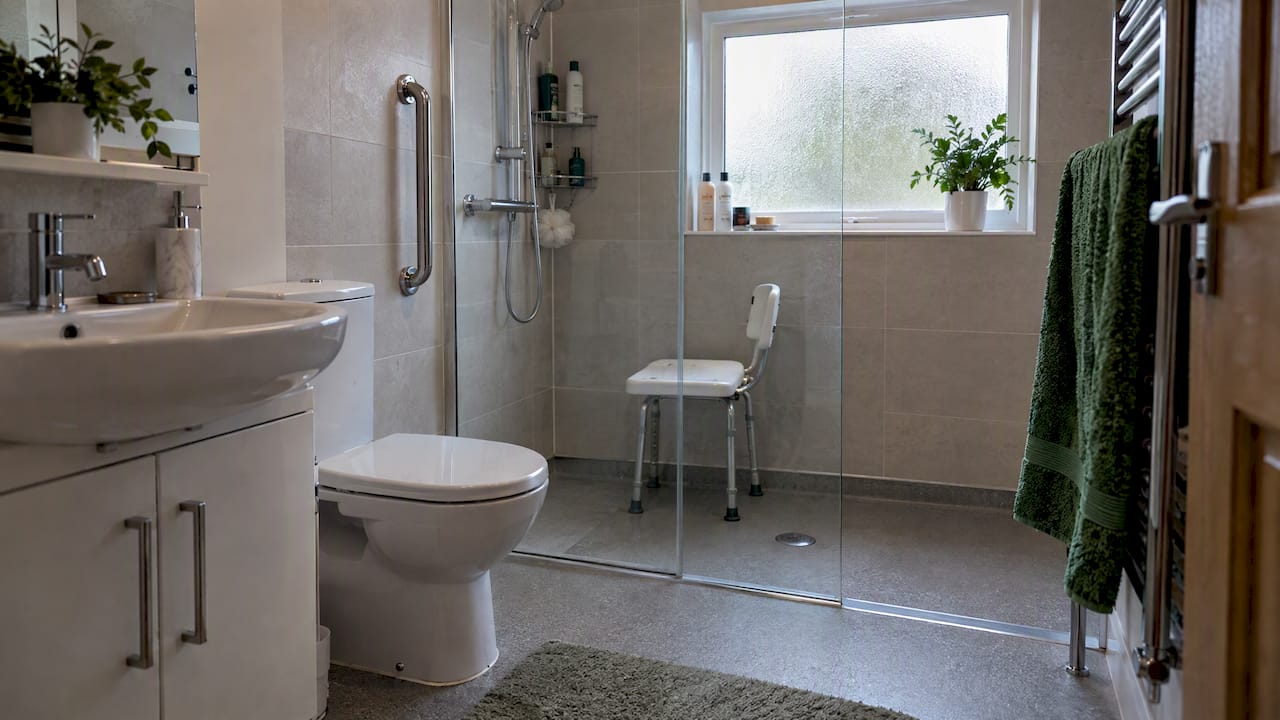
Start with grab rails, non-slip surfaces, a level-access shower or bath lift, a raised toilet and a shower seat. Many smaller changes are low cost or council-funded once an occupational therapist (OT) has assessed you, and councils generally cover minor works under £1,000. Your next step is a free needs assessment: contact your local council’s social services team.
TL;DR:
- A free council assessment can unlock minor adaptations under £1,000; a Disabled Facilities Grant may fund larger work, which needs approval before construction starts.
- Choose aids around the difficulty: a level access shower removes a step, a raised seat eases toilet transfers, and a shower seat reduces standing.
- Try bath lifts and shower seats through loan services before buying; use professionals for fixed rails, wet room work, or powered lifts requiring electrical installation.
- While waiting for assessment, use non slip mats, a shower stool, brighter lighting, and temporary aids; these reduce risk but do not replace permanent adaptations.
Table of Contents
- 1. Which bathroom adaptations make the biggest difference?
- 2. How do you get an assessment and funding?
- 3. How do you choose and install equipment safely?
- 4. What low-cost steps can you take today?
- 5. How do you keep adaptations safe over time?
- 6. How do you tailor the bathroom to your mobility and health?
- 7. Can smart technology and alarms make the bathroom safer?
- 8. Why independence matters more than the equipment
- 9. How can home care help once adaptations are fitted?
- FAQ
- Sources
1. Which bathroom adaptations make the biggest difference?
Each adaptation below solves a specific problem, so match it to the task that worries you most: stepping over the bath, standing to wash, or getting up from the toilet.
- Grab rails and support bars: Fit them beside the toilet, inside the bath or shower, and at the point where you step in or out. They must be screwed into solid wall fixings, not plasterboard alone, and a towel rail is never a substitute. Age UK lists grab rails among the most common and effective changes.
- Non-slip flooring and mats: Choose textured, wet-room-rated vinyl or tiles, and suction-backed mats inside the bath or shower. A mat that curls at the edges becomes a trip hazard, so check it regularly.
- Walk-in, level-access showers and wet rooms: Removing the step can make a major difference for someone who struggles to lift their legs. It usually means a new floor former, drainage and waterproofing, so plan for plumbing and tiling work.
- Bath lifts and side-entry baths: A bath lift lowers you into the water and raises you again, which suits people who cannot step over the rim. A side-entry bath has a door, but you sit while it fills and drains.
- Raised toilets and frames: A raised seat or a toilet frame reduces the strain on knees and hips during transfers.
- Shower seats, transfer benches and handheld showers: Sitting to wash saves energy, and a handheld head lets you rinse without turning or stretching.
- Flood detectors and safety plugs: Age UK also notes that detectors on sinks and baths and special safety plugs help prevent overflow if the taps are left running.
For wider home measures, our fall prevention tips for seniors explain why the bathroom is such a priority.
2. How do you get an assessment and funding?
The process normally begins with a care needs or home assessment, carried out together with an occupational therapist. The assessment is free through your council’s social services department. An OT matters because they watch how you actually move around your bathroom and spot risks family members miss, such as awkward reach paths or poor lighting. Our guide to the occupational therapy home assessment explains what to expect on the day.
- Minor adaptations: Councils generally cover the full cost of items such as grab rails or small step changes when they cost less than £1,000 and an OT or social services representative recommends them.
- Major works: A Disabled Facilities Grant (DFG) can pay for adaptations such as widening doors, installing ramps or grab rails, and providing access to bathing and toilet facilities. Local guidance also lists level-access showers and wash-dry toilets.
- Fast-track routes: Some councils prioritise people who cannot reach a toilet, and may speed up cases involving palliative diagnoses or rapidly progressing illnesses. Waiting times vary by area.
- Before you apply: Note the tasks you find hard, who lives in the home, and whether you own or rent. Do not start major works before the grant is approved.
3. How do you choose and install equipment safely?
Test before you buy. NHS equipment services and Independent Living Centres let you loan or try equipment, which is worth doing for a bath lift or shower seat. An OT recommendation also improves safety, because the aid is matched to your body and your bathroom, and it is often needed for funding. Our equipment for elderly care at home guide lists common aids.
Hire a specialist for wet rooms and for any powered bath lift that needs electrics, and ask to see their safety checks. Put these questions to suppliers and installers:
- What is the maximum user weight?
- Does it fit my bath model and wall type?
- What warranty and fitting guarantee do you give?
- Who services it, and how often?
- Is the work done by one of your own fitters?
Pro Tip: Fit it yourself only if it is a freestanding item such as a mat, a stool or a bath board. Anything fixed to a wall, floor or electrical supply is a job for a professional.
4. What low-cost steps can you take today?
You do not need to wait for a grant to cut risk.
- Place wet-area non-slip mats in the bath and on the floor outside it.
- Add temporary grab handles, a bath board or a shower stool as interim aids.
- Swap round taps for lever taps and use long-handled sponges to avoid bending.
- Brighten the lighting and check for a thermostatic mixer valve or anti-scald device.
These steps do not replace permanent adaptations. They keep you safe while assessments and works are arranged, and they show the OT what helps most. Early, minor aids often prevent loss of confidence and bigger safety problems later.
5. How do you keep adaptations safe over time?
Check regularly that rails do not wobble and that fastenings show no rust or wear. Wipe non-slip surfaces and seats with a mild cleaner and dry them, since soap residue reduces grip. Test flood detectors and alarms regularly, and make sure safety plugs still seal. A fall, a new diagnosis, or a noticeable change in strength or balance should trigger a fresh OT review, because the equipment that suited you last year may not suit you now.

6. How do you tailor the bathroom to your mobility and health?
Plan around the person, not the product. Start by writing down which tasks are hardest: stepping in, standing, turning, or getting up. Practical guidance recommends starting with simple measures such as bath boards, bath seats and grab rails, with an OT assessment guiding bigger choices.
- Arthritis or weak grip: Choose lever taps and thicker, textured rails.
- Balance problems or a risk of falls: Prioritise a level-access shower, a seat and rails on both sides.
- Wheelchair or walking frame: Check door widths and turning space before choosing fittings.
- Dementia: Use clear colour contrast between toilet, floor and walls, and keep the layout familiar.
- Fatigue or breathlessness: A seat, a handheld shower and a bath lift save energy.
Involve the person using the bathroom at every step. Our guide on how to promote client independence at home offers ideas that pair well with adaptations.
7. Can smart technology and alarms make the bathroom safer?
Yes, and you can add it without major building work. A pendant or wrist alarm lets you call for help from the shower, as long as it is waterproof, so check the rating before buying. Motion-activated night lights guide you to the bathroom after dark. Flood detectors alert you if the taps overflow, and thermostatic valves prevent scalding.

Some systems pass an alert to a family member or a monitoring centre. Fall-detection sensors can summon help automatically if you cannot press a button. Ask your OT or council whether telecare is available locally, and test every device when it is fitted and again whenever the batteries change. Technology backs up a safe layout. It does not replace rails, seats and non-slip floors.
8. Why independence matters more than the equipment
In my experience, people resist adaptations because they fear looking frail, not because the equipment is hard to use. I once heard of a gentleman who had stopped showering alone after a slip. A simple seat and rail helped him return to his routine, and his confidence returned with it. The aim is never to take over. It is to remove the single risk that stops someone doing something for themselves. Our needs assessment page explains how we approach personalised support.
— Dan
9. How can home care help once adaptations are fitted?
Even a well-adapted bathroom is easier and safer with a trained hand nearby. Our carers offer call-in visits and live-in care, and they can help with bathing, safe transfers and using new equipment. We also carry out personal care assessments, so support is shaped around you. You can read about our home care services or request our free home care guide to see what suits your family.
FAQ
Can I get a bath lift on the NHS?
Bath lifts are not routinely provided on the NHS. Your council’s OT service may recommend one after an assessment, and you can try equipment through loan schemes first. A Disabled Facilities Grant can fund larger bathroom works.
Can I get a grant to update my bathroom?
Yes, if you are disabled or have age-related needs. A Disabled Facilities Grant from your council can cover access to bathing and toilet facilities. Councils also fund minor adaptations after a free assessment.
Are there free grants for pensioners to adapt a bathroom?
Minor adaptations recommended by an OT are generally fully funded by the council when they fall under the usual threshold. Eligibility for larger grants depends on your needs and circumstances, so contact your local authority.
What should I do first if the bathroom feels unsafe?
Contact your council and ask for a free needs assessment. While you wait, add non-slip mats, a shower stool and better lighting, then follow the OT’s advice before spending on bigger works.
Sources
- Home adaptations – Social care and support guide – NHS
- Home adaptions and aids for older people | Age UK
- Gov
- Apply for a Disabled Facilities Grant | Bath and North East Somerset Council