

A good autism bedtime routine is short, follows the same order every night, and is shaped around your child’s senses and preferences. NHS and autism charity guidance agrees on the core: keep the main routine the same so your child knows what to expect and feels secure, and support it with visuals. This guide shows you how to build one, adjust it when it isn’t working, and where extra help at home can make evenings easier. At Kells Care we support families of children with autism across London, so we have written this for parents who are tired and want something practical.
TL;DR
- Keep the routine predictable, in the same order each night, and relatively short: BeyondAutism suggests 20 to 30 minutes.
- Use a visual schedule, timer or social story so your child can see what comes next.
- Check the bedroom for light, noise, smell and fabric triggers, and look at whether a bath or screen is stimulating rather than calming.
- Keep a sleep diary for at least two weeks. It shows what is working and gives your GP or specialist useful facts.
- If settling stays hard, change one thing at a time. Melatonin is a decision for a specialist clinician, never something to start on your own.
Table of Contents
- Why bedtime can be so hard for autistic children
- How to build the routine, step by step
- A sample evening timetable
- Food, exercise and caffeine
- Adapt the routine to your child’s senses
- Build in flexibility for hard days
- Keep a sleep diary
- If your child still struggles to settle
- Support at home for your evenings
- FAQ
- Sources
Why bedtime can be so hard for autistic children
Sleep problems are common. NHS Healthier Together reports that over 80% of children with additional needs have a sleep issue, and 40 to 80% of autistic children and young adults are affected. If your child struggles, you are far from alone, and it is not a parenting failure.
There is rarely a single cause. Autism UK lists several reasons an autistic child may find sleep hard, including difficulty winding down, repeated night waking, anxiety, sensory differences, irregular melatonin release and atypical body-clock rhythms. Some children also have conditions such as epilepsy, which is worth raising with your GP.
Two of these are worth explaining:
- Body clock (circadian rhythm). This is the internal clock that roughly follows the 24-hour day. Things that interfere with it can make sleep more difficult.
- Melatonin. This is a hormone made in the brain, normally produced from the evening. Because light affects it, the rhythm is thought to be disturbed in children with neurodevelopmental conditions such as autism.
Autism UK’s professional guidance also points to raised cortisol (a stress hormone), sensory sensitivity and anxiety about change or separation. That is why a child who is calm at 5pm can be distressed at 8pm: the routine is not only about sleep, it is about feeling safe enough to let go of the day.
How to build the routine, step by step
1. Pick a bedtime and a wake-up time, and hold both
The Northern Health and Social Care Trust advises that a chosen bedtime is stuck to, a regular wake-up time is kept, and everyone in the house is consistent. The wake-up time matters as much as bedtime, because it anchors the body clock.
Where this goes wrong: one parent holds the line and the other, or a grandparent, relaxes it. Agree the plan between all the adults who do bedtimes, including anyone who covers evenings.
2. Choose three to six steps and fix their order
A typical sequence is a wash or bath, pyjamas, teeth, toilet, a story or quiet activity, then lights out. NHS Healthier Together describes a calm routine of wash, change, brush teeth, quiet activity and lights down, and recommends using the bed only for sleep.
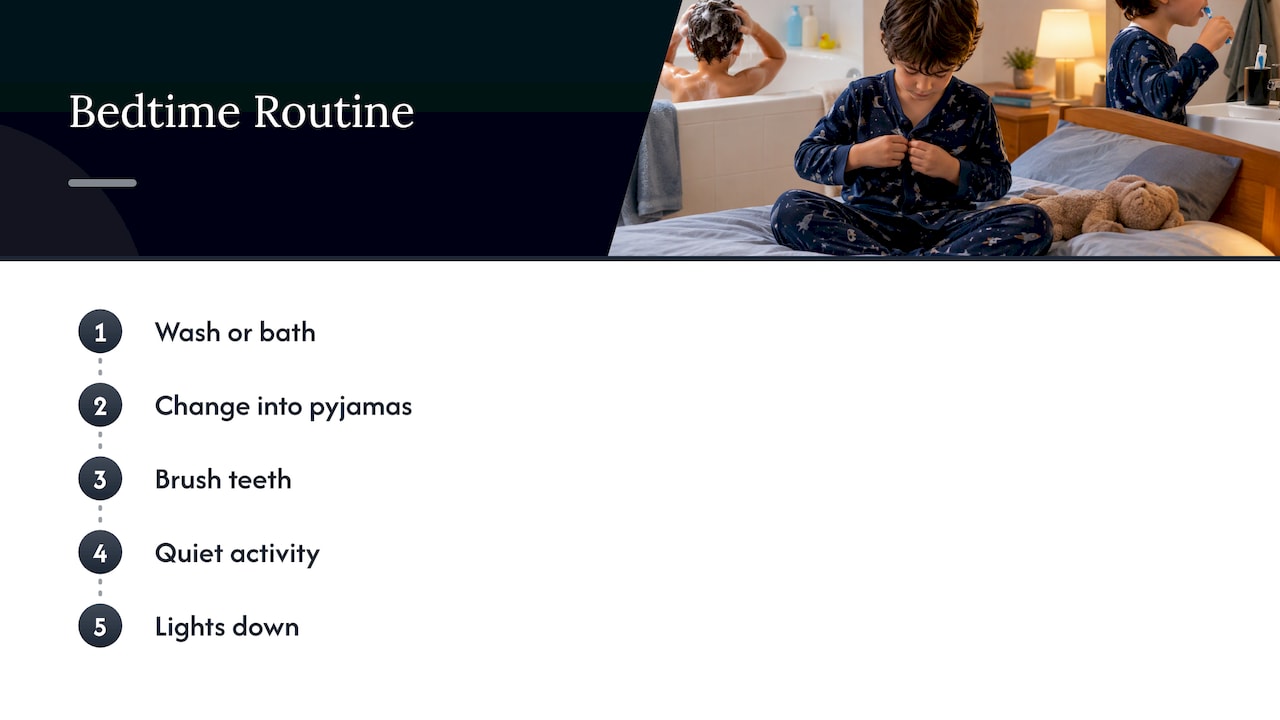
Keep the core steps identical. The Northern Trust’s example is that pyjamas, teeth and a story stay fixed while one activity, such as a board game or music, can vary. A little variety inside a fixed frame stops the routine feeling rigid without removing the predictability.
3. Keep it short
BeyondAutism advises that the routine should be predictable and relatively short, around 20 to 30 minutes, and individualised according to how easy or hard each activity is for your child, whether it stimulates or relaxes them, and what they like. A routine that drags on gives more chances for distress and negotiation.
4. Make the routine visible
Autism UK recommends a basic, ordered evening routine that can be followed anywhere, supported by visual timetables. The Northern Trust says visual bedtime routines are useful from age 2 to 18 and can use objects, pictures, symbols or words, depending on your child’s language and understanding.
Pick the format that matches your child’s level. A child who does not read yet may need photographs of their own bathroom and bed. An older child may prefer a written checklist they tick off. Our guide to making and using an autism visual schedule at home walks through the practical side.
NHS Healthier Together also notes that picture timetables, timers and social stories help some children understand the routine. A social story, a short personalised story, can explain why we sleep and reassure a child that they are safe when sleeping or alone.
5. Involve your child
The Norfolk NHS leaflet says young people should have input into the routine so they understand it, enjoy it and find it effective. Let your child choose the pyjamas, the story or the order of two steps. Choices inside the structure give a sense of control, which can lower resistance.
A sample evening timetable
Autism UK’s professional guidance gives an example of a simple, predictable evening that a sleep counsellor might suggest, designed to lower cortisol, support the natural rise of melatonin and give consistent sleep cues. Adjust the times to your child’s age and school day.
| Time | Activity | Purpose |
|---|---|---|
| 5pm | Evening meal | Eating well before bed |
| 6pm | Energetic play | Burns off energy early |
| 6.30pm | Quieter play | Begins the wind-down |
| 7pm | Bath | Signals that bedtime is approaching |
| 7.30pm | Pyjamas, into bed, story and cuddle | Connection and calm |
| 8pm | Lights out | Consistent sleep cue |
This is an example from Autism UK, not a prescription. An older child will have later times, and the order should follow what works for them.
Food, exercise and caffeine
BeyondAutism’s guidance says daytime exercise can help sleep come faster, but exercise too close to bedtime may prevent it. It also advises limiting caffeine (coffee, tea, chocolate and fizzy drinks) before bed, and avoiding food within two hours of sleeping because a full stomach affects digestion.
If your child gets hungry, NHS Healthier Together suggests a small snack is fine. Some autistic children find it hard to recognise hunger, fullness, thirst or tiredness (this is called interoception), so a child who is wide awake at 9pm may simply be hungry or overtired without knowing it.
Adapt the routine to your child’s senses
Most bedtime battles have a sensory cause that is easy to miss. Walk through the room at bedtime and ask what your child sees, hears, smells and feels.
- Light. The Northern Trust suggests dark curtains, removing night lights and turning off lights outside the door. BeyondAutism notes that children who are over-sensitive to input may like black-out blinds and silence, while under-sensitive children may prefer a night light or white noise.
- Sound. Close the door, move the bed away from a wall with noise on the other side, or try earplugs, headphones or soft background noise, as Autism UK suggests.
- Smell. Think about detergent, cooking smells from the kitchen and scented candles.
- Touch. Remove scratchy labels, try different pyjama and bedding fabrics, short or long sleeves, and check the mattress is not too hard or too soft.
- Visual clutter. Take down busy posters and keep TVs, computers and phones out of reach.
Our autism-friendly home checklist covers the rest of the house, and our guide to stopping sensory overload at home is useful if the evening tends to end in distress.
Is the bath calming or stimulating?
A bath is not relaxing for every child. The Northern Trust notes it may be stimulating for some and suggests moving it earlier in the day, or using a gentle hand or foot massage before bed instead. BeyondAutism suggests thinking about water temperature, bath versus shower, shower caps and unscented soaps, and using timers. For toothbrushing, it suggests a small amount of toothpaste at first, adapted brushes, favourite characters or music-playing brushes.
Screens
NHS Healthier Together recommends turning screens off about an hour before bed, and Autism UK points out that bright screen light may inhibit melatonin production. The hard part is the handover: switching a device off can trigger a meltdown. Warn your child with a timer and a visual cue, and offer a calm replacement activity. For a practical plan on managing screen time as a family, this guide sets out clear steps you can copy.
Worries at bedtime
If your child is anxious, the Norfolk leaflet suggests setting aside time to write in a diary, journal or to-do list, by pen and paper or on a phone, to take worries out of the head. For a younger child, this can be a drawing or a “worry box” they post a note into.
Build in flexibility for hard days
A routine that cannot bend will eventually break. The Norfolk NHS leaflet advises that on stressful or low-energy days, skipping getting changed or washing can make the routine easier. It also suggests agreeing to finish a task, such as a game level, rather than enforcing a strict stop time.
The skill is deciding in advance which steps are essential. Perhaps the story and lights out are fixed, while washing is optional. Write that down on the schedule so your child sees the same sequence even when you shorten it. If bedtime regularly ends in meltdowns, our guide to autism meltdown strategies may help.
Keep a sleep diary
Before changing things, find out what is actually happening. Autism UK says a sleep diary can help identify unusual sleep patterns and factors affecting sleep, show how well strategies work, and give information to professionals.
BeyondAutism lists what to record:
- Time and length of naps
- When you started preparing for bed
- Difficulties and how you responded
- When your child got into bed, and where
- How long they took to settle, and what helped
- When they fell asleep
- Number and length of night wakings
- When they woke up in the morning
The full list is in their resource, and it also asks when the parents went to bed, which is a useful reminder that your own sleep matters. Two weeks of entries is a sensible minimum: NHS guidance for melatonin says a diary should be completed for at least two weeks before treatment is considered.
If your child still struggles to settle
Change one thing at a time and give it a week or two, so you know what made the difference.
- Move bedtime later. The Northern Trust advises that if a child takes over an hour to fall asleep, you may consider moving bedtime half an hour later. Going to bed before the body is ready can make lying awake a habit.
- Change the stimulating step. Move the bath earlier, drop the screen, or swap in a massage.
- Reduce your presence gradually. If your child needs you in the room, BeyondAutism describes a graduated approach: sit on the bed with a hand on your child, then sit on the bed, then at the bottom of the bed, then on a chair beside the bed, then move the chair gradually towards the door. If your child wakes, repeat the process while avoiding stimulation.
- Be patient with a move to their own room. Autism UK notes that moving from a parent’s room to their own can be hard because of difficulty with change and a need for reassurance, and may need consistent reassurance and a creative approach.
When to see your GP
See your GP or paediatrician if sleep problems continue despite a consistent routine, or if you suspect a medical cause such as epilepsy, pain or reflux. Autism UK warns that left unsupported, poor sleep can worsen distressed behaviour, affect school attendance and learning, and strain family life, so it is worth asking for help early.
Melatonin is prescribed only by a doctor. One NHS guideline says prescribing in children is supported for those with conditions including autism, that treatment should be started by a specialist clinician, and that sleep hygiene measures and the diary continue alongside it. Dosing is set by your child’s clinician, so do not give melatonin that has not been prescribed for your child. Your diary will make that appointment far more productive.
Our perspective on autism bedtimes
After more than 30 years of supporting families in London in their own homes, our view is simple: a bedtime routine works when it is built around the child, not the clock. The guidance above agrees on the principles, but every child’s version looks different, and it depends on which activities calm them and which wind them up.
We also know that the evening is the hardest time for the adult. You may have been up since early morning, you may be managing other children, and you may be doing every bedtime alone. Holding a routine steady night after night is tiring, and it is reasonable to want another trained pair of hands.
That is why we offer personalised support for children with learning disabilities, mental health issues, autism and challenging behaviours, and respite cover for parents. Our carers are qualified and DBS checked, and Kells is regulated by the Care Quality Commission. We aim to promote independence, dignity and freedom of choice, for children as much as for adults.
Dan
Support at home for your evenings
If bedtimes are wearing you down, we can talk through what support could look like for your family. Kells Care provides home care and support services in London, including support for children with autism and respite cover, planned around your child’s needs. You can also read our guide on what autism support involves for families, or contact us through our website to discuss your situation.
FAQ
How long should an autism bedtime routine take?
Around 20 to 30 minutes is what BeyondAutism suggests, though your child’s needs come first. Keep it short enough that your child stays engaged, and long enough to let them wind down. Use a timer or visual schedule so the end point is clear.
What should I do if my child won’t follow the routine?
First check whether a step is too stimulating, uncomfortable or confusing, such as a bath, a toothbrush or a scratchy label. Then make the sequence visible with pictures or a social story, and offer small choices within it. On hard days, shorten it rather than abandoning it.
Is it a problem if my child sleeps in my room?
Not in itself, but moving to their own room can be difficult because of the need for reassurance and difficulty with change. Autism UK recommends consistent reassurance and a creative approach. A graduated reduction in your presence, done in small steps, is easier than a sudden move.
Can melatonin help my autistic child sleep?
Melatonin can be prescribed for children with autism, but only a specialist clinician should start it, and a sleep diary and sleep routine measures continue alongside it. Speak to your GP or paediatrician rather than giving it without a prescription.
At what age should I start a visual bedtime routine?
The Northern Health and Social Care Trust says visual bedtime routines are useful from age 2 to 18. The format changes with age and understanding: photographs and objects for younger children, written lists for older ones.
Sources
- Parents and families: sleep, Autism UK
- Autism and sleep disturbance, Autism UK
- Sleep difficulties in children and young people with SEND, NHS Healthier Together
- Sleep, Neurodiversity, Child 5 to 12 years, NHS Healthier Together
- Autism and Sleep leaflet, NHS Just One Norfolk
- Sleep support for autistic children and young people, Northern Health and Social Care Trust
- Developing bedtime routines, BeyondAutism
- Developing bedtime routines (PDF), BeyondAutism
- Managing screen time for families