

For London families, the safest route to a matched carer is a CQC-regulated domiciliary care agency, which carries employer responsibility, insurance and a formal complaints process. Introduction services or private hire can work, but only if you understand and accept the extra employer duties involved. Costs vary by borough and care type, so start with a local authority care needs assessment, then contact a regulated provider to discuss named carers and a written quote.
TL;DR:
- Regulated domiciliary care agencies in London provide the safest, most accountable option, handling employment responsibilities, insurance, and formal complaints processes.
- Costs for home care visits in London typically range from £15 to £30 per hour, with higher rates in the city due to staff wages and travel expenses.
- An initial local authority care needs assessment is essential, followed by a structured matching process that emphasizes continuity for complex or dementia-related care.
- Private hire arrangements require families to manage payroll and insurance, which can be cost-effective but demand significant administrative effort and carry higher risks.
- Choosing a provider with a strong CQC rating, clear care plans, and properly trained, named carers reduces mismatches and improves safety and consistency.
Table of Contents
- What carer matching involves: live-in vs domiciliary care
- Ways to arrange matched care in London: agency, introduction service, or private hire
- How carer matching works step by step: assessment to confirmation
- Costs and funding in London: typical rates and council support
- Continuity and specialist matching for dementia or complex needs
- How to choose a carer-matching service: checklist and sample questions
- Kells Domiciliary Care: what we offer and how our matching works
- A practitioner’s note on common pitfalls and practical next steps
- Get a free home care guide and a no-obligation assessment
- Where to verify agencies and carers in London
- Sources
- FAQ
What carer matching involves: live-in vs domiciliary care
Carer matching means pairing a person’s specific needs, personality and routine with a carer who can genuinely meet them, not just filling a rota slot. In London, that pairing usually takes one of two forms: domiciliary care or live-in care.
Domiciliary care (sometimes called visiting care) means a carer arrives for scheduled visits, anywhere from thirty minutes to several hours, to help with washing, medication, meals or companionship. It suits people who need support at specific points in the day but can otherwise manage independently. A woman recovering from a hip operation might need three thirty-minute visits daily; someone with early-stage dementia might need one longer morning visit to help structure the day.
Live-in care puts a carer in the home around the clock, with breaks built into the arrangement. Families tend to choose this when needs are complex or unpredictable, when dementia has progressed to the point where someone shouldn’t be left alone, or when isolation itself has become the problem. Domiciliary care suits light to moderate support, while live-in care is usually chosen for complex or dementia-related needs.
Whichever type you choose, a proper care plan should state exactly what’s expected:
- Visit times, duration and which tasks are covered at each one
- Named carers assigned to the case, not a rotating pool of strangers
- Medication support, mobility assistance and any specialist needs
- Emergency contact procedures and what happens if a carer is unwell
Home care visit rates typically run between £15 and £30 per hour across the UK, with London routinely sitting above the national average because of higher staff wages and travel time between visits.
Ways to arrange matched care in London: agency, introduction service, or private hire
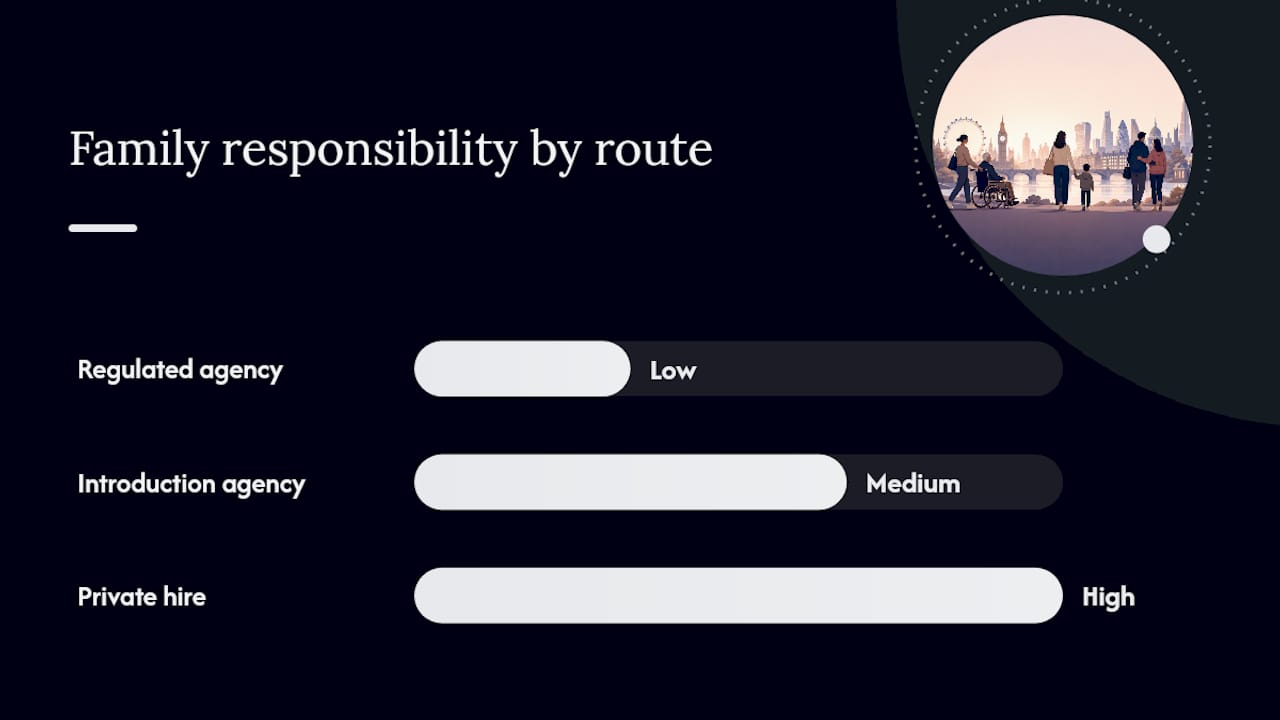
There are three lawful routes to arranging care at home, and they carry very different levels of responsibility for the family involved.
- Regulated domiciliary care agency. The agency employs the carers directly, handles payroll, insurance and training, and answers to the Care Quality Commission if something goes wrong. You get a formal complaints process and continuity backup if a carer is off sick.
- Introduction agency. These services match you with a self-employed carer but stop being responsible once the introduction is made. You become the client of that individual carer, not the agency’s client, which shifts more onus onto you if things don’t work out.
- Private hire. You employ a carer directly, which means running payroll, arranging liability insurance and meeting HMRC obligations as an employer. It can be cheaper, but only if you’re prepared to manage the administrative load that a family with a full-time job or their own care needs may struggle to carry.
There are three lawful ways to arrange care at home, and each model allocates legal responsibility differently. That distinction matters most when a carer doesn’t turn up, gets injured on shift, or is accused of poor practice. A CQC-registered provider carries statutory duties, including a registered manager, safe recruitment checks and a complaints process, that introduction agencies simply don’t hold.
For London families juggling work, other children, or their own health, the practical trade-off usually comes down to cover. A regulated agency can send a replacement carer at short notice if someone’s ill. An introduction service or private arrangement leaves you making that call yourself, often at 7am with someone waiting for their medication. If you want to understand what domiciliary care actually involves before choosing a route, it’s worth reading up before you commit to any single model.
How carer matching works step by step: assessment to confirmation
Getting matched with the right carer follows a fairly predictable sequence, even though every provider phrases it slightly differently.
Start with a local authority care needs assessment, even if you plan to pay privately. It’s free, it’s not means-tested at the assessment stage, and it gives you an independent, professional view of what support is actually needed rather than guesswork based on a difficult phone call last week. Independent Age recommends getting this assessment and checking that any agency’s care plan matches it before signing anything.
Once you’ve approached an agency or matching service, expect an assessment that covers:
- Daily tasks: washing, dressing, meal preparation, medication prompts
- Mobility, falls risk and any equipment already in use
- Medical conditions, allergies and GP or district nurse contact details
- Personal preferences: language, faith, gender preference, interests and routine
From there, the provider selects candidates based on skill match, availability and, increasingly, personality fit. Reputable agencies arrange an introduction or short trial visit before confirming the carer permanently, so both sides can check the fit works in practice, not just on paper.
Pro Tip: Ask specifically whether the introduction is supervised by a manager on the first visit. A provider that sends a manager along to the first session, rather than leaving the carer and family to work it out alone, tends to catch mismatches early.
Your written contract should specify the named carer (or small named team), visit times, what happens during holiday or sickness cover, notice periods, and how fees are reviewed. If you’d like a fuller breakdown of what the local authority process involves, our guide to care assessments in London covers eligibility and funding routes in more detail.
Costs and funding in London: typical rates and council support
London care costs run higher than most of the country, and the gap between visiting care and live-in care is significant enough to shape which option makes financial sense.
Home care visits typically cost between £15 and £30 per hour nationally, and London rates commonly sit at the top of, or above, that range once you account for higher wages and travel time between clients in dense boroughs. Live-in care is usually quoted as a daily or weekly rate rather than hourly, reflecting the fact that a carer is present continuously rather than clocking in and out.
Statistic Callout: London homecare agencies listed on CareAH publish rates and CQC ratings by postcode, letting families compare costs and regulatory status for their specific borough rather than relying on a single national average.
Funding routes worth exploring before you commit to full self-funding:
- Local authority care needs assessment, followed by a financial assessment (means test) to see if you qualify for council-funded or part-funded support.
- Direct payments, where the council gives you the budget to arrange your own care rather than commissioning it for you.
- NHS Continuing Healthcare, for people with primarily health-driven needs, which is assessed separately from social care funding.
- Grants and benefits such as Attendance Allowance, which some families use to offset ongoing hourly costs.
When comparing quotes, ask each provider to break costs down by hourly rate, minimum visit length, weekend and bank holiday uplifts, and any travel charges. A quote that looks cheap on the phone can look very different once weekend rates and 45-minute minimum visits are factored in.
Continuity and specialist matching for dementia or complex needs
Continuity of carer matters more for dementia than almost any other factor in the matching process. A small, named team, ideally two or three carers who rotate rather than an unpredictable roster, lets someone build familiarity and trust that reduces distress and confusion. Agencies that publish a clear continuity policy and offer named carers tend to be rated more highly for dementia outcomes than those that don’t formalise it.
For complex or cognitive needs, ask specifically about:
- Dementia training tiers the carer has completed, since basic awareness training differs substantially from advanced behavioural support training
- Cognitive Stimulation Therapy or similar structured activity programmes, which some agencies build into visit plans for people with dementia
- Clinical oversight, meaning whether a nurse or senior manager reviews the care plan periodically rather than leaving it static for years
- Contingency cover, so you know who steps in if a named carer is unavailable at short notice
Matching also extends beyond clinical skill. Language, cultural background and familiarity with specific equipment, hoists, catheters, feeding tubes, all affect whether a placement actually works day to day. A carer fluent in someone’s first language, or comfortable with religious dietary requirements, often makes a bigger practical difference than an extra certificate on paper. Structured activity and music sessions can also help maintain engagement for people with cognitive impairment, and providers sometimes draw on external activity ideas for care settings to keep visits varied rather than purely task-focused.
How to choose a carer-matching service: checklist and sample questions
Shortlisting providers gets much easier with a fixed set of criteria rather than judging on gut feeling after one phone call.
- CQC rating and recent inspection report, checked directly rather than taken on trust from a brochure
- DBS and reference checking process, including whether checks are renewed
- Named carer model, rather than a rotating pool with no continuity promise
- Written care plan, produced after a proper assessment, not a generic template
- Transparent pricing, with hourly rates, minimum visit lengths and uplift charges stated upfront
- Cover arrangements for sickness, holiday or emergencies
- Complaints process, clearly explained and easy to find in writing
- Specialist training, particularly for dementia or complex medical needs
At first contact, ask how quickly they can arrange an introduction, whether a manager attends the first visit, and how they handle a mismatch between carer and client. At the actual introduction, ask the carer directly about their experience with your specific condition or equipment, rather than relying solely on what the office told you.
Pro Tip: Read the cancellation and notice clauses before signing anything, not after. Some providers require four weeks’ notice to end a contract, which matters enormously if a placement isn’t working out.
Check written terms carefully for extra charges, bank holiday rates, mileage, or minimum visit fees are common areas where quotes diverge from actual invoices. Generally, prefer a regulated agency over private hire unless you’re genuinely prepared to take on employer duties yourself. Our guide to questions worth asking home care agencies covers the follow-up questions that catch providers off guard.
Kells Domiciliary Care: what we offer and how our matching works
Kells Domiciliary Care has been supplying home care across London for over 30 years, working directly in clients’ own homes rather than through a call centre model. Every carer on our team is fully qualified, DBS checked, and we’re regulated by the Care Quality Commission, which means our practice is open to inspection and public scrutiny, not just our marketing.
An approach to home care in London is often built around flexibility rather than a fixed package. Whether a family needs brief check-in visits or round-the-clock live-in support, a service can be personalised to promote independence, dignity and freedom of choice rather than a one-size-fits-all schedule.
When you contact a regulated agency, expect a proper assessment first, followed by a shortlist of named carers matched to the specific needs discussed, not a stranger sent at random. You should receive a written care plan and a transparent quote before anything is confirmed, so there’s no ambiguity about what’s included or what costs extra.
A practitioner’s note on common pitfalls and practical next steps
The most common mistake families make isn’t choosing the wrong agency. It’s underestimating what private hire actually demands: payroll, insurance, cover arrangements, and full responsibility if something goes wrong. Continuity gets overlooked too often, families accept a rotating carer pool because it’s offered first, then wonder why their parent seems more agitated by week three.
The pragmatic move is straightforward: get a needs assessment, then request a short trial with named carers before signing a long contract. It costs little and tells you far more than any brochure.
— Dan
Get a free home care guide and a no-obligation assessment
A regulated domiciliary care provider exists as the local alternative to piecing together private hire arrangements yourself, taking on payroll, insurance, and employer responsibility. After contact, they carry out a proper assessment, put together a shortlist of named carers matched to your situation, and send a written quote with no ambiguous extras hidden in the small print.
Download our free home care guide to see exactly what to expect before you commit to anything, and request a no-obligation assessment to start matching with named carers in your area.
Where to verify agencies and carers in London
Before signing with any provider, run your own checks. The NHS homecare service finder is a sensible first stop, alongside the CQC’s directory for inspection reports and ratings. CareAH’s London listings let you compare published rates by postcode, and Carers UK’s guidance on finding care agencies covers what to look for at first contact.
This article is general information, not a substitute for advice from a qualified doctor. Consult a qualified healthcare professional about your own circumstances before acting on anything here.
Sources
Every carer entering someone’s home in London should have passed an enhanced DBS check, the most thorough level of criminal record check available, which covers spent and unspent convictions along with police intelligence where relevant. Ask the provider directly whether checks are renewed periodically, not just done once at recruitment.
Beyond DBS, ask about:
- NHS — Homecare
- Care Quality Commission — Find homecare agencies
- Independent Age — Factsheet: arranging home care
The CQC’s directory of registered homecare agencies lets you read full inspection reports, not just a headline rating. Look specifically at the “Safe” and “Well-led” domains, since these tend to flag recruitment and safeguarding weaknesses before they show up in the overall score.
If you spot anything concerning, a rating that’s dropped since the last inspection, unexplained staff turnover, or vague answers about training, treat it as a signal to ask harder questions or look elsewhere. Reputable London agencies won’t flinch at direct questions about their vetting process. If they do, that hesitation tells you something.
FAQ
What is the £300 carer’s grant?
The Carer’s Allowance supplement varies by nation and circumstance, and specific one-off grants change over time, so check current eligibility directly with your local authority or Carer’s UK rather than relying on a fixed figure.
How much does a private carer charge per hour in the UK?
Home care visits typically cost between £15 and £30 per hour, with London rates often at the higher end due to wages and travel time between visits.
How can I find a carer in London?
Start with a local authority care needs assessment, then check the CQC directory or CareAH’s London listings for registered agencies, or contact a regulated provider such as Kells Domiciliary Care directly for an assessment.
Can you get free care in the UK?
Free care depends on the outcome of a local authority financial assessment (means test) following your care needs assessment, and eligibility varies depending on income, savings and the level of need identified.


