
TL;DR:
- Proper elderly care equipment improves safety and independence at home. Access to funding often involves assessments, grants, and support services, not just purchases. Selecting aids based on functional needs and integrating them into routines maximizes safety and effectiveness.
Equipment for elderly care at home consists of practical aids designed to improve safety, independence, and daily comfort for older people living in their own homes. The term “assistive devices for elderly” is the recognised industry standard for this category, covering everything from simple grab rails to powered wheelchairs. Choosing the right aids can prevent falls, reduce caregiver strain, and help your loved one stay at home longer. The NHS, local authority social care services, and the Disabled Facilities Grant (DFG) all provide statutory routes to access many of these aids at little or no cost. This guide helps families understand what is available, how to access it, and how to choose wisely.
1. What are the essential categories of equipment for elderly care at home?
Assistive devices for elderly people fall into five clear categories. Knowing which category applies to your loved one’s daily challenges is the fastest way to identify the right starting point.
Mobility aids are the most commonly needed group. These include:
- Walking sticks and quad sticks for mild balance issues
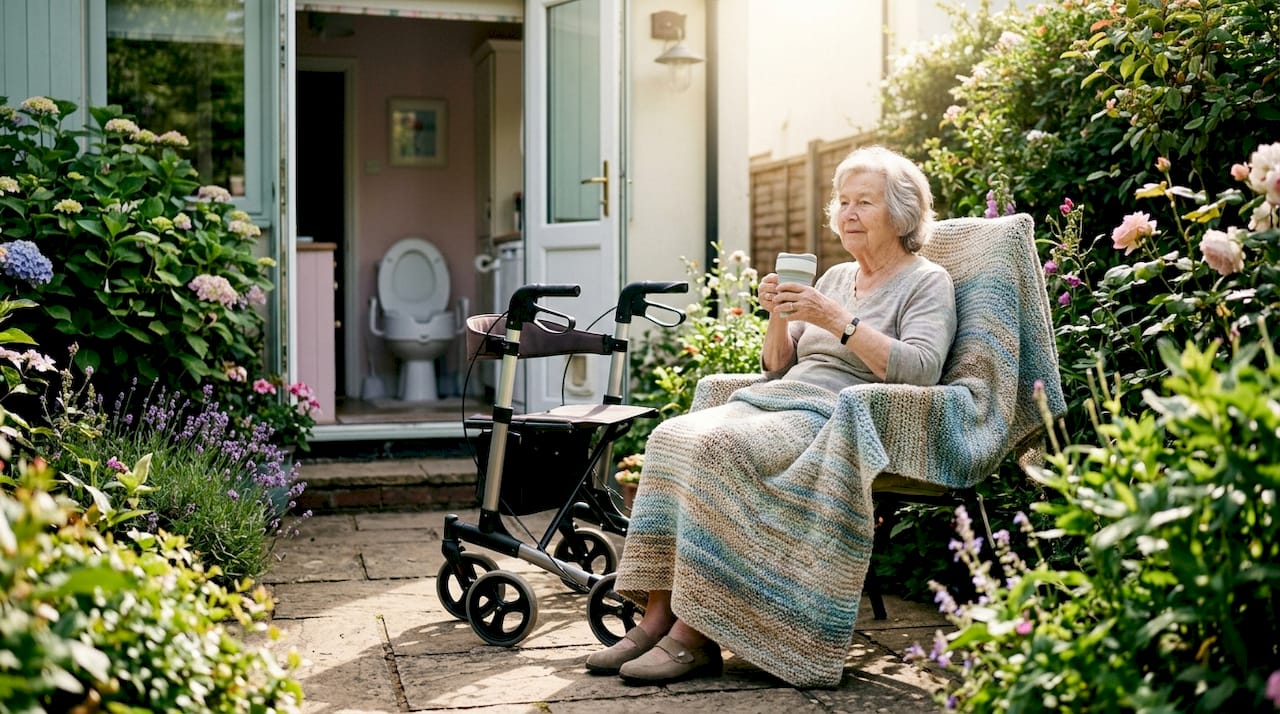
- Walking frames and rollators for those needing more support
- Wheelchairs, both manual and powered, for those with limited walking ability
- Transfer boards and turntables for moving safely between surfaces
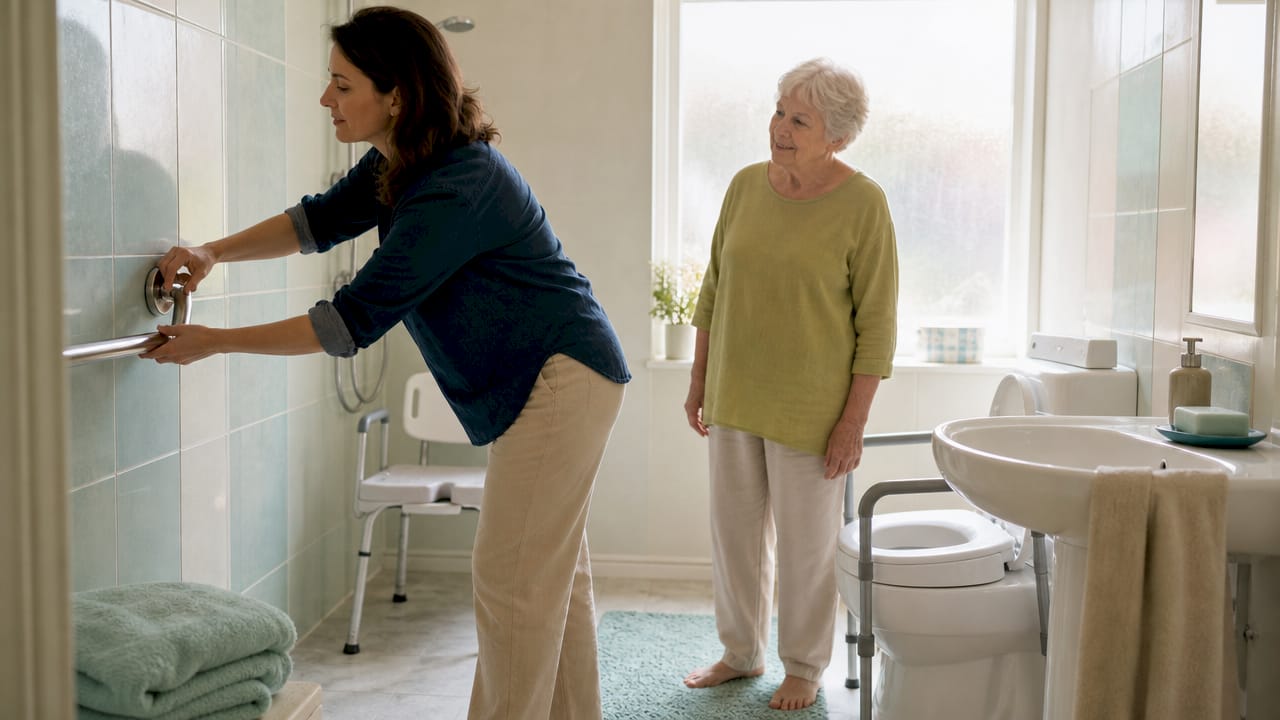
Bathroom and toileting aids address the highest-risk room in the home. Grab rails, shower chairs, and raised toilet seats are among the most widely used aids, directly reducing the risk of slips and falls during personal care. These are also among the most frequently provided free by local authorities after a needs assessment.
Dressing and personal care aids preserve dignity and independence. Sock aids remove the need to bend to the floor. Long-handled shoehorns and button hooks help those with limited grip or joint stiffness dress without assistance.
Kitchen and eating aids keep mealtimes safe and manageable. Adaptive cutlery with thick handles suits those with reduced grip. Kettle tippers, jar openers, and non-slip mats reduce the risk of spills and burns.
Bedroom and living room aids support transfers and rest. Bed levers help your loved one sit up and stand safely. Chair raisers lift low seats to a height that reduces strain on knees and hips. Reachers extend the arm’s range, reducing dangerous bending. You can read more about supporting independent living with these types of aids on the Kells-care website.
2. How can families access funding and support for elderly care equipment in the UK?
Statutory support in the UK is more generous than many families realise. The key is knowing which pathway to use and in what order.
-
Request a needs assessment from your local authority. This is the entry point for all statutory support. Local authorities must provide minor home adaptations costing under £1,000 and community equipment free of charge following a formal needs assessment. That means grab rails, raised toilet seats, and many other common aids cost you nothing if the assessment confirms the need.
-
Ask for an occupational therapist (OT) assessment. An OT assessment goes beyond a medical diagnosis. OT assessments identify functional capabilities, home environment factors, and personal preferences to tailor equipment recommendations. This prevents unsuitable purchases and ensures the aids provided actually match your loved one’s daily life.
-
Apply for the Disabled Facilities Grant for larger adaptations. The DFG funds essential adaptations such as stairlifts, wet rooms, and widened doorways. It is available to people of all ages, requires a needs assessment, and is subject to a financial means test. Eligibility does not depend on owning the property.
-
Explore NHS intermediate care and re-ablement services. Local authorities provide up to six weeks of re-ablement and intermediate care, often including equipment loans, to support recovery after a hospital discharge. This service helps older people regain independence and reduces long-term care reliance.
-
Look into charitable grants as a supplement. Organisations such as Turn2us and local benevolent funds can provide financial assistance for equipment not covered by statutory routes. These are best used after exhausting statutory options, not as a first resort.
3. What criteria should guide the selection of home care aids for seniors?
Selecting the right aid requires more than browsing a catalogue. The most effective approach matches equipment to specific functional deficits, not to a general diagnosis.
The biomechanical matching approach is the standard used by occupational therapists. Matching equipment to physical limitations such as reduced grip strength, hip stiffness, or poor balance ensures the aid directly addresses the problem. A person with hip stiffness benefits from a long-handled reacher and raised toilet seat. A person with weak grip needs thick-handled cutlery and lever taps, not standard equipment.
Prioritise by risk, not by convenience. Focusing on high-risk daily tasks such as toileting, bathing, and transfers first reduces the chance of injury and caregiver strain. Falls during these activities cause the most serious harm, so equipment addressing them delivers the greatest safety benefit.
When evaluating any aid, check these practical factors:
- Stability: Does the aid remain fixed during use? Wobble is a warning sign.
- Ease of use: Can your loved one operate it independently, or does it require assistance every time?
- Maintenance: Is it easy to clean? Does it have parts that wear out quickly?
- Home fit: Does it suit the layout and dimensions of the actual room it will be used in?
- User acceptance: Will your loved one actually use it? Resistance to equipment is common and worth addressing early.
Pro Tip: Never purchase equipment privately before completing a formal needs assessment. Local authorities may provide the same aids at no cost under statutory care plans. Buying first wastes money and may result in unsuitable equipment.
You can learn more about the formal needs assessment process through Kells-care, which helps families understand what to expect before their first appointment.
4. How can families integrate equipment into daily care routines effectively?
Equipment alone does not produce good outcomes. Embedding equipment use into daily life with consistent support and training achieves the best results for both the elderly person and the family carer.
The most practical steps families can take include:
- Set up the environment before each use. Place the shower chair in position before your loved one enters the bathroom. Lay out the sock aid before dressing begins. Preparation removes hesitation and reduces risk.
- Prompt use consistently. Gentle, regular reminders build habit. Skipping prompts leads to skipped equipment use, which leads to accidents.
- Supervise during the learning phase. New equipment feels unfamiliar. Staying close during the first few weeks builds confidence and catches errors before they become dangerous.
- Adapt for cognitive decline. For loved ones with dementia, simplify equipment choices and use visual cues such as labels or colour contrasts to guide use. Read the Kells-care guide on home safety for dementia for specific strategies.
- Review seasonally. Needs change. A walking frame that suited your loved one in spring may need adjustment or replacement by winter if their condition has progressed.
Pro Tip: Involve your loved one in every equipment decision. People are far more likely to use aids they helped choose. Resistance often signals that the wrong aid was selected, not that the person is being difficult.
Combining equipment with personalised home care from a professional carer produces the most consistent results. A carer who knows the equipment and the person can reinforce safe habits during every visit.
5. What are common mistakes to avoid when selecting elderly care equipment?
Most equipment failures are not product failures. They are selection and implementation failures. Avoiding these common errors saves money, prevents injury, and protects your loved one’s dignity.
- Buying without a professional assessment. Families often purchase equipment after a quick online search. Without an OT assessment, the aid may not match the actual functional deficit, and statutory provision may have covered the cost anyway.
- Choosing aids that do not address the specific problem. A standard walking stick does not help someone with significant balance impairment. Selecting the wrong category of aid creates a false sense of security.
- Ignoring maintenance and safety checks. Grab rails loosen over time. Wheelchair tyres deflate. Walking frame feet wear down. Regular checks prevent equipment from becoming a hazard.
- Skipping user training. Handing over equipment without instruction is a common and dangerous shortcut. Every aid requires a demonstration and a supervised practice period.
- Excluding the elderly person from decisions. Equipment chosen without the user’s input is frequently abandoned. Dignity and autonomy matter as much as clinical suitability. Why independence matters in care decisions is a principle Kells-care applies across all its services.
- Failing to review equipment as needs change. An aid that worked well after a hip replacement may be insufficient six months later if mobility has declined further. Schedule reviews at least every six months.
Key takeaways
The most effective approach to elderly care equipment at home combines professional needs assessment, statutory funding, and consistent daily integration supported by trained carers.
| Point | Details |
|---|---|
| Start with a needs assessment | Local authorities provide many aids free after a formal assessment, so always request one first. |
| Use the biomechanical matching approach | Select aids that directly address your loved one’s specific physical limitations, not general age-related needs. |
| Prioritise high-risk tasks | Focus equipment on toileting, bathing, and transfers first, as these carry the greatest injury risk. |
| Embed equipment into daily routines | Consistent prompting, supervision, and environment preparation determine whether equipment is actually used safely. |
| Review equipment regularly | Needs change over time; schedule reviews at least every six months to keep aids suitable and safe. |
What I have learnt from years of watching families navigate this
Families often come to equipment decisions in a moment of crisis, after a fall or a hospital discharge, and they want to act fast. That instinct is understandable. But the families who get the best outcomes are the ones who slow down just enough to get a proper assessment before spending a penny.
The most impactful aids I have seen are rarely the expensive ones. Simple, low-cost modifications like a well-placed grab rail or a raised toilet seat consistently produce more meaningful improvements in daily safety than high-tech devices costing hundreds of pounds. The technology is not the point. The fit is the point.
What I find families underestimate most is the emotional dimension. Accepting equipment can feel like a loss of identity for an older person. A walking frame is not just a walking frame; it is a visible sign of change. Approaching that conversation with patience and genuine involvement, rather than presenting equipment as a done decision, changes everything. The person who chose their own shower chair uses it. The person who had one installed without consultation often does not.
The other thing worth saying plainly: equipment works best when a skilled carer is part of the picture. A carer who knows the person, understands the equipment, and shows up consistently turns a good aid into a genuinely safe daily routine. That combination, the right equipment and the right person, is what aging in place actually looks like in practice.
— Dan
How Kells-care supports families with home care equipment needs
Kells-care has provided high-quality domiciliary care across London for over 30 years, regulated by the Care Quality Commission (CQC). The team works with families to understand individual needs and advise on safety equipment, daily living aids, and home adaptations that complement professional care. Every care plan is personalised, and carers are trained to support the safe use of assistive devices as part of daily routines. If you are unsure where to start, the free home care guide from Kells-care gives families a clear, practical overview of equipment options and care services available in London. For a broader picture of what personalised support looks like, visit the Kells-care home page to explore the full range of services.
FAQ
What equipment do elderly people most commonly need at home?
Grab rails, shower chairs, and raised toilet seats are the most frequently used aids, addressing balance, strength, and safety in the bathroom. Mobility aids such as walking frames and rollators are also widely needed.
Can I get elderly care equipment free from the NHS or local authority?
Local authorities must provide community equipment and minor adaptations costing under £1,000 free of charge after a formal needs assessment. Always request an assessment before purchasing privately.
What is the Disabled Facilities Grant and who qualifies?
The Disabled Facilities Grant funds larger home adaptations such as stairlifts and wet rooms. It is available to people of all ages, requires a needs assessment, and is subject to a financial means test.
How does an occupational therapist help with equipment selection?
An OT assessment evaluates functional ability, the home environment, and personal preferences to recommend aids that genuinely match the individual’s needs, preventing unsuitable or wasted purchases.
How often should elderly care equipment be reviewed?
Equipment should be reviewed at least every six months, or sooner if the person’s condition changes. Aids that no longer fit the user’s needs can create new risks rather than reduce them.


