TL;DR:
- Families in London should insist on an enhanced DBS check with barred list status when hiring carers to ensure proper vetting and safety. DBS checks are vital tools that help identify individuals with a history of misconduct but must be complemented by references and ongoing oversight for comprehensive protection. Active family involvement and choosing reputable agencies further strengthen safeguarding measures for vulnerable loved ones.
Many families in London assume that any carer who turns up at the door is safe, vetted, and cleared to work with vulnerable people. That assumption can be costly. Understanding why use DBS checked carers is one of the most important steps you can take when arranging home care for an elderly relative, someone with dementia, or a family member with a disability. A Disclosure and Barring Service (DBS) check is a formal background screening tool that reveals criminal records and, at its most thorough level, whether someone is legally barred from working with vulnerable adults. This guide explains what those checks involve, how to use them, and why they are non-negotiable.
Table of Contents
- What is a DBS check and why does it matter for carers
- How DBS checks protect vulnerable adults: evidence and impact
- Navigating DBS checks in London home care: process, costs, and practical tips
- Other safety measures alongside DBS checks: building confidence in carers
- Choosing the right DBS-checked carer: practical steps for London families
- Why DBS checks alone are not enough: a London perspective
- Getting the right DBS-checked home carer in London with Kells Domiciliary Care
- Frequently asked questions
Key Takeaways
| Point | Details |
|---|---|
| DBS checks explained | Enhanced DBS checks provide detailed background information vital for carers working with vulnerable adults. |
| Legal changes in 2026 | Since January 2026, families can legally require enhanced DBS checks from self-employed carers in London. |
| Practical verification | Families must see original DBS certificates and can use the Update Service for instant online status checks. |
| Broader safety measures | DBS checks should be combined with references and right-to-work checks to ensure total carer suitability. |
| Choose trusted providers | Selecting carers through reputable agencies with strict DBS compliance reduces risks and improves peace of mind. |
What is a DBS check and why does it matter for carers
A DBS check is a background screening carried out by the Disclosure and Barring Service, a government body in England and Wales. It allows employers and, increasingly, private individuals to review a carer’s criminal history before granting them access to vulnerable people. There are three levels, and the differences matter enormously.
- Basic DBS check: Shows only unspent convictions. This is the minimum level and is not adequate for personal care roles.
- Standard DBS check: Shows both spent and unspent convictions, cautions, reprimands, and warnings.
- Enhanced DBS check: Includes everything in the standard check, plus any relevant information held by local police.
- Enhanced DBS check with adults’ barred list: The highest level. Confirms whether a person is legally prohibited from working with vulnerable adults. This is the appropriate level for personal carers.
For carers entering someone’s home to provide intimate or personal care, only the enhanced check with barred list status gives you a complete picture. The barred list is maintained by the Disclosure and Barring Service and includes individuals who have been formally banned from working with vulnerable adults following proven misconduct or abuse.
A significant legal development in 2026 means that private individuals can now require enhanced DBS checks from carers providing personal care to vulnerable adults, covering spent and unspent convictions as well as barred list status. This is a meaningful shift. Previously, families had limited formal power to demand the most thorough level of check from self-employed carers. Now you have that right.
When using qualified carers from a reputable agency, the enhanced DBS check is standard practice. But if you are hiring privately, you now have the legal standing to insist on it.
How DBS checks protect vulnerable adults: evidence and impact
Understanding the DBS check itself is essential. Now let us explore how it directly protects your loved ones.
Enhanced DBS checks are one of the most reliable tools available for identifying people who pose a risk to vulnerable adults. They capture information that a simple interview or reference call would never reveal. A carer may present professionally and warmly, yet have a history of financial abuse or violence against elderly clients that only a thorough background check would surface.
The government’s position on this is clear. As highlighted in recent legislative guidance, enhanced DBS checks provide families with clear, reliable information that helps keep those with harmful intentions away from vulnerable adults. This is not a bureaucratic formality. It is a genuine safeguard.
“Enhanced DBS checks provide clear, reliable information helping families keep those with harmful intentions away from vulnerable adults.” — UK Government guidance on stronger security checks, 2026
The broader context makes this even more pressing. Many home care providers lack recent CQC ratings, which means DBS checks are vital for families who need to verify carer safety independently. If a provider has not been recently inspected or rated, you cannot assume their recruitment standards are robust. A current, enhanced DBS certificate is one of the few concrete pieces of evidence available to you.
For elderly people living alone, those with dementia, or adults with disabilities, the risks of an unvetted carer entering the home are significant. Emotional vulnerability, physical dependency, and reduced capacity to report problems all increase the stakes. DBS checks reduce those risks meaningfully. They are not a guarantee, but they are a vital first filter.
You can learn more about ensuring carer safety at home in our dedicated London guide.
Navigating DBS checks in London home care: process, costs, and practical tips
With a clear understanding of DBS benefits, here is how to practically manage DBS verification and avoid hiring delays in London.
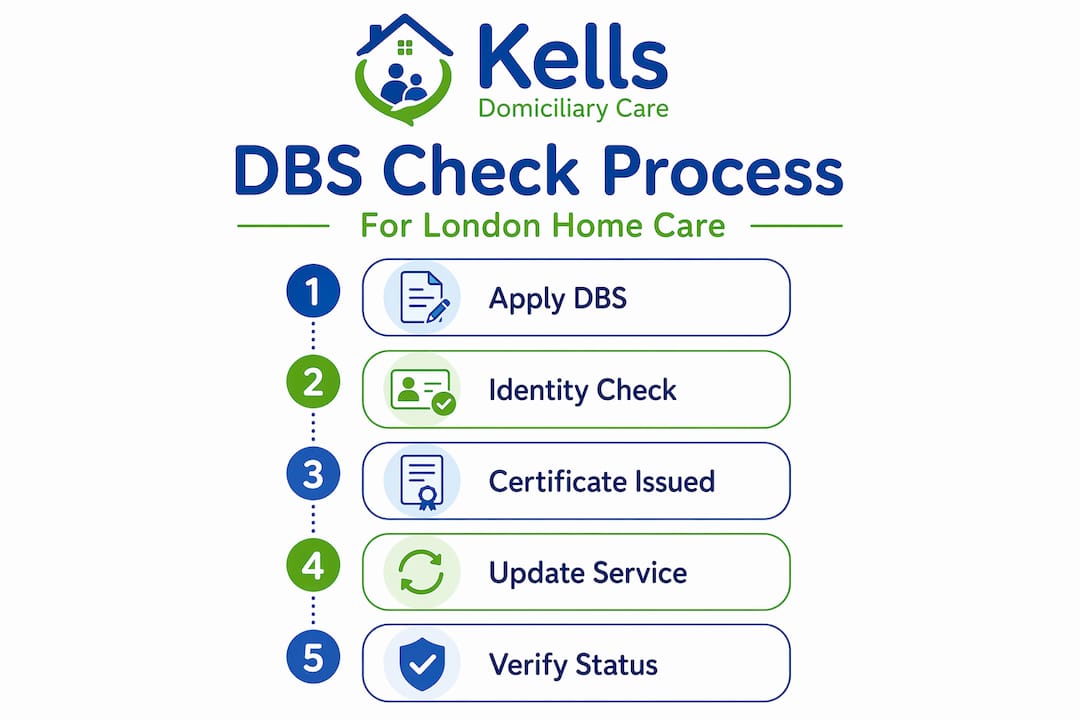
Cost and timescale: An enhanced DBS certificate costs around £40 to £50 and typically takes 7 to 14 days to process. There is no official expiry date, but most reputable care providers renew them every one to three years.

The DBS Update Service: This is a subscription service that allows carers to keep their certificate current and lets employers or families check its status online instantly, without waiting for a new application. If a carer subscribes to this service, you can verify their status in minutes. Families must verify original certificates physically and may use the DBS Update Service for instant online status confirmation.
Here is a summary of the key details:
| DBS check type | Cost | Timescale | Barred list included | Suitable for personal carers |
|---|---|---|---|---|
| Basic | £18 | 2 to 5 days | No | No |
| Standard | £18 | 5 to 10 days | No | No |
| Enhanced | £40 to £50 | 7 to 14 days | No | Partial |
| Enhanced with barred list | £40 to £50 | 7 to 14 days | Yes | Yes |
Common pitfalls to avoid:
- Accepting a photocopy or photo of a DBS certificate. Always view the original in person.
- Assuming a basic DBS check is sufficient for a carer providing personal care. It is not.
- Not checking whether the barred list has been included on an enhanced certificate.
- Overlooking the date of issue and not asking when renewal is planned.
- Failing to use the Update Service when it is available, which can delay verification unnecessarily.
Pro Tip: Ask carers directly whether they are subscribed to the DBS Update Service. If they are, you can verify their current status online within moments, saving both parties time and giving you immediate peace of mind.
Our carer hiring checklist for London families covers these steps in further detail.
Other safety measures alongside DBS checks: building confidence in carers
While DBS checks offer key protection, they must be part of a wider safety approach to ensure thorough carer screening.
A DBS certificate tells you what is on record. It does not tell you whether a carer is compassionate, dependable, or skilled. That is why the benefits of DBS checked carers are best realised when combined with other safeguards.
DBS checks are part of safer recruitment. Families should combine them with references and consider role-specific safety concerns. Here is what a thorough recruitment process looks like:
- At least two professional references: Ideally from previous care employers, not personal contacts.
- Right-to-work verification: Confirming the carer is legally permitted to work in the UK.
- A structured interview: Including scenario-based questions about how they would handle distress, a fall, or a client refusing care.
- Proof of relevant qualifications: Such as NVQ in Health and Social Care or equivalent training certificates.
- Evidence of ongoing training: First aid, moving and handling, dementia awareness, and safeguarding.
Regulated agencies handle most of these checks as a matter of course. Independent hirers face these checks alone, which is one reason many London families choose to work with a regulated provider. CQC inspections frequently flag DBS gaps, so families should also request proof of right-to-work and references before hire.
Do not rely solely on DBS clearance and assume all other aspects of suitability are covered. A clear certificate is a positive sign. It is not a complete endorsement of a carer’s character or competence.
To understand the full picture of regulated care, read our guide on understanding the CQC’s role in home care.
Choosing the right DBS-checked carer: practical steps for London families
Now that you understand the safety checks, here are practical steps to choose the best DBS-checked carer for your family member.
- Request the enhanced DBS certificate with barred list status. Make this a condition of any carer beginning work with your relative.
- View the original certificate in person. Check the certificate number, date of issue, and that the barred list box has been ticked.
- Verify via the Update Service if available. Log on to the DBS Update Service website and check the carer’s current status using their certificate number and date of birth.
- Review any disclosed information carefully. A disclosed offence does not automatically disqualify a carer. Consider the nature, age, and relevance of the offence to the care role.
- Discuss disclosures openly. Apply open, measured discussions about offences revealed on DBS checks with applicants. Do not discriminate unfairly, but prioritise vulnerable adult safety.
- Cross-reference with references and interview performance. A DBS check should inform your decision, not make it in isolation.
- Confirm right-to-work status and relevant training before the first visit.
Here is a quick comparison of DBS check types and their suitability for different home care roles:
| Care role | Recommended DBS level | Barred list required |
|---|---|---|
| Companionship visits only | Standard | No |
| Personal care (washing, dressing) | Enhanced with barred list | Yes |
| Medication administration | Enhanced with barred list | Yes |
| Dementia or complex needs care | Enhanced with barred list | Yes |
| Live-in carer | Enhanced with barred list | Yes |
Pro Tip: If a carer or agency hesitates when you ask to see the original DBS certificate, treat that as a serious warning sign. Legitimate, properly vetted carers expect this request and welcome the transparency.
Our guide on choosing a home care agency in London provides further advice on evaluating providers confidently.
Why DBS checks alone are not enough: a London perspective
DBS checks are foundational. We will never suggest otherwise. But over more than three decades of working in London home care, one pattern stands out clearly: families who treat a DBS certificate as the final word on carer safety are the ones most likely to be caught off guard later.
A DBS check captures what has been recorded. It does not capture what has never been reported. It does not tell you whether a carer is emotionally suitable for working with someone in advanced dementia, whether they communicate well under pressure, or whether their attitude towards dignity and privacy aligns with your family’s expectations.
The CQC notes workforce pressures and the need for comprehensive governance alongside DBS to improve care quality and safety. Workforce challenges in London are real. Staff turnover in home care is high, and pressure on carers can affect the quality of day-to-day care in ways that no certificate can predict or prevent.
What does work, in our experience, is active family involvement. Regular communication with the carer, honest check-ins with your relative about how visits are going, and a genuine relationship with the care provider all create layers of oversight that no single document can replicate. If something feels wrong, it probably warrants a conversation.
Choosing a reputable agency that carries CQC registration, maintains thorough recruitment records, and communicates openly with families creates a structure of accountability that goes well beyond the DBS check itself. The check opens the door. Everything that follows is what builds genuine trust.
For a fuller picture of safe home care in London, our home care services guide for London families is a useful starting point.
Getting the right DBS-checked home carer in London with Kells Domiciliary Care
Armed with this knowledge about DBS checks and safe recruitment, here is how Kells Domiciliary Care supports London families in finding the right DBS-checked carer.
At Kells, every carer we place holds a current enhanced DBS check with adults’ barred list status. We are regulated by the Care Quality Commission, and our vetting process goes further than a certificate: references, right-to-work checks, structured interviews, and ongoing training are all part of how we work. If you are new to domiciliary care and unsure where to begin, we are here to guide you through the process calmly and clearly.
We understand that choosing a carer for someone you love is not a simple decision. Our team matches carers to clients based on personality, experience, and care needs, not just availability. Whether your family member needs a daily check-in visit or round-the-clock support, our fully qualified carers are trained to provide care with dignity and warmth. You can also use our carer checklist for London families to prepare the right questions before your first conversation with any care provider.
Frequently asked questions
What does a DBS check for carers include?
An enhanced DBS check for carers includes spent and unspent convictions, cautions, local police intelligence, and a barred list check to prevent unsuitable people working with vulnerable adults. As confirmed by government guidance, enhanced DBS checks include spent and unspent convictions, cautions, and barred list status for roles involving vulnerable adults.
Can families in London request enhanced DBS checks from self-employed carers?
Yes. Since January 2026, private individuals can now require enhanced DBS checks from self-employed carers providing personal care to vulnerable adults, giving London families a stronger legal footing to demand the highest level of background screening.
How often should DBS checks be renewed for carers?
DBS certificates have no official expiry date but are generally renewed every one to three years. Enhanced DBS checks have no official expiry but carers subscribing to the Update Service can have their status verified online instantly, removing the need for a full renewal each time.
Are DBS checks enough to guarantee carer safety?
No single check guarantees safety. DBS checks are part of safer recruitment and must be combined with professional references, right-to-work confirmation, and ongoing oversight to provide genuine reassurance that a carer is both safe and suitable.