

TL;DR:
- Support planning involves creating a legally recognized, personalized care plan for individuals with eligible needs under UK law. It ensures coordinated, person-centred support that reflects personal goals and is regularly reviewed to adapt to changing circumstances. Families play a vital role by preparing for meetings, documenting informal support, and actively advocating for their loved one’s true needs.
Support planning is the process of developing a legally recognised, personalised care plan that details an individual’s needs, preferences, and the support services to be provided. In the UK, support planning is a legal requirement under the Care Act, applying to anyone assessed as having eligible care needs. The formal term used by the NHS and local authorities is a “personalised care and support plan.” For families and caregivers in London supporting an elderly relative, someone with a disability, or a person with mental health challenges, understanding this process gives you real power to shape the care your loved one receives.
What is support planning and why does it matter?
A support plan is a mandatory document that records assessed needs, eligible requirements, and the services arranged to meet those needs. It is not simply a form. It is the legal foundation for all care services your loved one will receive.

The Care Act places a duty on local authorities to produce a support plan for every person who meets the eligibility threshold. That plan must specify what the person’s needs are, what outcomes they want to achieve, and how services will help them reach those outcomes. Without a completed plan, funding cannot be released and services cannot formally begin.
The importance of a support plan goes beyond paperwork. It is a life guide that gives the individual and their family a clear, shared understanding of what care looks like day to day. For families in London working across multiple boroughs or with several providers, having one authoritative document prevents confusion and protects your loved one’s rights.
What are the key steps in the support planning process?
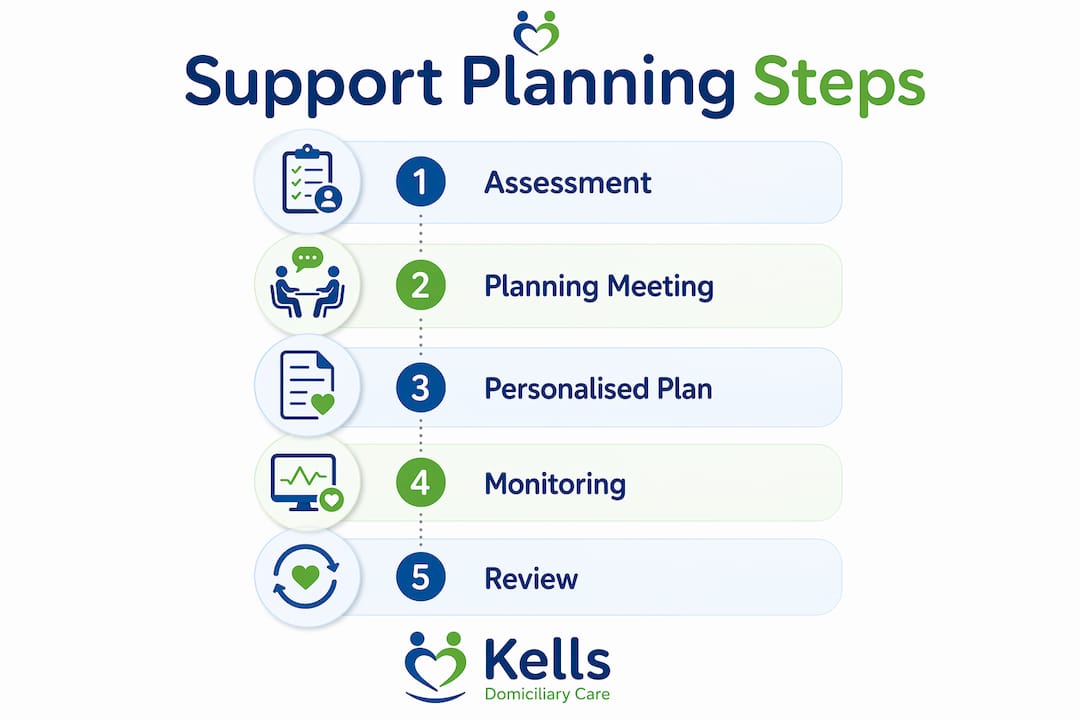
The support planning process follows four clear stages. Knowing these stages helps you prepare and ensures nothing is missed.
- Needs assessment. A social worker or care coordinator from your local authority carries out a formal assessment. They look at what the person can and cannot do, and what impact this has on their wellbeing.
- Eligibility determination. The assessor applies national eligibility criteria under the Care Act. If the person meets the threshold, they qualify for a funded support plan.
- Plan development. A planning meeting takes place to agree goals, preferred services, and how care will be delivered. Formal planning meetings with case managers should occur within 30 days of eligibility approval. Delays at this stage directly affect when care begins.
- Authorisation and implementation. The completed plan is signed off by the local authority. Funding is confirmed and services start.
The role of social workers in this process is central. They coordinate assessments, facilitate planning meetings, and act as the link between the family and the local authority.
Pro Tip: Before the planning meeting, write down your loved one’s daily routine, the tasks they struggle with, and the goals that matter most to them. Bringing this to the meeting ensures the plan reflects real life, not just clinical observations.
How does person-centred planning shape effective support plans?
Person-centred planning puts the individual at the heart of every decision. It is the opposite of a service-led approach, where care is shaped by what services happen to be available rather than what the person actually needs.
The NHS Standards Directory defines a personalised care and support plan as one that promotes dignity, independence, and choice, moving beyond symptoms to reflect the whole person. That means the plan should capture hobbies, social connections, daily preferences, and personal goals alongside clinical needs. A person who loves gardening and values their independence on a Tuesday afternoon should have that reflected in their plan.
A key part of this approach is the “discovery phase.” This phase focuses on what the individual values in life, not only their limitations. It sets the foundation for a plan that genuinely improves quality of life rather than simply managing risk.
Experts also warn against paternalistic attitudes in planning. Treating individuals as equals increases their engagement and commitment to their own goals. Families play a vital role here. You know your loved one better than any professional. Your input shapes whether the plan feels real or generic.
“A support plan should reflect who the person is, not just what they cannot do. The best plans start with a conversation about what a good day looks like.” — NHS Standards guidance on personalised care
The benefits of this approach are practical as well as emotional. A single shared plan accessible to all professionals involved in care improves continuity and reduces the burden on families who would otherwise have to repeat the same information to every new carer or clinician.
For families looking to personalise home care services for a loved one, the support plan is the starting point for every conversation with providers.
What practical advice can families use in support planning in London?
Active participation in the planning process produces better outcomes. Families who prepare, ask questions, and follow up consistently get plans that are more detailed and more useful.
Before the planning meeting, prepare the following:
- A written summary of your loved one’s daily routine and the tasks they need help with
- A list of their personal goals, preferences, and what matters most to them
- Details of any informal support already in place, such as family visits or community groups
- Questions about funding, direct payments, and which services are available in your London borough
During the meeting, raise these topics:
- How will the plan be shared with all care providers involved?
- What happens if needs change between formal reviews?
- How are informal carers recognised and supported within the plan?
- Who is the named contact if there is a problem with services?
Informal support networks are crucial to care delivery and must be documented in the plan. If a family member provides regular support, that contribution needs to be recorded. This protects both the individual and the family member, and it ensures the local authority understands the full picture of care being provided.
Pro Tip: Ask for a copy of the completed plan in writing before services begin. Check that every agreed service, contact, and goal is recorded accurately. Errors at this stage can cause delays and funding disputes later.
You can also request a review of the plan at any time if circumstances change. You do not have to wait for the annual formal review. Knowing how to communicate with carers and coordinators clearly makes this process much smoother.
What challenges occur in support planning and how to overcome them?
Support planning does not always go smoothly. Knowing the common pitfalls helps you spot them early and address them before they affect care.
| Challenge | Impact | How to address it |
|---|---|---|
| Service-led planning | Plan reflects available services, not personal goals | Insist on a discovery phase; bring written goals to the meeting |
| Multiple disconnected plans | Fragmented care and repeated information | Request a single shared plan accessible to all providers |
| Outdated plan | Care gaps as needs change | Schedule informal reviews every 3–6 months |
| Informal care not documented | Funding gaps and unrecognised support | Ensure all informal support is recorded in writing |
| Paternalistic approach | Individual feels excluded from decisions | Advocate for equal partnership in every meeting |
The most common problem families in London report is a plan that was written once and never updated. Support plans are living documents requiring ongoing review and adaptation. Informal reviews are recommended every 3–6 months even when the formal annual review is not yet due. Needs change, and the plan must change with them.
Fragmented care is the second major risk. When a person receives support from a GP, a community nurse, a domiciliary care agency, and a family carer, each professional may hold a different version of the care picture. The NHS push for unified plans addresses this directly. One shared plan, accessible to all, prevents gaps and reduces the burden on families who would otherwise act as the link between every provider.
Pro Tip: Keep your own copy of the support plan and note the date of every change. If a service is altered or removed, ask for the updated plan in writing. This record protects your loved one if a dispute arises.
The role of care coordinators is particularly valuable when plans become complex. A good coordinator holds the whole picture and ensures every provider is working from the same information.
Key takeaways
Effective support planning requires a person-centred approach, active family involvement, and regular reviews to keep the plan current and meaningful.
| Point | Details |
|---|---|
| Legal foundation | A support plan is mandatory under the Care Act for anyone with eligible care needs. |
| Four-stage process | Planning follows assessment, eligibility, plan development, and authorisation before services begin. |
| Person-centred approach | Plans must reflect personal goals, preferences, and daily life, not just clinical needs. |
| Document informal support | All informal care must be recorded to protect funding and ensure full care coordination. |
| Living document | Review the plan every 3–6 months informally to prevent care gaps as needs evolve. |
Why good support planning changes everything
I have seen families arrive at planning meetings with no preparation and leave with a plan that barely reflects their loved one’s actual life. I have also seen families who came prepared with notes, questions, and a clear sense of what their relative values most. The difference in the quality of the plan produced is significant.
The thing most families do not realise is that the planning meeting is not a formality. It is your best opportunity to shape everything that follows. Professionals are working from assessments and criteria. You are working from lived experience. Both matter, but yours is often the piece that is missing.
What I find most encouraging is how much the system has shifted toward person-centred approaches in recent years. The NHS Standards framework, the Care Act, and guidance from organisations like the LDA Commissioner Network all point in the same direction. The individual’s voice belongs at the centre of the plan.
My honest advice to any family in London going through this process: treat the support plan as your document, not the local authority’s. Ask for it in writing. Review it regularly. Push back if it does not reflect what your loved one actually needs. The plan exists to serve them, and you are the most important advocate they have.
— Dan
Support planning and home care in London with Kells-care
Kells-care has been providing personalised home care across London for over 30 years. If you are working through a support plan for an elderly relative, a family member with a disability, or someone managing a mental health condition, Kells-care can help you put that plan into practice at home.
All Kells-care staff are fully qualified, DBS checked, and regulated by the Care Quality Commission. Services range from short check-in visits to round-the-clock care, all tailored to the individual’s support plan. Download the free home care guide to understand your options clearly before your next planning meeting. For families ready to take the next step, contact Kells-care directly to discuss how home care services can align with your loved one’s plan.
FAQ
What is a support plan under the Care Act?
A support plan is a mandatory document required under the Care Act that records a person’s assessed needs, eligible requirements, and the services arranged to meet those needs.
How long does the support planning process take?
Formal planning meetings should take place within 30 days of eligibility approval. Delays beyond this point can affect when care services begin.
What is individual support planning?
Individual support planning is a person-centred process that creates a care plan based on a specific person’s goals, preferences, and daily life rather than a generic service template.
How often should a support plan be reviewed?
Support plans should be reviewed formally at least once a year. Informal reviews are recommended every 3–6 months to reflect any changes in needs or circumstances.
Can families request changes to a support plan?
Yes. Families and caregivers can request a review of the support plan at any time if needs change. All changes should be confirmed in writing and shared with every provider involved in care.


