

TL;DR:
- An autism care workflow organizes assessments, therapy, and support through shared systems to improve coordination. Building a team, establishing communication, and applying evidence-based practices create an effective and adaptable care process. Digital tools and regular reviews help families reduce delays and manage caregiver stress better.
An autism care workflow is an organised, step-by-step process that families and caregivers use to coordinate and manage support for individuals with autism. Without a clear structure, care quickly becomes fragmented across therapists, schools, and home settings. A well-built workflow brings every part of the autism treatment process together, reducing delays, improving communication, and giving caregivers a reliable system to follow each day. Digital tools and evidence-based strategies are now making this process more manageable than ever before.
What essential components does an autism care workflow need?
A strong autism care workflow starts with the right people, documents, and tools in place before any scheduling or therapy begins. Skipping this foundation is the most common reason workflows break down within the first few months.
Key participants in the workflow
Every effective workflow involves a multidisciplinary team. That team typically includes:
- Family and primary caregivers who manage day-to-day routines and observe behaviour at home
- Speech and language therapists, occupational therapists, and applied behaviour analysis (ABA) practitioners who deliver direct intervention
- Paediatricians or developmental specialists who oversee medical needs and referrals
- Special educational needs coordinators (SENCOs) and classroom teachers who implement support at school
- Care coordinators who connect all parties and track progress across settings
Understanding the role of care coordinators is particularly useful here, as they often become the central point of contact for families managing complex care plans.
Documents and assessments
A formal autism evaluation typically lasts between 2 and 4 hours and includes parent interviews, direct observation, and standardised tools such as the ADOS-2 (Autism Diagnostic Observation Schedule). This assessment forms the foundation of every care plan that follows. You will also need behavioural support plans, school education and health care plans (EHCPs), therapy goal sheets, and medication records where relevant.
Tools and platforms
| Tool type | Purpose | Examples |
|---|---|---|
| Digital knowledge bases | Store linked client records and prompt hierarchies | Obsidian |
| Scheduling platforms | Coordinate therapy and school appointments | Google Calendar, Outlook |
| Communication apps | Share updates between home, school, and therapists | WhatsApp groups, Slack |
| Progress tracking tools | Log behavioural data and therapy outcomes | ABA data apps, spreadsheets |
| Document management | Organise intake files and assessments | Google Drive, SharePoint |
Clinicians use digital knowledge bases like Obsidian to maintain linked client records, enabling rapid retrieval of reinforcement preferences and prompt hierarchies. Paper files simply cannot match that speed or accuracy.
How can families implement step-by-step autism care coordination?
A clear process removes the guesswork from daily care management. The steps below reflect best practice for building a workflow in autism therapy from the ground up.

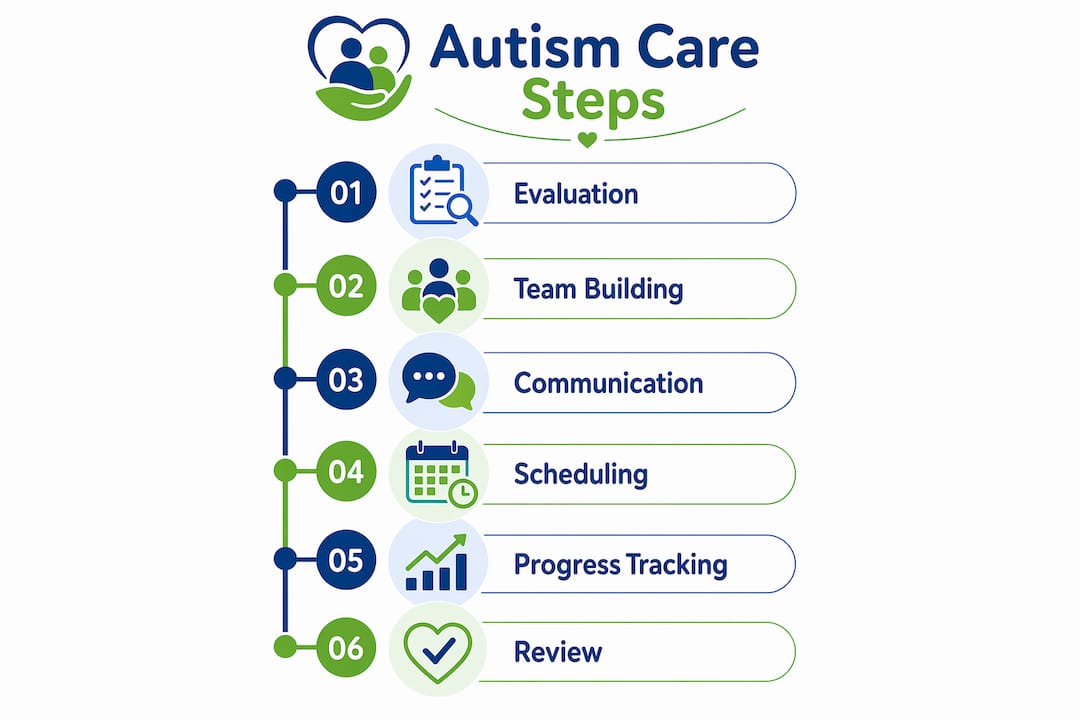
Step 1: Complete the formal evaluation
Start with a comprehensive diagnostic assessment. The ADOS-2 and parent interview give you the clinical picture you need to make informed decisions about therapy type, frequency, and setting.
Step 2: Build your multidisciplinary team
Once you have a diagnosis, identify which professionals your child needs. Contact your GP, local authority SEND team, and any private therapy providers. Confirm roles and responsibilities in writing so everyone knows who does what.
Step 3: Establish shared communication channels
Set up a single communication system that all team members use. A shared folder for documents and a group messaging thread for quick updates prevents information from getting lost. You can find practical guidance on communicating with carers to help you set this up confidently.
Step 4: Schedule and coordinate sessions
Map all therapy sessions, school meetings, and medical appointments onto one shared calendar. Colour-code by provider so you can see the week at a glance. Build in buffer time between sessions to avoid rushing.
Step 5: Track progress and adjust plans
Collect simple behavioural data at home using a notebook or app. Review this data with your therapy team every four to six weeks. Adjust goals and strategies based on what the data shows, not just on gut feeling.
Step 6: Review the whole workflow regularly
Schedule a full team review every school term. Check whether the workflow is still meeting your child’s needs and whether any providers have changed their approach.
Pro Tip: Request digital, pre-summarised intake files from every new provider before the first appointment. Pre-summarised digital intake can cut administrative onboarding time from months to days, freeing you to focus on care rather than paperwork.
What common challenges arise in autism care workflows?
Even well-planned workflows hit obstacles. Recognising these bottlenecks early means you can fix them before they affect your child’s progress.
Common bottlenecks caregivers face
- Long waiting lists between referral and first appointment
- Information silos where one provider does not know what another is doing
- Inconsistent strategies between home, school, and therapy settings
- Caregiver burnout from managing too many moving parts without support
- Delayed document processing that holds up new service starts
AI-driven workflow automation has reduced patient onboarding wait times from 6 months to 4 days and cut document processing error rates to 5%. That kind of improvement shows what is possible when digital tools replace manual paperwork in autism care coordination.
Consistency across settings
Using the same visual supports and tools at home and school is the most effective way to reduce cognitive load for autistic individuals. Inconsistency creates confusion and stress. Share your child’s visual schedule and communication tools with every setting they attend.
Involving the autistic individual
Environmental modifications are most effective when they come directly from consultation with the autistic person. Sensory preferences vary widely, and self-report is the most reliable guide. Ask your child or young person directly what helps them feel calm and focused, and build those preferences into the workflow. An autism-friendly home checklist can help you structure these conversations practically.
“The most overlooked part of any care workflow is the autistic person’s own voice. Build in regular, low-pressure check-ins where they can tell you what is working and what is not.”
Pro Tip: Wait 10 to 20 seconds after asking a question before repeating it. This ‘silence gap’ strategy gives the autistic individual time to process your words without the added stress of repeated prompting.
How do evidence-based practices support effective autism management?
Evidence-based practices give your workflow a scientific foundation. Without them, care plans risk being inconsistent or ineffective, however well-intentioned.
The National Clearinghouse on Autism Evidence and Practice (NCAEP) identified 28 evidence-based practices based on a review of 972 peer-reviewed studies published between 1990 and 2017. That body of research is the strongest available guide for choosing which strategies to include in your workflow.
Practices with the strongest evidence base
- Visual supports: Picture schedules, task boards, and social stories reduce anxiety and improve independence across settings
- Task analysis: Breaking complex skills into small, teachable steps makes learning manageable and measurable
- Reinforcement: Identifying and consistently applying preferred rewards increases the likelihood of target behaviours
- Naturalistic developmental behavioural interventions: Embedding learning into everyday routines rather than isolated sessions improves generalisation
- Behavioural data collection: Recording frequency, duration, and intensity of behaviours allows the team to make data-driven decisions
Integrating data collection directly into your daily routine is one of the most practical autism care best practices you can adopt. A simple tally sheet or a dedicated app takes under two minutes per observation and gives your therapy team the information they need to adapt plans quickly.
Shared care models, where home, school, and therapy settings use the same language, symbols, and reward systems, produce the most consistent outcomes. Inclusive care approaches that maintain uniform supports across environments are central to this consistency.
Key takeaways
A well-structured autism care workflow, built on multidisciplinary coordination, evidence-based practices, and consistent digital tools, is the most reliable way to reduce delays and improve outcomes for autistic individuals and their families.
| Point | Details |
|---|---|
| Start with formal assessment | Use tools like ADOS-2 to build a clinical foundation before designing any care plan. |
| Build a named multidisciplinary team | Assign clear roles to family, therapists, educators, and care coordinators from the outset. |
| Use digital tools for coordination | Platforms like Obsidian and shared calendars reduce information silos and speed up onboarding. |
| Apply NCAEP evidence-based practices | Visual supports, task analysis, and reinforcement are proven to improve skill development. |
| Involve the autistic individual | Direct consultation on sensory and environmental preferences produces the most effective adjustments. |
What I have learned about building autism care workflows that actually work
Having spent years working alongside families navigating complex care arrangements, I have noticed one pattern that separates workflows that hold together from those that collapse within weeks. The families who succeed treat the workflow as a living document, not a one-off plan. They review it, question it, and change it when the evidence says something is not working.
Post-diagnosis withdrawal is normal and should be viewed as a temporary phase rather than a permanent state. Families often feel pressure to act immediately after a diagnosis. Giving yourself a short period to process before building the workflow actually produces better results, because decisions made from a calmer place are more considered.
The digital tools available now are genuinely useful, but only if you adopt them thoughtfully. A shared folder that nobody updates is worse than no system at all. Start with one or two tools, get the whole team using them consistently, and add more only when the basics are working.
The emotional weight of managing an autism care workflow is real and should not be minimised. Caregiver fatigue is one of the biggest risks to workflow continuity. Build in regular breaks, delegate tasks where you can, and remember that asking for professional support is part of good care management, not a sign of failure.
— Dan
How Kells-care supports families with autism care at home
Kells-care has provided personalised home care in London for over 30 years, working with families who need reliable, consistent support built around their loved one’s specific needs. For families managing autism care, that consistency across home settings is not a nice-to-have. It is central to every effective care plan.
If you are building or reviewing a care workflow and want to understand what professional home support can add, the free home care guide from Kells-care is a practical starting point. It covers care planning, coordination, and what to expect from a regulated domiciliary care provider. All Kells-care staff are fully qualified, DBS checked, and regulated by the Care Quality Commission (CQC). Contact the team directly to discuss a personalised care assessment.
FAQ
What is an autism care workflow?
An autism care workflow is a structured process that coordinates assessments, therapy sessions, school support, and home care for an autistic individual. It connects all providers and caregivers through shared communication, documentation, and scheduling systems.
How long does a formal autism evaluation take?
A standard formal autism evaluation typically lasts between 2 and 4 hours and may be completed in a single session or across multiple appointments, depending on the individual’s needs.
Which evidence-based practices should be included in an autism care workflow?
The NCAEP identified 28 evidence-based practices, with visual supports, task analysis, and reinforcement among the most widely applicable for daily care and skill development.
How can digital tools improve autism care coordination?
Digital tools such as shared document platforms and scheduling apps reduce information silos and speed up onboarding. AI-driven automation has cut patient onboarding wait times from 6 months to 4 days in some autism care settings.
What is the ‘silence gap’ strategy in autism communication?
The silence gap strategy involves waiting 10 to 20 seconds after asking a question before repeating it. This gives the autistic individual time to process the question without the added stress of repeated prompting.

