
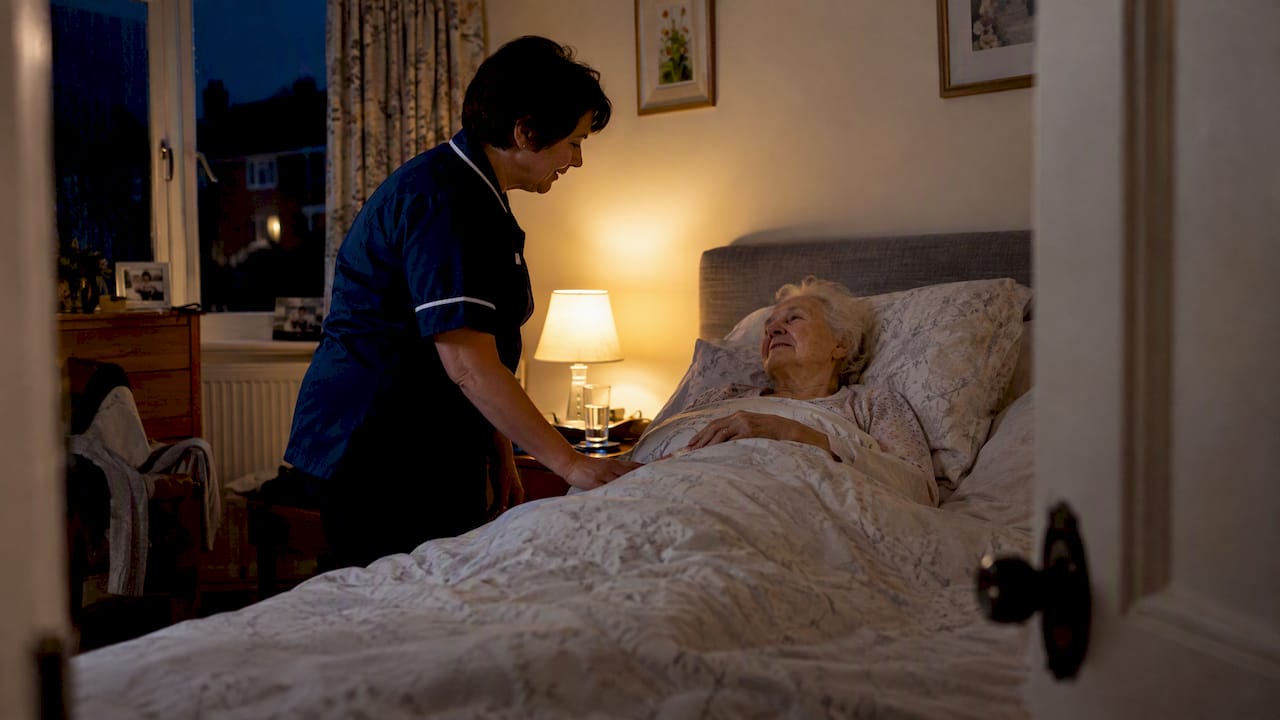
Overnight respite care is temporary night-time support for the person you look after, so you can sleep and recover. The main routes are a night-sitter or waking carer at your home, or a short stay in a care home, while live-in or 24-hour care is a different, ongoing service. Your next step is to ask for a carer’s assessment, or contact a regulated home care agency.
TL;DR:
- Choose a waking carer if the person wakes repeatedly, wanders, or needs repositioning; a sleeping night sitter responds only when help is needed.
- Request the person’s needs assessment and your carer’s assessment, even if paying privately; both can shape support and document the effects of caring.
- In England, savings above the £23,250 capital limit usually mean paying in full; ask your council about local rules and request a full financial assessment.
- Request an itemized written quote: home night care may cost by the hour or night, while care home rates include accommodation and meals.
- Check a provider’s registration, staff training, medication policy, insurance, and written care plan, especially when dementia or mobility needs require specific skills.
Table of Contents
- Which overnight respite options are there?
- What does overnight respite care involve in practice?
- Who can use overnight respite, and how do assessments decide?
- How do I arrange overnight respite step by step?
- How is overnight respite paid for?
- What should you prepare before an overnight stay?
- How do you check that overnight care is safe?
- How do you choose a provider?
- A carer’s view on getting a proper night’s sleep
- How can we help with overnight and respite care?
- FAQ
- Sources
Which overnight respite options are there?
Most overnight breaks fall into two categories: home-based night-sitting, where a carer stays overnight in the home, and residential short stays in a care home. A few other routes sit alongside them.
- Night-sitting or night support at home: a carer covers the night so the person stays in their own bed, with familiar routines and surroundings. This suits people who become unsettled by a change of place.
- Live-in or 24-hour care: ongoing support across the day and night. This is not the same as overnight respite, and the difference matters when you compare costs.
- Short-stay respite in a care home: the person moves into a registered home for a set period. Stays can run from a few days to longer short-term periods, depending on assessed need.
- Shared Lives: the person stays for a short time with an approved host in their home, which some councils arrange as a break.
- Respite holiday schemes: support for arranging a supported holiday or applying for a grant towards one.
None of these is the “right” one for everyone. The choice depends on how much help the person needs at night, how they cope with change, and how long you need a break.
What does overnight respite care involve in practice?
Night support comes in two forms. A sleeping night-sitter is on the premises and is woken only if the person needs help. A waking night carer stays awake throughout and checks on the person at agreed times. If the person is up several times a night, wanders, or needs turning in bed, a waking carer is usually the safer fit.
Common overnight duties include:
- prompting or giving medication when this has been agreed and written into the care plan
- helping with toileting and continence care
- repositioning someone who cannot turn themselves
- responding to a fall, calling for help and keeping the person comfortable
- reassuring someone with dementia who wakes confused or distressed
- simple wound or skin checks, where the carer is trained to do them
Complex clinical tasks, such as injections or managing specialist equipment, are not routine night duties. They can sometimes be arranged, but only when the provider confirms the carer is trained and the task is documented in the care plan.
Choosing the right service level also protects your budget. Because night-sitting is distinct from 24-hour or live-in care, you avoid paying for round-the-clock support when you only need cover while you sleep. If you want to see how in-home night support works day to day, our guide to night care at home explains it in more detail.
Pro Tip: Keep a log of how often the person wakes, and why. It shows the assessor and the provider whether you need a sleeping or a waking carer.
Who can use overnight respite, and how do assessments decide?
Overnight respite is used by many different people. Typical beneficiaries include:
- older adults who need help with toileting or movement at night
- people living with dementia who wake or wander
- adults with physical or learning disabilities
- children and young people with disabilities, where parents need a rest
Two assessments sit behind most funded breaks. The person receiving care has a needs assessment, and you, as the family carer, can have a separate carer’s assessment. NHS guidance explains that councils fund respite only after a formal needs assessment and a carer’s assessment. You can ask for both even if you plan to pay privately, because the carer’s assessment records how caring affects your health and sleep.
The outcome shapes what is offered. An assessment might lead to a few nights of home support each week, a planned short stay, or a one-off break. Processes differ across the UK, with local authorities in England and social work departments or health and social care trusts elsewhere, so start with your own area’s adult social care team. They can explain the options and how long a break might last.
How do I arrange overnight respite step by step?
Follow these steps in order. Each one makes the next easier.
- Ask for the assessments. Contact adult social care, or social work in your area, and request a needs assessment for the person you care for and a carer’s assessment for yourself. Our guide to arranging holiday cover for carers shows how to word the request.
- Consider direct payments. If the council agrees to fund support, a direct payment lets you choose and pay a night-sitter or a short stay yourself. Some councils publish indicative night-support rates in their direct payments guidance, which shows how much local costs vary. Our explainer on direct payments for care covers how they work.
- Contact a provider directly. A regulated agency will normally ask for the person’s medication list, any existing care plan, GP contact details, mobility needs and daily routine. Having these ready speeds up the first conversation.
- Book a trial night if you can. A first night while you are still in the house lets everyone settle before you step away.
- Plan for short notice. Agree in advance who to call if you are ill, or if the arranged carer cannot come. Carers UK suggests a contingency plan that gathers contacts, medication details and care notes in one place, and it helps to see what getting help in an emergency looks like before you need it.
If you want a fuller walkthrough of the home-based route, our step-by-step guide to respite care at home covers it.
Pro Tip: Send your questions to the agency in writing and keep the replies. A clear written record helps if anything needs to be changed later.
How is overnight respite paid for?
Costs differ between the two routes. A night-sitter is usually charged by the hour or per night, while a care home charges a nightly or weekly rate that includes accommodation and meals. Comparing like with like is difficult, so ask each provider for a written quote that lists exactly what is included. For private rates in our own area, see our page on respite care costs in London.
Common funding routes include:
- Council funding after assessment: the council looks at the person’s finances as well as their needs.
- Flat-rate charges for short stays: some councils offer a flat rate for a short respite stay, and you can ask for a full financial assessment instead if that gives a fairer result. East Riding Council sets this out for respite stays.
- Direct payments: money paid to you to arrange your own cover.
- Grants and schemes: charities and local funds, and the Time to Live holiday grants, can help towards a break. Carers UK describes the available options, including Shared Lives and help arranging holidays.
Capital limits matter. Funding eligibility often depends on a financial assessment, with capital limits typically capped at £23,250 in England. Savings above the limit usually mean paying in full, so check the figure that applies in your nation.
Ask your local authority how it charges for short-term or temporary stays, and request a full assessment if the first offer does not reflect your circumstances.
What should you prepare before an overnight stay?
A little preparation makes the first night calmer for everyone.
What to pack:
- pyjamas, a dressing gown and slippers
- toiletries, continence products and a spare set of clothes
- phone and chargers, glasses, hearing aids and dentures with their cases
- walking aids, with spares where possible
- a favourite blanket, photographs or other familiar comforts
Documents to hand over:
- an up-to-date medication list with doses and times
- GP and pharmacy contact details
- any advance care preferences and the current care plan
- emergency contacts, including a back-up if you cannot be reached
Brief the staff on routines as well as medical facts: what the person likes to eat, when they usually go to bed, what settles them if they wake, and anything that tends to cause distress. For someone with dementia, a short note about triggers and calming approaches can prevent a difficult night.
Finally, write a short emergency checklist and leave copies with the carer, a neighbour or relative, and in a visible place at home. The Carers UK contingency plan guidance lists what to include.
Pro Tip: Photograph the medication list and your emergency plan on your phone, and label the originals with the date. Out-of-date lists are a common cause of confusion.

How do you check that overnight care is safe?
Start with registration. Services that provide personal care in a home setting must be registered with the regulator, and CQC guidance on registering personal care services notes that privately arranged individual care can be exempt. In that case the responsibility for checking quality falls to the family. In Wales, Scotland and Northern Ireland, check with the equivalent regulator. Our plain-English explainer on what CQC regulation means is a good place to start.
On a pre-visit to a care home, or when meeting a night carer, look for:
- warm, unhurried interaction between staff and residents
- clean surroundings and sensible infection control
- a written, personalised care plan, not a generic one
- staff who can describe their training in your relative’s needs
Once the stay or night support begins, arrange visits or phone check-ins and note what you saw and heard. If something worries you, raise it with the manager first, in writing. If it is not resolved, contact the regulator. Where you believe the person is at risk of harm, involve adult social services and the local safeguarding team without delay.
How do you choose a provider?
Use the same short list of questions with every provider you consider.
- Is the service CQC registered, and what did its latest inspection say?
- Are staff DBS checked, and how are they trained and supervised?
- What is the medicines policy, and who can give medication?
- How are safeguarding concerns and emergencies handled overnight?
Ask to see paperwork, not only to hear answers: a sample care plan, the complaints procedure, details of staff rotas for night shifts, and confirmation of insurance. Age UK advises choosing registered care that can meet specific health and mobility needs, with person-centred standards at its core.
Red flags include no written care plan, vague answers about medication, no references, and no evidence of training. Match experience to need: if your relative has dementia, ask about dementia training. If they need a hoist or extra help to move safely, confirm staff are trained and that enough people will attend.
Pro Tip: Ask the provider to describe a typical night for someone with your relative’s needs. A specific, confident answer is a good sign.
A carer’s view on getting a proper night’s sleep
Having worked in home care, I have seen the same pattern many times: families wait until they are exhausted before asking for help. A typical case is a daughter looking after her father, who has dementia and wakes several times a night. She asked for a carer’s assessment, wrote down what each night involved, and booked a waking night carer regularly. Before long she was sleeping properly and her father was calmer with a familiar carer in his own home.
You have a right to ask for an assessment, and you are entitled to insist that any care is written down in a plan. Asking is not a failure. It is how caring stays sustainable.
— Dan
How can we help with overnight and respite care?
Our team provides night care at home, respite cover, live-in care and call-in visits across London, with qualified, DBS-checked carers, and we are regulated by the CQC. We supply home care, shaping each plan around the person’s routine, dignity and choices.
The simplest next step is to call us for a conversation about what your relative needs at night. We can talk through how direct payments might fund cover and how a booking works, and you can read more about respite care explained for carers. See all of our home care services, or get in touch today to arrange a respite assessment.
FAQ
What is the difference between night-sitting and live-in care?
Night-sitting gives overnight cover so the person stays at home while you rest. Live-in care is ongoing day-and-night support. Carers UK notes the distinction, and recognising it stops you paying for more care than you need.
How can I cope when I am struggling as a carer?
Ask for a carer’s assessment, build in regular breaks, and tell your GP how caring affects your health. Respite, whether a night-sitter or a short stay, is a recognised part of support rather than a luxury. Planning ahead also eases stress when something goes wrong.
Who looks after the carer?
Councils must consider your needs through a carer’s assessment, and the NHS explains how breaks are funded. Your GP, local carers’ organisations and family can also share the load. Asking early makes it easier to keep going.
How long can a respite stay last?
It depends on assessed need. Residential respite can range from a few days to longer short-term periods, as Carers UK describes. Your assessment will indicate what is appropriate for you.
Sources
- Carers’ breaks and respite care – Social care and support guide – NHS
- Carersuk
- Information for Adults with Care and
- Respite stay in a care home financial assessment
- Cqc


