

TL;DR:
- CQC regulation is a legal framework that sets and enforces standards to protect care quality in England’s health and social services. It involves registration, unannounced inspections, and transparent ratings based on five key questions; providers face enforcement when standards are not met. Families and professionals should review full inspection reports and ask providers about their ongoing compliance to ensure safe, high-quality care.
CQC regulation is the legally binding framework that sets and enforces quality and safety standards across health and social care services in England. The Care Quality Commission is the independent statutory regulator operating under the Health and Social Care Act 2008 and the Regulated Activities Regulations 2014. Whether you are a family choosing a care provider or a professional working in the sector, understanding how this framework operates helps you make better decisions and hold services to account.
What is CQC regulation and what does it cover?
CQC regulation is the system through which the Care Quality Commission registers, monitors, inspects, and rates health and social care providers in England. Its legal basis sits in the Health and Social Care Act 2008, which gave the CQC statutory powers to set minimum standards and take enforcement action when those standards are not met. The framework applies to every registered provider, from large NHS hospital trusts to small domiciliary care agencies.

The regulation exists because care quality cannot be left to chance. Without an independent body with legal teeth, there is no consistent mechanism to protect people who rely on care services. The CQC fills that role by combining registration requirements, regular inspection, published ratings, and escalating enforcement powers into one coherent system.

Providers must register with the CQC before they can legally operate. Registration is not a formality. It requires demonstrating that the service can meet the 13 fundamental standards before a single client is seen. This gatekeeping function is one of the most underappreciated aspects of CQC oversight.
What are the fundamental standards of CQC regulation?
The 13 fundamental standards are the legally required baseline that every registered provider must meet at all times. They are set out in the Health and Social Care Act 2008 (Regulated Activities) Regulations 2014, specifically Regulations 5 and 9 through 20. Failure to meet any one of them can trigger enforcement action, up to and including prosecution.
The standards cover the full range of care quality and safety concerns. They include person-centred care, dignity and respect, consent, safety, safeguarding from abuse, food and drink, premises and equipment, complaints handling, good governance, staffing levels, fit and proper persons in leadership, duty of candour, and the display of ratings. Each standard carries equal legal weight.
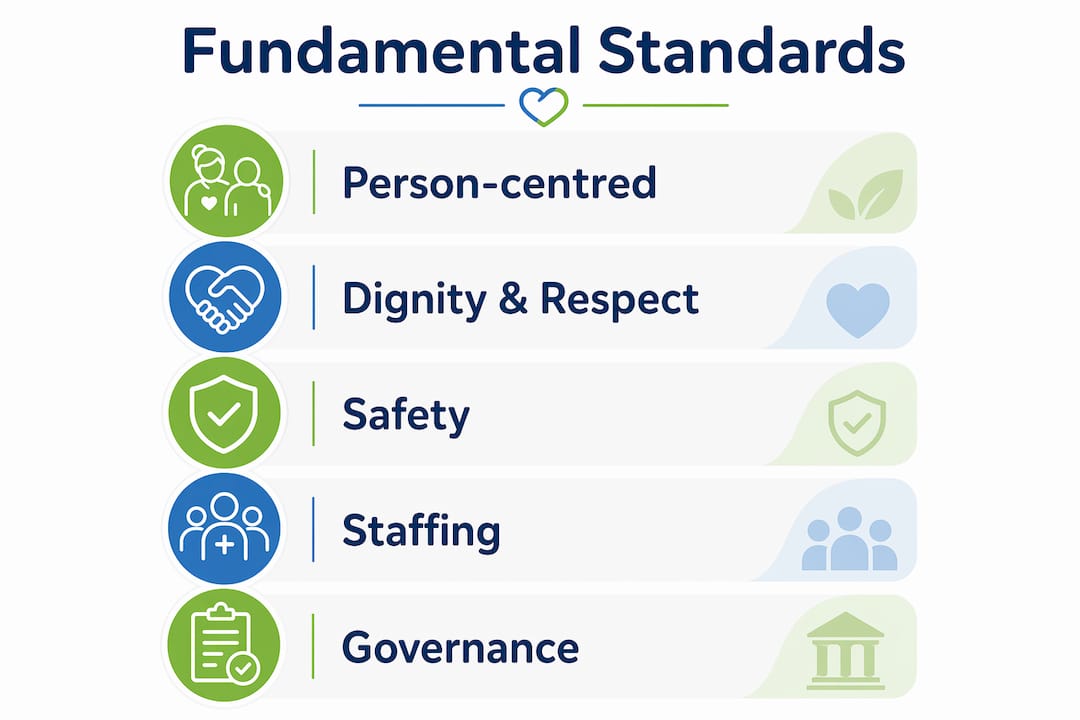
Pro Tip: When assessing a care provider, ask them directly which of the 13 standards they were last assessed against and what their most recent inspection found. A confident, specific answer is a good sign.
The table below summarises the key fundamental standards and what they require in practice.
| Standard | What it requires |
|---|---|
| Person-centred care | Care must reflect individual needs, preferences, and choices |
| Dignity and respect | Providers must treat people with compassion and maintain privacy |
| Consent | Care must only be given with informed consent or lawful authority |
| Safety | Providers must protect people from avoidable harm and abuse |
| Staffing | Sufficient, competent, and trained staff must be in place at all times |
| Good governance | Providers must have systems to assess, monitor, and improve quality |
| Duty of candour | Providers must be open and honest when things go wrong |
| Display of ratings | The current CQC rating must be displayed on-site and online |
The legal obligation to meet these standards is non-negotiable. A provider cannot argue that resource constraints or staffing difficulties justify falling below them. The CQC treats breaches as regulatory failures, not operational setbacks.
How does the CQC inspection and rating system work?
CQC inspections assess whether providers are meeting the fundamental standards in real life, not just on paper. Inspections often occur unannounced, which means providers must maintain standards every day, not just when they know an inspector is coming. This design choice is deliberate. It prevents superficial preparation and gives inspectors a genuine picture of day-to-day care.
During an inspection, the CQC team uses several methods to gather evidence:
- Direct observation of care being delivered
- Interviews with residents, service users, and family members
- Interviews with staff at all levels, including frontline carers and managers
- Review of care plans, medication records, and governance documentation
- Assessment of the physical environment and equipment
The CQC assesses every service against five key questions: Is the service safe? Is it effective? Is it caring? Is it responsive to people’s needs? Is it well-led? Each question receives its own rating, and these combine to produce an overall service rating.
The four-tier rating scale runs from Outstanding at the top, through Good and Requires Improvement, to Inadequate at the bottom. A “Good” rating is the expected standard for a compliant service. Providers rated “Requires Improvement” or “Inadequate” face more frequent inspections and regulatory scrutiny. An “Outstanding” rating reflects performance that goes well beyond the minimum.
Pro Tip: Read the full inspection report, not just the headline rating. The five domain scores often reveal specific strengths and weaknesses that the overall rating does not show.
Inspection frequency depends on the current rating. Services rated “Good” or “Outstanding” are inspected less often, typically every two to three years unless concerns are raised. Services with lower ratings receive more frequent visits until improvement is demonstrated.
What enforcement and accountability mechanisms does CQC regulation include?
The CQC holds real legal power to act when providers fall short. Enforcement escalates in proportion to the severity and persistence of the breach, giving providers the opportunity to improve before the most serious actions are taken.
The main enforcement tools, in order of escalating severity, are:
- Requirement notices — a formal instruction to make specific improvements within a set timeframe
- Warning notices — issued when a breach is more serious or improvement has not followed a requirement notice
- Conditions on registration — restrictions placed on what a provider can do or how many people they can care for
- Special measures — intensive oversight and support, typically for services rated “Inadequate”
- Cancellation of registration — the provider is no longer permitted to operate
- Prosecution — criminal proceedings for the most serious breaches of fundamental standards
Providers must also display their CQC rating prominently on their premises and on their website. Failing to do so is itself a compliance breach. This transparency requirement means that families can always check a provider’s current status before making a decision.
Enforcement is triggered by breaches of the fundamental standards themselves, not only by poor quality statements. This distinction matters. A provider can have excellent marketing materials and still face prosecution if the standards are not being met in practice.
How can families and professionals use CQC ratings effectively?
CQC inspection reports give families a transparent view of a service that no brochure or website can replicate. Inspection reports reveal staff behaviour, resident experience, and governance quality in concrete detail. Reading the full report, rather than stopping at the headline rating, is the most effective way to assess a provider.
A “Requires Improvement” rating does not always signal a dangerous service. It may reflect specific administrative gaps, such as incomplete record-keeping, rather than a failure of direct care. Context matters. Reading the individual domain scores and the inspector’s narrative helps you understand exactly what the concern is and whether it has since been addressed.
Families can find all published CQC ratings and inspection reports on the CQC website at cqc.org.uk. The search function allows you to look up any registered provider by name, postcode, or service type. Reports are updated after each inspection and are free to access.
When visiting a care provider, use the CQC report as a starting point for questions. Useful questions to ask include:
- What actions did you take following your last CQC inspection?
- How do you involve residents and families in reviewing care quality?
- What is your process when a concern is raised about a member of staff?
- How do you monitor staffing levels against the fundamental standards?
For professionals, the CQC framework offers a structured basis for internal quality improvement. Mapping your service against the five key questions — safe, effective, caring, responsive, and well-led — before an inspection identifies gaps early. Understanding care quality standards in depth helps both families and professionals engage with the process confidently.
What types of services fall under CQC regulation?
The CQC regulates a wide range of health and social care services across England. Regulated services include hospitals, care homes, GP practices, dental surgeries, ambulance services, mental health services, hospices, and domiciliary care agencies. All must register with the CQC and comply with the fundamental standards, regardless of whether they are NHS-funded or privately run.
Different service types receive tailored regulatory approaches. A hospital inspection focuses heavily on clinical safety, infection control, and patient outcomes. A domiciliary care inspection places greater weight on person-centred care, consent, and the quality of one-to-one support in the home. The questions asked are the same; the evidence gathered reflects the nature of the service.
The table below shows the main service categories and the primary regulatory focus for each.
| Service type | Primary regulatory focus |
|---|---|
| Care homes | Dignity, safety, staffing, and governance |
| Domiciliary care | Person-centred care, consent, and home safety |
| Hospitals | Clinical safety, effectiveness, and patient outcomes |
| GP practices | Effectiveness, responsiveness, and clinical governance |
| Dental surgeries | Safety, infection control, and consent |
| Mental health services | Safeguarding, dignity, and responsiveness |
Registration is not optional. A provider that operates without CQC registration is acting unlawfully. For families, checking that a provider is registered is the first step in any assessment. You can verify registration quickly on the CQC website. For a broader introduction to regulated care, including what registration means in practice, the distinction between regulated and unregulated services is worth understanding before you choose a provider.
Key takeaways
CQC regulation is the legal framework that protects people receiving care in England by setting 13 fundamental standards, inspecting providers against five key questions, and publishing transparent ratings that families and professionals can act on.
| Point | Details |
|---|---|
| Legal basis | CQC regulation operates under the Health and Social Care Act 2008 and the Regulated Activities Regulations 2014. |
| Fundamental standards | All 13 standards are legally binding; breaching any one can lead to enforcement action or prosecution. |
| Inspection and ratings | Providers are rated Outstanding, Good, Requires Improvement, or Inadequate across five assessed domains. |
| Enforcement powers | The CQC can issue notices, restrict registration, place services in special measures, or prosecute. |
| Using ratings wisely | Read the full inspection report, not just the headline rating, to understand a provider’s real performance. |
Why CQC regulation matters more than most people realise
People often treat a CQC rating like a restaurant star. They glance at the headline, note whether it says “Good,” and move on. That approach misses most of what the framework actually tells you.
What I find genuinely valuable about CQC regulation is the five-domain structure. A service can be rated “Good” overall while receiving “Requires Improvement” for being well-led. That detail matters enormously if you are placing a vulnerable family member in that service’s care. Leadership quality predicts how a service responds when things go wrong, and things always go wrong eventually in care.
The unannounced inspection model is also more significant than it appears. It means that the rating you see reflects how a service operates on an ordinary Tuesday, not how it performs when management has had three weeks to prepare. That is a meaningful guarantee that most regulated industries cannot offer.
My honest advice to families is this: use the CQC report as a conversation starter, not a final verdict. Ask the provider what they did about the last inspection’s findings. A service that responds openly, with specific examples of change, is demonstrating exactly the culture of candour that the fundamental standards require. A service that deflects or dismisses the question is telling you something important.
For professionals, the CQC framework is not just a compliance burden. It is a structured quality improvement tool. Services that engage proactively with the five key questions, rather than waiting for an inspector to raise them, consistently perform better over time. The regulation works best when providers treat it as a mirror rather than a test.
— Dan
Home care in London that meets CQC standards
Kells-care has provided home care services in London for over 30 years, and CQC regulation sits at the centre of how the agency operates. Every carer is fully qualified, DBS checked, and supported to meet the 13 fundamental standards in every visit. Kells-care is registered with the Care Quality Commission, which means families can verify the agency’s standing directly on the CQC website. Whether you need check-in visits or round-the-clock support, Kells-care builds care around the individual, promoting independence, dignity, and freedom of choice. If you are looking for a trusted, compliant care provider in London, Kells-care is ready to help.
FAQ
What is CQC regulation in simple terms?
CQC regulation is the legal framework that requires health and social care providers in England to meet 13 fundamental standards of quality and safety, enforced by the Care Quality Commission through registration, inspection, and ratings.
How does CQC rate care services?
The CQC uses a four-tier scale: Outstanding, Good, Requires Improvement, and Inadequate. Ratings are based on five assessed domains: safe, effective, caring, responsive, and well-led.
Are CQC inspections announced in advance?
CQC inspections are often unannounced, meaning providers must maintain standards at all times. This approach ensures that inspection findings reflect everyday care quality rather than prepared performance.
What happens if a provider fails CQC standards?
Enforcement escalates from requirement notices and warning notices through to conditions on registration, special measures, cancellation of registration, and prosecution for serious breaches of the fundamental standards.
Where can I find a provider’s CQC rating?
All CQC ratings and full inspection reports are publicly available at cqc.org.uk. You can search by provider name, postcode, or service type, and providers are also legally required to display their current rating on-site and online.