NHS continuing healthcare (CHC) is free, NHS-funded care for adults assessed as having a “primary health need”. It covers people living with complex, long-term health conditions, whether they live at home, in a care home, or occasionally in a hospice. Eligibility is decided on assessed needs, not diagnosis. A multidisciplinary team (MDT) completes a Decision Support Tool (DST) to weigh those needs and recommend an outcome, which the local Integrated Care Board (ICB) then confirms.
If you think a relative or you might qualify:
- Ask their GP, hospital discharge team, or social worker for a Checklist assessment to screen for full assessment.
- Contact your local ICB directly if nobody has raised it.
- Get independent guidance from a service such as Beacon if the process feels unclear.
Key Takeaways
NHS continuing healthcare eligibility depends entirely on assessed health needs across four characteristics, not on diagnosis or a fixed points total.
| Point | Details |
|---|---|
| Eligibility is needs-based | The MDT weighs nature, intensity, complexity, and unpredictability, not diagnosis alone. |
| Expect a 28-day decision | Full assessments should conclude within 28 days, with refunds possible from day 29 if delayed. |
| Reviews continue after approval | Packages are reviewed at three months, then at least annually. |
| Ineligibility isn’t the end | Local authority support or NHS-funded nursing care may still apply. |
| Evidence wins cases | Dated logs of falls, medication, and incidents carry more weight than general descriptions. |
Table of Contents
- Where NHS continuing healthcare at home and elsewhere is provided
- What is the primary health need test and the 12 care domains?
- What are the stages of a continuing healthcare assessment?
- Planning care once continuing healthcare is agreed
- How often is continuing healthcare reviewed?
- What happens if you are found not eligible for CHC?
- How do you apply for NHS continuing healthcare?
- What families can do to prepare for assessment
- Getting the right home care support once CHC is confirmed
- A closer look at what actually decides eligibility
- Sources
Where NHS continuing healthcare at home and elsewhere is provided
NHS continuing healthcare at home is one of three main settings the NHS funds, alongside care homes and, occasionally, hospices. Wherever the care happens, the NHS pays for the full package once eligibility is confirmed.
- Own home — CHC can fund carers, nursing input, and equipment so someone stays independent in familiar surroundings.
- Care home — funding covers both the care itself and, importantly, accommodation costs when that forms part of the assessed needs.
- Hospice — used in some end-of-life situations, often alongside the fast-track pathway.
Acute hospital stays are excluded, because hospital treatment is funded separately through NHS commissioning. This is also where CHC differs sharply from ordinary social care assessments: local authority care is means-tested, while CHC is entirely free once you meet the health-needs threshold, according to NHS guidance on continuing healthcare.
What is the primary health need test and the 12 care domains?
Eligibility hinges on one legal test: does the person have a “primary health need”? The National Framework for NHS Continuing Healthcare and NHS‑funded Nursing Care sets out four characteristics the MDT must weigh together, not in isolation:
- Nature — the type and quality of the need, including how it affects daily wellbeing.
- Intensity — the severity, and how much support it demands.
- Complexity — how needs interact or are hard to manage.
- Unpredictability — how much the condition fluctuates or risks sudden deterioration.
These are assessed across 12 care domains, including behaviour, cognition, communication, mobility, nutrition, continence, skin and tissue viability, breathing, medication, altered states of consciousness, and psychological and emotional needs, using the Decision Support Tool.
A dementia diagnosis on its own does not guarantee eligibility. What matters is how the condition actually shows up day to day, such as unpredictable falls, resistance to medication, or swallowing difficulties. NHS guidance on dementia care confirms this explicitly: it is the level of need, not the label, that decides the outcome.
Pro Tip: Keep a simple diary logging incidents, missed medications, falls, or distress episodes for two to three weeks before assessment. Specific dated evidence carries far more weight with an MDT than a general description of “getting worse”.
What are the stages of a continuing healthcare assessment?
The continuing healthcare assessment process typically runs through four stages, though a fast-track route exists for people nearing the end of life.
- Checklist screening. A nurse, social worker, or discharge coordinator completes a Checklist to decide if a full assessment is warranted. A positive Checklist does not mean eligibility, only that the case deserves closer scrutiny.
- Full multidisciplinary assessment. At least two professionals from different disciplines, often a nurse and a social worker, gather evidence across the 12 domains and complete the DST.
- MDT recommendation. The team scores each domain and reaches a recommendation on eligibility, based on the four characteristics rather than a simple points total.
- ICB decision. The Integrated Care Board reviews the MDT’s recommendation and makes the final call. It can depart from the MDT’s view, though this is unusual and must be justified.
For people who are rapidly deteriorating and may be approaching the end of life, the fast-track pathway bypasses the full DST process. A decision, and funded care, should typically follow within 48 hours of a fast-track referral being received. Most standard full assessments should conclude within 28 days of the checklist or referral, though complex cases sometimes run longer.
Planning care once continuing healthcare is agreed
Once the ICB confirms eligibility, it takes responsibility for arranging and funding a package that matches the assessed needs, while keeping half an eye on value for money across the local health budget.
- ICB-arranged packages — the ICB commissions care directly, whether that’s home visits, live-in support, or a care home placement.
- Personal health budgets — some people can manage their own budget or receive direct payments, giving more control over which carers or agencies are used.
- Private top-ups — families can pay privately for additional services beyond what’s assessed, such as extra social outings, but cannot pay to substitute or reduce the NHS-funded core package.
This is where working with an experienced agency matters. Kells-care has spent over 30 years arranging personalised home care in London, and packages funded through CHC still need day-to-day coordination that fits the person, not the paperwork.
How often is continuing healthcare reviewed?
Your first review happens around three months after CHC is agreed, then at least annually after that, checking whether needs have changed and the package still fits.
On timescales, the NHS’s own guidance sets a 28-day target from checklist or referral to decision. Where the delay is unjustified, families are entitled to a refund of care costs from day 29 onwards. If your case is dragging past that window without a clear reason, put your concern in writing to the ICB and ask for a specific explanation and timeline.
What happens if you are found not eligible for CHC?
Not everyone assessed qualifies, and that’s not the end of the road for support.
- Local authority social care. Your council can carry out a means-tested care needs assessment and may fund or part-fund a care package.
- NHS-funded nursing care. If you’re in a care home and don’t meet the CHC threshold but do have some ongoing nursing need, the NHS may still fund the nursing element while you or the council cover the rest.
- Joint packages. Health and social care funding sometimes combine, particularly where needs sit close to the CHC threshold.
- Ask for a review or independent review. If you disagree with the decision, request local resolution with the ICB first, then formal independent review if that doesn’t resolve things.
How do you apply for NHS continuing healthcare?
Anyone can trigger the process, a GP, hospital discharge nurse, social worker, or the individual and their family, by requesting a Checklist.
- Request a Checklist from a health or social care professional, or contact the ICB directly if nobody has started one.
- Gather evidence beforehand: medication charts, GP and hospital letters, care notes, incident logs, and any existing care assessment paperwork.
- Attend the MDT meeting if invited, families can and should contribute their own observations.
- Contact your local ICB for case-specific queries, or use the official DST referral form to formally request assessment.
- Use independent advice from a service such as Beacon or Age UK, or exercise your right to independent review through NHS England if local resolution doesn’t settle things.
What families can do to prepare for assessment
Compiling evidence before the MDT meets makes a genuine difference to how clearly your case is understood.
- Collect medication charts, nursing notes, GP letters, and any incident logs from the past few months.
- Note specific dates, not general impressions, wherever possible.
- Ask your carers or care agency to summarise recent changes in writing.
Kells-care’s carers already support many families through this exact transition, delivering CHC-funded home care alongside hourly visits and dementia-specific support.
Pro Tip: Ask whichever agency currently provides care, including Kells-care, to write a short factual summary before the MDT meeting. A carer’s day-to-day observations often fill gaps that clinical notes miss.

Getting the right home care support once CHC is confirmed
Being awarded continuing healthcare funding is only half the job. The care itself still needs to be arranged around the person, not the process. Kells-care has provided domiciliary and live-in care across London for more than 30 years, with fully qualified, DBS-checked carers regulated by the CQC. Whether you need hourly check-in visits, round-the-clock live-in care, or dementia-specific support once CHC funding is agreed, our team works alongside your ICB care plan to keep things practical and dignified. Download the free home care guide to see how a CHC-funded package translates into everyday support at home.
A closer look at what actually decides eligibility
Here’s the perspective that gets lost in most guidance: CHC eligibility isn’t a checklist exercise, whatever the name of the screening tool suggests. Families often walk into the MDT meeting expecting a scorecard, a certain number of “severe” ratings across the domains equals a yes. There is no such formula. The framework is explicit that professional judgement, applied to the four characteristics together, decides the outcome, not a tally.
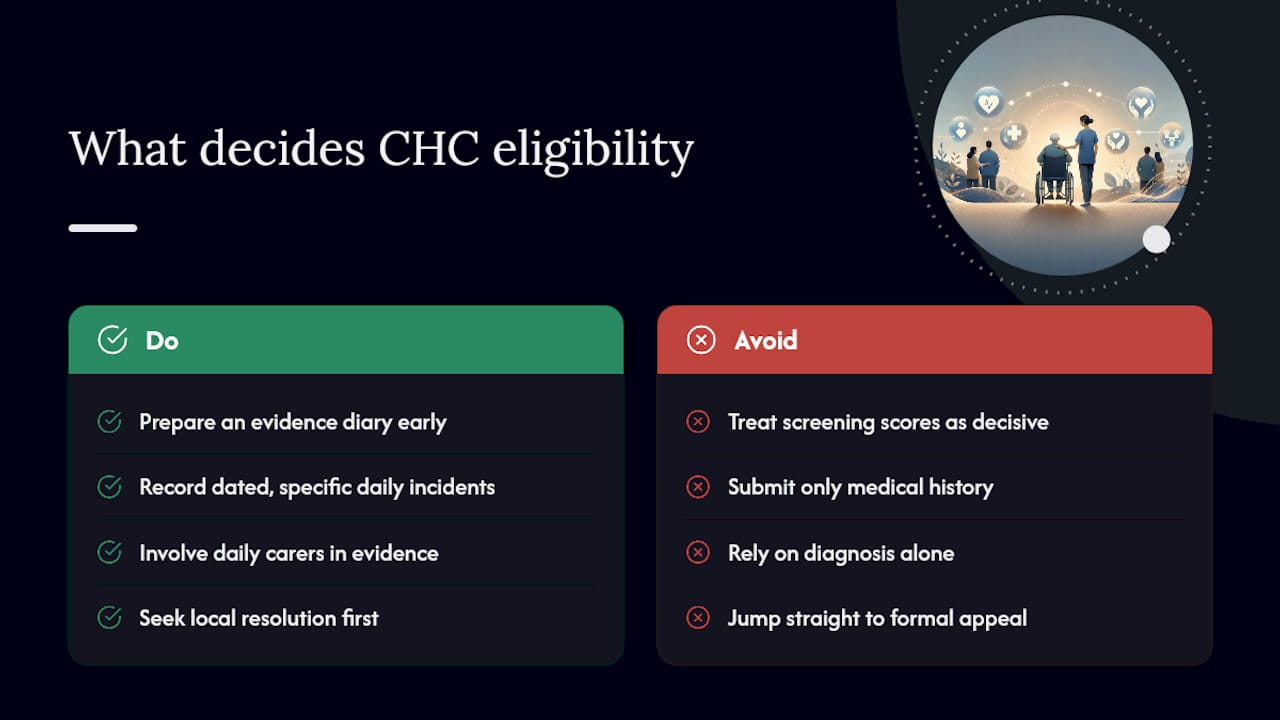
That’s where most cases go wrong. Families gather medical history when what actually moves an MDT is dated, specific evidence of how a condition behaves day to day, an unpredictable fall at 3am, a swallowing episode, three missed medications in a week. Diagnosis is almost irrelevant next to that.
My honest view: spend your energy before the meeting, not after a refusal. Build the evidence diary early, involve whoever provides daily care, and treat local resolution as your first and best chance to fix a wrong decision, rather than jumping straight to formal appeal. The system rewards preparation far more than persistence.
— Dan
Sources
- National Framework for NHS Continuing Healthcare and NHS‑funded Nursing Care (July 2022, revised)
- NHS continuing healthcare – Social care and support guide
- NHS Continuing Healthcare — NHS England
This article is general information, not a substitute for advice from a qualified doctor. Consult a qualified healthcare professional about your own circumstances before acting on anything here.