
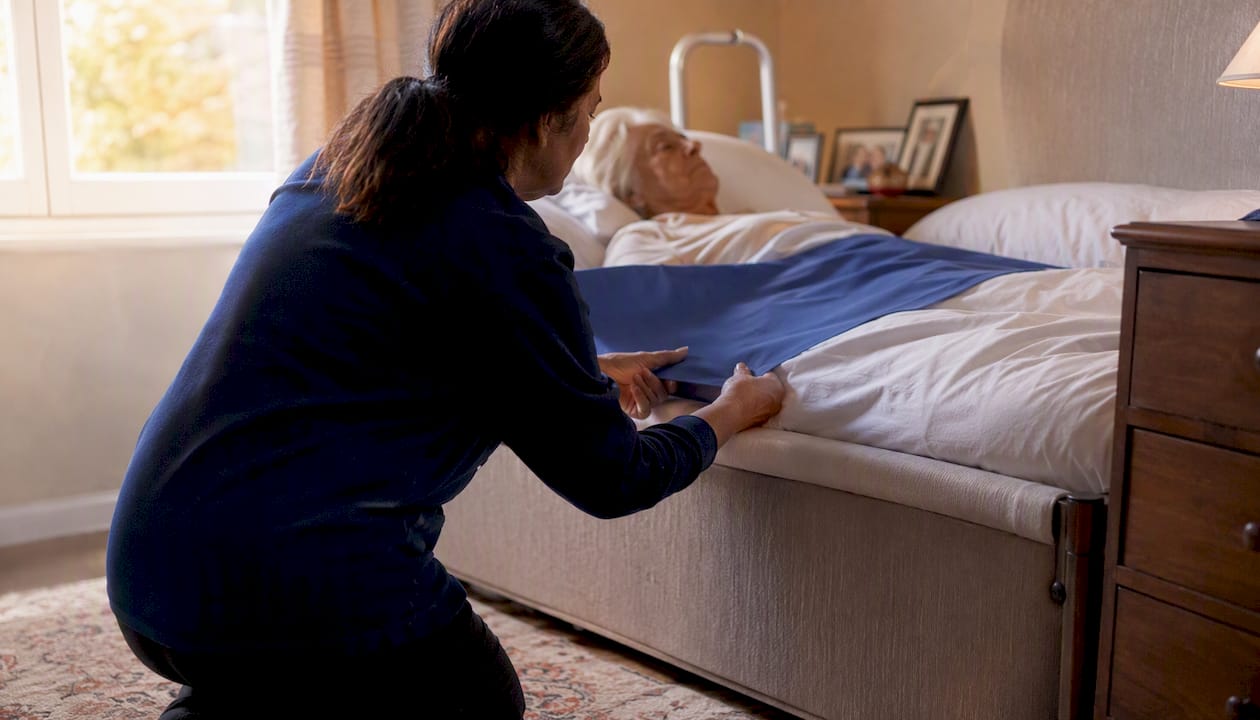
For most family carers, the safest immediate approach is simple: avoid lifting where possible, plan every move, and use an aid or ask for help. Before any handling task, run through this quick checklist:
- Think first. Is this move necessary right now? Can it wait for a second person?
- Ask for help. Two carers are almost always safer than one.
- Use an aid. A slide sheet, transfer board, or standing aid reduces physical strain on everyone.
- Keep the load close. The further the person is from your body, the greater the strain on your back.
- Step, don’t twist. Move your feet to change direction rather than rotating your spine.
- Stop if something feels wrong. Pain, resistance, or unexpected movement are signals to pause.
For printable guidance, visit the HSE moving and handling pages. To request an occupational therapist (OT) assessment, contact your local NHS community team or council social services department.
Key takeaways
Safe manual handling at home depends on avoiding unnecessary lifting, planning every move, using the right equipment, and getting a professional demonstration before introducing any new technique or aid.
| Point | Details |
|---|---|
| Avoid lifting where possible | Plan every move first; use an aid or ask for a second person before attempting a transfer alone. |
| Follow the eight-step sequence | Think, prepare, stable base, bend hips and knees, keep load close, lift with legs, move feet to turn, lower carefully. |
| Get an OT assessment | An occupational therapist can prescribe equipment, demonstrate safe technique, and identify small adaptations that reduce daily risk. |
| Know when to stop | Call for help if the person cannot bear weight, the floor is wet, or anything feels unsafe; never attempt a risky lift alone. |
| Kells-care provides trained support | CQC-regulated, DBS-checked carers in London can demonstrate transfers, liaise with OT teams, and document agreed handling plans. |
Print this summary and keep it near the bed or bathroom as a quick reference for anyone involved in the person’s care. A home care safety checklist for London families is also available to download from Kells-care.
Table of Contents
- Why manual handling at home matters: who gets hurt and why
- Core safe-handling principles you can use every time
- How to plan a move: a quick risk check before you start
- Step-by-step approaches for common home transfers
- Assistive equipment: what it is and when to use it
- If someone falls or is injured during handling: immediate steps
- Where to get training in the UK and who has responsibilities
- How a CQC-regulated agency can support safe handling at home
- Small changes make a bigger difference than perfect technique
- Kells-care can help you handle transfers safely at home
- Sources
Why manual handling at home matters: who gets hurt and why
Back pain from manual handling is one of the most common and largely preventable causes of disability among carers. When a family member takes on the physical task of moving, lifting, or repositioning someone at home, the risk of musculoskeletal injury rises sharply, particularly when technique is poor, the environment is cramped, or no equipment is available.
The people most affected are family carers supporting older adults, people with limited mobility following a stroke or surgery, and children with complex physical needs. The cared-for person is equally at risk: a poorly supported transfer can cause falls, skin tears, or fractures.
HSE guidance for health and social care is clear that protecting the carer is not separate from protecting the person being cared for. They are the same goal. A carer who injures their back cannot continue caring, which removes the very support the person at home depends on.
Core safe-handling principles you can use every time
The single most important technical rule is this: keep the person or load as close to your body as possible, and never twist your spine. Everything else in safe handling technique builds on these two points.
HSE’s good-handling guidance sets out a clear sequence, and UK training providers such as British Manual Handling teach an eight-step safe-lift approach that mirrors it. Here is the sequence adapted for home carers:
- Think and plan. Decide whether the move is necessary, who else is needed, and what equipment to use.
- Prepare the environment. Clear the route, remove trip hazards, and position any equipment before you start.
- Take a stable base. Feet shoulder-width apart, one foot slightly forward to give balance.
- Bend at the hips and knees. Lower yourself by bending your legs, not your back.
- Get a good grip. Hold the person or load firmly and close to your body.
- Keep the load close. The person’s centre of gravity should stay near yours throughout.
- Lift with your legs. Push up through your legs, keeping your back in its natural curve.
- Move your feet to turn. Never rotate your spine. Take small steps to change direction.
Good technique is genuinely useful, but it is not a substitute for equipment or task redesign. If a move feels unsafe even when you follow every step, that is a signal to introduce an aid or ask for professional input, not to try harder.
Pro Tip: Wear flat, non-slip, close-toed shoes for every handling task. Slippers and socks are among the most common contributors to carer falls during transfers.
How to plan a move: a quick risk check before you start
Do a brief risk check every single time before you assist someone, even for a routine transfer you have done dozens of times. The person’s condition, the environment, and your own energy levels all change day to day.
A useful way to structure this check is the five Ps:
Plan what the move involves. Where is the person starting, where are they going, and how much can they assist? A person who could bear weight yesterday may not be able to today.
Position yourself and any equipment before the move begins. Adjusting a bed height, moving a chair, or placing a slide sheet takes thirty seconds and can prevent a serious injury.
Prepare the route. Check for wet floors, loose rugs, poor lighting, or obstacles between the starting point and the destination. Workplace safety guidance consistently highlights cleared routes and suitable footwear as two of the most effective environmental controls.
Pace the move. Rushing is one of the most common causes of handling incidents. Tell the person what you are about to do, agree a cue word (“ready, steady, stand”), and move at their pace, not yours.
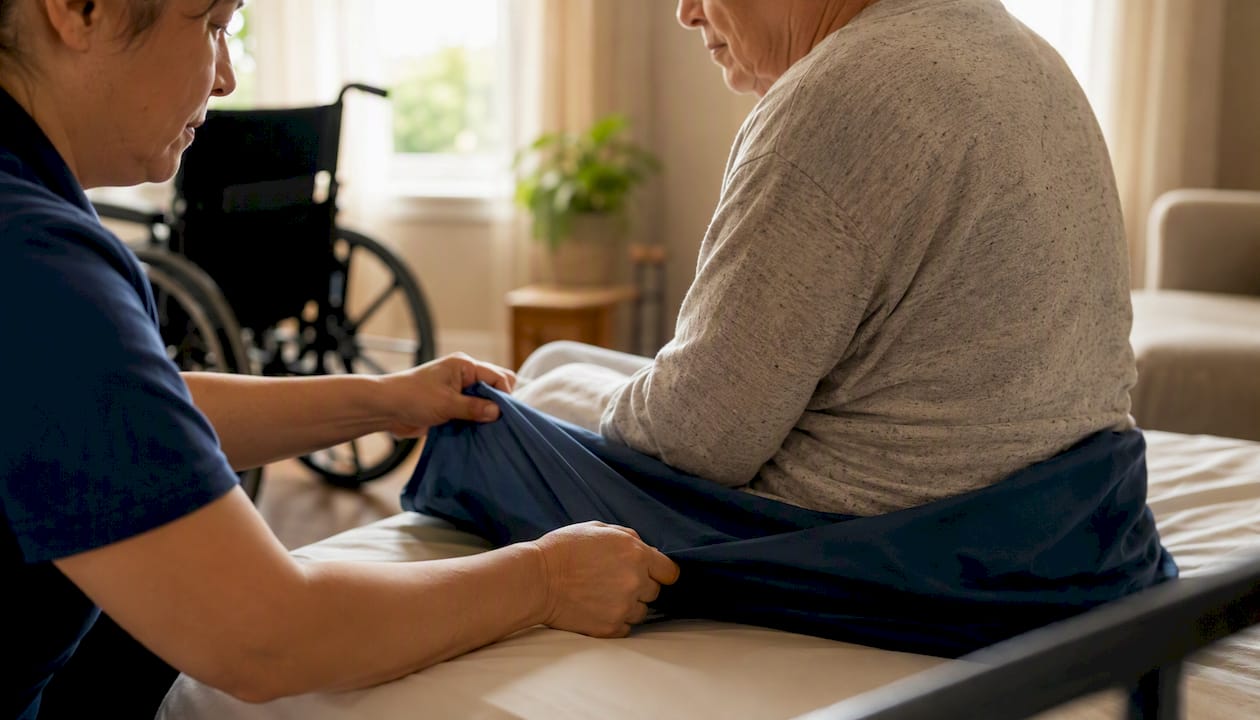
Protect both of you. If anything in the check raises a concern, stop. Call for a second person, use equipment, or contact your GP, district nurse, or OT team.
Stop and call for help if: the person is showing signs of pain or distress, you suspect a fracture, the person is too heavy to support safely, the floor is wet or slippery, or the lighting is too poor to see clearly.
When more than one carer is involved in someone’s care, record the agreed approach in the care plan. HSE guidance recommends both generic and individual assessments, with documentation wherever multiple people are carrying out the same handling tasks.
Pro Tip: Keep a short written note near the bed or bathroom listing the agreed transfer method, equipment needed, and any known risks. It takes two minutes to write and prevents a great deal of confusion when a different carer steps in.
Step-by-step approaches for common home transfers
The goal in every transfer is to use the person’s own ability as much as possible, keep them safe and comfortable, and protect your own back throughout. The NHS manual handling textbook and NHS carer guidance both stress that technique must be learned through face-to-face demonstration, not text alone. Use these steps as a rehearsal framework, not a replacement for professional training.
Bed to chair transfer
- Raise the bed to a height where the person’s feet rest flat on the floor when sitting on the edge.
- Help the person roll onto their side, then push up to sitting using their arms.
- Allow a moment to sit and gain balance before standing.
- Place the chair at a 45-degree angle to the bed, close enough to minimise the distance.
- Use a transfer belt or gait belt around the person’s waist if needed for support.
- Ask the person to push up with their hands, then guide them to pivot and lower into the chair.
Safety caution: Do not attempt this transfer if the person cannot bear any weight through their legs without a hoist. If in doubt, use a mobile hoist.
Chair to toilet transfer
- Position the wheelchair or chair as close to the toilet as possible, at an angle.
- Ensure the toilet seat is at the right height (a raised toilet seat may help).
- Use a grab rail if one is fitted; if not, request one through your local council.
- Follow the same stand-pivot-lower sequence as the bed-to-chair transfer.
Safety caution: Wet floors around the toilet are a significant hazard. Place a non-slip mat and check it is flat before starting.
Assisting someone to stand from seated
- Ask the person to shuffle to the front edge of the chair.
- Position their feet flat on the floor, hip-width apart.
- Ask them to lean forward (“nose over toes”) before pushing up.
- Offer your forearm or a standing aid for support rather than pulling them by the hands or arms.
- Let them set the pace.
Safety caution: Never pull a person up by their arms. This risks shoulder dislocation and gives you no control if they begin to fall.
Helping a child with physical needs
Local OT teams, such as those provided by Cambridgeshire and Peterborough children’s occupational therapy services, publish tailored guidance for family carers of children with additional needs. The principles are the same: keep the child close, use your legs, and avoid twisting. For lifting a child onto your lap, sit first, bring the child close to your body, and lower them onto your lap rather than lifting them up to you.
Safety caution: Children with hypermobility, spasticity, or fragile bone conditions need specific handling plans. Always request an OT assessment before establishing a routine.
Getting someone up from the floor (non-injured)
- Stay calm and reassure the person. Do not rush.
- Check for injuries before attempting any movement.
- Help the person roll onto their side, then onto hands and knees if able.
- Place a sturdy chair nearby for them to push up from.
- Support at the hips or waist, not under the arms.
- If you cannot assist safely, keep the person warm with a blanket, stay with them, and call for help.
Pro Tip: Before moving anyone, say clearly what you are about to do and use a consistent cue word. “Ready, steady, stand” gives the person time to prepare and keeps the move controlled. It also preserves their dignity by making them a participant, not a passenger.
Assistive equipment: what it is and when to use it
Use equipment whenever technique alone would be unsafe, uncomfortable, or undignified. NHS guidance is explicit: incorrect use of hoists or slide sheets can cause skin tears, falls, or serious injury to both the carer and the person being moved. Always have equipment demonstrated by an OT or physiotherapist before using it.
Common aids and their primary purpose:
- Mobile hoist: Lifts a person from bed, floor, or chair using a sling; requires two carers in most home settings.
- Ceiling hoist (overhead track hoist): Fixed to ceiling tracks; reduces physical effort and is particularly useful in bedrooms and bathrooms.
- Slide sheet: A low-friction sheet placed under the person to allow repositioning in bed with minimal lifting.
- Transfer board (slider board): A rigid or flexible board that bridges two surfaces (bed to chair, chair to car seat) so the person can slide across.
- Sling: Used with a hoist; must be correctly sized and fitted to the individual. Different sling types suit different needs (universal, hammock, divided-leg).
- Standing aid (stand-aid): Supports a person who can bear some weight to move from sitting to standing; reduces strain on the carer.
- Transfer belt / gait belt: A padded belt worn around the person’s waist, giving the carer a safe, firm hold during assisted standing or walking.
- Profiling bed: An adjustable bed that raises the head, foot, or overall height, reducing the need for manual repositioning.
For a broader overview of home-care equipment options, the Kells-care equipment guide for elderly care covers practical considerations for families.
Funding and access in the UK: Your local council can carry out a needs assessment for the person being cared for and a carer’s assessment for you. Both can lead to equipment loans, adaptations, or direct payments to fund training or equipment purchase. HSE guidance notes that local councils may provide assessments and equipment, and that professional demonstration is part of safe provision. If the council cannot fund training directly, a direct payment may allow you to commission it privately.
If someone falls or is injured during handling: immediate steps
Stop, assess for danger, and call for help if needed. Do not attempt to lift the person alone unless you are trained, the person is very light, and there is no risk of injury.
- Stay calm and speak to the person. Reassure them and ask if they are in pain or feel dizzy.
- Check for injuries. Look for signs of a fracture (deformity, severe pain, inability to move a limb), head injury, or loss of consciousness.
- Call 999 if there is any doubt. If you suspect a fracture, head injury, or the person cannot be safely assisted to stand, call 999 and keep them still and warm until help arrives.
- Keep the person warm. Place a blanket or coat over them while you wait.
- Only assist to stand if safe. If the person is conscious, uninjured, and able to assist, use the floor-to-standing sequence above. Only proceed if you have been trained and feel confident.
- Document the incident. Record what happened, when, and what steps were taken, particularly if the person is receiving care from an agency.
Do not:
- Drag the person across the floor.
- Attempt to lift alone if the person’s weight is beyond your safe capacity.
- Move the person if a spinal injury is suspected.
After any fall, arrange a review with the GP, district nurse, or OT team. Falls often signal a change in the person’s condition that needs a fresh assessment. Your local NHS falls team can provide a home assessment and recommend further adaptations.
Where to get training in the UK and who has responsibilities
Get a professional demonstration from an OT or physiotherapist before using any hoist, sling, or new piece of equipment. This is the single most important step for family carers who are new to handling. Community OT teams provide assessment, training, and equipment recommendations for both adults and children.
Training sources available in the UK:
- HSE guidance pages: Free, authoritative reference material covering risk assessment, technique, and employer duties.
- NHS OT and physiotherapy teams: Provide face-to-face demonstrations and individual handling plans through GP or self-referral.
- Local authority OT teams: Accessible via adult social care or children’s services; can arrange home visits and equipment trials.
- Accredited manual-handling trainers: Look for RoSPA-accredited or CPD-certified courses; ask for the course outline and confirm it aligns with HSE guidance.
- CQC-regulated domiciliary care agencies: Staff at regulated agencies receive regular manual-handling training as part of their ongoing professional development.
For employed carers and domiciliary agencies, the Manual Handling Operations Regulations 1992 (MHOR) place a legal duty on employers to avoid hazardous manual handling where reasonably practicable, assess remaining risks, and reduce them. The Care Quality Commission (CQC) inspects domiciliary agencies against standards that include safe moving and handling practices, staff training, and equipment maintenance. When choosing an agency, ask specifically about their manual-handling training frequency, whether staff receive refresher training, and how individual handling plans are documented. A broader checklist of questions to ask is available in the Kells-care London agency guide.
How a CQC-regulated agency can support safe handling at home
A CQC-regulated domiciliary care agency can supply trained carers, liaise with OT teams, and help establish a safe, documented transfer plan in the home. This is particularly valuable when a family carer lacks confidence with equipment, when a new piece of kit has been prescribed, or when the person’s needs have recently changed.
Consider a situation where a family has been prescribed a mobile hoist following a hospital discharge but has never used one. A regulated agency can send a trained carer to demonstrate the correct sling fitting, run through the transfer sequence with the family, and document the agreed approach in the care plan. That documentation then travels with the person if a different carer visits, keeping the routine consistent and safe.
When choosing an agency for this kind of support, check for:
- CQC registration: Verify the agency’s current rating on the CQC website before engaging.
- DBS-checked staff: All carers should hold a current enhanced DBS certificate.
- Manual-handling training records: Ask when staff last completed refresher training and whether it was delivered by an accredited trainer.
- Equipment experience: Confirm that carers have practical experience with the specific equipment prescribed for your household.
If you are not yet confident managing transfers alone, arranging even a short series of visits from a trained carer can build your own skills alongside providing direct support.
Small changes make a bigger difference than perfect technique
The conventional wisdom around safe handling tends to focus almost entirely on technique: bend your knees, keep the load close, don’t twist. That advice is sound, but in practice the biggest gains come from the things that happen before the move begins.
The carers who sustain the fewest injuries are not necessarily those with the most training. They are the ones who have made small, consistent changes to their environment and routine: a bed raised to the right height, a grab rail fitted in the right place, a clear path to the bathroom, a consistent cue word that the person recognises and responds to. These adaptations reduce the physical demand of every single transfer, day after day.
Communication is equally underrated. A person who knows what is coming, who has been asked rather than moved, and who is given a moment to prepare will almost always assist more effectively. That cooperation reduces the load on the carer and preserves the person’s dignity and sense of control. Both matter.
Balancing independence with safety is a genuine tension. The goal is not to do everything for someone; it is to do only what they cannot safely do themselves. An OT assessment often reveals that a person can do more than a carer realised, once the right equipment or environment is in place. That is a better outcome for everyone.
Kells-care can help you handle transfers safely at home
If you need hands-on support with safe transfers at home, Kells-care offers a practical starting point: an in-home assessment where a trained, experienced carer visits, reviews your current routine, and demonstrates safer approaches for the specific transfers you carry out every day.
Kells-care has been providing home care across London for over 30 years. All carers are fully qualified, DBS-checked, and trained in manual handling. The service is regulated by the CQC, so you can verify the agency’s standing independently before making any commitment. Support ranges from a single hourly visit to live-in care, and the team can liaise directly with OT and NHS teams to align with any existing handling plan.
To take the first step, download the free home care guide for practical advice on arranging support, or contact Kells-care directly to discuss an in-home assessment.
Sources
Use HSE and NHS pages for official guidance, and contact your local OT team for personalised advice specific to your household and the person you care for.
- Moving and handling in health and social care – HSE
- How to move, lift and handle someone else – NHS
- The manual handling book
- Correct posture for manual handling | British Manual Handling
- Moving and handling in your home – Cambridgeshire and Peterborough children’s occupational therapy service
- Workplace safety management system (site safety information pack) – MyCompassHSE
- Occupational therapy (children) – CPFT
To request a carer’s assessment or needs assessment, contact your local council’s adult social care or children’s services team. They can arrange equipment loans, home adaptations, and in some cases direct payments to fund professional training.