
TL;DR:
- Reablement care is a short-term service focused on helping individuals regain independence at home after illness or injury. It involves structured assessment, goal setting, daily professional visits, and reviews over about six weeks to rebuild skills and confidence. Families should actively support participation and plan for ongoing care if needed once reablement concludes.
Reablement care is defined as a short-term, goal-oriented support service that helps people regain independence at home after illness, injury, or a hospital stay. The NHS and organisations such as Age UK and the Edinburgh Health & Social Care Partnership all recognise reablement as a distinct form of intermediate care. Unlike ongoing home care, reablement is time-limited and focused on rebuilding skills rather than doing tasks for someone. If your loved one has recently left hospital or is struggling to manage daily life, understanding what is reablement care can help you make better decisions about their recovery.
What is reablement care and how is it defined?
Reablement is a short-term service helping individuals relearn daily living skills to maintain safety and independence at home. The word “reablement” is the recognised industry term used across NHS England, local authorities, and social care providers in the UK. You may also hear it called intermediate care or restorative care, but the core meaning is the same. The goal is not to provide permanent support. The goal is to help someone do things for themselves again.
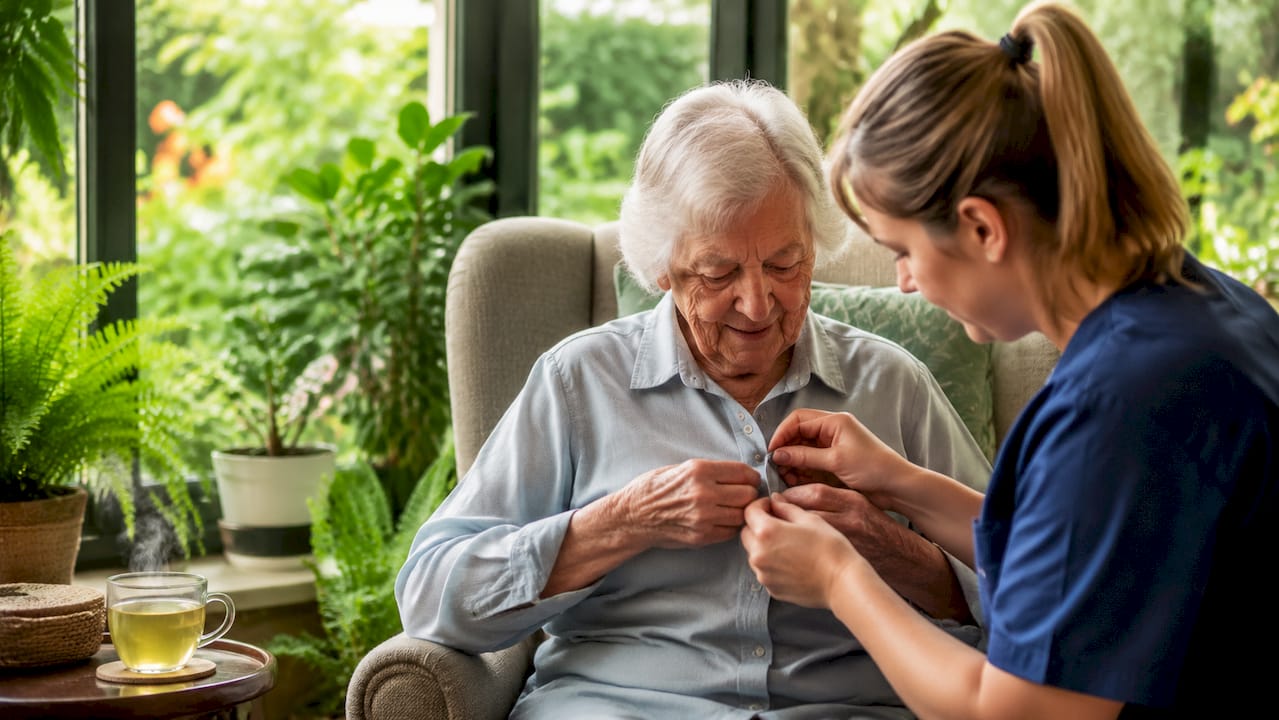
This type of care is most commonly arranged after a hospital discharge, a fall, a stroke, or a period of illness that has left someone less able to manage at home. The Edinburgh Health & Social Care Partnership describes reablement as a process of rebuilding functional abilities to maintain or increase independence. That distinction matters. Reablement is active, not passive. The person receiving care is encouraged to practise tasks, not simply have them done on their behalf.
How does reablement care work in practice?
Reablement follows a structured process. Here is what families can typically expect:
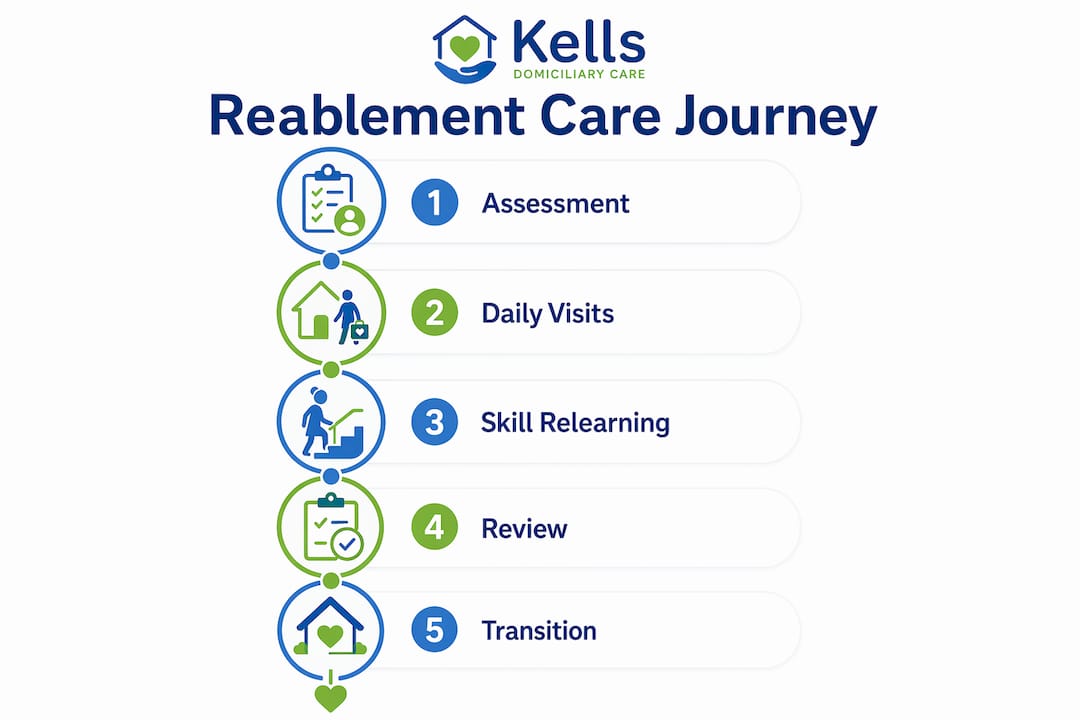
- Initial assessment. A care coordinator or social worker assesses the individual’s current abilities, home environment, and specific difficulties. This assessment shapes the entire programme.
- Personalised goal setting. Goals are agreed with the individual and their family. Common goals include washing and dressing independently, preparing a hot drink, moving safely around the home, and social participation.
- Daily visits from a multidisciplinary team. Reablement teams include occupational therapists, physiotherapists, and trained support workers. Each professional plays a specific role in guiding and encouraging the individual.
- Graded support. The team does not complete tasks for the person. Instead, they guide and encourage, stepping back as confidence and ability grow.
- Review at weeks four and six. Reviews at weeks four and six serve as decision points. The team assesses progress and adjusts the care plan or begins planning for what comes next.
The typical duration of a reablement programme is up to six weeks, with daily visits adjusted according to how the individual is progressing. That time limit is not a constraint. It is a motivating framework that keeps the focus on recovery rather than dependency.
Pro Tip: Before the initial assessment, write down every specific task your loved one finds difficult. The more precise your list, the better the team can target their support. “Getting dressed” is less useful than “cannot fasten buttons on left side due to weakness in right hand.”
What are the benefits of reablement care for elderly people and caregivers?
Reablement care delivers meaningful benefits for both the person receiving support and the family around them.
- Greater independence and confidence. Practising daily tasks with professional guidance rebuilds both physical ability and self-belief.
- Reduced hospital readmissions. Active rehabilitation helps prevent long-term dependency and lowers the risk of returning to hospital.
- Delayed or avoided care home admission. When someone regains the ability to manage at home, the need for permanent residential care is reduced.
- Preserved dignity. Being encouraged to do things yourself, rather than having everything done for you, supports a person’s sense of self-worth.
- Reduced pressure on family caregivers. When a professional team is actively supporting recovery, families can focus on emotional support rather than physical care tasks.
Age UK recognises reablement as a service that improves confidence and independence while reducing the likelihood of permanent care home moves. That outcome is significant for families who are worried about what the future holds.
“Reablement is best understood as active rehabilitation. It involves encouraging people to perform tasks rather than receiving help passively, which reduces long-term dependency.” — Age UK
The benefits extend beyond the individual. Families often report feeling more reassured when they understand that a structured, reviewed programme is in place. Knowing there is a plan, with clear goals and review points, reduces anxiety for everyone involved.
How is reablement care different from traditional home care?
This is one of the most common questions families ask, and the distinction is important.
| Feature | Reablement care | Traditional home care |
|---|---|---|
| Duration | Time-limited, typically up to six weeks | Ongoing, no fixed end date |
| Purpose | Rebuild independence and skills | Assist with daily tasks long-term |
| Approach | Encourages self-performance of tasks | Completes tasks on behalf of the person |
| Funding | Local authority funded, subject to assessment | Funded privately or through local authority |
| Review structure | Formal reviews at weeks four and six | Reviewed periodically but not goal-driven |
| Outcome goal | Reduce need for ongoing support | Maintain current level of support |
Reablement is focused on active rehabilitation and reducing support over time. Traditional domiciliary care, by contrast, is designed for people who need consistent, long-term assistance with daily living. Neither is better than the other. They serve different needs at different stages of a person’s life.
Funding pathways also differ. Reablement is usually arranged and funded by the local authority following a care needs assessment. It is not an automatic entitlement after hospital discharge. Eligibility depends on local authority assessment and individual goals. Traditional home care may be funded privately or through a local authority, depending on a financial assessment.
Understanding this difference helps families plan. If reablement ends and your loved one still needs support, that is the point at which ongoing domiciliary care becomes the appropriate next step. The two services are designed to work in sequence, not in competition.
What should families consider when arranging reablement care?
Families play a vital role in making reablement work. Here is what to focus on:
- Ask about eligibility early. Contact the hospital discharge team or your local authority social care department as soon as possible. Reablement is not always offered automatically, so you may need to request an assessment.
- Communicate clearly with the care team. Share your observations about what the person can and cannot do at home. You know your loved one better than any professional does.
- Encourage participation, not passivity. The hardest part for many families is watching a loved one struggle with a task without stepping in. Reablement works precisely because the person practises. Resist the urge to take over.
- Prepare realistic goals. Goals should reflect what the person actually wants to achieve, not what the family thinks they should achieve. A goal of “making my own cup of tea” may matter far more to someone than “walking to the end of the road.”
- Use review points as planning moments. Mid-programme reviews at weeks four and six are not just progress checks. They are the right moment to ask what happens next, whether that is continued short-term support or a transition to longer-term care.
Terminology and service models vary by region across the UK. Families should focus on identifying core components: home-based, goal-oriented, time-limited rehabilitation that encourages self-care. Do not get distracted by what a service is called locally. Ask whether it does these things.
Pro Tip: Treat the week-four review as your planning meeting. Come prepared with notes on what has improved, what has not changed, and what your loved one says they still find difficult. This gives the team the clearest picture for deciding next steps.
Key takeaways
Reablement care is a time-limited, goal-focused service that rebuilds independence at home, and it works best when families actively support the process alongside the professional team.
| Point | Details |
|---|---|
| Clear definition | Reablement is short-term intermediate care focused on relearning daily living skills, not long-term assistance. |
| Structured process | Programmes include assessment, personalised goals, daily team visits, and formal reviews at weeks four and six. |
| Distinct from home care | Reablement reduces support over time; traditional domiciliary care maintains ongoing assistance. |
| Family involvement matters | Encouraging participation rather than taking over tasks is the single most effective thing families can do. |
| Plan for what follows | Use review points to discuss next steps, including whether ongoing home care is needed after reablement ends. |
Why reablement care deserves more attention than it gets
I have spoken with many families over the years who first heard the word “reablement” at the point of hospital discharge, with little explanation and a great deal of anxiety. That timing is unfortunate. Reablement is one of the most genuinely hopeful forms of care available, and yet it is often treated as an administrative box to tick rather than a real opportunity for recovery.
The most common misunderstanding I encounter is the belief that reablement is just a cheaper version of home care. It is not. It is a fundamentally different approach, one that asks more of the person receiving it and, in doing so, gives them something far more valuable than assistance. It gives them capability back.
Families sometimes struggle with the encouragement-over-help principle. Watching a parent or spouse work hard to button a shirt or carry a cup across the kitchen can feel unkind. It is not. It is the point. The discomfort of watching is worth the outcome of watching them succeed.
My honest advice to any family navigating this process is to treat reablement as a partnership. Ask questions at every review. Write things down. Advocate for your loved one’s goals, not just their safety. And when reablement ends, whether it ends in full independence or in a transition to post-hospital home care, know that the progress made during those weeks is real and lasting.
— Dan
How Kells-care supports families after reablement
When reablement ends, many families need ongoing support to maintain the independence their loved one has worked hard to rebuild. Kells-care has provided personalised home care across London for over 30 years, with fully qualified, DBS-checked carers regulated by the Care Quality Commission. Whether your loved one needs check-in visits or more regular support, Kells-care builds care around the individual, not a standard package. Download the free home care guide to understand your options clearly before making any decisions.
FAQ
What is the goal of reablement care?
The goal of reablement care is to help individuals regain the ability to perform daily living tasks independently at home, reducing the need for long-term care support.
How long does a reablement programme last?
Reablement programmes are typically time-limited, lasting up to six weeks, with formal reviews at weeks four and six to assess progress and plan next steps.
Is reablement care free in the UK?
Reablement care is usually funded by the local authority, but eligibility is not automatic. Access depends on a care needs assessment, and provision varies between local authorities.
Who delivers reablement care?
Reablement is delivered by multidisciplinary teams that include occupational therapists, physiotherapists, and trained support workers, all working together to support recovery at home.
What happens when reablement care ends?
At the end of a reablement programme, the care team reviews progress and recommends next steps. These may include full independence, continued short-term support, or a transition to ongoing domiciliary care.


