

Live-in care means a trained carer lives in your young adult’s home and supports them day and night, so they can keep their routine, their independence and their place in the community. It suits many young adults with a learning disability, autism, a physical disability or mental health needs. It works best when the care plan is built around the person, not around a standard timetable. We provide live-in care in London as part of our CQC-regulated home care.
TL;DR
- Live-in care puts one carer in the home, giving continuous support with personal care, routines, meals, medication assistance and getting out and about.
- Start with a thorough assessment of the young adult’s needs and a person-centred Care and Support Plan. The carer then follows that plan.
- Ask your local authority for a needs assessment. It cannot be charged for, and it can lead to a personal budget.
- Choose a provider regulated by the Care Quality Commission (CQC) that covers sickness and holiday for its carers.
- Plan the move from children’s to adult services early, from around 16.
Table of Contents
- What live-in care involves for a young adult
- When live-in care can suit a young adult
- Supporting independence and a daily routine
- Moving from children’s to adult services
- How live-in care is arranged and paid for
- Practical arrangements for a live-in carer
- Safeguarding and quality
- Why families choose us
- Our view
- FAQ
- Sources
What live-in care involves for a young adult
A live-in carer stays in the home and provides support through the day and, where needed, the night. For a young adult this is rarely just personal care. It usually covers routines, cooking, medication assistance, travel to college, work or leisure, and help to build skills such as budgeting or shopping.
In England, a young adult supported at home should have a Care and Support Plan that sets out what care is provided, who provides it, how and when. The Challenging Behaviour Foundation’s adult social care guide (2025) says the provider’s own support plan should then record the details that make a day work: communication needs, likes and dislikes, dietary needs, triggers, morning, evening and night-time routines, and personal care preferences such as bathing and hair or nail care.
Our own carers work from this kind of detail. You can read what a carer does through the day and night in our live-in carer duties guide.
A typical day
No two days are identical, but a plan might include:
- Waking, washing, dressing and breakfast in the way the young adult prefers.
- A morning activity: college, work, volunteering or a community group.
- Meals, shopping and light housework done together, to build skills.
- Medication prompts and help with appointments.
- An evening routine that is calm and predictable, and night-time support if needed.
When live-in care can suit a young adult
Live-in care is worth considering when someone wants to stay in their own home or family home but needs more support than visits can give. Examples include a young adult with autism who needs a stable routine and familiar faces, someone with a learning disability who needs prompting through the day, or someone with a physical disability who needs help at several points in the day and night.
The Local Government Association’s Preparing for adulthood guidance (2023) says there must be a thorough assessment of disability-related needs, and that the accommodation must be suitable for them. Specialist care may be considered.
The CQC’s Home For Good report is clear on what good looks like: services that are bespoke and person-centred, staff with specialist training, links with health professionals such as occupational and speech and language therapists, and family involvement in planning. It also says challenging behaviour should be understood as a way of communicating distress, often supported through Positive Behaviour Support.
The CQC also notes that NICE guidance recommends people with a learning disability can choose to live alone with appropriate support if that suits them. Live-in care is one way to make that real.
What to assess first
- Daily needs: personal care, eating, mobility, medication, sleep.
- Communication: how the person expresses choices, worry or distress.
- Behaviour and triggers: what helps and what escalates things, and the approach the carer will use.
- Goals: work, study, friendships, hobbies, living more independently.
- The home: whether it is suitable, and whether the carer will have a room of their own.
The Challenging Behaviour Foundation advises families to ask any provider for its behaviour policies before agreeing it is suitable. We cover learning disability and autism support in more detail on our learning disability and autism page, and on learning disabilities at home.
Supporting independence and a daily routine
The aim of live-in care for a young adult is not to do things for them. It is to widen what they can do. The CQC’s expectations for providers (updated May 2025) include outcomes such as “I have a good and meaningful everyday life” and “I have choice and control over how my health and care needs are met”.
In practice, that means:
- Letting the young adult make the daily choices: what to eat, what to wear, how to spend the afternoon.
- Breaking tasks into steps so they can be learned and repeated.
- Keeping a visual or written routine that the whole household follows.
- Supporting friendships and community activity, not just time at home.
The Care Act 2014 statutory guidance on wellbeing lists the things care should protect: dignity, control over day-to-day life, taking part in work, education or recreation, relationships and suitable accommodation. A good plan can be checked against that list.
For help turning preferences into a plan, see how to personalise home care. A clear overview of caregiver roles and daily check-ins can also help your family agree who does what.
Moving from children’s to adult services
Transition is where families often feel most exposed. Under the Care Act 2014, sections 58 to 66 give local authorities powers to assess children, young carers and parent carers before adulthood, as the Act’s explanatory notes set out. The aim is no gap in support when a young person turns 18.
The LGA’s guide to the Care Act adds that assessment and planning must be based on individual needs, taking family issues into account to cause minimum disruption.
Practical steps:
- Ask the social worker or school about a transition assessment well before the 18th birthday.
- Where health needs are the main need, ask about NHS Continuing Healthcare. In Wales, official guidance says children’s services should refer for screening at 16 and complete a full assessment by 17, so a package is ready for the 18th birthday. Check the equivalent process with your own NHS integrated care board in London.
- Keep carers, routines and the home as stable as possible through the change.
How live-in care is arranged and paid for
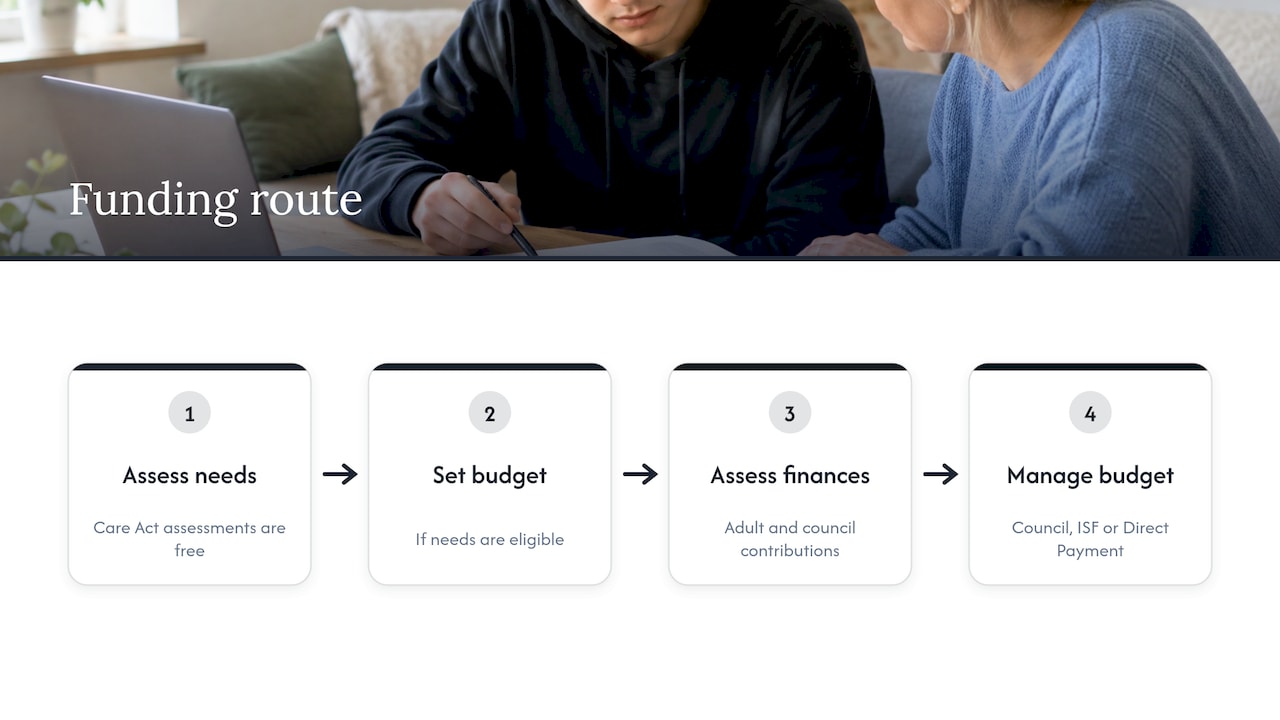
In England, start with your local authority. For London families that means your borough’s adult social care team. Under the Care Act, needs assessments and carer’s assessments cannot be charged for.
If the person has eligible needs, the council sets a personal budget. Section 26 of the Care Act says it specifies the cost of meeting those needs, what the adult pays after a financial assessment and what the council pays. The Challenging Behaviour Foundation explains the budget can be managed by the council, held as an Individual Service Fund, or paid as a Direct Payment to the person or, if they lack capacity, a family member. Their social worker should be able to explain the options, and support can be funded across education, health and social care.
Many families also pay privately for some or all of the care. Our guide to protecting council funding for live-in care explains timing and what to ask. We do not publish a fixed price for live-in care, because the cost depends on the assessed needs, so we agree it with you after an assessment.
Practical arrangements for a live-in carer
A room and privacy. The carer needs their own room. A live-in carer is usually a service occupier, meaning they live in the home because the job requires it, and their right to stay normally ends when the work does.

Breaks and rest. The Working Time Regulations 1998 give workers at least 11 hours’ daily rest, 24 hours’ weekly rest and a 20-minute break when working over six hours. Cover for these breaks needs planning so the young adult’s support never has a gap.
Sickness and holiday cover. The Low Incomes Tax Reform Group explains that a fully managed agency is CQC-regulated and takes responsibility for sick leave and holiday cover. With an introductory agency, you manage the carer and find any replacement. Families usually find the managed route less stressful.
Safeguarding and quality
Providing personal care is a regulated activity, so the provider must be registered with the CQC. Check the provider’s CQC rating on the CQC website, and also ask about:
- Adult protection, behaviour management and physical intervention policies.
- Risk assessments for the individual.
- A clear complaints procedure.
- Monitoring that detects poor practice and prevents closed cultures.
The Challenging Behaviour Foundation lists these as statutory policies for services supporting people with severe learning disabilities and challenging behaviour. Local Safeguarding Adults Boards exist in every area under sections 42 to 47 of the Care Act.
Our carers are qualified, DBS-checked and work under CQC regulation.
Why families choose us
Kells Domiciliary Care has supplied home care across London for over 30 years. Our carers are fully qualified and DBS-checked, we are regulated by the CQC, and our services cover young adults and children with learning disabilities, autism, mental health needs and challenging behaviours, as well as physical disability and complex needs. We offer live-in care, call-in visits, respite cover and domestic help, so support can change as your young adult’s needs change.
To talk through what live-in care could look like for your family, see our live-in care service or contact us through kells-care.com.
Our view
A young adult is not a smaller version of an older client. They have goals, friends and a future, and the carer’s job is to protect all three.
At Kells we build care around the person: their communication, their routine, what calms them and what they want to learn next. Live-in care gives that consistency, one familiar face in a home that stays theirs, and the continuity matters most during transition and change.
We promote quality of life, independence, dignity and freedom of choice. For families in London, that means a CQC-regulated team with over 30 years of local experience, ready to start from a proper assessment.
Dan
FAQ
Can a young adult get live-in care funded by the council?
If an assessment finds eligible needs, the local authority sets a personal budget, and whether it covers live-in care depends on the assessment and the person’s finances. The needs assessment itself is free. Ask your borough’s adult social care team to begin it.
At what age can someone receive adult live-in care?
Adult services apply from 18, but planning should start earlier. Councils can assess young people before they turn 18 so support is ready on time, and continuing care screening can begin around 16.
Is live-in care suitable for autism or challenging behaviour?
It can be, when the carer is trained and the plan is person-centred. Challenging behaviour is understood as communication of distress, so a good carer works out the cause and uses approaches such as Positive Behaviour Support. Ask any provider for its behaviour policies.
Does the carer work 24 hours a day?
No. Carers are entitled to daily and weekly rest and breaks under the Working Time Regulations, so cover is planned around them. Night-time support is agreed in the care plan.
Sources
- Adult Social Care (England), Challenging Behaviour Foundation, 2025
- Preparing for adulthood, Local Government Association, 2023
- Home For Good, CQC
- Services for autistic people and people with a learning disability, CQC
- How providers demonstrate they are meeting requirements, CQC
- Care and support statutory guidance, GOV.UK
- Care Act 2014 explanatory notes, legislation.gov.uk
- Care Act 2014, section 26
- Guide to the Care Act 2014, Local Government Association
- Children and Young People’s Continuing Care Guidance, Welsh Government, 2020
- The Working Time Regulations 1998
- Using an agency to find a carer, Low Incomes Tax Reform Group
- Service occupiers, Shelter England