
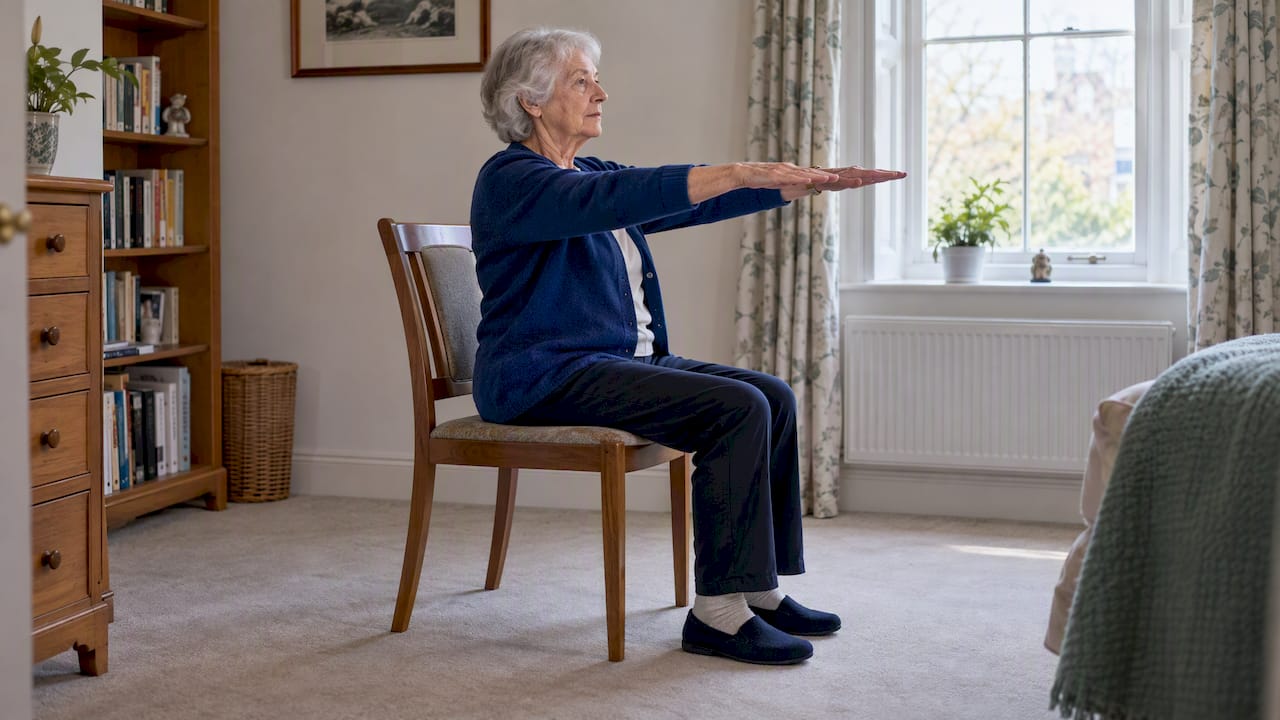
Chair exercises let you build strength, flexibility and confidence without getting down on the floor or standing for long. You need a sturdy chair, comfortable clothes and about 10 to 15 minutes. This guide shows you how to set up the chair, which movements to start with, how often to do them, and when a carer or a health professional should be involved.
TL;DR
- Sit on the front third of a stable chair without wheels or arms, with your feet flat and your knees bent at right angles.
- Start with five slow repetitions of each movement. Slow and controlled matters more than speed.
- The UK Chief Medical Officers advise older adults to do strength and balance activities on at least two days a week, and to break up long periods of sitting.
- If you have not been active for a while, or you have a health condition, check with your GP first.
- Seated exercise is for everyone, not only people who cannot stand.
Table of Contents
- Why chair exercises work for older adults
- How much activity do you actually need?
- Setting up your chair safely
- Six chair exercises to start with
- A simple weekly plan
- Making it meaningful, not just mechanical
- Chair exercises and falls prevention
- Our perspective: what we see in people’s homes
- Helping someone else exercise safely
- When regular support helps
- FAQ
- Sources
Why chair exercises work for older adults
A common belief is that seated exercise is a second-best option for people who cannot stand. The NHS describes it differently: the strength exercises are gentle, easy to follow and suitable even if you have not done much for a while. Simple movements such as lifting your arms while sitting count towards your daily activity.
There are three practical reasons to start in a chair:
- It is stable. You can concentrate on form instead of worrying about your balance.
- It is easy to repeat. You can do a few minutes in the morning, and a few more in the afternoon.
- It lowers the barrier. Many people avoid activity because they fear falling. Occupational therapists see this often, and the fear itself becomes a risk, because inactivity leads to weaker muscles and poorer stability. A seated routine is a small, controlled risk that helps rebuild trust in your body.
How much activity do you actually need?
The UK Chief Medical Officers’ guidelines for adults aged 65 and over say you should be active every day, and the target is 150 minutes of moderate-intensity activity a week. On at least two days a week you should also do activities that improve muscle strength, balance and flexibility.
That number can feel out of reach. The same guidance is clear that some activity is better than none, and that breaking up long spells of sitting with light movement is a good first step. If you are currently very inactive, do not aim for 150 minutes this week. Aim for a few minutes of chair exercises, then build up.
Setting up your chair safely
The set-up matters as much as the exercises. The NHS advice on sitting exercises is to choose a chair that is stable, solid and without wheels, so that you can sit with your feet flat and your knees bent at right angles. It also advises avoiding chairs with arms, as they restrict your movement.
A simple checklist:
- Choose a dining-style chair and place it on a non-slip floor, ideally against a wall so it cannot slide back.
- Sit on the front third of the seat, with your back tall and away from the backrest.
- Put both feet flat on the floor, about hip-width apart.
- Wear supportive shoes or non-slip socks. Loose slippers are a trip risk when you stand up afterwards.
- Keep a glass of water within reach and a phone or alarm pendant nearby.
- Stand up slowly at the end. Pause for a moment before you walk.
If you have a heart condition, dizziness, recent surgery, severe osteoporosis or pain that comes with movement, speak to your GP or physiotherapist before starting. They can tell you which movements to avoid.
Six chair exercises to start with
The first five follow the movements in the NHS sitting exercises for older people. Each is typically done five to ten times. Stop if anything hurts, as opposed to feeling a mild stretch or tiredness.
1. Chest stretch
Sit tall, pull your shoulders back and down, and extend your arms out to the sides. Gently push your chest forwards and up until you feel a stretch across the front of your chest. Hold for five to ten seconds and repeat five times. This is good for posture, especially if you spend long periods reading, watching television or leaning over a table.
2. Upper body twist
Cross your arms and reach for your shoulders. Without moving your hips, turn your upper body to the left as far as is comfortable. Hold for five seconds, then repeat to the right. Do five each way. It keeps the upper back flexible, which helps with turning to look behind you.
3. Hip marching
Sit tall and hold the sides of the chair if you need to. Lift one knee a little, lower it, then lift the other, as if marching slowly on the spot. It strengthens the hips and thighs, which you use every time you stand up from a chair.
4. Ankle stretch
Straighten one leg with your heel on the floor and point your toes towards you, then away from you. Switch legs. This keeps your ankles mobile, which matters for walking and for stepping over thresholds.
5. Arm raises
With your arms by your sides, lift them slowly forwards and up to shoulder height, then lower them with control. You do not need weights. Once this feels easy, you could hold a small tin or a light water bottle in each hand, if your GP or physiotherapist agrees.
6. Seated knee extensions
This one is our addition rather than an NHS-listed movement, and it is a common leg exercise in seated programmes. Sit tall, slowly straighten one knee until your leg is level with the seat, hold for a second or two, then lower. Do five to eight on each leg. It works the front of the thigh, which is the muscle group that helps you rise from a chair.
A simple weekly plan
Use this as a starting point. Adjust it to how you feel on the day.
| Week | How long | How often | What to do |
|---|---|---|---|
| 1 | 5 to 10 minutes | 2 days | Exercises 1 to 4, five slow repetitions each |
| 2 | 10 minutes | 2 to 3 days | Add arm raises and knee extensions |
| 3 to 4 | 10 to 15 minutes | 3 days | Increase to eight to ten repetitions, if comfortable |
| After a month | 15 minutes | Most days | Add a short walk or standing movements, if your GP agrees |
The guidelines ask for strength and balance work on at least two days a week. This table is our suggestion for getting there gently. It is not a prescription.
Making it meaningful, not just mechanical
Occupational therapists put emphasis on what they call meaningful occupation. In practice the best exercise is the one that fits into a person’s life, such as dancing, gardening or a social class, rather than a purely mechanical routine. For people living with dementia, the Royal College of Occupational Therapists points to activities that need some thought, such as dancing in a class, as helpful, with support from a chair if needed, for people with conditions like Parkinson’s.
Some ways to bring that into a seated routine:
- Exercise to music you like, and move in time to it.
- Do the routine together with a friend, a partner or a carer, so it becomes a social moment.
- Add a task that needs a decision, such as passing a soft ball, copying a sequence of arm movements or naming a colour each time you lift your knee.
- Try a group class. Age UK runs seated exercise classes that are suitable for people with reduced mobility, and some use resistance bands and light hand weights. Availability depends on your local Age UK, so check what is near you. For ideas closer to home, see our guide to elderly activities in London.
Chair exercises and falls prevention
Strength and balance are the two things that most affect your risk of falling. Seated exercises mainly build strength in the legs, hips and core, and balance work is the natural next step. If you want to understand where balance training fits, this article on balance training for seniors explains the principles of safe exercises for preventing falls. It is written by a US clinic, so use it for the ideas and follow UK guidance and your own clinician for what suits you.
If you do fall, falls advice from a UK council health team says not to panic and to try to signal for help. If you are uninjured, try to get onto your hands and knees beside a sturdy chair and use it to help you stand. If you cannot get up, keep moving to stay warm while you wait for help. Report every fall to a GP or other health professional, even if you feel fine.
For more on the home environment, read our practical fall prevention guide and our overview of equipment for elderly care at home.

Our perspective: what we see in people’s homes
We have supported people in their own homes in London for over 30 years, and the pattern is consistent. The person who exercises regularly is rarely the one who has the best equipment or the most motivation. It is the person for whom the routine is easy to start, easy to finish and tied to something they enjoy.
Three things help most:
- Link it to a daily moment. Do the routine after morning tea, or before the lunchtime news. It then becomes part of the day and needs no willpower.
- Keep a carer or relative close, not in charge. Our aim is to promote independence, dignity and freedom of choice. A carer can set up the chair, count repetitions and keep the conversation going, but the person doing the exercise decides the pace.
- Respect fear. Someone who has fallen may be nervous about any movement. Start with two minutes, praise the effort and increase slowly. A small win is better than an ambitious plan that gets abandoned.
For someone with dementia, a short, familiar, musical routine at the same time each day often works better than a long or complicated one. For someone with limited hand strength or a physical disability, we adapt the movements together with the person and, where needed, their GP or physiotherapist. You can read more in our guides on how to promote independence at home and what mobility support means.
— Dan
Helping someone else exercise safely
If you are exercising with a parent, partner or client, a few rules keep you both safe:
- Never pull on someone’s arms or shoulders to help them stand. This can injure both of you. Our guide to manual handling at home explains safer methods.
- Stand or sit in front of them at the side, where they can see you, and demonstrate each movement.
- Give one simple instruction at a time. For someone with dementia, show the movement rather than describing it.
- Watch for signs to stop: breathlessness that makes talking difficult, dizziness, chest pain, new pain in a joint, or confusion. Stop, let them rest and seek medical advice if symptoms continue. Call 999 for chest pain or sudden severe symptoms.
- Keep hydration and food in mind. Our guides on nutrition for elderly care cover how eating well supports strength.
When regular support helps
Some families want company and encouragement for the routine. Others need practical help because mobility, memory or confidence has changed. We provide call-in visits, live-in care, companionship, dementia care, respite cover and care for adults and children with physical or learning disabilities across London. Our carers are qualified and DBS checked, and we are regulated by the Care Quality Commission. A carer can encourage a daily seated routine as part of a wider care plan, always at the person’s own pace. See our home care services or get in touch to talk through what would suit your family. Our free home care guide is a good place to start if you are still deciding.
FAQ
What is the best chair exercise for seniors?
There is no single best one. Hip marching and knee extensions are useful because they work the legs and hips, which you use to stand up and walk. Combine them with arm raises and a chest stretch for a balanced routine, and ask your GP or physiotherapist which suit your health.
How often should older adults do chair exercises?
The UK guidelines recommend strength and balance activities on at least two days a week, alongside daily movement. If you are new to exercise, start with two short sessions and add time slowly. A few minutes is a good start.
Can chair exercises count as proper exercise?
Yes. The NHS notes that simple movements such as lifting your arms while sitting count towards your daily activity. They will not replace every kind of activity, such as walking, but they are a legitimate and useful starting point, especially if mobility is limited.
Do I need a GP’s approval first?
If you have not been active for a while, the NHS suggests getting the all-clear from a GP before starting. Talk to them in particular if you have heart problems, dizziness, recent surgery, osteoporosis or ongoing pain.
Are chair exercises suitable for someone with dementia?
Often yes, if they are short, familiar and enjoyable. Music, group settings and movements that need a little thought can help. Show each movement rather than explaining it, and stop if the person becomes distressed.
Sources
- UK Chief Medical Officers’ physical activity guidelines, GOV.UK
- Strength exercises, NHS
- NHS sitting exercises for older people
- Occupational therapy for people with Parkinson’s, Royal College of Occupational Therapists
- Exercise and keep fit classes for older people, Age UK
- Up and about: positive steps to avoid falls
- Balance training for seniors