

A live-in care rota is the schedule that sets out which carer is in your loved one’s home, when, and for how long. Most UK agencies run rotas in blocks of a few weeks, with relief carers rotating in so the primary carer gets proper time off. The rota also has to respect statutory rest entitlements, which is the part families most often overlook until it causes a problem.
TL;DR:
- A well-structured live-in care rota typically involves two to four-week primary blocks with designated relief carers to maintain continuity and prevent burnout.
- UK law mandates live-in carers receive at least 24 hours off weekly or 48 hours every two weeks, and rotas must comply with these statutory rest requirements to avoid legal issues.
- Overlap days and clear handover procedures are essential to ensure safety, reduce hidden costs, and provide smooth transitions between carers.
- Carers providing waking nights or specialized care for high-dependency needs significantly increase weekly costs due to active attention and tailored support.
- Choosing a registered provider ensures oversight, compliance, and transparent pricing, especially regarding relief cover, statutory breaks, and proper rostering practices.
Table of Contents
- How does a typical live-in care rota work?
- What are the legal rest rules for live-in carers?
- How does rota design affect cost and continuity of care?
- How do you plan and check a live-in care rota?
- How does Kells arrange live-in care rotas for families?
- What families get wrong about live-in care rotas
- Next steps: getting a rota that actually works for your family
- Where to check the rules yourself
- Sources
- FAQ
How does a typical live-in care rota work?
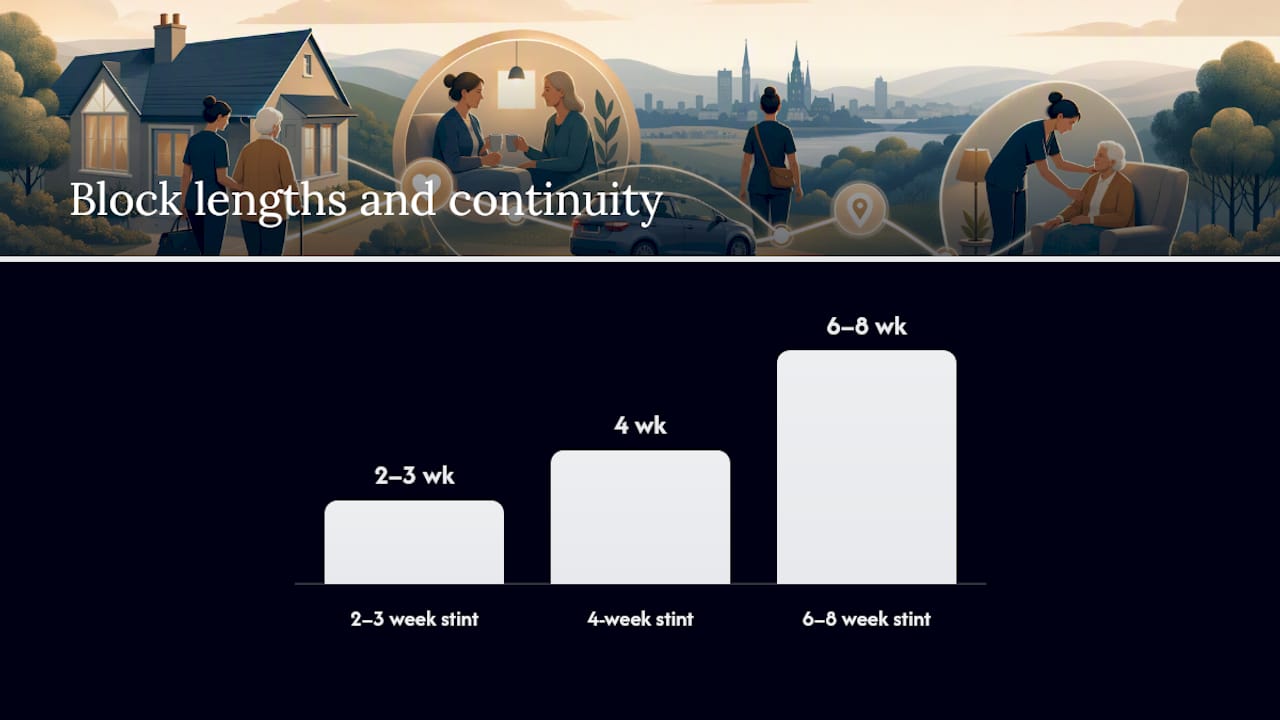
Live-in carers cannot work every day of the year without a break, so agencies build rotas around fixed blocks. The most common pattern is a two or three-week stint, though some providers stretch primary blocks to four weeks before swapping carers. A relief carer then takes over for a week or so while the primary carer rests, before the cycle repeats.
Providers often favour 6 to 8 week primary blocks with a named relief carer attached from the outset, rather than sending a different stranger every time cover is needed. Keeping the same small team of two, a primary and a relief carer, tends to work better for continuity than rotating through a long list of unfamiliar faces.
Within each day, the schedule usually splits into sleeping-in or waking-night arrangements. A sleeping-in carer rests overnight in the home but is on hand if woken, whereas a waking-night carer stays fully alert throughout, which agencies use when someone needs frequent repositioning, monitoring, or medication overnight. That distinction changes the whole shape of the day, and sector guidance on live and night care explains why waking nights cost more: you’re paying for full attention rather than availability.
A sample day under a sleeping-in arrangement might look like this:
- 7:00am to 9:00am: morning personal care, medication, breakfast
- 9:00am to 1:00pm: domestic tasks, appointments, companionship
- 1:00pm to 6:00pm: lunch, rest periods, light activities
- 6:00pm to 10:00pm: evening meal, personal care, settling for the night
- 10:00pm to 7:00am: sleeping-in period, carer wakes only if called
A waking-night package replaces that last block with active overnight checks, often on a set rota of two-hourly interventions.
Couples living together and clients with high dependency needs change this picture again. One live-in carer can often support both members of a couple where care needs are moderate, which keeps costs well below two separate placements, though this depends entirely on how demanding each partner’s needs actually are (more detail on this is covered in guidance on live-in care for couples). High-dependency cases, by contrast, sometimes need two carers overlapping during the day, on top of the usual rota.
Pro Tip: Ask any prospective provider whether their rota is built around a fixed primary/relief pairing or a pooled team of carers who rotate in as availability allows. The named-pair model is far kinder to someone living with dementia, who may find a stream of new faces distressing.
What are the legal rest rules for live-in carers?
Live-in carers are workers, not exceptions to employment law, and that shapes every rota an agency builds. Under UK working time rules, carers are entitled to a weekly rest period: either an uninterrupted 24 hours off each week, or an uninterrupted 48 hours off every fortnight, as ACAS sets out in its guidance on rest breaks. A rota that never gives the primary carer this break isn’t just poor practice; it breaches the law, and it’s a fair question to put directly to any agency quoting you a price.
Pay during sleeping-in shifts involves complex rules; generally, time asleep but available to be woken is treated differently from active work. Providers should ensure National Living Wage compliance throughout the 24-hour period and incorporate this into pricing rather than leaving it unclear.
Regulation matters here too. Not every introductory agency needs to register with the Care Quality Commission, but any provider that arranges rotas on an ongoing basis and monitors how care is actually delivered generally does need CQC registration, according to CQC guidance on personal care and introductory agencies. This distinction matters because:
- A registered provider is inspected and rated, giving you an independent check on quality.
- CQC’s own reporting framework asks live-in providers to account for the full 24 hours across 28 days and confirm pay above the National Living Wage, as outlined in its PIR guidance for service-specific questions.
- An introductory-only agency, by contrast, hands you a carer and then steps back, leaving rota management and oversight to you.
If cost is a concern, it’s worth checking whether your local council might contribute. An NHS needs assessment determines what care someone is eligible for, and any council funding that follows is subject to a financial means test rather than being automatic.
How does rota design affect cost and continuity of care?
Rotation exists for a reason beyond scheduling neatness: no carer can sustain round-the-clock responsibility indefinitely without a serious risk of burnout, and a burnt-out carer is a safety risk to the person they’re looking after. Relief cover isn’t a luxury add-on; it’s the mechanism that keeps a rota sustainable and safe over months and years.
Overlap days, where the outgoing and incoming carer are both present to hand over, are widely regarded as best practice, but they aren’t always included in a standard quote. Ask specifically whether overlap is billed separately, because a single unbudgeted overlap day here and there adds up over a year of rota changes.
Several factors typically push weekly costs upward:
- Waking nights instead of sleeping-in, because you’re paying for continuous active attention rather than availability.
- Specialist cover for conditions like advanced dementia, Parkinson’s, or complex medication regimes.
- Travel and, where relevant, accommodation costs for relief carers covering rural or outer-London addresses.
- Additional daytime support layered on top of a live-in carer during high-dependency periods.
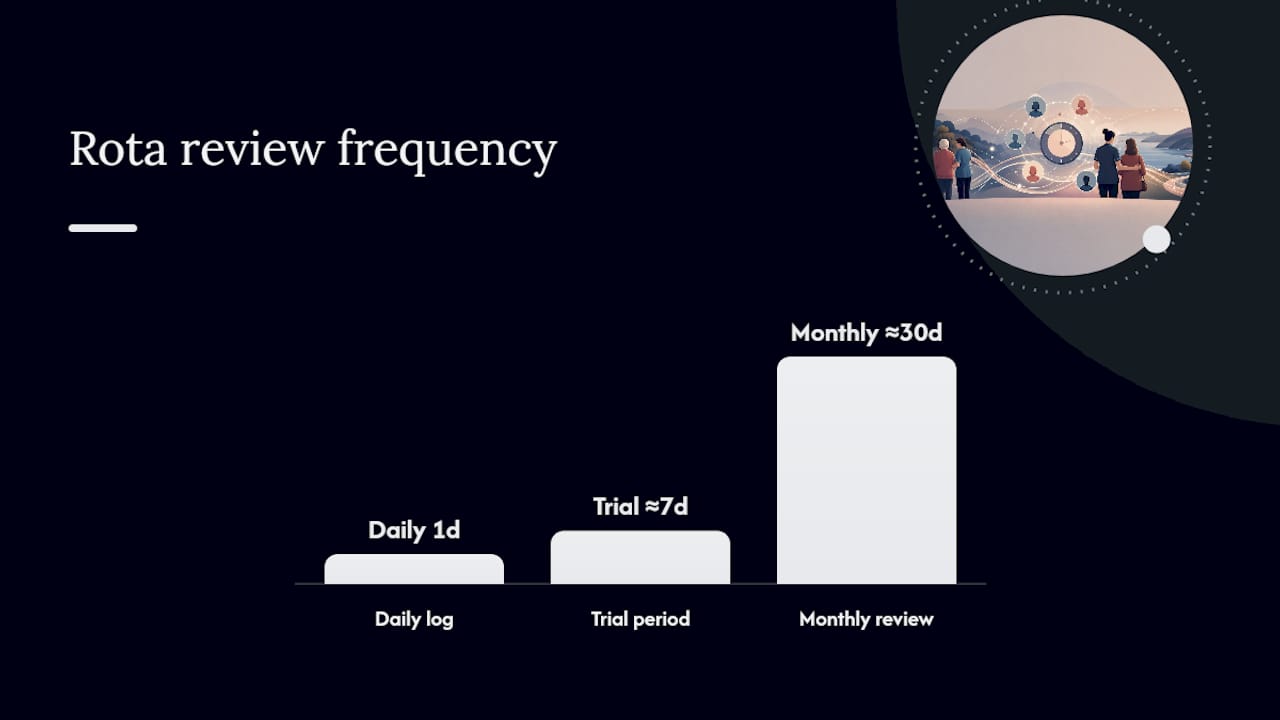
Practical reporting from the sector flags rota overlap days and relief-carer travel as two of the most common hidden cost drivers, alongside continuity risks when handover isn’t properly documented. Written, dated handover notes and a clearly agreed trial period, often around a week, go a long way towards catching problems early rather than after a rota has already broken down.
To reduce risk, ask for named relief carers rather than “someone from the team,” insist on written handover notes as standard practice, and get any guaranteed cover clause (what happens if the relief carer is ill) confirmed in writing before you sign anything.
How do you plan and check a live-in care rota?
Getting the rota right starts before a single carer walks through the door, and it needs checking again once care is underway.
- Arrange a needs assessment. Whether through the council or privately with an agency, this establishes what kind of support, and how many hours of attention, the rota actually needs to cover.
- Go through carer matching. A good agency matches on both skill and personality fit, not just availability.
- Agree a trial period. A short trial, commonly around a week, lets everyone assess the fit before committing to a longer arrangement.
- Get the rota in writing. The agreement should specify the rotation pattern, who provides relief cover, and how costs for overlap or emergency cover are handled.
- Monitor and review. Daily reports, medication administration records (MAR charts), and notes on night-time interventions all help you judge whether the current rota still fits.
Before signing, ask a provider directly: what is the rotation pattern? Who covers the primary carer’s statutory rest breaks? Is relief cover included in the quoted price or billed as an extra? What does the handover procedure actually involve? And what happens in a genuine emergency, out of hours?
Pro Tip: Keep a simple daily log, even a one-page notebook by the kettle, tracking meals, medication times, and anything unusual overnight. Reviewing it monthly makes it far easier to spot whether a rota pattern is genuinely working or quietly failing.
Treat vague answers as a warning sign. A provider that can’t tell you who the relief carer is, or dodges questions about overlap billing, is one you should be cautious about.
How does Kells arrange live-in care rotas for families?
Kells-care builds each rota around a proper needs assessment first, matching carers by skill, personality, and the practical demands of the home before a rota pattern is even proposed. Every carer is vetted, and that vetting directly shapes how relief planning works, because rotas only stay stable when every carer in the pairing meets the same standard.
Trial periods and re-matching are treated as normal, not exceptional. If a pairing isn’t working, Kells-care responds to concerns and adjusts the arrangement rather than leaving a family to manage friction alone.
For families wanting to see how this looks in practice, useful references include:
- Short-term live-in care options for families testing the arrangement before committing long term
- Live-in care for couples, where one carer supports two people under one rota
- Examples of daily care routines showing what a typical day actually involves
Whichever provider you choose, ask for these same safeguards: documented matching, a genuine trial period, and a clear response process when something isn’t right.
What families get wrong about live-in care rotas
Most guidance on live-in care rotas treats scheduling as a logistics problem: fit the blocks together, tick the legal box, move on. That misses the point. The rota is the single biggest determinant of whether care actually holds together over a year, not a month.
Families fixate on the headline weekly price and barely question the rota behind it, yet two quotes at the same price can represent wildly different arrangements. One might include a named relief carer and overlap days; the other might leave you scrambling to find cover the moment the primary carer falls ill. That gap only shows up when you ask direct questions about relief, not when you compare numbers on a page.
The other blind spot is treating statutory rest as a compliance detail rather than a safety issue. A carer denied proper weekly rest isn’t just legally exposed; they’re tired, and tiredness in a caregiving role has real consequences. Prioritise the relief structure and the paperwork behind it before you ever compare prices.
— Dan
Next steps: getting a rota that actually works for your family
Beyond straightforward live-in care, Kells-care also arranges short-term live-in placements and couples’ live-in care, both built around the same assessment and matching process described above. If you’re weighing up whether a live-in rota suits your situation at all, the free Home Care Guide walks through the options in plain terms before you commit to anything.
What makes the difference isn’t a lower headline price; it’s knowing exactly who your relief carer is, what your handover looks like, and that everything is confirmed in writing rather than promised verbally. That’s the standard worth holding any provider to, Kells-care included.
The most useful next step is a free needs assessment, where you can talk through the rota pattern you’d prefer, whether that’s sleeping-in or waking nights, a two-week block or something longer, before any agreement is signed. You can arrange that assessment through Kells-care’s home care services page and get a rota proposal built around your family’s actual routine, not a generic template.
Where to check the rules yourself
- ACAS sets out the statutory weekly rest entitlement that governs how any live-in rota must be structured.
- NHS guidance on needs assessments explains how councils determine eligibility for funded care.
- CQC clarifies when a provider must register and what ongoing oversight involves.
- Third-sector resources, such as caregiver support services guidance, cover respite and community support that can sit alongside a formal rota.
Sources
- ACAS — rest breaks and working time
- NHS — getting a needs assessment
- CQC — personal care, ongoing role and introductory agencies
- Croner-i — live and night care in domiciliary services
FAQ
How much does a live-in carer cost per week in the UK?
Costs vary by dependency level, location, and whether waking nights are needed, with couples’ care often working out cheaper per person than two separate placements. A detailed breakdown is available in Kells-care’s live-in carer cost guide.
How much does a live-in carer earn in the UK?
Pay depends on the provider and whether shifts involve sleeping-in or waking nights, since National Living Wage rules apply differently across active and available time. Reputable agencies build compliant pay structures into their pricing rather than treating it as a grey area.
Will the NHS pay for live-in care?
Funding isn’t automatic. A council-arranged needs assessment determines eligibility, and any resulting support is subject to a financial means test rather than being free for everyone.
How many hours does a live-in carer work?
Live-in carers cover extended daily periods but are entitled to statutory weekly rest, either 24 uninterrupted hours a week or 48 hours every fortnight, under ACAS working time rules, which is why relief carers rotate in on a regular schedule.


