TL;DR:
- Complex care provides integrated support for individuals with multiple or severe conditions, extending beyond standard home help to include medical, social, and practical needs. Its management involves a multidisciplinary team with clear roles, proactive communication, and person-centered planning to improve outcomes and preserve independence. Families must actively advocate, ask questions, and understand care coordination processes to navigate fragmentation and access effective support.
When a loved one has needs that go beyond routine support, families often find themselves facing an unfamiliar system with few clear answers. What is complex care, exactly, and how does it differ from the home help or nursing visits you might already know about? The short answer is that complex care covers a broad spectrum of health, social, and practical support for people living with multiple or severe conditions. But the full picture is richer than that, and understanding it properly makes a real difference when you are making decisions for someone you love.
Table of Contents
- Key takeaways
- What is complex care?
- How complex care management works
- Challenges families face when accessing complex care
- Types of complex care services
- Why the whole-person approach matters
- My perspective on navigating complex care
- How Kells-care can support your family
- FAQ
Key takeaways
| Point | Details |
|---|---|
| Complex care goes beyond medicine | It addresses physical, psychological, and social needs together, not just clinical symptoms. |
| Coordination is central | A dedicated care coordinator or case manager helps prevent gaps between different services and providers. |
| Families must advocate actively | Never assume care is being coordinated automatically. Ask who is responsible for managing communication. |
| Home-based care is a real option | Complex care services can be delivered at home, supporting independence and dignity for elderly or disabled individuals. |
| Person-centred planning improves outcomes | Tailoring care to individual goals and preferences leads to better health outcomes and lower crisis-driven service use. |
What is complex care?
Complex care is support provided to individuals whose needs cannot be met by a single service or straightforward care plan. The definition of complex care covers people living with multiple long-term conditions, significant disability, or a combination of health and social needs that interact with one another.
Think of conditions like acquired brain injury, multiple sclerosis, advanced dementia, or severe mental health difficulties alongside physical frailty. None of these exist in isolation. A person with an acquired brain injury may need specialist nursing, physiotherapy, psychological support, and practical help with daily tasks, all at the same time.
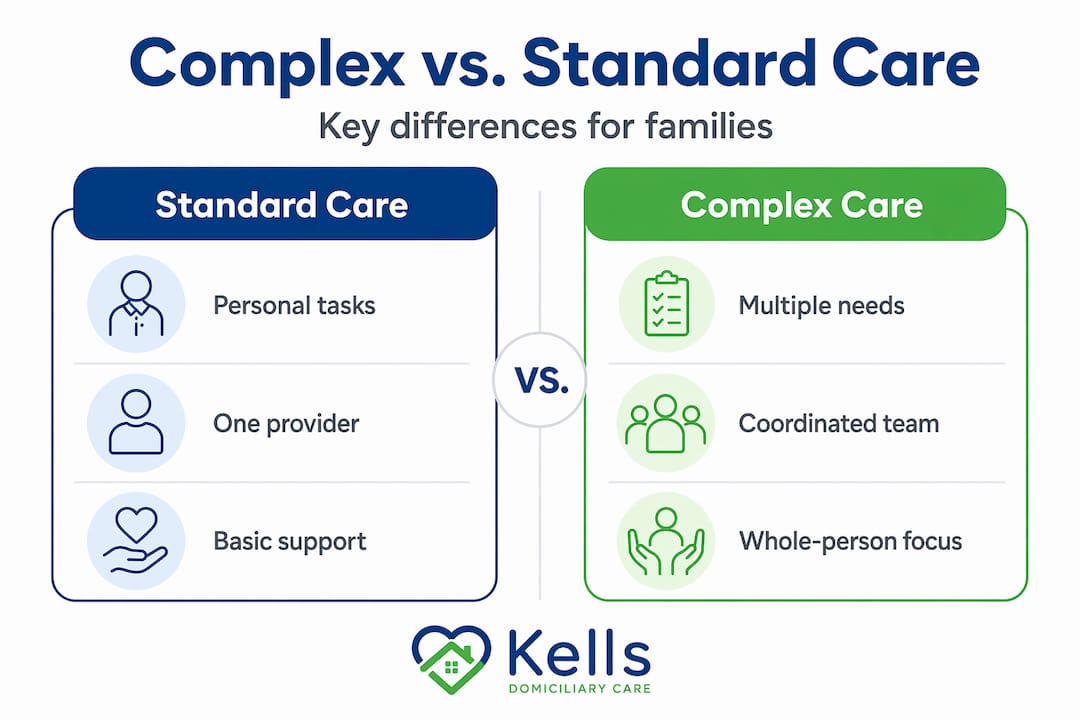
This is what separates complex care from general or domiciliary care. Standard home care might involve help with washing, dressing, or meal preparation. Complex care layers medical interventions, clinical monitoring, and coordinated support from several different professionals on top of that personal care.
The table below shows the key differences:
| Standard domiciliary care | Complex care |
|---|---|
| Single set of personal care needs | Multiple, interacting health and social needs |
| One or two carers involved | Interdisciplinary team across several services |
| Stable, predictable routines | Needs may change frequently and require review |
| Limited or no medical interventions | Ongoing clinical involvement and monitoring |
| Short-term or ongoing personal support | Can last weeks to lifelong depending on condition |
The whole-person approach is what makes complex care distinct. It considers physical health, mental wellbeing, relationships, housing, and social connection as equally important parts of the picture. No single clinician or service can hold all of that together alone.
How complex care management works
Good complex care management does not happen by accident. It requires deliberate structure, clear roles, and proactive communication. The Royal College of General Practitioners emphasises that managing multimorbidity requires a shift from reactive appointments to proactive, coordinated team-based care, with GPs playing a central role in promoting continuity and patient autonomy.
In practice, this means an interdisciplinary team that typically includes:
- A GP or lead clinician who oversees medical needs and coordinates with specialists
- A care coordinator or case manager who acts as the central point of contact
- Specialist nurses who manage clinical interventions such as wound care or medication
- Therapists, including physiotherapists, occupational therapists, or speech and language therapists
- Social workers who address housing, finances, and community support
- Personal carers who provide hands-on daily support at home or in a residential setting
The care coordinator role is particularly important. Dedicated case managers coordinating across hospitals, GPs, and social services are what prevent individuals from falling through the cracks between services.
Care transitions are a high-risk period. When someone is discharged from hospital, effective complex care programmes target a GP appointment within seven days and a specialist appointment within fourteen days to reduce the risk of readmission. The first 30 to 90 days after discharge are critical, requiring intensive engagement, clinical assessment, and careful care planning.

Pro Tip: Ask the hospital discharge team before your loved one leaves: who will contact the GP, when is the first follow-up appointment, and who do you call if something goes wrong in the first week? Getting these answers in writing prevents dangerous gaps.
The goal of well-managed complex care is not just to keep someone medically stable. It is to reduce the overall burden of treatment, support rehabilitation where possible, and preserve the person’s sense of control over their own life.
Challenges families face when accessing complex care
Understanding what complex care is and actually getting it organised are two very different things. Most families encounter significant difficulties when trying to arrange support for a loved one with complex needs.
The most persistent problem is fragmentation. Healthcare, social services, and community support often operate in separate systems with poor communication between them. Cross-sector coordination through approaches like regional case conferencing can help bridge these gaps, but families should not assume this is happening automatically.
Common challenges include:
- Unclear responsibility: no single person owns the overall care plan
- Poor communication between hospital, GP, and social services teams
- Long waiting times for assessment or specialist referral
- Inconsistent information given to families by different professionals
- Difficulty understanding what funding or support the person is entitled to
- Sudden changes in care needs that the existing plan does not cover
One of the most important insights for families comes from research into care management: families should not assume coordination is happening. They need to actively ask who manages communication between specialists and what the formal care plan looks like. The role of social workers in care is often underused, yet they can be powerful advocates for accessing the right services and funding streams.
Pro Tip: In your first meeting with any care professional, ask these three questions: Who is the named lead for coordinating my loved one’s care? Where is the written care plan and how do we access it? What happens when needs change or something goes wrong outside of office hours?
Knowing what to ask is half the battle. You are not expected to understand every part of the system, but you are entitled to clear answers.
Types of complex care services
Complex care services can be delivered across a range of settings, and the right option depends on the individual’s specific needs, preferences, and level of support required.
| Care setting | What it involves | Best suited to |
|---|---|---|
| Home-based complex care | Clinical and personal support delivered in the person’s own home | Those who can safely remain at home with adequate support |
| Residential care | 24-hour support in a care home setting | People who need constant supervision or whose home is unsuitable |
| Specialist nursing facilities | High-level medical and nursing care for complex clinical needs | Individuals with advanced or highly technical care requirements |
| Respite care | Short-term complex care to give family carers a break | Families providing ongoing care at home |
Home-based complex care is often the preferred option for families because it allows the individual to remain in a familiar environment. Long-term complex care needs often require a combination of personal care and ongoing medical intervention, and these can frequently be arranged at home by a skilled care team.
Personalised care plans are central to all of these options. A good plan covers:
- Daily personal care routines and any clinical tasks involved
- Medication management and monitoring schedules
- Therapy input and rehabilitation goals
- Social activities and community connection
- Emergency procedures and out-of-hours contacts
- Review dates and how changes will be communicated to the family
Funding for complex care can come from several sources, including NHS Continuing Healthcare, local authority funding following a needs assessment, or private arrangements. Eligibility depends on the nature and severity of needs. Exploring personalised home care options early helps families understand what is realistic and what questions to raise with their GP or social worker.
Kells-care provides dementia personal care and a range of home-based complex care support for families across London, tailored to each individual’s needs and delivered by fully qualified, DBS-checked carers.
Why the whole-person approach matters
Medical stability alone is not the goal of good complex care. The importance of complex care lies in how it addresses the full context of a person’s life.
Research consistently shows that social determinants such as housing instability, food insecurity, and unresolved trauma are major drivers of poor health outcomes and high healthcare costs. A person discharged from hospital into unsuitable housing, without adequate nutrition or social contact, will almost certainly deteriorate regardless of the quality of their clinical care.
Whole-person care addresses this directly. Integrated teams that include behavioural health support and social work alongside nursing and therapy produce meaningfully better results. They reduce crisis-driven service use, improve the person’s experience of care, and support genuine independence rather than just symptom management.
Empathy and cultural sensitivity matter too. Care that does not reflect a person’s values, background, or preferences will not be followed consistently, however clinically excellent it might be. The best complex care approach starts with understanding what matters most to the individual, not just what is wrong with them.
“Whole-person care means understanding that a person’s health is shaped by everything around them, not just their diagnosis. Housing, relationships, purpose, and daily routine are all part of the picture.”
This perspective shapes how Kells-care approaches every care arrangement. The focus is always on quality of life, dignity, and what the person themselves wants from their care.
My perspective on navigating complex care
I have spent years working alongside families who are trying to make sense of complex care for a parent, partner, or sibling. The thing that strikes me most is how often people assume the system will take care of coordination. It rarely does, at least not reliably.
The uncomfortable truth is that care fragmentation is the norm, not the exception. Hospitals, GPs, and social services genuinely want to help, but they operate in separate structures with different pressures and priorities. Without someone actively joining the dots, things fall through.
What I have seen work is families who ask direct questions, get answers in writing, and involve themselves in the care plan review process. It is not about being difficult. It is about being present. The families who actively shape their loved one’s care get better outcomes, full stop.
Maintaining the person’s dignity and autonomy throughout this process is non-negotiable. Even when someone needs a great deal of support, their preferences and choices still matter. A good care plan reflects what the person values, not just what professionals think is best for them. Ask questions. Push for clarity. You are your loved one’s strongest advocate.
— Dan
How Kells-care can support your family
If you are trying to arrange complex care for an elderly or disabled loved one in London, Kells-care is here to help. For over 30 years, Kells-care has been providing high-quality, person-centred home care tailored to the specific needs of each client. Whether your loved one requires regular check-in visits, specialist personal care, or more intensive round-the-clock support, the team at Kells-care works with you to build a plan that genuinely fits.
Start by downloading the free home care guide for practical information on care options, funding, and what to expect. You can also explore the full range of elderly home care services available across London. Contact Kells-care today for a friendly, no-pressure conversation about your family’s situation.
FAQ
What is complex care in simple terms?
Complex care is support for people with multiple or severe health and social needs that cannot be met by one service alone. It combines medical, personal, and social support delivered by an interdisciplinary team.
Who needs complex care?
People living with conditions such as acquired brain injury, advanced dementia, multiple sclerosis, or significant physical disability often need complex care. It applies when needs are multiple, ongoing, and require coordination across different services.
What is the difference between complex care and standard home care?
Standard home care covers personal tasks like washing and meal preparation. Complex care adds clinical interventions, specialist input, and coordinated support from multiple professionals, often over a longer or indefinite period.
How is complex care managed at home?
Home-based complex care is managed through a personalised care plan that includes clinical monitoring, personal care, therapy input, and a named coordinator who liaises between all services involved in the person’s care.
What should families ask when arranging complex care?
Ask who is the named care coordinator, where the written care plan is held, and what the process is when needs change. Formal care plan targets with clear timings and responsibilities significantly reduce care gaps.