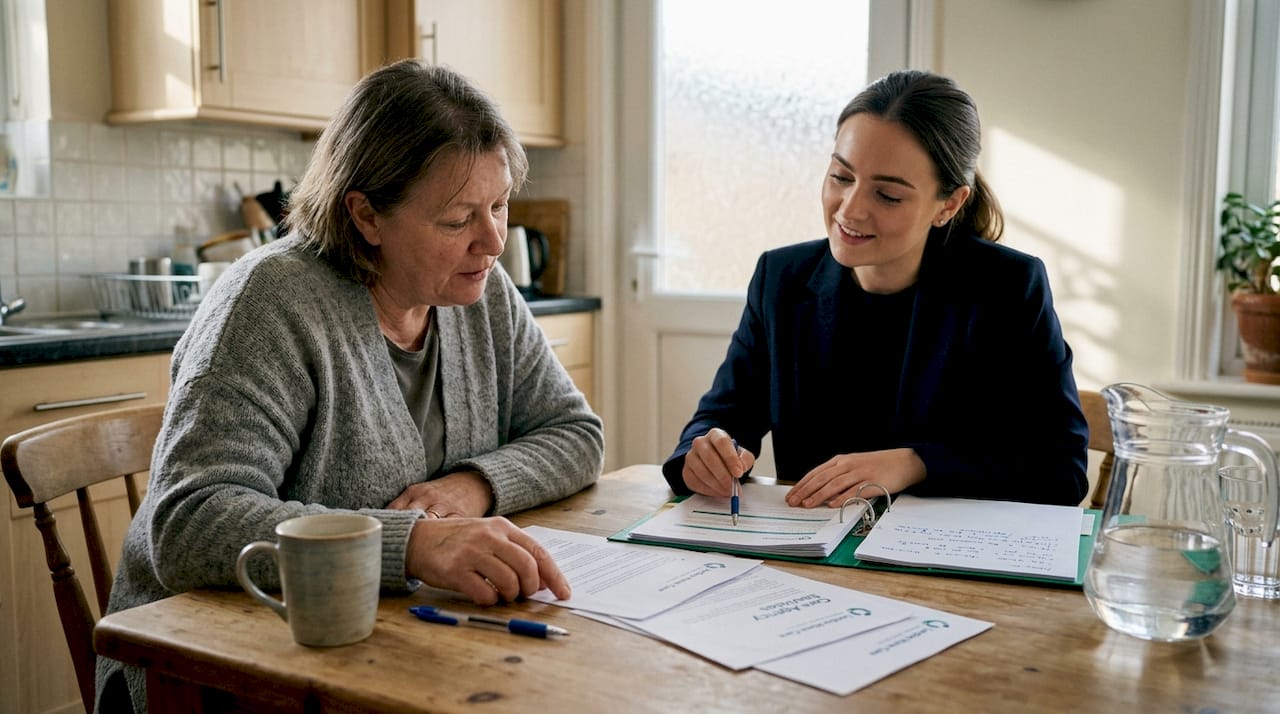
Most London families pay somewhere between £1,100 and £1,900 a week for dementia care, depending on whether that’s homecare visits, live-in support or a residential place. The quickest way to find out what you’ll actually pay is to ask your local council for a needs assessment and a financial assessment this week, as these two steps decide whether the council, the NHS or you will cover the bill.
TL;DR:
- London dementia care costs typically range from £1,100 to £1,900 weekly, with higher prices for specialized housing and nursing support.
- Care costs vary significantly by setting, with homecare starting around £28-£38 per hour, and residential or nursing care reaching up to £1,900 weekly.
- Funding options include local authority assessments, NHS Continuing Healthcare, benefits claims, and deferred payment schemes, which can reduce out-of-pocket expenses.
- Only costs for nursing care are partly covered by NHS-funded nursing care, while other care types are subject to means testing and personal contributions.
- Key factors influencing costs include staffing ratios, dementia-specific training, room features, and the provider’s CQC rating, not just the headline price.
Table of Contents
- At a glance: London and UK dementia care costs
- Cost breakdown by care setting: what you’re actually paying for
- Who pays: the funding routes you need to check
- Capital thresholds, tariff contributions and deferred payment agreements
- Budgeting for care: practical ways to reduce the cost
- Choosing care in London: what to ask and what to watch for
- What London families tell us about real-world dementia care costs
- What to prioritise if you’re deciding this week
- How Kells Domiciliary Care supports London families through this
- FAQ
- Sources
At a glance: London and UK dementia care costs
Dementia care costs more in London than almost anywhere else in England. Staff wages, property costs and demand all run higher here, and specialist dementia units add a further premium on top of standard residential fees.
Here’s what families are typically looking at across the main care types:
- Homecare (hourly visits): often £28 to £38 an hour in London, more at weekends or for complex dementia needs.
- Live-in care: commonly £1,400 to £1,700 a week, covered in more depth on Kells’ dementia live-in care page.
- Residential dementia care: frequently £1,100 to £1,600 a week for a specialist dementia unit place.
- Nursing dementia care: usually £1,300 to £1,900 a week, reflecting the extra clinical staffing.
The Homecare Association recommends a minimum sustainable hourly rate of £34.42 for 2026/27, which means quotes below that figure are worth questioning rather than celebrating. Features that push fees higher include a single en-suite room, a dedicated dementia unit with secure outdoor space, and round-the-clock nursing cover rather than daytime-only staffing.
Cost breakdown by care setting: what you’re actually paying for
Comparing care settings only works once you know what sits inside each price. The headline weekly figure hides very different staffing ratios, qualifications and extras.
- Visiting homecare: you pay per visit or per hour, with holiday and sickness cover usually built into the agency’s rate rather than charged separately. London agencies often add a modest uplift for travel time and weekend working, and you can see how this plays out for a related condition on Kells’ Parkinson’s care cost page, where the same pricing logic applies.
- Live-in care: priced weekly rather than hourly, covering a carer living in the home with scheduled breaks and relief cover. London live-in packages for dementia typically sit at £1,400 to £1,700 a week once relief carer costs are included.
- Residential dementia care: the weekly fee usually bundles accommodation, meals, personal care and activities, with specialist dementia units adding higher staff ratios and secure environments.
- Nursing dementia care: applies when a resident needs regular input from a registered nurse, which is why nursing home fees run higher than standard residential care. Part of this gap is offset by NHS-funded nursing care, a fixed contribution the NHS pays towards the nursing element for eligible residents, separate from full Continuing Healthcare funding.
Knowing which of these you’re comparing matters more than the headline number, since a £1,300 nursing home fee and a £1,300 residential fee are not buying the same thing.
Who pays: the funding routes you need to check
Before you commit to any provider, work through these funding checks in order, because each one can significantly change what you owe.
- Request a needs assessment from your local council. This establishes what type and amount of care your relative needs, and it’s free regardless of income.
- Ask for a financial assessment (means test) alongside it. The council uses this to decide how much, if anything, it will contribute towards non-nursing care costs.
- Ask the NHS to assess for Continuing Healthcare (CHC). CHC eligibility depends on the complexity and severity of health needs, not on a dementia diagnosis alone, so it’s worth requesting a checklist assessment even if you expect to be turned down.
- If a nursing home place is needed, ask whether NHS-funded nursing care applies. This covers the nursing element specifically, not the whole placement.
- Check benefit entitlements. Attendance Allowance, Pension Credit and Carer’s Allowance are not means-tested against savings in the same way as council care funding, and claiming them can ease the financial pressure while assessments are under way.
Each of these sits on gov.uk or nhs.uk, and printing the relevant pages before you call the council saves a lot of back-and-forth on the phone.
Capital thresholds, tariff contributions and deferred payment agreements
The money rules sound complicated, but three figures do most of the work. For the 2026/27 financial year, if your capital exceeds £23,250 you pay the full cost of your care, and between £14,250 and £23,250 you pay a tariff contribution of £1 a week for every £250 of capital in that band.
- Below £14,250, capital is ignored and the council assesses only income.
- A 12-week property disregard usually applies when someone first moves into residential care, so the family home isn’t counted as capital during that window.
- A Deferred Payment Agreement (DPA) lets you delay selling the home to pay care fees. However, interest and administration charges apply, and independent financial advice is recommended before signing one.
- Top-up fees, paid by a relative to secure a pricier room or home, carry a real risk: if the paying relative stops contributing, the placement can become unstable.
Pro Tip: Ask the council in writing exactly which disregards apply to your relative’s case before the 12-week window starts, so nothing gets missed in the financial assessment.
Budgeting for care: practical ways to reduce the cost
A handful of administrative steps can meaningfully reduce what a family pays out of pocket, and they’re worth doing in parallel with the needs assessment rather than afterwards.
- Apply for Attendance Allowance as soon as dementia symptoms affect daily living, since it isn’t means-tested.
- Check Carer’s Allowance eligibility if you provide at least 35 hours of care a week.
- Claim Pension Credit if your relative’s income is low, as this can unlock other discounts too.
- Document disability-related spending before the financial assessment, since councils can otherwise count disability benefits as income without allowing for the costs they’re meant to cover.
- Consider a DPA or third-party top-up only after getting independent financial advice, as both come with ongoing costs and risks to continuity if arrangements change.
Deliberately giving away savings or property to avoid care fees, known as deliberate deprivation of assets, is treated seriously by councils and can be reversed in the assessment, so it’s not a shortcut worth taking.
Pro Tip: Keep a simple folder of bank statements, benefit letters and medical evidence from the start. It’s the single biggest time-saver when the financial assessment begins.
Choosing care in London: what to ask and what to watch for
Price alone tells you very little about whether a service will suit someone living with dementia day to day. A short list of direct questions does more good than comparing headline fees.
- Ask about staff-to-resident ratios and whether staff receive dementia-specific training, not just general care training.
- Ask how the provider handles continuity of staff, since familiar faces matter enormously for someone with dementia.
- Ask what happens in an emergency outside office hours, and who is contactable.
- Check the provider’s CQC rating and most recent inspection report, which is published and free to view.
- Treat frequent or unexplained top-up fee changes as a warning sign, along with any fee schedule that isn’t clearly written down.
A premium that pays for better staffing ratios or specialist dementia training is usually worth it. A premium that pays mainly for décor or “hotel-style” extras rarely improves day-to-day care, so it’s worth asking providers to separate the two when they quote a price.
What London families tell us about real-world dementia care costs
Families typically ask about live-in care in the typical £1,400 to £1,700 a week range, or hourly visiting care, which tends to track close to the Homecare Association’s recommended minimum once weekend and dementia-specific staffing are factored in.
Continuity of carer matters more to families than almost anything else once dementia has progressed, because a familiar face reduces distress far more reliably than a change of surroundings ever does.
CQC-regulated agencies with DBS-checked staff typically manage holiday cover and staff rotas centrally, which helps families avoid the gaps in continuity that often come with informal or one-off care arrangements. Some families have used such stability to bridge the period between a council financial assessment and a confirmed funding decision, maintaining the same carer throughout.
What to prioritise if you’re deciding this week
Start with the needs assessment and a benefits check this week, not after you’ve chosen a provider. Gather bank statements and medical letters now, because London care providers often have waiting lists and slow responses cost you choice later. Whatever you decide, involve the person living with dementia in the conversation as far as they’re able, and keep a second family member informed of every financial decision made on their behalf.
— Dan
How Kells Domiciliary Care supports London families through this
Some home care providers in London have over 30 years of experience, employ fully qualified, DBS-checked carers, and are regulated by the CQC. For families working through council assessments or weighing options, this regulatory track record and local experience can offer benefits such as continuity, because the same small team of carers stays with the relative rather than rotating strangers through the door.
- Some providers help families prepare for needs and financial assessments by explaining what the council will ask.
- Some liaise directly with councils and case workers where a care package needs coordinating alongside local authority funding.
- Flexible hours may be offered, from short check-in visits to full live-in care, so costs scale with need rather than a fixed package.
If you’d like a clearer picture of what dementia care looks like for your family, our home care services page sets out hourly and contracted options, or you can request our free home care guide for a step-by-step planning resource.
This article is general information, not a substitute for advice from a qualified doctor. Consult a qualified healthcare professional about your own circumstances before acting on anything here.

FAQ
How much does dementia cost in the UK per year?
Costs vary widely by care type and region, so there’s no single UK-wide annual figure that applies to every family. In London, weekly residential dementia care fees of £1,100 to £1,600 translate to a rough annual range, though your own cost depends on the council’s financial assessment and any NHS funding you receive.
Is there an 86,000 cap on care home fees?
A lifetime cap on personal care costs was legislated for but has not been implemented, and for the 2026/27 financial year the existing capital thresholds of £23,250 and £14,250 still apply instead. Families should plan around the current means-testing rules rather than a cap that hasn’t come into force.
Do dementia patients pay for care in the UK?
Most people with dementia do pay towards their care, since a dementia diagnosis alone doesn’t qualify someone for free NHS-funded support. Eligibility for NHS Continuing Healthcare depends on the complexity of clinical needs, assessed case by case, so some people qualify for full funding while most contribute according to the local authority means test.
What happens if I can no longer afford my care home fees?
Tell the local authority and the care home as soon as affordability becomes a concern, rather than waiting until fees go unpaid. A Deferred Payment Agreement can delay the need to sell a property, and the council has a duty to reassess need if circumstances change, so an early conversation protects more options than a late one.
Sources
- Social care charging for care and support 2026 to 2027: local authority circular
- Homecare Association research and reports
- NHS‑funded nursing care
- Will I have to sell my home to pay for my care home costs? (Norfolk County Council / Age UK guidance referenced)