

Yes. CQC guidance means providers must make every reasonable effort to respect your preference for a male or female carer during intimate or personal care. The Equality Act 2010 allows lawful exceptions, and genuine emergencies or staff shortages can sometimes limit what’s possible on a given day. Your practical next step is simple: put the preference in writing on the support plan and ask your provider for a copy of their carer gender policy.
TL;DR:
- A recorded preference for male or female carers must be incorporated into the support plan during assessment, with acceptable alternates and review dates.
- Genuine emergencies, staffing shortages, or sick leave can limit respecting carer gender preferences, even with lawful justification under the Equality Act 2010.
- Providers must communicate preferences clearly to all staff, including relief and agency carers, to ensure consistent and respectful delivery.
- For trans and non-binary clients, easy-to-update records of pronouns and chosen names support truly inclusive personal care.
- Repeated or systemic failure to honor documented gender preferences should be formally challenged and may constitute a service failure.
Table of Contents
- What CQC, the Equality Act and the Care Act say about carer gender preference
- How to request and record a preferred carer gender in a support plan
- Respectful and inclusive practice for trans and non-binary people
- When a preferred-gender carer isn’t available: reasonable limits and contingency planning
- If your preference is not respected: complaints and legal options
- How Kells Domiciliary Care puts these principles into practice
- The gap between the rulebook and the rota
- Get help putting your preference into practice
- Sources
What CQC, the Equality Act and the Care Act say about carer gender preference
Three pieces of legislation and guidance work together here, and it helps to know which one does what.
Regulation 10 of the Health and Social Care Act, covering Dignity and Respect, requires every CQC registered provider to treat people with dignity and to make reasonable efforts to respect their preferences, including who provides intimate or personal care. It sits alongside Regulation 9 on personalised care, which obliges providers to plan support around the individual rather than fitting people into a standard rota. Together these two regulations are the backbone of any gender preference request in England.
The Equality Act 2010 doesn’t ban providers from accommodating gender preference. Its explanatory notes set out when single-sex service provision is lawful, provided there’s an objective justification, such as privacy or decency during washing and dressing. That justification test matters: a provider can’t refuse a reasonable request, but nor is a guarantee automatic in every circumstance.
Where someone lacks the mental capacity to state or confirm a preference, the Care Act 2014 and Mental Capacity Act framework take over. Providers should run a documented best-interests process involving family and professionals, drawing on any known history of the person’s wishes.
- Regulation 10: dignity and respect for stated preferences
- Regulation 9: personalised, individual care planning
- Equality Act 2010: lawful single-sex exceptions with objective justification
- Care Act 2014 / Mental Capacity Act: best-interests decisions where capacity is lacking
How to request and record a preferred carer gender in a support plan
Getting this right starts at assessment stage, not after care has begun. Say it plainly and early: “I would like female carers only for personal care” or “My father prefers a male carer for washing and dressing.” You never need to justify the reason. What matters is that it’s recorded formally so the provider can plan staffing around it rather than treating it as a passing comment.
- State your preference clearly during the pre-assessment visit and ask for it to be written into the support plan word for word.
- Ask to see the provider’s written choice of carer gender policy, including what happens when that gender isn’t available.
- Agree acceptable alternates in advance, such as a second carer you’d accept if the first choice is off sick.
- Set a review date, ideally every three to six months, so the plan doesn’t gather dust while circumstances change.
Good personalised support planning also covers chaperone preferences for shared tasks and what to do if a visit falls outside normal hours.
Pro Tip: Ask the provider how they record and communicate preferences to bank and agency staff, not just permanent carers. A preference noted only on a paper file in the office does nothing for the relief carer covering a Sunday shift.
Respectful and inclusive practice for trans and non-binary people
Gender preference isn’t only about male or female. For trans and non-binary clients, dignity starts with asking how someone wishes to be addressed and recording their name and pronouns accurately in the care record. CQC’s guidance on relationships and sexuality expects providers to treat gender identity as part of personalised care planning, not as a special case bolted on afterwards.
- Ask directly rather than assuming, and update records if a person’s needs or identity change over time.
- Avoid blanket rules; each request deserves individual, person-centred assessment.
- Keep gender identity details confidential, shared with staff strictly on a need-to-know basis.
The British Medical Association’s guidance on inclusive care reinforces the same principle used across health and social care: individualised treatment beats assumptions every time.
When a preferred-gender carer isn’t available: reasonable limits and contingency planning
“Every reasonable effort” doesn’t mean an absolute guarantee. Courts have looked at whether providers owe an unqualified duty to deliver same-sex intimate care and found that existing statutory duties govern the outcome rather than some new combined right. In practice, that means genuine emergencies, sickness cover, or a thin rota can sometimes force a compromise.
- Ask what contingency measures apply: delaying non-urgent personal care, using a chaperone, or calling the nearest available trained carer in an emergency.
- Record your accepted alternates and any emergency contact instructions in the support plan itself.
- If shortages become a pattern rather than a one off, ask for rota transparency and a formal review, not just repeated apologies.
Pro Tip: If chronic staffing gaps mean your preference is routinely missed, that’s a service failure worth raising formally, not something to accept as normal. Providers who supply temporary staff to care homes understand this balancing act particularly well, since they manage exactly this tension between safety and preference at scale.
If your preference is not respected: complaints and legal options
Don’t let a missed preference go unrecorded. Escalation works best when you follow it in order.
- Raise it first with the care manager or coordinator directly, in writing where possible, noting dates and what was agreed.
- Keep a simple log: which visits didn’t match your recorded preference, and what reason (if any) was given.
- If the provider doesn’t resolve it within a reasonable timescale, contact your local authority commissioning team if the care is publicly funded, or report the concern to CQC directly.
- For systematic or repeated refusal, especially where it looks like discrimination rather than a genuine staffing constraint, seek advice from a solicitor specialising in community care law or a patient advocacy service.
Groups supporting self-advocacy against bias in care settings offer useful scripts for these conversations, particularly when you feel your concerns are being brushed aside. CQC won’t resolve individual disputes directly, but a pattern of complaints against one provider does inform its inspection ratings.
How Kells Domiciliary Care puts these principles into practice
Kells Domiciliary Care has supplied home care across London for more than 30 years, and gender preference sits inside every assessment we carry out, not as an afterthought. All our carers are fully qualified and DBS checked, and we’re regulated by CQC, so Regulation 10 duties are built into how we plan rotas from day one.
We record preferred carer gender, acceptable alternates, and chaperone requirements directly in each client’s support plan, then build staffing around it wherever the rota allows. When genuine shortages arise, families are told honestly rather than left guessing, and contingency options are agreed in advance so nobody’s caught off guard mid visit.

The gap between the rulebook and the rota
Most guidance on carer gender preference stops at quoting Regulation 10 and calling it done. That’s the easy part. The harder truth is that dignity and staffing arithmetic sometimes pull in different directions, and no regulation forces a small rota to conjure a same-sex carer out of thin air at 7am on a bank holiday.
What the research actually supports is a shift in emphasis: the paperwork matters less than the conversation that produces it. A preference scribbled once at assessment and never revisited is close to worthless. A preference discussed, written down with acceptable alternates, and reviewed every few months is something a provider can genuinely deliver on.
Where conventional advice falls short is treating this as a one-off legal tick-box. It isn’t. It’s an ongoing operational commitment that depends on rota transparency and honest communication when things go wrong. If you take one thing from this guide, make it this: ask your provider not just “will you respect my preference” but “show me how you record and communicate it to every carer who might visit me.” That question separates providers who mean it from those who merely say it.
— Dan
Get help putting your preference into practice
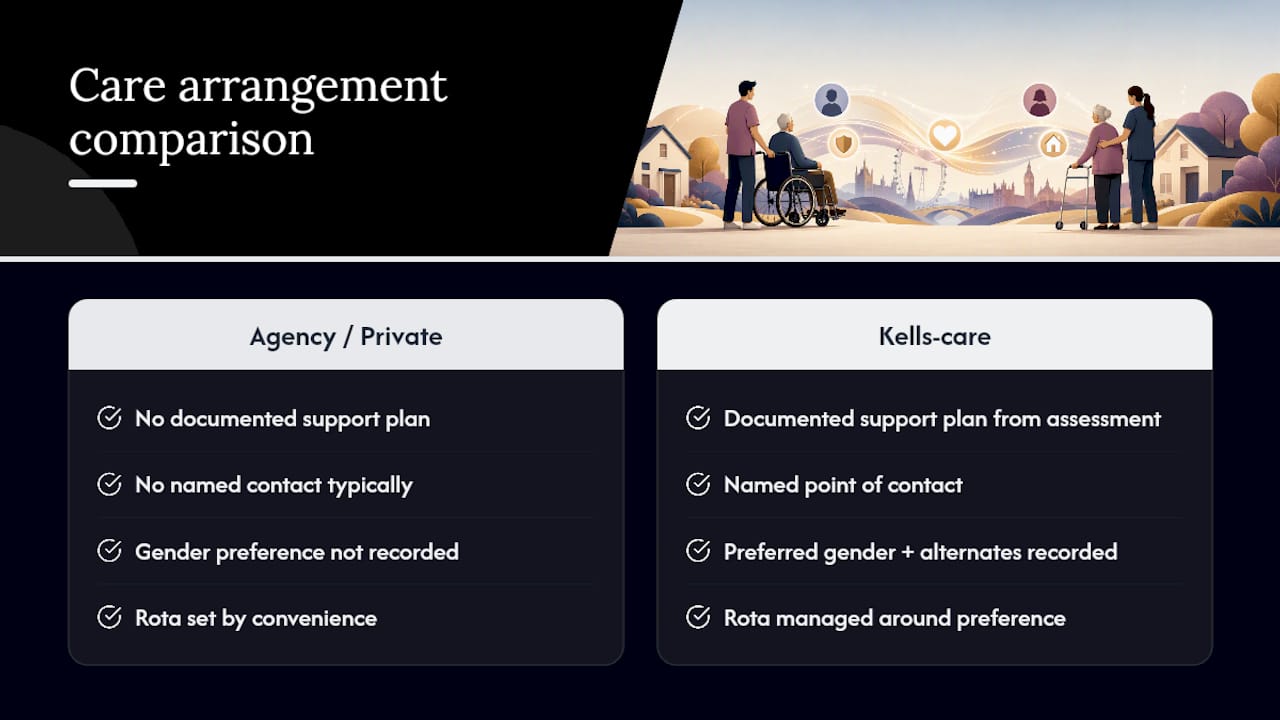
There are other ways to arrange care in London, from agency-only staffing to informal private arrangements, but neither typically gives you a documented, reviewable support plan with a named point of contact. Kells-care is the alternative that puts your gender preference in writing from the first assessment, then manages the rota around it rather than around convenience.
Our personal care and services cover intimate and personal care visits, live-in care, and respite support, all built around a support plan that records your preferred carer gender, acceptable alternates, and review dates from the outset. If you’d like to see how this works before committing to anything, download our free Home Care Guide or call us to arrange a no-obligation assessment. It’s the simplest way to find out exactly what a properly documented plan looks like for your family.
This article is general information, not a substitute for advice from a qualified lawyer. Consult a qualified legal professional about your own circumstances before acting on anything here.
Sources
- Regulation 10: Dignity and respect | Care Quality Commission
- Equality Act 2010 explanatory notes (relevant paragraphs on single-sex services)
- If a woman does not want male carers, is this covered by the Act? | QCS


