

Reliable care start times mean your carer arrives within an agreed, realistic window, tells you early if that will not happen, and has a back-up plan so you stay safe. Most agencies agree a time band rather than an exact minute, so the useful questions are how wide the band is, who tells you about delays, and what happens when a visit is missed. This guide explains what you can reasonably expect in England, what the official guidance says, and what to do when visits keep running late.
TL;DR
- A home care visit is usually booked within a time band, not at an exact minute. Ask for the band in writing.
- NICE says missed or late visits can seriously affect health and wellbeing, so every care plan needs a back-up plan.
- Carers should contact you if they will be late or cannot come. You should not be left to chase.
- If a carer is 30 minutes late and nobody has called, phone the agency. If it keeps happening, ask for a review of the rota.
- You can raise unresolved concerns with the agency, your local council and the Care Quality Commission (CQC).
Table of Contents
- Why start times matter more than they seem
- What a time band is, and what is a reasonable tolerance
- What causes late or missed visits
- What good practice looks like
- Questions to ask before you sign an agreement
- What to do when visits are late or missed
- Our perspective
- How Kells can help
- FAQ
- Sources
Why start times matter more than they seem
A visit that starts at the wrong time can change the whole day. Breakfast, medication, getting out of bed, a trip to the toilet and a hot meal all depend on someone arriving roughly when they are expected.
NICE states that missed home care visits can have serious implications for an older person’s health and wellbeing, and that late visits are a problem if the person’s needs cannot be met. It also notes that an older person may not be able to alert anyone when a visit is missed or late.
There is an emotional side too. NICE’s communication guidance explains that late or missed visits can cause distress and break trust in the service. People who live alone or who lack capacity are particularly affected by changes to their usual visit.
What families tell us and what researchers found
Healthwatch’s Support at Home report found that evening calls can vary from 6pm to 11.45pm. People said this was not what they want, and some said they simply sit and wait. Family carers described cancelling appointments, social activities and shopping because the agency was unreliable, and having to phone for extra support themselves.
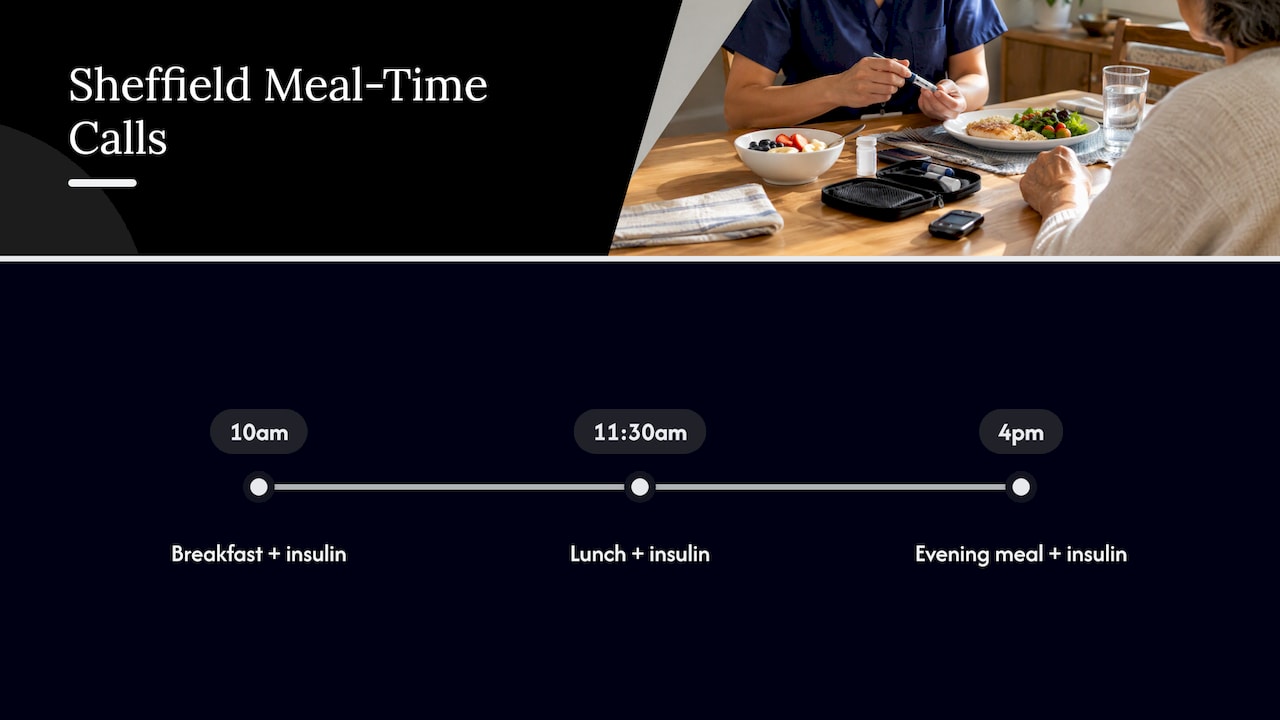
The Sheffield Home Care Report from Healthwatch gave a clear health example. One person with diabetes who injects insulin at meal times described carers arriving at 10am for breakfast, 11:30am for lunch and 4pm for the evening meal, which made managing the condition hard. Family carers in the same report worried about people being put to bed too early and helped up too late the next day.
What a time band is, and what is a reasonable tolerance
No agency can promise to arrive at exactly 8:00am every day. Traffic, a previous visit that needed more time, or an emergency can all shift the day. That is why visits are normally booked in a band.
Bolton Council’s home care guide gives a clear example. It explains that a visit will happen between two set times, not at a specific time, and that the council has agreed a contract tolerance of 30 minutes between the planned and actual start time. Its bands are:
| Visit | Early band | Late band |
|---|---|---|
| Breakfast | 7:00am to 8:30am | 8:31am to 10:30am |
| Lunch | 11:00am to 12:30pm | 12:31pm to 2:00pm |
| Tea | 3:00pm to 4:30pm | 4:31pm to 6:00pm |
| Bed | 6:01pm to 8:00pm | 8:01pm to 11:00pm |
That is one council’s contract from 2019, so treat it as an illustration, not a national rule. Other councils and private arrangements set their own terms. The useful lesson is that a good band is tied to the person’s needs. A band that is a few hours wide can be fine for a companionship visit and unsafe for a visit linked to medication or food.
Derbyshire County Council’s procedure for its own services shows how tolerances can be defined formally. It treats a call as late or early when it falls more than 60 minutes outside the person’s scheduled call tolerance. For a missed call, the registered manager must decide whether a safeguarding referral or CQC notification is needed.
Visits that need a tighter window
Some visits are time-critical. Ask for a narrower band, and have it written into the care plan, if the visit involves:
- medication that must be taken at set times or with food
- insulin or other diabetes management
- help to get to the toilet, where a long wait causes distress or risk
- a person with dementia who becomes anxious when a routine slips
- a person who cannot use a phone or call for help
Our guide to how to schedule daily care visits explains how to match visit times to the person’s day. If you are unsure how long each visit should be, see our article on care visit length.
What causes late or missed visits
Most delays are not carelessness by individual carers. They come from how the rota is built and monitored.
CQC inspection findings show the pattern:
- Rotas without travel time or breaks. At a Rochester agency, CQC found leaders had not planned rosters to allow travel time and breaks, causing significant delays. Some people who asked for visits before 10am were still waiting at 1 or 2pm.
- No system to spot lateness. In Colchester, CQC found no robust system to monitor care visits, so the agency could not tell when visits were late or missed. People were seen within a window, and in one example breakfast, lunch and bedtime visits took place within five hours.
- Unfamiliar or inconsistent staff. In Shropshire, CQC found staff consistently late or missing visits, and that leaders failed to make sure people had care from consistent members of staff.
- Poor communication. In Leicestershire, people and relatives felt anxious because staff were sometimes early or late, and in some cases left early or missed calls entirely.
The Homecare Association’s analysis of 1,052 inspection reports from July 2024 to August 2025 points to the same root. For services rated Inadequate, the most serious failing was governance, which for people receiving care translates to missed calls, unfamiliar workers and communication breakdowns. Of those reports, 758 services were rated Good and 29 Outstanding, so reliable care is common. It also shows what to look for: planning, monitoring and honest communication.
What good practice looks like
NICE guideline NG21 sets out what providers should do. The recommendations include:
- Avoid missed visits and recognise the risk they carry (1.4.10).
- Monitor risks linked to missed or late visits and act promptly, recognising that people living alone or lacking capacity are especially vulnerable (1.4.11).
- Plan for missed visits, for example by arranging for a family member, carer or neighbour to visit, giving carers their contact details, and setting out in the risk assessment what should happen (1.4.12).
- Put contingency plans into action when visits are missed or late (1.4.13).
- Monitor missed and late visits as part of quality assurance and discuss them at contract monitoring meetings (1.4.14).
- Make carers contact the person or their carer if they will be late or unable to visit, and inform their manager (1.4.15).
The NICE quality statement adds that a plan for late or missed visits should cover how and when you will be told, emergency contact details, who can step in, and a risk assessment.
Telling people quickly is the part families notice most. The same principle applies in any service that runs on appointments: clear, prompt notice of changes protects trust. A Spanish-language guide on scheduling errors in health appointments makes the point for medical practices, and it holds for home care too.
Questions to ask before you sign an agreement
A calm conversation before care starts prevents most disputes later. Ask:
- What is the time band for each visit, and can it be narrower for medication or meals?
- Who phones me, and how soon, if a carer is running late?
- What is the plan if a visit is missed, and who can step in?
- Will the same small group of carers visit, so they know the routine?
- How does the agency record arrival and departure times, and can I see them?
- How often is the care plan reviewed?
Write the answers into the care plan. If you can, also give the agency the name and number of a family member, friend or neighbour who can check in during a missed visit, as NICE suggests.
To make the first visit smoother, read about what to expect at a first home care visit and how to prepare your home for carers. Good visit reporting also lets you see what happened, and when.
What to do when visits are late or missed
Step 1: Call the agency
Southwark Council advises people to call the provider’s office if a care worker is 30 minutes late and the provider has not phoned. Bolton’s guide gives the same advice: if nobody arrives within the time band, contact the agency directly.
If the person is alone and at risk, for example because they have missed medication, ask the agency to send someone immediately, and ask a family member or neighbour to check in.
Step 2: Keep a simple log
Note the date, the booked band, the actual arrival time and whether anyone phoned. A few weeks of notes turns a general complaint into something the agency can act on. The UK Home Care Association, cited in NICE’s communication guidance, suggests providers audit missed and late visits and their reasons over at least four weeks and then review their practice. Your log supports that review.
Step 3: Ask for a rota review
Southwark says that if a worker is regularly late, the provider should review rotas and speak with the person or their representative. Ask for this in writing, and ask whether the booked band still suits the person’s needs.
Step 4: Escalate
If the agency does not resolve the problem, use its complaints procedure. If you are funded by the council, tell the person who arranged the care, because councils monitor late and missed visits through their contracts. If you think someone is at risk of neglect, contact the council’s adult safeguarding team. You can also share your experience with CQC, which regulates home care in England. CQC action in recent years shows how seriously it treats the problem. At one Sandwell agency it found that 27% of care calls were not made.
Our perspective
Reliable timing is not a courtesy. It is part of the care itself. When someone has dementia, lives alone, or relies on a visit for medication or a meal, the time a carer arrives shapes how safe and settled the day feels.
At Kells, we have supplied home care in London for over 30 years, and we are regulated by the CQC. Our carers are qualified and DBS checked. We build care around the person, which starts with agreeing what their day needs: when they like to get up, when they eat, when medication is due and when they want company. Whether a family calls it homecare or care at home, reliable visit times remain essential.
We believe the right visit pattern depends on the person. Some people do well with short call-in visits. Others need contracted hours, or live-in care, where the carer is in the home and the question of a visit time largely falls away. Families should be able to choose between these, not be fitted into whatever slot is available.
Our advice is simple. Ask for the time band in writing, ask who will phone you if something changes, and ask what the back-up plan is. These are fair questions, and you should expect clear answers from any agency.
Dan
How Kells can help
We provide call-in visits, live-in care, personal care, companionship, dementia care, medication assistance and respite cover for adults and children across London. Personal care assessments help us understand what each person needs before care begins. If the person needs help at set times of day, tell us at the start so the plan reflects it.
For families weighing up options, our free home care guide explains how home care works. To talk through your situation, contact us through kells-care.com.
FAQ
How late is too late for a home care visit?
There is no single national figure. One council’s contract allows a 30-minute tolerance from the planned start time, and another procedure treats a call as late when it is more than 60 minutes outside the agreed tolerance. Check the band in your own care plan, and phone the agency if a carer is about 30 minutes late with no call.
Can I ask for a fixed visit time?
You can ask. Agencies work in time bands because visits run on a route, but a narrower band can often be agreed for visits linked to medication, insulin or meals. Have whatever is agreed written into the care plan so everyone works to the same expectation.
What should happen if a carer cannot come?
The carer should contact the person or their family and tell their manager, as NICE recommends. The agency should then follow the back-up plan, which may include sending another carer or asking a named family member, friend or neighbour to visit. Ask to see this plan before care starts.
Who can I complain to about repeated late visits?
Start with the agency’s complaints procedure. If that does not work, speak to your local council, especially if it funds or arranged the care, and raise safeguarding concerns with its adult safeguarding team. You can also share your experience with the Care Quality Commission, which regulates home care agencies in England.
Sources
- NICE QS123, Quality statement 2: Plan for missed or late visits
- NICE NG21, Communication tools and resources
- NICE NG21, Recommendations
- Healthwatch, Support at Home report
- Healthwatch Sheffield, Home Care Report January 2019
- Bolton Council, Your Guide to Home Care
- Derbyshire County Council, Home care failed, aborted and missed calls procedure
- Southwark Council, When home care is available
- CQC, Rochester care agency press release
- CQC, Essex home care agency press release
- CQC, Shropshire home care service press release
- CQC, Sandwell home care service press release
- Homecare Association, CQC regulatory performance one year on