TL;DR:
- Care quality standards define whether your loved one is treated with dignity, safety, and attentive listening in home care.
- Understanding these standards helps families make informed decisions by evaluating inspection reports, policies, and caregiver practices.
When a loved one needs home care, the phrase “care quality standards” can feel abstract, even bureaucratic. Yet understanding care quality standards is one of the most practical things you can do as a family member or carer. These standards are not just paperwork filed away in a regulator’s office. They define whether your relative is treated with dignity, kept safe from harm, and genuinely listened to every single day. This guide breaks down what those standards mean, how they are assessed, and how you can use them to make confident, informed decisions about home care.
Table of Contents
- Key takeaways
- Understanding care quality standards in England
- The five questions CQC asks about every service
- How other countries measure home care quality
- How to assess a home care provider in practice
- Quality standards and dementia care
- My perspective: what families often miss
- How Kells-care can support your family
- FAQ
Key takeaways
| Point | Details |
|---|---|
| CQC sets the legal baseline | Fundamental standards are the minimum below which no care provider may legally fall. |
| Five questions frame every inspection | Safe, Effective, Caring, Responsive, and Well-led are the lenses CQC uses to evaluate every service. |
| Ratings alone are not enough | Look beyond an overall rating to examine consent, safeguarding, and complaints policies in practice. |
| International frameworks add perspective | Australia and the US use measurable, outcome-focused standards families can learn from when asking questions. |
| Person-centred care is the goal | For those with dementia or complex needs, how well a provider personalises care matters as much as any rating. |
Understanding care quality standards in England
The Care Quality Commission, or CQC, is the independent regulator of health and social care in England. Every home care provider operating in England must be registered with the CQC, and registration and inspection are how the regulator checks that providers are meeting their obligations.
At the heart of this system are the fundamental standards. The CQC is clear that these are the legal minimum below which care must never fall. Think of them as a floor, not a ceiling. There are 13 in total, and together they cover the full scope of a person’s experience in care.
The standards most relevant to home care services include:
- Person-centred care. Care must be tailored to each individual’s needs, preferences, and circumstances. The CQC requires consent to be obtained before any care or treatment is given.
- Safeguarding from abuse. Providers must protect people from physical, psychological, financial, and other forms of harm.
- Safe care and treatment. Risks must be assessed and managed, and medicines handled correctly.
- Receiving and acting on complaints. Providers must have a clear process for investigating complaints promptly and using them to improve.
- Good governance. Providers must have the systems in place to monitor and improve the quality of care they deliver.
Understanding the CQC’s role also means knowing that inspection reports are publicly available. You can search any registered home care provider on the CQC website and read the findings directly. This is one of the most underused tools families have.
Pro Tip: When reading a CQC inspection report, go straight to the “What the service does well” and “What the service needs to improve” sections. These give you a far more honest picture than the headline rating alone.
The five questions CQC asks about every service
The CQC structures every inspection around five key questions. Each question is designed to assess a different dimension of care quality, and understanding them helps you know exactly what inspectors look for and what you should look for too.
- Safe. Is the person protected from avoidable harm, abuse, or neglect? This includes proper medicines management, infection control, and staff training.
- Effective. Does the care achieve good outcomes? Inspectors assess whether staff follow best practice guidelines and whether people’s needs are properly assessed.
- Caring. Are staff compassionate and respectful? This question is about the quality of human interaction: whether people feel heard, valued, and treated with dignity.
- Responsive. Does the provider adapt to individual needs and preferences? This includes responding to changing needs, handling complaints well, and offering genuine choice.
- Well-led. Is there strong, ethical leadership? Inspectors look at governance systems, staff culture, and whether the provider actively seeks to improve.
The CQC frames quality as something that must be both delivered and managed. A service can have good policies on paper but still fall short if leadership does not embed those values into daily practice.
This distinction matters enormously for families. A carer who arrives on time, follows a care plan, and treats your relative kindly is the visible outcome of a well-led, well-governed service. The five questions help you trace that connection from leadership to lived experience.
How other countries measure home care quality
Looking beyond England gives families a richer vocabulary for evaluating care. Two systems in particular offer useful frameworks.
Australia’s approach
Australia’s aged care system uses seven Quality Standards covering the individual, the organisation, the care environment, clinical care, food and nutrition, and community engagement. These standards are monitored by the Aged Care Quality and Safety Commission and are built around rights-based, measurable outcomes.
The strengthened Quality Standards go further, adding dedicated standards for clinical care, dementia, and nutrition, reviewed every five years. For families, this model is useful because it asks specific questions about clinical support and food, areas that are sometimes overlooked in a purely regulatory context.
The US framework
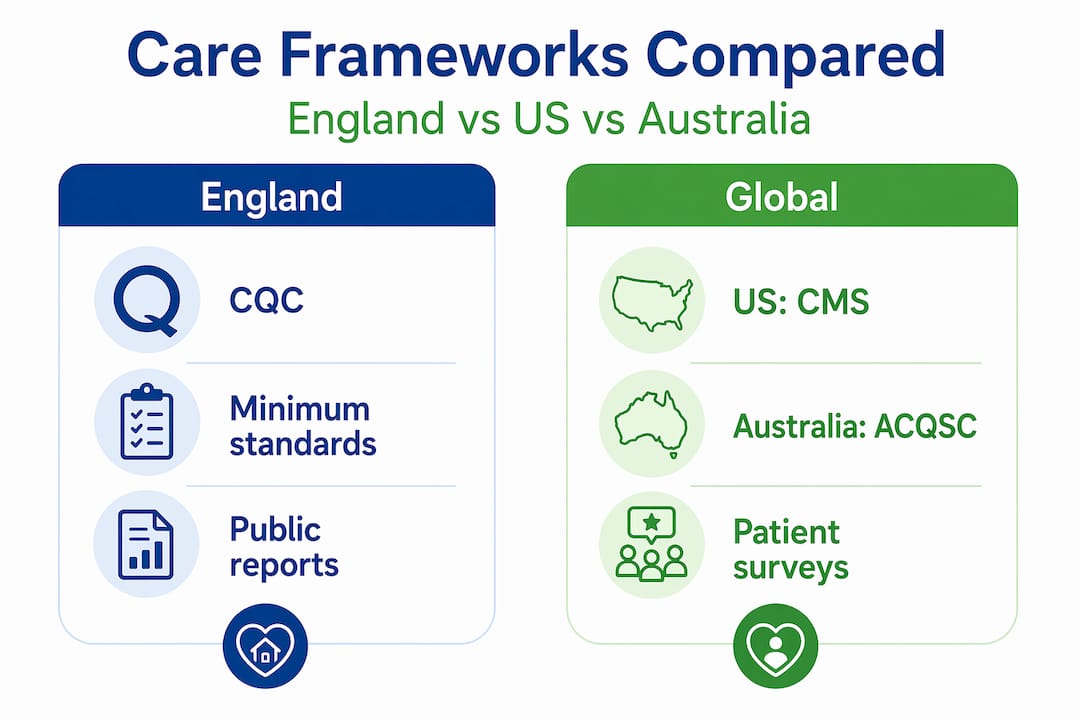
In the United States, Medicare-funded home health agencies are evaluated through star ratings and patient surveys known as HHCAHPS, alongside clinical outcome measures collected via a tool called OASIS. Critically, the CMS publishes separate star ratings for clinical quality and patient experience. A provider can score highly on clinical outcomes but poorly on patient satisfaction, or vice versa.
| Feature | England (CQC) | Australia (ACQSC) | United States (CMS) |
|---|---|---|---|
| Governing body | Care Quality Commission | Aged Care Quality and Safety Commission | Centres for Medicare and Medicaid Services |
| Framework | 13 fundamental standards, 5 key questions | 7 (strengthened) Quality Standards | HHCAHPS surveys, OASIS outcome measures, star ratings |
| Focus | Safety, dignity, governance, person-centred care | Rights, clinical care, nutrition, dementia | Clinical outcomes and patient experience separately scored |
| Public data | Inspection reports and ratings online | Provider compliance reports | Star ratings and survey results published online |
The US insight that clinical outcomes and patient experience are separate measures is genuinely useful. A family member who receives technically correct wound care but feels rushed and unheard has experienced a quality gap that a clinical metric alone would miss.
How to assess a home care provider in practice
Knowing the standards exists is one thing. Using them as a practical filter when choosing or reviewing a provider is another. Here is a clear process you can follow.
- Check CQC registration first. Any home care provider operating in England must be registered. If a provider cannot confirm their CQC registration number, that is a serious concern before anything else.
- Read the full inspection report. The headline rating (Outstanding, Good, Requires Improvement, Inadequate) gives a starting point, but the narrative reveals far more. Look for patterns in complaints, staffing concerns, or repeated recommendations.
- Ask directly about fundamental standards. Request to see the provider’s safeguarding policy, consent procedures, and complaints process. A reputable provider will share these without hesitation. Families should treat consent and safeguarding policies as a non-negotiable baseline.
- Separate experience from outcomes. Borrowing from the US model, ask both “What health outcomes do your clients typically achieve?” and “How do clients and families rate their experience of care?” These are different questions and both matter.
- Ask about dementia-specific or complex care experience. If your relative has dementia, ask specifically how carers are trained, how care plans are adapted as the condition progresses, and how the provider handles distress or behavioural changes.
- Look for evidence of continuous improvement. Ask whether the provider has made any changes following a CQC inspection or a formal complaint. A provider who can point to specific improvements is demonstrating exactly the kind of culture that quality standards are designed to promote.
Pro Tip: Ask to speak with a current family whose relative receives a similar level of care. Most quality providers will facilitate this. If a provider hesitates or declines, take note.
Good practical guidance for choosing carers includes checking whether individual carers hold relevant qualifications and whether all staff are DBS checked, as these are direct indicators of a provider’s commitment to safety.
Quality standards and dementia care
For families supporting a relative with dementia, quality standards are not abstract concepts. They translate directly into whether your relative feels calm and secure, or confused and distressed.
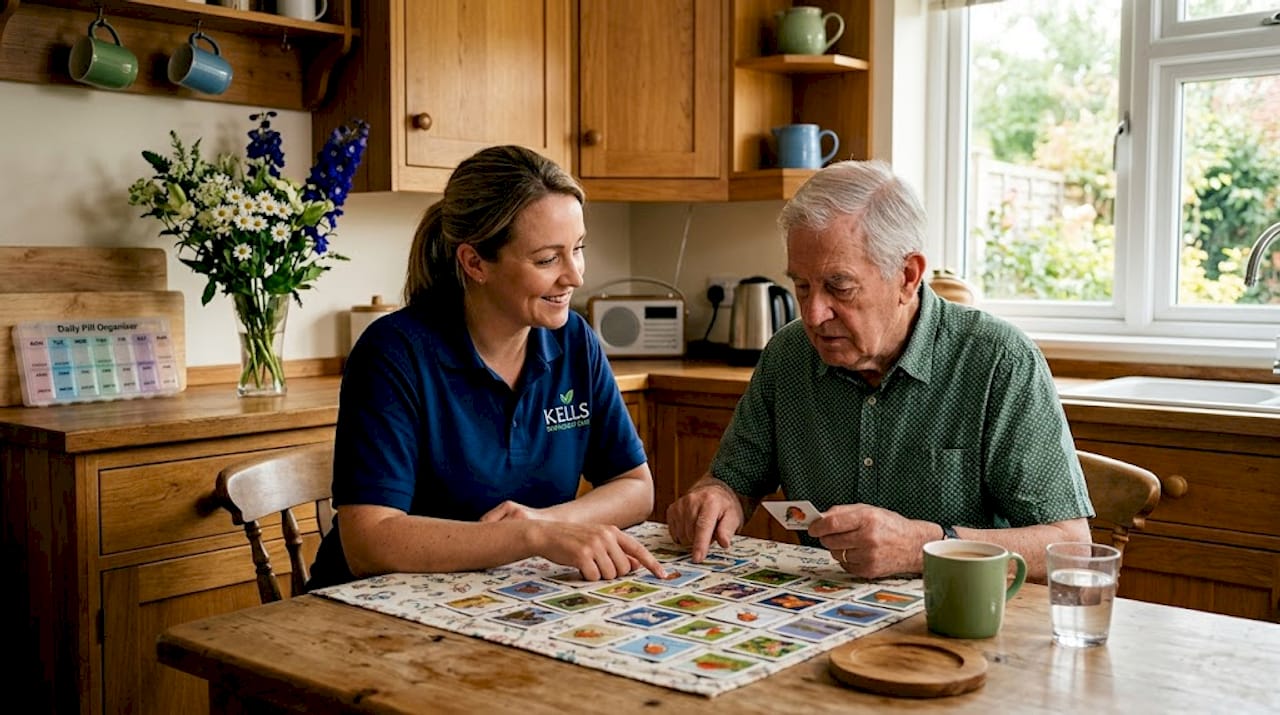
Person-centred care, one of the CQC’s fundamental standards, is particularly significant here. For someone with dementia, person-centred care means carers understand the individual’s life history, preferences, routines, and communication style. A care plan that treats all dementia patients the same is failing this standard, even if it ticks every procedural box.
Several areas within the fundamental standards are especially worth examining for dementia care:
- Responsive care. As dementia progresses, needs change rapidly. A provider that reviews and adjusts care plans regularly is meeting its responsiveness obligations. One that waits for a crisis is not.
- Dignity and respect. People with dementia can lose the ability to self-advocate. The obligation falls squarely on the carer and the provider to uphold dignity at every interaction.
- Complaints handling. A person with advanced dementia may not be able to raise a complaint themselves. Families must know that the provider’s complaints process actively includes and welcomes family involvement.
Providers demonstrating genuine commitment to personalised dementia care go beyond the minimum. They train carers in dementia communication techniques, offer consistency in which carers visit, and build care plans around the whole person rather than a diagnosis.
My perspective: what families often miss
I have spent considerable time working with families who are navigating home care decisions, and there is one pattern I see more often than any other. Families check the CQC rating, see “Good,” and feel reassured. Then, months later, they realise the daily experience of care does not match what that rating implied.
Here is what I have learned: ratings reflect a moment in time. An inspection happens, a report is published, and then care continues, usually without a regulator present, every single day. The question that matters is not “What did the inspector find?” but “What happens on an ordinary Tuesday morning?”
The families who get the best outcomes are the ones who stay curious and stay involved. They read the inspection report, yes. But they also visit unexpectedly, talk to the carers directly, and create an open dialogue with the provider. The importance of care standards lies not just in the standards themselves but in whether a provider lives them when no one is watching.
Empowering yourself with knowledge about what these standards require is genuinely one of the most protective things you can do for a relative receiving home care. And providers who welcome that knowledge are almost always the ones delivering care worth choosing.
— Dan
How Kells-care can support your family
If you are at the beginning of this process, or if you have concerns about a current provider, Kells-care is here to help. Kells Domiciliary Care has been delivering home care across London for over 30 years, and every service is fully regulated by the CQC. All carers are DBS checked, properly qualified, and matched carefully to each client’s needs.
You can start by downloading the free home care guide from Kells-care, which walks families through what to expect, what to ask, and how to plan. For families supporting a relative with dementia, the dementia personal care guide offers practical, London-specific advice on care planning and provider selection. Whether you need check-in visits or full round-the-clock support, Kells-care offers flexible, personalised home care built around your loved one’s specific circumstances. Contact the team today to discuss your needs with no obligation.
FAQ
What are CQC fundamental standards?
The CQC fundamental standards are the legal minimum standards that all registered care providers in England must meet. They cover areas including person-centred care, consent, safeguarding, complaints handling, and governance.
How do I check if a home care provider is CQC registered?
You can search any provider on the CQC website using their name or postcode to confirm registration and access the full inspection report and current rating.
What does “person-centred care” mean in practice?
Person-centred care means the provider tailors all care to the individual’s specific needs, preferences, and circumstances, obtaining consent before any care or treatment is carried out.
Why do CQC ratings not tell the whole story?
Ratings are based on inspections carried out at specific points in time. The daily quality of care depends on leadership culture, staff training, and how consistently standards are applied, none of which are fully visible in a single rating.
How should I assess home care quality for a relative with dementia?
Ask providers specifically about their dementia training, how frequently care plans are reviewed, how they handle distress or changing behaviour, and how family members can raise concerns on behalf of their relative.