

If the care written in your relative’s care plan is not happening, act in this order: write down what is missing, raise it with the care provider, ask your local council for a review, and make a formal complaint if that does not work. If anyone is in danger or being harmed, skip all of that and make a safeguarding referral straight away. The rest of this guide explains each step for families in London, in plain terms.
A care plan is the written record of what support a person needs and how it will be given: which tasks, at what times, by whom, and what the support is meant to achieve. When it is not followed, the harm is rarely dramatic at first. A missed medicine prompt, a shortened visit, a carer who has not been told about a change. These small gaps add up, and they are the families’ business to notice.
TL;DR
- Keep a dated record of each missed or changed task, who you spoke to and what was said.
- Speak to the provider first. If that fails, ask the council’s adult social services for a review, then complain formally.
- A complaint is for fixing a problem. Abuse, neglect or immediate danger needs a safeguarding referral, or the police, without waiting.
- Councils normally review a plan within the first few months and then yearly, but you can ask for an earlier review after any change, such as a fall or a hospital stay.
- Providers are required to keep a clear plan that staff can see and to keep it up to date.
Table of Contents
- What “not followed” looks like in practice
- Who is responsible for delivering the plan
- Step 1: Build a record before you raise anything
- Step 2: Raise it with the provider
- Step 3: Ask for a review of the plan
- Step 4: Make a formal complaint
- Step 5: Know when it is not a complaint but a safeguarding matter
- Preventing the problem: what a plan that works contains
- Special points for dementia, learning disability and autism
- Our perspective
- Where Kells can help
- FAQ
- Sources
What “not followed” looks like in practice
Families often hesitate because they are unsure whether what they have seen is a real breach. A useful test is to compare what happens with what the plan says. Common signs include:
- Visits that are shorter than agreed, or arrive at times that do not match the plan.
- Medicines missed, given late or not recorded.
- Tasks listed in the plan, such as help with washing, meals or mobility, that are skipped.
- Different carers each time who seem unaware of preferences, risks or changes in needs.
- A plan that still describes your relative as they were a year ago, even though their health has changed.
- Goals in the plan (for example, getting out of the house twice a week) that nobody is working towards.
For people living with dementia, a learning disability, autism or mental health needs, the plan often holds details that matter a great deal: how to approach someone who becomes distressed, which routines keep them calm, what triggers behaviour that challenges. When those details are lost, the effect is felt quickly. Treat a pattern of lapses as significant even if no single one looks serious.
Who is responsible for delivering the plan
Knowing who is responsible tells you where to take the problem. There are three layers.
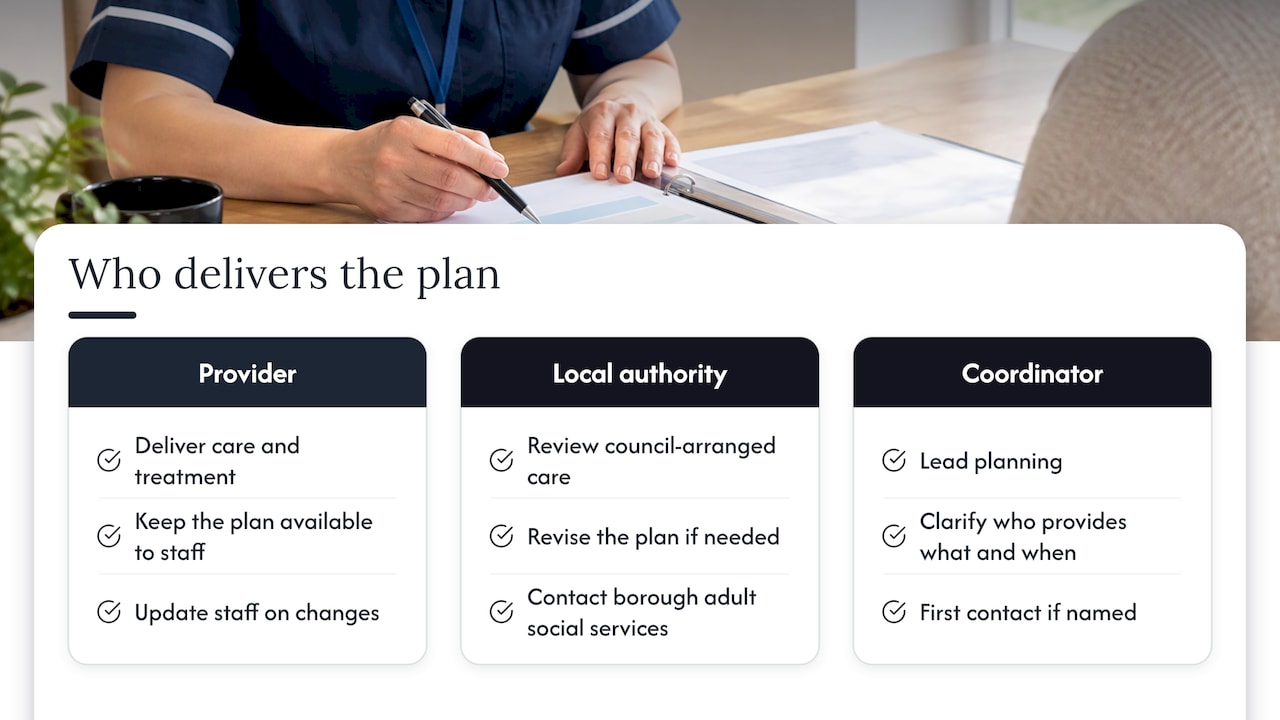
The care provider. The Care Quality Commission (CQC) is the independent regulator of health and social care in England. Its guidance on person-centred care says providers must make sure care and treatment meets people’s needs and preferences, develop a clear plan that is available to staff, include an agreed review date, and keep staff up to date with changes. So the provider is not only expected to deliver the plan, but to make sure the people on the doorstep have read it.
The local authority. If the council arranged or assessed the care, it has a continuing duty under the Care Act 2014 to keep the care and support plan under review. The statutory guidance says the authority must ensure a review takes place and revise the plan if needed. In London that means your borough’s adult social services team.
A named coordinator. For council-arranged home care, NICE guidance says the named care coordinator should lead planning, make sure everyone knows what they must provide and when, and keep communication going. If you have a name and number for this person, they are your first point of contact. Our own guide to the role of care coordinators explains what to expect from one, and a wider look at caring for seniors shows how families manage the practical side of arranging support.
If you pay for care yourself, the agreement with the provider is your main lever, and the provider is directly answerable to you. If the council or the NHS funds it, the funder shares responsibility and you can go to them as well.
Step 1: Build a record before you raise anything
A complaint backed by dates is far harder to brush aside than a general impression. Guidance for families from the Challenging Behaviour Foundation advises keeping a record of the dates and times of calls, who you spoke to, written correspondence and any evidence.
A simple log works well:
- Date and time of the problem (what was due, what happened instead).
- The plan wording it conflicts with. Keep a copy of the current plan to hand.
- Who was present or told you.
- What you did next and what the reply was.
- Any effect on your relative: a missed meal, a fall, a distressed evening.
If the provider keeps a daily record of visits at the home, read it when you visit and note anything that does not match what you saw. Keep to facts, not opinions. “Visit due at 8am, carer arrived at 8.50am, no breakfast given” is stronger than “care is poor”.
Step 2: Raise it with the provider
Both Mind and CQC advise speaking to the service provider first. Every regulated provider must have a complaints procedure, and you are entitled to ask to see it.
Start informally with the coordinator or the manager. Be specific about what you want:
- Name the task, the day and the plan wording.
- Ask what happened and why.
- Agree what will change, who will do it and by when. The Challenging Behaviour Foundation’s guidance suggests exactly this: agree what needs to happen, who is doing it and by when.
- Follow up in writing, so there is a record of the agreement.
Many problems are fixed at this stage, particularly ones caused by a missed handover, a rota change or a plan that was never updated. If the same problem returns after the agreed date, you have your evidence for the next stage.
Step 3: Ask for a review of the plan
Sometimes the plan is not being followed because it no longer fits. Your relative’s needs may have grown, the visits may be too short for the tasks, or the goals may be out of date. A review is the right tool for that.
How often reviews happen
The NHS social care guide says social care plans are usually reviewed within the first few months of support starting, then once a year. For NHS personal health budgets paid as direct payments, NHS England guidance requires a formal review within the first three months and at least annually after that.
When to ask for an earlier one
You do not have to wait for the yearly date. Under the Care Act statutory guidance, reviews can be planned, or unplanned after a change such as a fall or a hospital admission. They can also be requested by the adult, a carer, a family member, an advocate or another interested person. Mind’s guidance on care and support planning adds that a worsening condition, a reduced support network or problems with delivery are reasons for more frequent review. If the council plans to close a plan, a review must come first.
To ask, call adult social services at your local council and say you want a review of the care and support plan, and why. Put the request in an email too, so the date is on record.
What a good review covers
The statutory guidance says a review should look at what is working, what is not, whether needs or circumstances have changed, whether outcomes are being achieved, and whether the plan or personal budget is still enough. NHS England makes a related point: reviews that focus on outcomes are more useful than process-only checks, because they show whether the support actually achieves what the person needs. Go to the review with your log and with a short list of the outcomes that matter most to your relative, such as eating properly, taking medicines on time, getting out, or having a calm evening routine.
Step 4: Make a formal complaint
If talking to the provider and asking for a review do not fix it, complain formally. Where you complain depends on who arranged the care.
| Who arranged or funds the care | Where to complain first | If still unresolved |
|---|---|---|
| You pay privately | The care provider’s complaints procedure | Local Government and Social Care Ombudsman, once the provider has had a fair chance to respond |
| The council arranged it | Your local council’s complaints procedure | Local Government and Social Care Ombudsman |
| An NHS service | The NHS complaints procedure | Parliamentary and Health Service Ombudsman; local Healthwatch can help you find support |
The NHS guide says that if you are unhappy with how your assessment or care plan was done, you should complain to your local council first, and if you are unhappy with how the council handles the complaint, you can contact the Local Government and Social Care Ombudsman. For NHS complaints, CQC points to local Healthwatch as a source of help.
The Ombudsman’s adult social care factsheet says it normally expects the council or provider to have had a fair chance to respond, and that complaints should usually be made within 12 months of you knowing about the problem. It also allows that particularly vulnerable circumstances may justify earlier involvement. Do not let the log sit for months: start the complaint while events are fresh.
A good complaint letter is short:
- What the plan says and what happened, with dates.
- What you have already done and what you were told.
- What outcome you want: for example, the tasks delivered as written, a named point of contact, a review within a set time.
- A date by which you expect a reply.
Step 5: Know when it is not a complaint but a safeguarding matter
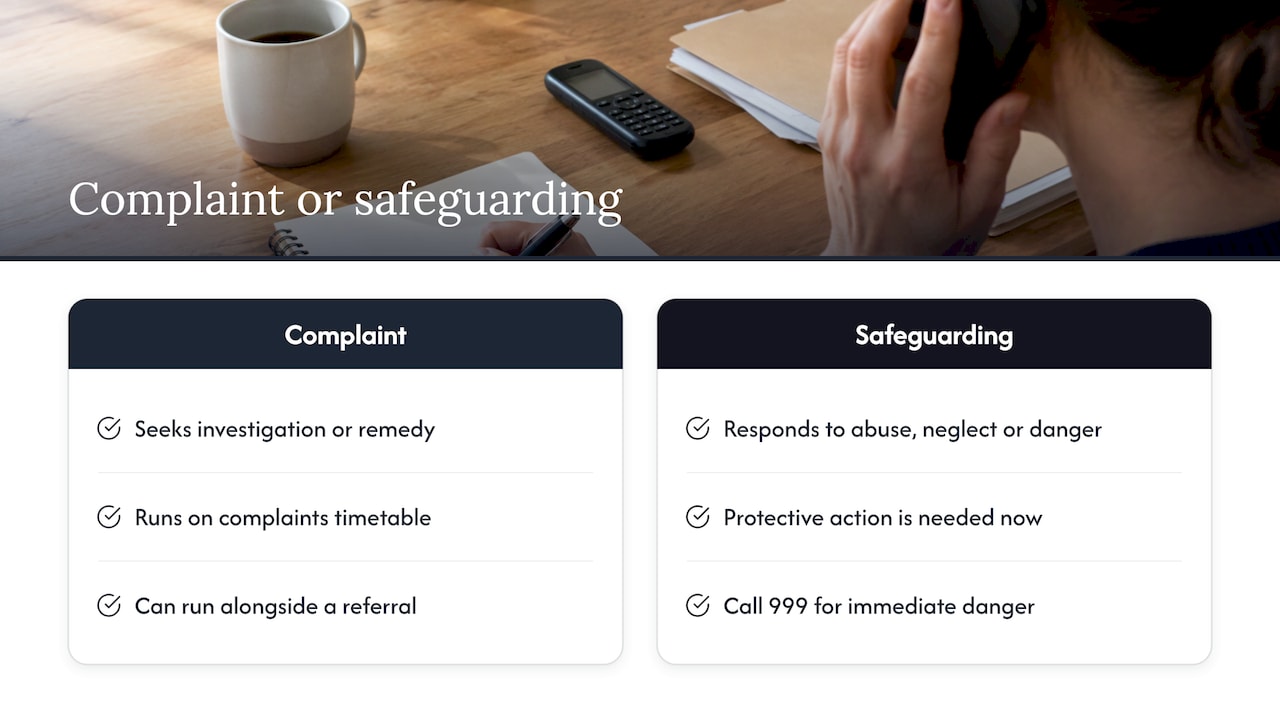
The Challenging Behaviour Foundation’s guidance draws a distinction that is worth remembering. A complaint seeks investigation or a remedy and runs on a complaints timetable. Suspected abuse, neglect or immediate danger needs protective action now.
If your relative’s safety is in question or you think they are being abused or neglected, make a safeguarding referral to your borough’s adult safeguarding team, or children’s services if the person is a child. If someone is in danger right now, call 999. Examples that fall on this side of the line include repeated missed medicines with clear harm, someone left unable to eat, drink or move safely, injuries with no explanation, or a person with dementia left unattended when the plan says they must not be.
You can make a complaint and a safeguarding referral at the same time. The first does not delay the second.
Preventing the problem: what a plan that works contains
Most lapses are cheaper to prevent than to fix. When a plan is set up, check that it:
- Describes tasks and timings in plain, specific language, not general phrases.
- Records preferences that matter to your relative, including routines, food, how they like to be addressed, and carer gender preference (see our guide on recording a carer gender preference).
- Contains clear goals and an agreed review date, as CQC guidance expects.
- Explains medicines support and who is responsible for it.
- Says how changes are passed to carers, and who tells them.
- Gives you a named person to contact.
It also helps to prepare the home so carers can do what the plan asks without obstacles. Our guide on getting your home ready for carers covers safety, medicines and privacy.
And know what you are looking at when you read a provider’s inspection history. Our explanation of CQC ratings shows what families should take from them. Inspection reports sometimes point to exactly this issue: in a June 2025 update, CQC reported that at one inspected hospital care plans were not always followed for medicines and were sometimes out of date. It shows regulators treat plan delivery and plan accuracy as one concern.
Special points for dementia, learning disability and autism
For families of someone with dementia, plans must change as the condition does. A plan written at the point of diagnosis will not fit a year or two later, so ask for an earlier review whenever you notice changes in memory, sleep, appetite, mobility or mood. Our dementia personal care guide and behaviour management steps set out what good day-to-day care looks like.
For parents of children or adults with learning disabilities, mental health needs, autism or behaviour that challenges, the detail of how a person is supported is often the whole point of the plan. Make sure strategies that work are written down in specific terms, and that every new carer is briefed. If you see the strategies ignored, record it and raise it immediately, because the consequences for the person can escalate fast.
Our perspective
We have provided home care in London for over 30 years, and the pattern we care about most is simple: a good plan is a living document. It starts with listening to the person and their family, and it is only useful if the carer at the door knows what it says.
That is why we put so much weight on personalised care. Needs change, and a plan that does not change with them will drift from what the person actually needs. We believe independence, dignity and freedom of choice should shape every visit, from a short call-in to round-the-clock live-in care.
Our carers are fully qualified and DBS checked, and we are regulated by the CQC. We would encourage any family to ask for a review whenever circumstances change, and to expect their provider to welcome the question.
Dan
Where Kells can help
If you are arranging care and want a plan that reflects your relative’s needs from the start, our home care services include personal care assessments, medication assistance, dementia care, support for children and adults with disabilities and mental health needs, respite cover and live-in care across London. You can see the full range on our home care services page, or contact us through kells-care.com to talk through what your family needs.
FAQ
How often should a care plan be reviewed?
Social care plans are usually reviewed within the first few months of support starting and then once a year. You can ask for an earlier review at any time, for example after a fall, a hospital stay or any change in health. Family members and carers are entitled to request one.
Who do I contact first if my relative’s care plan is not being followed?
Start with the care provider, ideally the named coordinator or manager, and give dates and examples. If the council arranged the care, you can also call your borough’s adult social services and ask for a review. Keep a written record of every conversation.
How long do I have to make a complaint?
The Local Government and Social Care Ombudsman says complaints should usually be made within 12 months of you knowing about the problem. It expects the council or provider to have had a fair chance to respond first. Start the complaint as soon as an informal conversation has not worked.
What is the difference between a complaint and a safeguarding referral?
A complaint asks for an investigation or a remedy and follows a complaints timetable. A safeguarding referral is for suspected abuse, neglect or immediate danger, and should be made at once to your borough’s safeguarding team. If someone is in danger now, call 999.
Sources
- Care and support plans, NHS social care and support guide
- Regulation 9: Person-centred care, Care Quality Commission
- Care Act statutory guidance, October 2014
- Roles, responsibilities and multidisciplinary working, NICE
- When things go wrong, Challenging Behaviour Foundation
- How to complain about health or social care, Mind
- Care and support planning, Mind
- Guidance on direct payments for healthcare, NHS England
- Complain about a hospital, community or mental health service, CQC
- How to complain about adult social care and support, Local Government and Social Care Ombudsman
- Cygnet Hospital Godden Green inspection summary, CQC