

Block booking care staff means reserving a set number of care hours, visits or shifts with an agency in advance, instead of arranging each one as the need arises. Councils do this on a large scale with home-care providers. Families and care homes can do a version of it by agreeing contracted hours or regular shifts. What matters is not the reservation itself but what the agreement promises about who attends, when, and what happens if they cannot.
TL;DR
- Block booking reserves agreed hours or shifts in advance. It secures capacity, but it does not by itself guarantee the same carer every time.
- Ask for the same worker or workers, a rota in advance and a named contact. Put these in the agreement.
- Check visit length, travel time, cancellation terms, replacement cover and out-of-hours contact before you sign.
- If agreed visits are missed, keep dated notes, raise it with the agency manager or social worker, then use the formal complaints route.
- Care homes and families in London can talk to us about contracted hours and temporary staffing.
Table of Contents
- What block booking care staff actually means
- Who arranges and pays for it
- What is reserved, and what is not
- Continuity: why it matters for the person receiving care
- Why providers and commissioners use block arrangements
- What to check in the agreement
- Booking temporary staff for a care home
- Our perspective
- Planning around live-in and rota-based care
- If agreed visits or staff are not provided
- Talk to us about contracted hours or staffing
- FAQ
- Sources
What block booking care staff actually means
In plain terms, someone agrees to buy a fixed amount of care capacity ahead of time. The provider then plans its carers around that commitment.
The clearest public example comes from councils. A Southend care at home framework notice says the lead provider is expected to deliver mainstream care up to the agreed block hours. If those hours are used up and the provider cannot take on another person, the council’s brokerage finds other provision separately.
For a private family or a care home the idea is the same, on a smaller scale:
- Contracted hours for a person at home. For example, a set number of hours each week for personal care, agreed at the start and reviewed as needs change.
- Regular shifts for a care home. A home reserves cover for predictable gaps such as weekly nights, holiday periods or a long-term vacancy.
- Live-in care rotas. Carers are booked in blocks of days, with planned handovers between them.
Block booking is different from ad hoc booking, where you call when you need someone and the agency fits you in if it can. For regular homecare or care at home, agreeing hours in advance can make planning more predictable.
Who arranges and pays for it
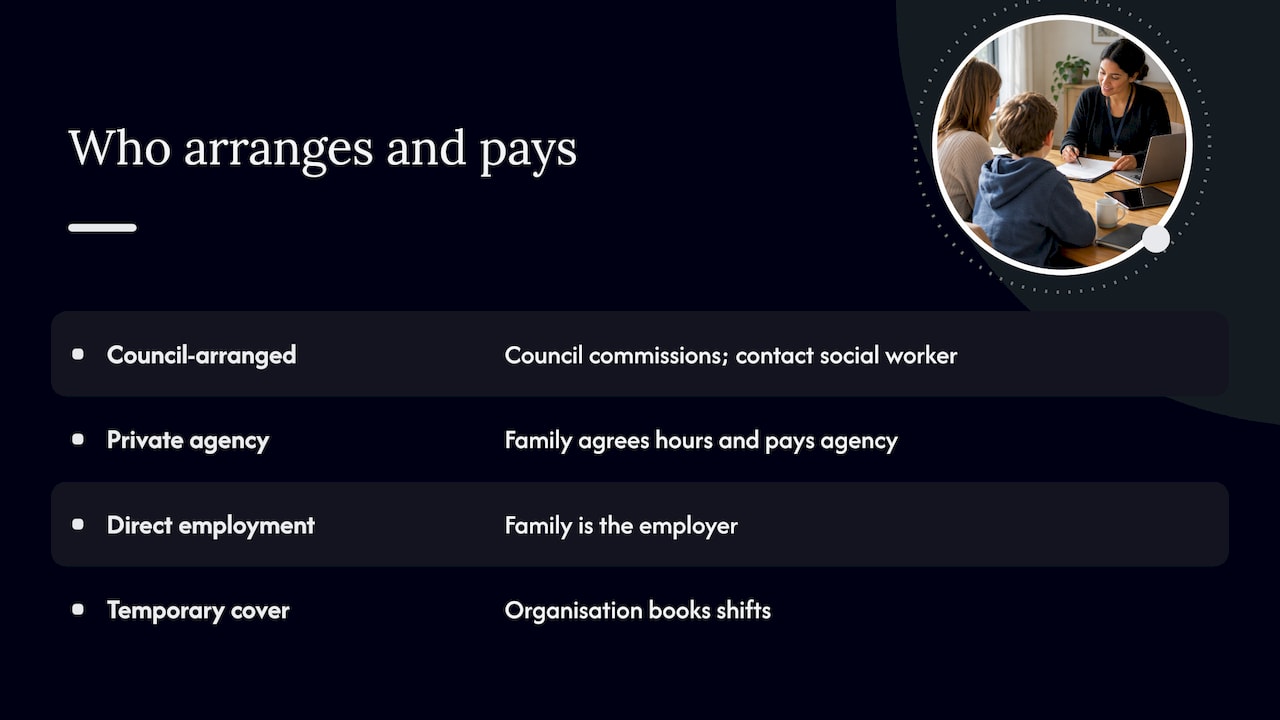
There are three common routes, and the route decides who you hold to account.
Council-arranged care. A council-arranged care plan sets out the support, how often it is provided and how long each visit lasts. Southwark Council explains this on its home care page. Here the council commissions the agency, and block arrangements sit in the council’s contract. Your first contact for problems is usually your social worker.
Private arrangement through an agency. You agree the hours directly and pay the agency. According to Independent Age’s guide to arranging home care, care can be arranged through an agency whether or not you receive council support. Councils may also commission agencies.
Employing a carer yourself. The same guide notes that agencies employ their care workers, whereas employing someone directly makes you the employer, with the responsibilities that follow. Many families choose an agency so that sickness and holiday cover are the provider’s job.
Care homes buying cover. Homes and local authorities can book temporary staff for shifts or longer periods. We supply this through our care staff for care homes and local authorities service, including high dependency care with two carers attending.
What is reserved, and what is not
A block booking reserves time and capacity. It does not automatically reserve a particular person. This is the point families most often misunderstand.
Scope’s guidance on using a care agency says that if you have an ongoing care contract you can ask for the same worker or workers, but the agency might not be able to guarantee it. Holidays, sickness, training, changing rotas and new clients can all alter who turns up.
That is why the useful questions are about how the agency manages change:
- Who is your usual carer, and who is the named back-up?
- How far ahead do you receive the rota?
- How will you be told when someone different is coming?
- What happens if the usual carer leaves?
An honest agency will answer these plainly and put the answers in the care agreement.
Continuity: why it matters for the person receiving care
For someone living with dementia, frailty or a disability, who walks through the door matters as much as when.
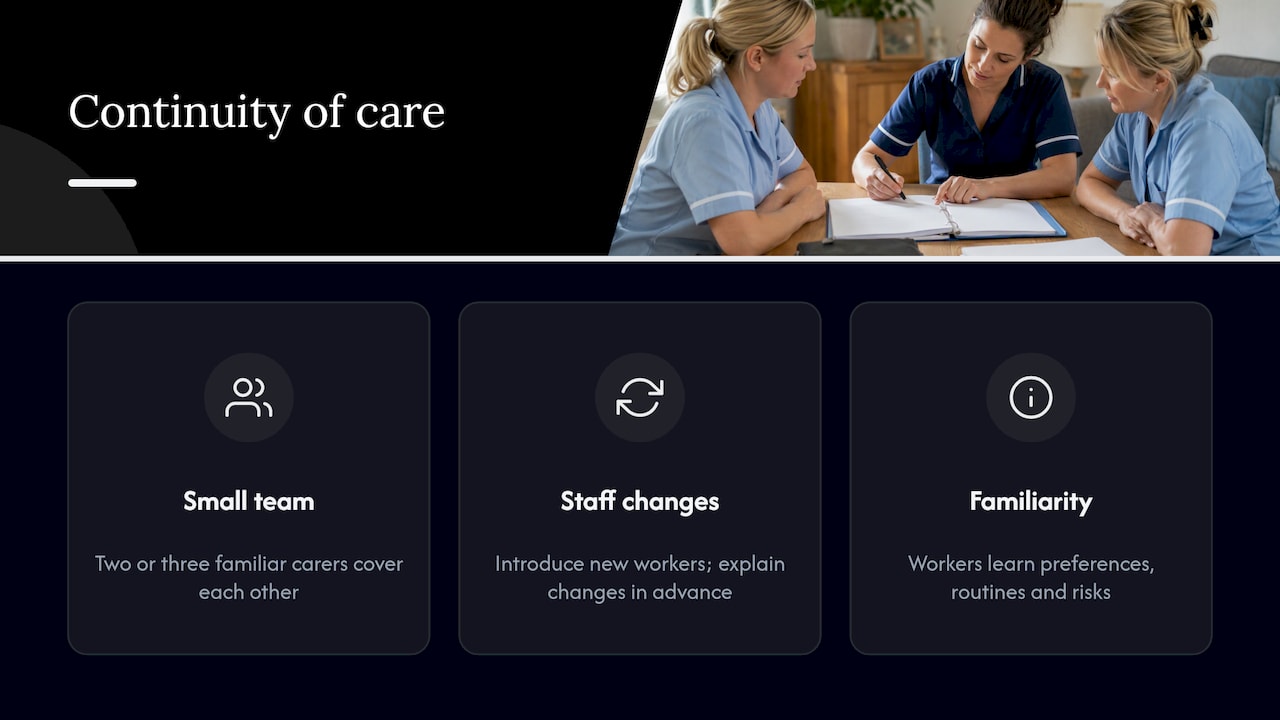
NICE guidance on home care recommends continuity through the same worker or workers. It also recommends building teams around the person and their carer, introducing new workers properly and telling people in advance about staff changes and the reason for them. NICE explains that familiarity helps workers learn a person’s preferences and routines, and recognise and respond to risks or concerns.
In practice, a good block arrangement uses a small, consistent team. Two or three familiar carers who cover each other work better than a long list of names. We cover this in more depth in our article on why continuity of care matters for elderly people.
Continuity also depends on keeping good carers. Recognising and thanking staff is part of that, and there are staff appreciation ideas that any care team can adapt. Settled carers mean a settled routine for the person in their care.
Why providers and commissioners use block arrangements
Block booking is not only a family choice. Councils use it because it can secure capacity and simplify contract management. Surrey County Council’s home-based care option appraisal sets out this trade-off. It also notes that providers need to keep staff available for the block hours, and that paying for hours that go unused is a risk the buyer should plan for.
For you, that translates into a sensible way to size the booking:
- Start with the hours you are confident you will need, not the maximum.
- Ask how the agreement handles hours you do not use, and how much notice you must give to reduce or increase them.
- Review the hours after the first few weeks, when real routines are clear.
If you are unsure how many hours to start with, our guide to planning your care hours, assessment and funding walks through typical ranges.
What to check in the agreement
Use this list when you read any contract for reserved hours or shifts.
Visit length and travel time
NICE says contracts should allow enough time for good-quality care and for travel, and that visits under 30 minutes should be limited to specified circumstances (NICE). Ask how long each visit is, and whether travel is built into the carer’s schedule rather than taken from your time. Our page on 30-minute home care visits explains how to document and monitor short visits.
Rota and replacement cover
Scope advises that you should receive a rota in advance and be told about any changes. If the contract covers set times or dates, the agency should provide a suitable replacement and tell you about the change (Scope). Write down what “suitable” means for your situation: for example, experience with dementia, or two carers for moving and handling.
Contact outside office hours
Independent Age suggests asking how to reach the agency during the day, outside office hours and in an emergency (Independent Age). Get the number written into the agreement, not just said on the phone.
Cancellation and changes
Ask how much notice you need to give to cancel or move a visit, whether any charge applies, and how much notice the agency gives you if it must change a booking. Ask the same about ending the arrangement.
Staff suitability
The Care Quality Commission says services should have enough competent staff with the right mix of skills, appropriate DBS and other recruitment checks and up-to-date safety training. It also expects arrangements for staff absence and for changes at short notice (CQC guidance on suitable staff and staff cover). When you ask an agency about its carers, ask about each of those points. You can also confirm that the agency is registered with CQC and read its latest inspection report.
CQC’s guidance also makes clear that reliability depends on the whole way a service runs: enough staff, geographical cover, travel time, absence arrangements and communication. Reserving a worker is only one part of that.
Directing how care is delivered
NICE recommends that the person using the service and their carer can direct how care is delivered. A block booking should leave room for this. Routines, preferences and the order of tasks should come from the person, and be recorded in the care plan.
Booking temporary staff for a care home
Care homes use block booking differently. They reserve cover to meet predictable gaps, and a home manager has duties of their own when using agency workers.
The Skills for Care working with agencies checklist says temporary staff should have the right values, skills and knowledge for their role. Their competence should be assessed before they work unsupervised, and they should have appropriate induction and training. The same logic helps keep continuity: workers who are known to the home, and properly inducted, fit in better than a different face each shift.
We provide temporary staff for residential and nursing homes, and our page on covering care home shifts quickly explains how we approach it. For staffing levels more generally, see what UK regulation requires on care home staffing ratios.
Our perspective
We have supplied home care in London for over 30 years, and our view is simple: a reserved block of hours is only as good as the people and planning behind it.
When a family arranges contracted hours with us, we think the first priority is a small, steady team who know the person well. That is what supports independence, dignity and freedom of choice, which are the things we care about most. We aim to tell families about changes before they happen, and to send carers who have been briefed on the person’s needs.
We also think the care plan should lead. Hours are set around the person’s routine, not the other way round, and they can be reviewed as needs change, whether that means more support after a hospital stay or less once confidence returns.
Our carers are qualified, DBS checked and we are regulated by CQC. If you are comparing arrangements, ask every provider to show you in writing how it handles absence, replacements and out-of-hours calls. We are happy to do that for you.
Dan
Planning around live-in and rota-based care
If the booking is for live-in care, the block is measured in days rather than hours, and the details are about handovers. Our guides explain how a live-in carer break rota and legal handover checklist works, and how to spot overlap days and travel costs in live-in care rotas. It also helps to know what a live-in carer does day and night before you agree the rota.
Whatever the type of care, prepare the home as well. Our checklist on getting your home ready for carers covers safety, medicines and privacy, which helps any new carer settle in quickly.
If agreed visits or staff are not provided
Missed or short visits should be dealt with promptly and calmly. The steps below follow Independent Age’s guidance.
- Keep records. Note the dates and times of missed or short visits, and keep copies of messages and letters.
- Raise it informally. If the council arranges or pays for care, speak to the social worker. If you pay privately, speak to the agency manager.
- Use the formal complaints procedure of the council or agency if that does not resolve it.
- Go to the ombudsman if the complaint is still unresolved.
The Equality and Human Rights Commission, in its home care and human rights booklet, says serious concerns should be escalated formally. Where there is a risk of serious harm or a crime, contact safeguarding or the police.
If someone is in immediate danger, call 999 first and sort out the paperwork afterwards.
Talk to us about contracted hours or staffing
We provide call-in visits, live-in care, dementia care, support for adults and children with disabilities or mental health needs, respite cover and temporary staffing for care homes. You can see the full range on our home care services page, or start from Kells Care and tell us what you need. We will talk through hours, rota and who your regular carers would be.
If you are weighing up costs first, our London home care costs and agency tips is a good place to begin.
FAQ
Does block booking mean I get the same carer every time?
Not automatically. You can ask for the same worker or workers, but an agency might not be able to guarantee it, because of sickness, holidays and rota changes (Scope). Ask for a small team and for advance notice of changes, and have this recorded in your agreement.
Do I pay for hours I do not use?
That depends on the agreement, so read the terms before signing. Councils have identified paying for unused hours as a risk of block arrangements (Surrey County Council). Ask about notice periods for reducing or changing hours, and start with the hours you are sure you need.
Who should I complain to if care staff do not turn up?
If the council arranges your care, start with your social worker. If you pay privately, start with the agency manager. Keep notes of dates, then use the formal complaints procedure and, if needed, the ombudsman (Independent Age).
Can a care home block book temporary staff?
Yes. Homes can reserve cover for predictable gaps, and we supply temporary staff for residential and nursing homes. Skills for Care advises that temporary workers should be inducted, trained and have their competence assessed before working unsupervised (Skills for Care).
Sources
- Provision of a Care at Home Framework, Find a Tender
- When home care is available, Southwark Council
- Arranging home care, Independent Age (2025)
- Arranging home care, Independent Age, complaints guidance
- Using a care agency, Scope
- Home care recommendations, NICE
- Home Based Care Option Appraisal, Surrey County Council
- Suitable staff and staff cover, Care Quality Commission
- Working with agencies checklist, Skills for Care
- Your home care and human rights, Equality and Human Rights Commission