Arthritis pain often feels sharpest at night because joints stiffen after hours of stillness, the day’s painkillers have worn off and there is nothing left to distract you. For an older person, a bad night also raises the risk of a fall the next day. The good news is that a steadier routine, a better bed set-up and a medicines review can all help. When a relative needs hands-on support through the night, our carers at Kells can provide it in your loved one’s own home in London.
TL;DR
- Night pain is common: in a 2026 study of 130 older people with osteoarthritis, 73% reported night pain.
- Stillness, fewer distractions and wearing-off medicine explain much of it. Poor sleep then lowers the pain threshold, so pain and tiredness feed each other.
- Regular bed and wake times, supportive pillows, warm (not hot) heat and a lit, clear route to the toilet are the first steps.
- Do not change prescribed medicines yourself. Ask a pharmacist or GP to review them if pain wakes you most nights.
- A hot, red, swollen joint with fever needs same-day advice from a GP or NHS 111.
Table of Contents
- Why arthritis pain feels worse at night
- What a bad night costs the next day
- Easing pain at home: an evening routine
- Getting up safely in the dark
- Medicines at night: what to check
- When to get medical advice
- Where night support at home fits in
- Perspective
- FAQ
- Sources
Why arthritis pain feels worse at night
There is rarely one cause. A UK guide to night pain lists several that add up:
- Joints stiffen after hours without moving.
- With fewer distractions, pain feels louder.
- A busy day can mean more aching later.
- Morning pain relief may have worn off by bedtime.
The type of arthritis matters too. Osteoarthritis is the wear-and-tear form. Rheumatoid arthritis is an inflammatory condition, where the immune system attacks the joints. A 2026 review in Nature Reviews Rheumatology says daily swings in rheumatoid arthritis symptoms are well established and follow changes in inflammation, while osteoarthritis patterns vary more from person to person. The UK guide adds that inflammatory arthritis tends to bring worse stiffness and pain in the early morning.
The pain and sleep loop
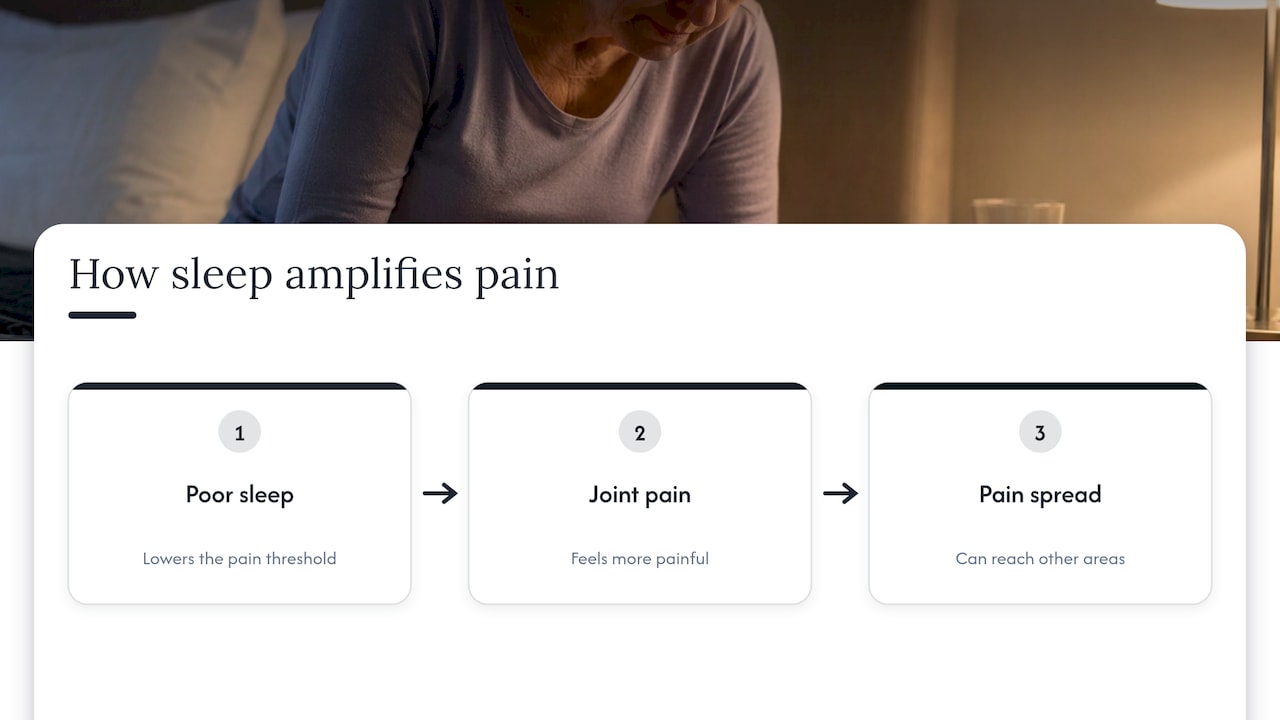
Poor sleep does not just follow pain, it adds to it. Arthritis UK explains that too little good sleep lowers your pain threshold, so a painful joint hurts more and pain can spread to other areas. A 2023 review describes a similar loop in rheumatoid arthritis, where disturbed sleep and inflammation reinforce each other.
Most adults need six to nine hours a night, and less is needed with age. Waking once or twice is normal. It becomes a problem when you cannot get back to sleep or are unhappy with how you sleep.
What a bad night costs the next day
For an older person, the cost goes beyond tiredness. In the 2026 study of 130 older patients, 58% had poor sleep quality, and those with night pain slept significantly worse. The authors conclude that spotting older people at risk early, and following up with individual treatment, is key to managing their pain.
For families, this means a relative who says “I slept fine” may still be struggling. Watch for:
- slower, stiffer movement in the morning
- dozing through the day
- irritability or low mood
- reluctance to walk or go out
People who cannot easily say where it hurts need extra attention. UK national pain-assessment guidance says a 0 to 10 rating scale or simple descriptive words can work for mild to moderate cognitive impairment, and that observation tools such as PAINAD suit severe impairment. If your relative has dementia, new restlessness, calling out or resisting care at night can be pain. Our guide to calming dementia sundowning at home covers the evening difficulties that often overlap with this.
Easing pain at home: an evening routine
The NHS and the UK night-pain guide agree on the basics. Try them for a couple of weeks before judging whether they help.
- Keep fixed times. The NHS advises going to bed and getting up at the same time each day and avoiding daytime naps.
- Move gently in the evening. A short, easy walk or gentle stretches keep joints from locking up. Do not stop moving the joint altogether.
- Use warmth carefully. A warm bath or a wrapped heat pack for short periods can ease stiffness. Fill a hot-water bottle with hot tap water, not boiling water. For people with thin skin, numbness or diabetes, this heat-pack guide gives more detail.
- Cool a hot, sore joint. The NHS suggests a bag of frozen peas wrapped in a towel for up to 20 minutes every 2 to 3 hours.
- Wind down. Dim the lights, put screens away and cut back on caffeine and alcohol later in the day.
- If you cannot sleep, get up and do something relaxing rather than lying in pain.
Setting up the bed
Small changes make a real difference:
- A pillow between the knees for hip or knee pain when lying on your side.
- A pillow under the knees when lying on your back.
- A supportive, not too hard, mattress and a lightweight duvet, so covers do not weigh on sore joints.
- A bed lever or raised bed if getting in and out is hard. An occupational therapist can advise.
Pillow height and sleeping position also affect the neck and shoulders. This guide to sleeping positions and pillow height is a useful starting point for neck discomfort.
Getting up safely in the dark
The UK night-pain guide warns that getting up at night, sleepy, stiff and in the dark, is one of the most common times for an older person to fall. Housing guidance also notes that arthritis stiffness raises fall risk and recommends a higher bed, clear floors and no loose rugs.
A simple night-time checklist:
- Sit on the edge of the bed for a moment before standing.
- Keep the route to the toilet clear and lit.
- Leave a walking aid, glasses and well-fitting slippers within reach.
- If your relative lives alone, keep a phone or personal alarm by the bed.
Strength and balance work also helps. Our fall prevention tips for seniors set out practical steps for the home, and this guide to balance training for older adults explains the exercises. In cold months, our guide to winter care for an older relative covers keeping the bedroom warm and safe.
Medicines at night: what to check
Never stop or change a prescribed medicine on your own. Ask a pharmacist or GP. These points come from NICE advice as summarised in a UK pain-relief guide:
- Topical NSAID gels (anti-inflammatory gels rubbed on the skin) are the first choice for knee osteoarthritis.
- Oral NSAIDs should be used at the lowest dose for the shortest time. Check with a pharmacist first if the person is older, has stomach, kidney or heart problems or asthma, or takes blood thinners.
- Paracetamol and weak opioids suit only occasional, short use. Strong opioids are not advised for osteoarthritis.
- For inflammatory arthritis, disease-modifying medicines from the rheumatology team control the inflammation itself.
Timing and sleeping tablets
When the last dose of the day wears off at 10pm, the night is unprotected. An NHS pain-control guideline advises that the first and last doses of the day should be linked to waking time and bedtime, and that the person and those close to them should have the full regimen in writing: names, reasons, doses and intervals. Ask the GP or pharmacist whether timing could change for your relative.
Sleeping tablets need particular care. According to the UK night-pain guide, pharmacy sleep aids are for short-term use only, and in later life sleeping tablets can cause next-day drowsiness, confusion and unsteadiness, which raises fall risk. Do not mix them with alcohol, and never stop a long-term sleeping tablet suddenly.
When to get medical advice
The NHS says to see a GP if joint pain affects your sleep, has not improved after 2 weeks of home treatment, or morning stiffness lasts over 30 minutes. Book too if you are using painkillers most days or they are no longer helping.
| Situation | What to do |
|---|---|
| Pain wakes you most nights, or home measures have not helped after about 2 weeks | Book a GP appointment |
| One joint suddenly hot, red, swollen and very painful, especially with fever | Same-day GP or NHS 111 (possible joint infection or gout) |
| Fever or signs of infection while taking methotrexate or biologic medicines | Same-day GP or NHS 111 |
| Very bad pain after a fall, cannot bear weight, joint out of place, tingling or numbness after injury | A&E or 999 |
| Back pain with numbness around the bottom or genitals, new bladder or bowel problems, weakness in both legs, chest pain | 999 or A&E |
The table draws on NHS joint pain advice and the red-flag list in the UK pain-relief guide. A GP may refer you on to a rheumatology team, physiotherapist or occupational therapist. For long-lasting pain, NICE guideline NG193 recommends considering acceptance and commitment therapy or cognitive behavioural therapy.
Where night support at home fits in
Families often cope alone until the nights wear everyone down. If your relative needs help turning, repositioning, using the toilet, taking medicines on time or settling after pain wakes them, our home care services include personal care, medication assistance, companionship and respite cover, delivered by qualified, DBS-checked carers. We are regulated by the CQC and have supplied home care in London for over 30 years. For round-the-clock help, see our live-in care in London, and read more about night care at home.
Perspective
Families tell us the same thing about night pain: the pain itself is only half of it. The other half is worry. Will Mum get up alone to the toilet? Did Dad take his tablets at the right time? Who is awake if something goes wrong?
Our view is that a good night starts with a good day. A steady routine, the right pillows, warmth, a clear lit path and medicines that fit around bedtime and waking all matter, and they are easier to keep up when someone is there to help with them. That is what personalised home care is for. A carer who knows your relative’s habits can notice that they are guarding a hip, wincing on standing or restless in a way that is new.
We build care around the person, to protect independence, dignity and freedom of choice. Some families need a short visit at bedtime, others need a carer in the house through the night. Either way, you should not be managing it all by yourself.
Dan
FAQ
Why does my arthritis hurt more at night?
Joints stiffen when you lie still, there is less to distract you, and the day’s painkillers may have worn off. Poor sleep then lowers your pain threshold, which can make the next night worse. If it wakes you most nights, speak to your GP.
Is night pain different in rheumatoid arthritis and osteoarthritis?
Rheumatoid arthritis follows a well-documented daily pattern linked to inflammation, often with worse stiffness in the early morning. Osteoarthritis patterns vary more between people. Either way, your GP can work out which type you have and what suits it.
Is a hot-water bottle safe for painful joints?
Warm, not hot, is the rule, for short periods. Fill the bottle with hot tap water rather than boiling water. If you have thin skin, numbness or diabetes, take extra care and check the skin often.
How can I tell if a relative with dementia is in pain at night?
Look for new restlessness, calling out, grimacing or resisting care. Pain scales such as PAINAD are designed for people who cannot describe their pain. Tell their GP what you have seen.
When is night-time joint pain an emergency?
Call 999 or go to A&E after a fall with severe pain, if your relative cannot bear weight, or if a joint looks out of place. A hot, swollen joint with fever needs same-day help from a GP or NHS 111.
Sources
- Night pain and sleep with arthritis in later life
- Circadian rhythms in arthritis, Nature Reviews Rheumatology
- Sleep disturbance and inflammation, Nature Reviews Rheumatology
- Investigation of night pain in geriatric patients
- Arthritis and sleep, Arthritis UK
- UK national guidelines on pain assessment in older people
- 10 ways to reduce pain, NHS
- Joint pain, NHS
- Heat and cold packs for frail people with arthritis
- Making your home a better place to live with arthritis
- Arthritis pain relief guide
- NHS pain and symptom control guideline
- NICE guideline NG193 on chronic pain
- Sleeping positions and pillow height
- Balance training for seniors