

TL;DR:
- Double up care involves two qualified carers supporting one individual during tasks they cannot manage alone. It primarily ensures safety, reduces injury risks, and enhances dignity for individuals with complex mobility needs or conditions like dementia.
Double up care is defined as the provision of support by two qualified carers working simultaneously to assist one individual with tasks they cannot safely manage with a single carer. Also known as double-handed care, this approach is formally recognised in UK social care standards and is sometimes referred to informally as “double-ups.” It applies most often when a person has complex mobility needs, a progressive condition such as dementia, or requires personal care that demands both physical support and close observation. Understanding what double up care means, and when it is appropriate, helps families make confident, informed decisions for their loved ones.
What is double up care and when is it used?
Double-handed care involves two carers assisting one person at the same time, typically during tasks such as transfers, repositioning, bathing, or dressing. The arrangement is not simply a preference. It is a formal care decision, usually made following a professional risk assessment and documented within a person’s care plan.
The situations that most commonly require this level of support include:
- Safe transfers from bed to wheelchair or chair to standing
- Bathing and personal hygiene where one carer cannot safely support the person alone
- Repositioning in bed to prevent pressure sores
- Supporting individuals with unpredictable movements due to conditions such as Parkinson’s disease or advanced dementia
- Emergency or complex medical care tasks requiring two trained professionals
Double up caregiving is not a permanent state for most people. Needs change over time, and a care arrangement that requires two carers today may be safely reduced with the right equipment or rehabilitation support later.
Why is double up care important for safety and quality of life?
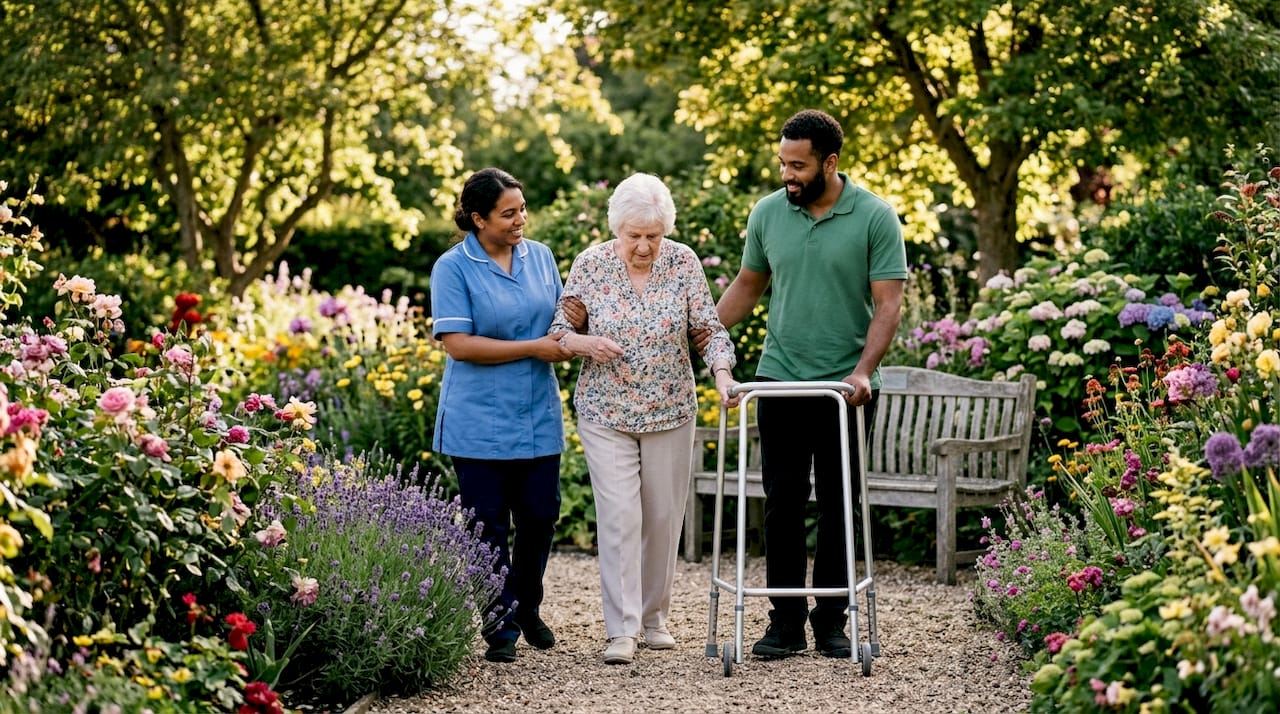
The primary purpose of double up care is safety. Care standards highlight that having two carers present reduces the risk of transfer-related accidents and shares the physical effort, protecting both the client and the carer from injury. A single carer managing a complex transfer alone faces a significantly higher risk of strain or error.
The benefits extend well beyond accident prevention:
- Reduced carer injury risk. Sharing physical effort across two carers lowers the chance of musculoskeletal strain, which is one of the most common workplace injuries in domiciliary care.
- Better observation. Two carers can monitor a client’s condition, comfort, and reactions simultaneously. This is particularly valuable for individuals with dementia, where distress or discomfort may not be clearly communicated.
- Improved dignity. Tasks completed with two carers can often be done more smoothly and with greater care for the person’s comfort and modesty.
- Faster response. If something goes wrong during a transfer or personal care task, a second carer is already present to respond immediately.
- Emotional reassurance. Some clients feel more secure and less anxious when supported by two familiar carers, particularly those with cognitive conditions.
Pro Tip: If your loved one has recently been discharged from hospital following a fall or surgery, request a formal manual handling assessment before their first home visit. This assessment determines whether double up care is needed from day one, rather than after an incident.
Quality of life is directly affected by how safely and comfortably daily tasks are completed. When a person feels secure during personal care, they are more likely to maintain their dignity and engage positively with their carers.

What factors determine the need for double up care?
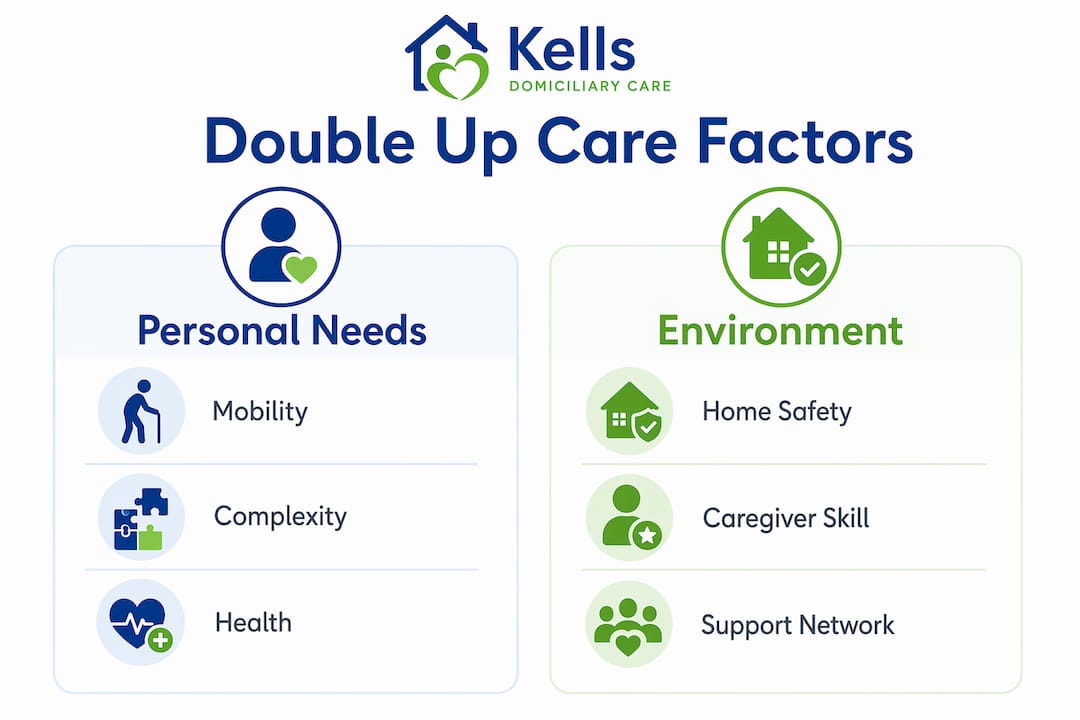
The decision to introduce double up care is not made informally. Formal risk assessments and manual handling regulations dictate when two carers are required, and CQC regulations often require documented justification for this level of support. Several factors are weighed during this process.
-
Mobility level. A person who can bear some weight and follow instructions may be safely supported by one carer using appropriate equipment. A person with no weight-bearing ability or unpredictable movements typically requires two carers.
-
Medical and cognitive conditions. Conditions such as advanced dementia, motor neurone disease, or severe stroke can make personal care tasks physically and cognitively complex. Two carers provide both the physical support and the attentiveness these conditions demand.
-
Equipment availability. Hoists, transfer boards, and standing aids can sometimes replace the need for a second carer. Insurers and CQC may find that advanced equipment is sufficient to reduce the number of carers required. The assessment process considers whether equipment is a safe and practical alternative.
-
Home environment. Narrow doorways, small bathrooms, or the absence of specialist equipment can make single-handed care unsafe even for clients who might otherwise manage with one carer.
-
Carer safety. Manual handling guidelines protect carers as well as clients. If a task poses an unacceptable risk to a single carer, two carers are required regardless of the client’s preferences.
-
Person-centred goals. Regular reassessments check whether double up care remains necessary or whether mobility aids could enable single-handed support instead. The goal is always to promote as much independence as possible.
The table below summarises the key factors and their influence on the care decision.
| Factor | Influence on double up care decision |
|---|---|
| Mobility level | Low or unpredictable mobility increases the likelihood of two carers being required |
| Medical condition | Complex or progressive conditions typically require two carers for safety |
| Equipment available | Appropriate equipment may reduce the need for a second carer |
| Home environment | Physical barriers in the home can make single-handed care unsafe |
| Carer safety risk | Manual handling guidelines may mandate two carers regardless of client ability |
| Independence goals | Regular review may reduce double up care as the client’s condition improves |
Understanding what is complex care can also help families see where double up arrangements fit within a broader care plan.
What are the challenges of double up care?
Double up care brings real benefits, but it also introduces challenges that families and care providers must manage carefully.
-
Coordination between carers. Two carers must communicate clearly and work in sync. Poor coordination can cause discomfort for the client, slow down the care visit, or create confusion about roles. Coordinating two carers requires careful scheduling and clear communication to prevent overlap and maintain client dignity.
-
Higher cost. Two carers mean two sets of hours billed. For families funding care privately, this cost increase is significant. For those receiving local authority funding, the justification for double up care must be clearly documented to secure the additional resource.
-
Risk of overdependence. There is a balance to find to avoid the client becoming reliant on two carers when one carer with the right equipment could safely manage. Overdependence can reduce a person’s motivation to maintain their own mobility and independence.
-
Privacy concerns. Having two carers present during intimate personal care can feel intrusive for some clients. This is particularly sensitive for individuals who are cognitively aware and value their privacy highly.
-
Administrative and emotional burden on families. Research shows heightened strain on family caregivers who coordinate double up visits, manage schedules, and liaise with multiple professionals. This burden is often underestimated when care plans are first put in place.
Pro Tip: Ask your care provider to assign consistent carers to double up visits wherever possible. Familiarity between the client and both carers reduces anxiety, improves communication, and makes personal care tasks feel less intrusive.
Managing these challenges requires honest conversations with your care provider and a willingness to review the arrangement regularly.
How can families coordinate double up care effectively?
Families play a central role in making double up care work well at home. Families’ active involvement in care planning improves consistency and satisfaction, making cooperation with care coordinators and registered nurse supervisors a practical priority rather than an optional extra.
-
Work with a registered care agency. Using a registered professional care agency helps families ensure that double up care plans address medical, safety, and personal needs from the outset. Agencies regulated by the CQC are accountable for the quality and safety of the care they provide.
-
Use a care coordinator. Care coordinators manage scheduling, communicate between carers and families, and flag any concerns about the care plan. They reduce the administrative load on families significantly.
-
Maintain open communication with the care team. Families who communicate regularly with carers are better placed to notice changes in their loved one’s condition and raise concerns before they become problems.
-
Share responsibilities within the family. Double-duty caregivers benefit when monitoring and communication responsibilities are shared with formal care agencies, reducing stress and coordination burdens on any one family member.
-
Reassess regularly. Expert Helen Harland notes that more carers does not automatically mean better care. The goal is to enable as much independence as possible, and a regular review of the care plan keeps this goal in focus. Exploring mobility support options alongside double up care can help identify when a reduction in carer numbers is safely achievable.
Families who stay engaged with the care process consistently report better outcomes for their loved ones and less stress for themselves.
Key takeaways
Double up care is the safest and most dignified option when a person’s needs genuinely exceed what one carer can safely provide, but regular review is the key to ensuring it remains appropriate over time.
| Point | Details |
|---|---|
| Core definition | Double up care means two qualified carers supporting one person simultaneously, also called double-handed care. |
| Primary benefit | Two carers reduce accident risk during transfers and protect both the client and carer from injury. |
| Assessment is essential | Formal risk assessments and CQC guidelines determine when double up care is required and justified. |
| Challenges exist | Higher costs, privacy concerns, and coordination demands require proactive management by families and providers. |
| Regular review matters | Care plans should be reassessed regularly to promote independence and reduce double up care when safely possible. |
Dignity first: what I have learned about double up care
Working in and around home care for many years, the question I hear most often from families is: “Are we doing too much, or not enough?” Double up care sits right at the heart of that tension.
The families who manage it best are the ones who treat the arrangement as a starting point, not a fixed solution. They ask questions at every review. They notice when their loved one seems more capable on some days than others. They push back, gently, when they feel the care plan has not kept pace with their loved one’s actual condition.
Dignity is not a soft consideration in care planning. It is a practical one. A person who feels respected and involved in their own care is more likely to cooperate, communicate, and maintain whatever independence they have. Two carers in a room can either reinforce that dignity or undermine it, depending entirely on how they work together and how well they know the person they are supporting.
My honest view is that double up care is often introduced correctly but reviewed too infrequently. Families should ask their care provider for a formal reassessment at least every six months, or sooner if their loved one’s condition changes. That single habit makes a meaningful difference to outcomes.
— Dan
How Kells-care supports families with double up care
Kells-care has provided personalised home care across London for over 30 years, including complex and double up care arrangements for clients with a wide range of needs. Every care plan is built around the individual, with input from qualified professionals and the family. If you are trying to understand whether double up care is right for your loved one, the free home care guide from Kells-care is a practical starting point. It covers the full range of home care options, from check-in visits to round-the-clock support, and helps families ask the right questions before committing to a care arrangement. All Kells-care staff are fully qualified, DBS checked, and regulated by the CQC.
FAQ
What is the double up care definition in UK social care?
Double up care, also called double-handed care, is when two qualified carers assist one person simultaneously with tasks such as transfers, personal care, or repositioning. The term is formally recognised in UK social care standards and CQC-regulated care planning.
How does double up care work in practice?
Two carers arrive together for a scheduled visit and divide roles during the care task. One carer typically provides physical support while the other guides, observes, and assists, ensuring the task is completed safely and with minimal discomfort for the client.
What are the main benefits of double up care?
The main benefits include reduced risk of transfer-related accidents, lower physical strain on individual carers, better observation of the client’s condition, and improved dignity during complex personal care tasks.
When should double up care be reassessed?
Double up care should be formally reassessed at least every six months, or sooner if the client’s condition changes significantly. The goal is always to reduce the number of carers required when it is safe to do so, supporting the client’s independence.
Is double up care more expensive than single-handed care?
Double up care does cost more because it involves two carers per visit. Families funding care privately will see a higher hourly cost, while those with local authority funding will need documented justification for the additional resource to be approved.


