
TL;DR:
- A DBS check is a formal disclosure of criminal record history used to assess suitability for roles involving vulnerable groups. Since January 2026, self-employed individuals can now obtain Enhanced DBS checks directly through vetted Umbrella Bodies, simplifying access for independent workers. Proper application details and understanding of regulated activity are essential to ensure the correct level of check and ongoing employment safety.
A DBS check is the UK’s official criminal record disclosure system, issued by the Disclosure and Barring Service, that helps employers assess whether a person is suitable for roles involving children or vulnerable adults. Understanding DBS checks is not just useful for job seekers. For anyone working in care, education, or health settings, it is a legal requirement. This guide explains the DBS check meaning, the four levels of disclosure, how the application process works, and what recent 2026 changes mean for self-employed workers and personal employees.
What is a DBS check and why does it matter?
A DBS check is a formal disclosure of an individual’s criminal record history, used by employers to make safer recruitment decisions. The Disclosure and Barring Service, a government body established under the Protection of Freedoms Act 2012, manages the process across England and Wales. Roles involving direct contact with children or vulnerable adults legally require this check before employment begins.
The importance of DBS checks extends beyond simple compliance. They give employers documented evidence to support their hiring decisions and give families confidence that the person entering their home has been properly vetted. For qualified home carers in particular, a DBS certificate is a baseline professional credential, not an optional extra.
DBS checks are not the same as a general background check. They specifically disclose convictions, cautions, reprimands, and warnings held on the Police National Computer, and at higher levels, they include information held locally by police forces. The level of detail disclosed depends entirely on the type of role being applied for.
What are the different types of DBS checks?
Four levels of DBS checks exist, each designed for a different category of role and carrying different fees and processing times.

| Level | Fee | Typical processing time | When it applies |
|---|---|---|---|
| Basic | £18 | 1–14 days | Any role; requested by employer or individual |
| Standard | £18 | 2–4 weeks | Regulated professions, e.g. solicitors, accountants |
| Enhanced | £38 | 2–8 weeks | Roles with regular supervised contact with children or adults |
| Enhanced with Barred Lists | £38 | 2–8 weeks | Regulated activity with children or vulnerable adults |
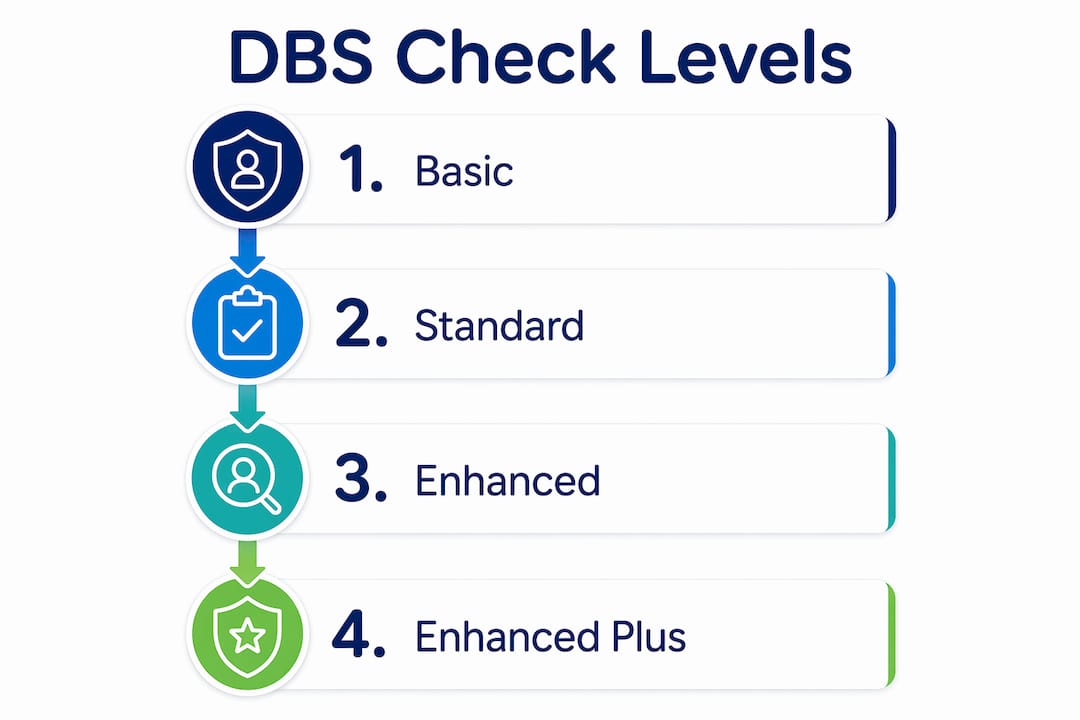
Each level builds on the previous one. A Basic check shows only unspent convictions. A Standard check adds spent convictions, cautions, reprimands, and warnings. An Enhanced check includes all of the above plus any relevant information held by local police. An Enhanced with Barred Lists check additionally confirms whether the applicant appears on the Adults’ Barred List, the Children’s Barred List, or both.
Employers cannot request a higher level than the role legally requires. A receptionist at a GP surgery, for example, does not automatically qualify for an Enhanced check simply because the workplace involves health. The role itself must meet the legal threshold.
Pro Tip: If you are applying for a care role and your employer requests only a Basic check, ask whether the role meets the threshold for an Enhanced check. Getting the correct level from the start avoids delays and repeat applications later.
What is regulated activity and why does it affect your DBS level?
Regulated activity is a legal term defined under the Safeguarding Vulnerable Groups Act 2006 and amended by the Protection of Freedoms Act 2012. It describes specific types of work with vulnerable adults or children that carry the highest safeguarding risk. Only roles that meet this definition require an Enhanced check with Barred List access.
For work with vulnerable adults, regulated activity includes:
- Providing personal care, such as washing, dressing, or administering medication
- Providing healthcare, including treatment or therapy
- Providing social work directly to a vulnerable adult
- Assisting with cash, bills, or shopping for a vulnerable adult who needs support
- Transporting a vulnerable adult because of their age, illness, or disability
- Conducting relevant assessments or reviews of a vulnerable adult’s needs
The frequency and nature of the contact matter. A person who provides personal care on a single occasion still falls within regulated activity. The law does not require the contact to be regular or frequent.
Understanding regulated activity is central to understanding DBS checks for care roles. If you are employed to provide hands-on personal care to an elderly person in their home, your role almost certainly constitutes regulated activity. That means your employer is legally required to obtain an Enhanced check with the Adults’ Barred List before you begin work.
Pro Tip: If you are unsure whether your role counts as regulated activity, the government’s eligibility tool on GOV.UK can help you confirm the correct check level before you apply.
How does the DBS check application process work?
The application process follows a clear sequence, though the route you take depends on your employment status. Employed individuals apply through their employer or a registered organisation. Since january 2026, self-employed individuals can apply for Enhanced DBS checks directly through government-vetted Umbrella Bodies, removing the previous requirement to have an employer submit the application on their behalf.
The steps for most applicants are:
- Confirm the correct check level with your employer or Umbrella Body.
- Complete the DBS application form, either online or on paper.
- Verify your identity using the three-route ID checking process.
- Submit the application through your employer or Umbrella Body.
- Receive your DBS certificate by post to your home address.
Identity verification is a critical step. The three-route ID checking process prioritises Route 1, which requires original government-issued documents such as a valid passport or photocard driving licence. If Route 1 documents are unavailable, Routes 2 and 3 allow combinations of other documents, but these routes take longer to process.
Providing complete and accurate information is the single most common area where applicants cause their own delays. You must supply a full five-year address history and list all previous names, including maiden names or names used before a deed poll change. Incomplete details trigger manual reconciliation, which can add weeks to the process.
Pro Tip: Register for the DBS Update Service at the time of application, not afterwards. The service costs £16 per year and allows employers to check your certificate status online at any time, making it far easier to move between care roles without reapplying.
How should you interpret DBS results and manage ongoing validity?
A DBS certificate is a disclosure report, not a pass or fail test. A criminal record does not automatically disqualify an applicant. Employers must assess the nature of any disclosed offence, how long ago it occurred, and whether it is relevant to the specific role. A spent conviction for a minor offence decades ago is treated very differently from a recent conviction involving harm to a vulnerable person.
This distinction matters enormously for applicants who are anxious about their history. The law requires employers to make a contextual judgement, not a blanket rejection. Many people with disclosed information go on to work successfully in care, education, and health roles.
A DBS certificate tells an employer what is on record. It does not tell them what decision to make. The employer’s duty is to weigh that information carefully against the demands and risks of the specific role, treating each case on its own merits.
DBS certificates have no official expiry date. However, employers in care settings commonly request a new check every three years or when a person changes role. The DBS Update Service solves this problem practically. With an active subscription, an employer can run a free online status check against your existing certificate at any time, confirming whether new information has been added since it was issued.
Key points on ongoing validity:
- A certificate is a snapshot of your record on the date it was issued.
- New convictions or cautions after the issue date will not appear on the original certificate.
- The Update Service bridges this gap by flagging changes in real time.
- If barred information appears on a certificate, the employer has a legal duty to act on it and cannot proceed with the appointment.
What do self-employed workers need to know about DBS checks in 2026?
The most significant recent change to the DBS system came into effect in january 2026. Self-employed individuals and personal employees can now apply for Enhanced DBS checks through Umbrella Bodies without needing an employer to sponsor the application. This is a major shift for independent carers, personal assistants, and private tutors who previously had no straightforward route to obtaining the highest level of check.
To be eligible, you must be applying for a role that genuinely meets the threshold for regulated activity. The change does not allow anyone to obtain an Enhanced check simply by preference. Umbrella Bodies are responsible for confirming eligibility before processing the application.
Practical steps for self-employed applicants:
- Confirm your role qualifies as regulated activity before approaching an Umbrella Body.
- Use only Umbrella Bodies listed on the GOV.UK register to avoid inflated fees or false promises.
- DBS recruitment experts warn that unofficial third parties sometimes charge excessive fees or claim to offer faster processing. Neither is legitimate.
- Keep a copy of your DBS certificate and register for the Update Service immediately after receiving it.
- Inform any private individual employing you that they can verify your certificate status online via the Update Service.
For families employing a private carer directly, this change means the person you hire now has a clear, legal route to obtaining the correct level of check. You no longer need to rely solely on agency-supplied workers to access Enhanced disclosure. That said, working with a regulated agency such as Kells-care remains the most reliable way to confirm that all checks have been completed correctly and are being maintained.
Key takeaways
A DBS check is a legal disclosure of criminal record history, and the correct level depends entirely on whether the role involves regulated activity with vulnerable adults or children.
| Point | Details |
|---|---|
| Four distinct levels exist | Basic, Standard, Enhanced, and Enhanced with Barred Lists each serve different roles and carry different fees. |
| Regulated activity determines level | Roles involving direct personal care of vulnerable adults legally require an Enhanced check with Barred List access. |
| Accuracy prevents delays | A full five-year address history and all previous names must be provided to avoid manual processing delays. |
| No official expiry date | Certificates do not expire, but the DBS Update Service keeps your status current for ongoing employment. |
| 2026 self-employed change | Since january 2026, self-employed individuals can apply for Enhanced checks directly through Umbrella Bodies. |
Why I think most people misunderstand what a DBS check actually does
People come to me with the same worry time and again. They have something on their record, perhaps a caution from years ago, and they assume a DBS check will end their chances of working in care. That fear is understandable, but it is based on a fundamental misreading of what the check is for.
A DBS certificate does not make a decision. It hands information to an employer and asks them to think carefully. I have seen people with disclosed histories go on to become exceptional carers, precisely because they understand vulnerability from their own experience. The check is a starting point for a conversation, not a closed door.
What I do think people underestimate is the practical side. Errors in your application, a missing address from six years ago, a previous name you forgot to include, these are the things that actually derail applications. The criminal record question worries people, but the paperwork question trips them up.
My honest advice is this: register for the DBS Update Service the moment your certificate arrives. It costs less than a monthly streaming subscription and it makes you genuinely portable across care roles. And if you are self-employed, use only Umbrella Bodies listed on GOV.UK. The ones that promise speed or charge unusual fees are the ones to avoid.
DBS checks exist because the people receiving care deserve to feel safe. That is not a bureaucratic inconvenience. It is the foundation of trust in this sector.
— Dan
Kells-care: safe, DBS-checked home care in London
Kells-care has provided home care across London for over 30 years. Every carer on the Kells-care team holds a current DBS check and is regulated by the Care Quality Commission (CQC), giving families genuine peace of mind. Whether you need check-in visits or full-time support, Kells-care matches you with a carer whose qualifications and background have been properly verified.
If you are choosing home care in London for a loved one, knowing that every carer is DBS-checked is a non-negotiable starting point. Download the free home care guide from Kells-care to understand what to look for, what questions to ask, and how to make a confident, informed decision for your family.
FAQ
What does DBS stand for?
DBS stands for Disclosure and Barring Service, the government body in England and Wales responsible for processing criminal record checks and managing the barred lists for people unsuitable to work with vulnerable groups.
How long does a DBS check take?
Processing times vary by level. A Basic check typically takes 1–14 days, while an Enhanced check can take 2–8 weeks depending on the complexity of the application and the accuracy of the information provided.
Does a criminal record automatically fail a DBS check?
No. A DBS check is a disclosure, not a pass or fail test. Employers must assess each disclosed item in the context of the role, considering the nature of the offence, its relevance, and how long ago it occurred.
How often do you need to renew a DBS check?
DBS certificates have no official expiry date. Most care employers request a new check every three years or when a role changes. Subscribing to the DBS Update Service allows employers to verify your certificate status online at any time without a new application.
Can self-employed carers get a DBS check?
Yes. Since january 2026, self-employed individuals whose roles meet the threshold for regulated activity can apply for an Enhanced DBS check directly through a government-vetted Umbrella Body, without needing an employer to submit the application.


